☕ Support Us
[🇧🇩] - July Shaheed Day | PKDefense

[🇧🇩] July Shaheed Day

Reply (Scroll)
Press space to scroll through posts
G Bangladesh Defense
[🇧🇩] July Shaheed Day
2
102
More threads by Saif

Saif

Senior Member
Joined
Jan 24, 2024
Messages
16,093
Likes
8,059
Nation

Axis Group

Bangladesh to observe state mourning Wednesday marking ‘July Shaheed Day’

Published :
Jul 15, 2025 21:01
Updated :
Jul 15, 2025 21:01

1752622733050.png


The government will observe state mourning on Wednesday to mark ‘July Shaheed Day’.

The Cabinet Division issued a notification in this regard on Tuesday, reports UNB.

According to the notification, the government has decided to observe the day as state mourning to mark July Shaheed Day.

As part of the observance, the national flag will be flown at half-mast on all government, semi-government, autonomous and educational institutions, as well as on all government and non-government buildings and Bangladesh missions abroad.

Special prayers will be offered at all mosques and other places of worship across the country on Wednesday seeking divine blessings for the departed souls.

The government declared July 16 as July Shaheed Day, commemorating the death of Abu Sayed, a student of Begum Rokeya University in Rangpur, who was shot dead by police on July 16 last year during the July uprising.​
 

Remembering Abu Sayed: The day fear died

1752713697862.png

VISUAL: SALMAN SAKIB SHAHRYAR

I did not know Abu Sayed. Not even his name, until after he had died. But even then, I distinctly remember the moment I saw him being shot.

At that point in the quota reform movement, most people were silently hoping that someone would step forward to support the public university students, who had been brutally beaten the day before by Chhatra League goons. Yet, the predominant fear was that the students would soon be beaten so mercilessly that the entire movement would be crushed.

This left a deep sense of unease all around.

It was after lunch at the office. In between tasks, I instinctively began scrolling through whatever footage was available to see what was unfolding. Eventually, I clicked on what I (mistakenly) thought was a livestream of the protests.

The first few seconds were chaotic—shifting scenes of violence and loud, terrorising sounds. Then, within minutes, a young man appeared on screen. Standing a few feet ahead of the other protesters, arms outstretched, he was gesturing to those in front of him that he meant them no harm and that any harm directed at those behind him would have to go through him.

It was not only a remarkable act of courage, but also of faith—faith that those facing him would not harm him, even though he had left himself completely vulnerable to them. He flinched for just a brief moment, seemingly struck by something, before resuming his extraordinary stance.

The video then showed him flinching a couple more times before switching to more chaotic scenes. Within minutes, it switched back to the young man, now squatting on the road, with someone standing beside him. And a few moments later, the video showed him being carried away by three or four individuals.

Having seen those scenes, I returned to work.

Shortly after, news arrived that one person had been killed during the protests. Details about the death started to pour in, one after the other. The first thing I remember hearing was that the killing had taken place in Rangpur. The next was his name: Abu Sayed.

Throughout the rest of the day, we were all silently praying for the protesters, our imaginations running wild as to what was happening to them on the streets. News of more deaths began to come in, although the situation remained relatively unclear, with speculation running rife. But the general belief was: "this is it." The Awami regime had done what it had always done over the past 15 years—used the full force of the state to successfully quell the protests. That everyone would get the message: protest, and you will pay with your limbs and your life. And having gotten that message, they would back down, too afraid to take to the streets.

That is what had happened again and again during the Awami League's 15-year reign.

But the next morning, I remember seeing Sayed's picture on the front page of this daily. Standing there, arms outstretched. Unafraid of death. And something shifted.

The newspaper was closed that day on the occasion of Ashura. Coincidentally, it was also my birthday. Someone close to me had planned a dinner for me with friends. But that morning, all we could think about were the protests. I remember watching students from various public universities say they would not leave their halls. Their defiance made my morning. But by the end of the day, through even more violence, the government had started to clear out most public university halls.

I was too depressed for any dinners or celebrations. Instead, in the evening, with a couple of friends, I watched Sheikh Hasina deliver yet another disgraceful address to the nation.

The next day, there was more violence as private university students took to the streets. Casualties started to pile up. Injuries were being reported left, right, and centre. However, the violence didn't matter anymore. Yes, there was sympathy for the injured. Grief for the dead and their families. But the fear was gone. Because Abu Sayed had stood there.

Despite knowing how far the Awami regime was willing to go to stay in power and carry on with its despicable acts, it was difficult—even for a journalist—to fathom the lengths it would go to in the following weeks. I had stood in front of the former home minister's residence 30 minutes before helicopters reportedly fired on people. Yet, when I initially heard about it from people I knew, who lived around Dhanmondi Road-5, I didn't believe it at first.

Although the fear of what might happen to others was there, what might happen to me was gone. Because Abu Sayed had stood there.

In earlier days, when the students were getting mauled by Chhatra League and law enforcers, there were moments when we had hoped that the students would just get off the streets. Because we did not want them to endure any more cruelty. But now, I, myself, started joining the protests after work. And anyone who asked how they could join, we would refer to events that we knew were happening. Because Abu Sayed had stood there.

Over the next days, one by one, everyone I knew started to say that this regime would surely fall. Because Abu Sayed had stood there.

And now that he was gone, someone else would stand there. And that if they too fell, we, ourselves, would stand there. Because we all wanted to be Abu Sayed.

Whereas before July 16, we were all hoping "someone else" would do something. After what Sayed did, we gave up on that hope. Instead, we learned to act, ourselves.

And once all of us felt that way, it was over. Our freedom from the oppressive Awami regime was all but guaranteed.

Today, the feeling Abu Sayed had instilled in us has left. We have gone back to hoping that someone else would do something. Blaming others for whatever is happening around us.

Perhaps, as we look back on that image of Sayed today, that feeling will return, however briefly. That, like Sayed, we must not step back. We must put ourselves on the front line. That, as individuals, we must take a stand for justice. And if enough of us collectively do that—just as Sayed inspired us to, nearly a year ago—the dreams of our July martyrs can surely be turned into reality.

Eresh Omar Jamal is the head of the editorial department at The Daily Star.​
 

Remembering Abu Sayed
A soul that lit the darkness


1752714133009.png

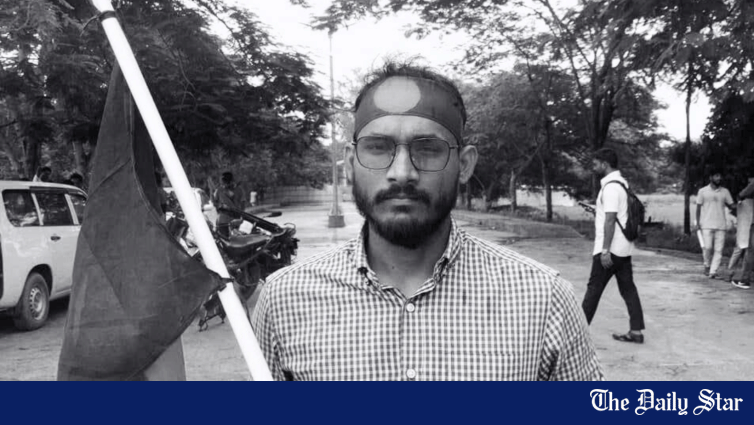
His fearless confrontation with death compels us to reflect on the real value of life and human existence. FILE PHOTO: COLLECTED

Today, July 16, marks the first death anniversary of Abu Sayed—the first martyr of the July uprising—who was once ordinary and overlooked, but rose to become the flagbearer in ending the reign of Awami League authoritarianism through his monumental sacrifice. He became an icon of fearless resistance, defiance, and selflessness, ushering in a new dawn for Bangladesh. His spirit left us a creed: to live not merely to breathe; to bow to no crimson glare of the tyrant; and never to retreat in the face of oppression when rights, truth, and justice demand a voice. And yet, beyond his place in history and the grandeur of public legacy, he was someone very close to my heart. To me, he was not merely a symbol of rebellion, but a living conscience—unyielding, immovable, and outspoken.

Although we were classmates, we recognised each other online, thanks to the suspension of in-person classes due to the Covid pandemic. The friend I kept encountering in every educational Facebook group was him—always showing resilience, determination, and commitment to his studies, with the hope of becoming the breadwinner for his family and working for the betterment of the underprivileged. That marked the beginning of our friendship, a spiritual bond that remained unbroken, even at the eleventh hour of his life. I still recall July 15, when he offered his umbrella to shield his friend from the rain and suggested we share a cup of tea. That simple act of kindness and generosity now lingers in my memory, haunting me with a quiet ache. If only I had accepted his offer, perhaps we could have shared one more moment, one more memory, over a warm sip of tea.

He was always the first person to ask how I was whenever I stepped into the classroom. No one else ever called just to go over the syllabus before an exam. It was Sayed, with his intellect and insight, who could always find a resolution, even in the most difficult topics. No one else showed such genuine grief and offered heartfelt condolences during my personal losses. It was Sayed who gave me the strength to carry on during my father's operation and our semester final examinations, encouraging me to stay strong when I needed it most. But now, there is no one left to encourage me with those familiar words: "You will do well in every exam." I no longer have someone to rely on for assignments, projects, and presentations, as we were always in the same group. He was the one who shared the burden, offering unwavering support that made our academic journey smoother and helped us overcome every challenge together.

Worse still, he is now thousands of miles away from us, living in a world beyond our reach. A world where our words cannot follow. Yet his memories remain ever-present. Sayed has transcended death by embracing it courageously, and he will remain etched in our memory and collective consciousness as long as Bangladesh lives.

As a student of the Department of English, he not only immersed himself in English literature but also embodied the noble character traits of significant literary figures, applying their morals in his own life.

He was like Hamlet from Shakespeare's Hamlet, having the mind of a philosopher without being an actual philosopher. As an intellectual, he thought more deeply and critically, constantly questioned the meaning of life and existence, and felt more intensely. He possessed a sense of appreciation for beauty—not physical beauty, but the inner beauty of human souls. His sense of idealism and moral sensibility made him vulnerable in the face of the vileness and ugliness of earthly gains, instigating him to brave death to remove inequality, injustice, spiritual barrenness, and ignite a flame to dispel the darkness.

His pursuit of knowledge prompted his relentless quest for understanding, wisdom, and truth. In most cases, society imposes certain standards that primarily benefit those in power. From an early age, we are taught to accept these norms without question. But he was capable of thinking independently and refused to shape his life around borrowed ideas. This ability to think critically set him apart from the mainstream, even though he came from modest means. Thus, he lived an authentic and examined life that gave him distinction.

Abu Sayed emerged as a true visionary, committed to building a nation free from corruption, discrimination, exploitation, ignorance, injustice, inequality, marginalisation, misrule, and unemployment. He was always vocal against the sinkhole of corruption, highlighting how lenient punishment emboldens it, and urging civic institutions to enforce transparency and accountability, holding perpetrators to account and dismantling corrupt networks. He championed anti-discriminatory efforts to eradicate deep-rooted bias and protect equal rights for all citizens, irrespective of caste, creed, or colour, in line with constitutional and international human rights standards. He raised his voice against exploitation and systemic oppression, demanding an inclusive nation that does not relegate anyone to the margins.

He held a deep admiration for education, believing it the path to genuine freedom through the elimination of unemployment. What he truly desired was a system where meritocracy triumphed over political favouritism. Time and again, he stressed the importance of women's empowerment through equal participation in education. He stood as an exemplary figure, underlining the urgency of girls' education by covering all educational expenses for his younger sister with his hard-earned tuition income.

He did not simply sympathise with the distressed, he empathised. He initiated several charitable organisations and actively participated in them with great devotion. He even dared to donate blood during exam periods, ignoring the physical strain. Having endured multiple layers of personal suffering throughout his life, he became more humane and deepened his desire to work for a better, more compassionate, and more just world.

Remarkably, what made him exceptional was his unwavering determination and firm resolution never to yield to injustice, standing on the edge between life and death, and finally he summoned death for a greater cause. He never bowed to injustice, nor did he compromise with wrongdoing. He delivered on his commitment until his final breath. He never tried to escape death. Instead, he embraced it willingly, as his death could ignite the conscience of a nation. It became more than a sacrifice. It became a call to action.

The way he embraced death raises a profound question: what truly gives life its meaning—its duration or its quality? His fearless confrontation with death compels us to reflect on the real value of life and human existence. His sacrifice reminds us that the search for meaning, the desire to build and endure, and the drive to uplift humanity are what truly give life its worth. His courageous acceptance of a tragic death at such a young age reflects the philosophical truth that all human beings are destined to die. Yet, it is heroic to embrace that fate unflinchingly when it serves a higher purpose. He reveals that true immortality does not lie in living forever, but in living with such meaning that your memory remains alive.

Do all his dreams remain unfulfilled? No. He is like the mythical Phoenix, sacrificing himself only to rise from the ashes as thousands more. He chose death not as an end, but as a means of awakening and empowering countless youths to protest, to proclaim, to resist, and to reclaim their rights from the monsters of oppression. Here, death is no longer an end, it becomes an opportunity to set ablaze all forms of injustice, suppression, and the historical silencing of voices. His courageous death marks the tipping point for Bangladesh to begin anew, echoing the dream of all those who gave their lives for an inclusive, non-communal nation—one built on equal footing, mutual respect, and peaceful coexistence.

Abu Sayed is like the sky, studded with stars, shining like Sirius—distant, yet radiant—his name now echoing in the hymn of our awakening. In every act of courage, in every stand against injustice, in every pursuit of truth, we carry a piece of him forward.

Sonia Benty Siddik, a Master's student of English Literature from Begum Rokeya University, was a friend of Abu Sayed.


Members Online

No members online now.

Latest Posts

Latest Posts