| Global Defense, OSINT & Geopolitics Wire

[šŸ‡§šŸ‡©] July uprising

[šŸ‡§šŸ‡©] July uprising
107
4K
More threads by Saif

G Bangladesh Defense

July attackers to be tried regardless of uniform, home minister tells JS
Staff Correspondent 31 March, 2026, 00:23

1774918953906.webp

Home minister Salahuddin Ahmed. | BSS Photo

Home minister Salahuddin Ahmed on Monday stated that those who had carried out armed attacks against activists during the July mass uprising were criminals, regardless of the uniform they wore, assuring that all related cases would be thoroughly investigated.

He also confirmed that the July fighters would receive legal protection.

The remarks came in response to two separate supplementary questions at the Jatiya Sangsad.

Answering a question from BNP lawmaker Zainul Abedin Farroque, the home minister said that those who attacked July fighters or ordinary citizens, whether they were in any official uniform or affiliated with Juba League or Chhatra League, were all criminals.

ā€˜Cases have already been filed against them. If not, you may file cases, and all will be properly investigated. The judiciary is responsible for delivering justice,’ Salahuddin said.

NCP lawmaker Akhtar Hossen inquired if the home ministry would take departmental action against police officers involved in killings and torture over the past 16 years, especially during the July Uprising, in addition to judicial proceedings.

He also claimed that the Awami League was committing police killings to create disorder.

In response, Salahuddin said that July fighters were legally and constitutionally protected under the July National Charter.

The interim government, he said, had issued an ordinance to safeguard them, which has been submitted to the Jatiya Sangsad and is expected to be passed as a bill with broad agreement.

ā€˜The Awami fascist groups are calling for justice for killings on social media. As I mentioned earlier, if that is applied, then freedom fighters would also have to be tried for actions against Razakars if a case is filed today,’ home minister said.

Regarding justice over police killings during the July uprising, he said that the matter was effectively settled on the battlefield.

ā€˜Some cases are being tried at the International Crimes Tribunal, while others are under the Penal Code in regular courts. Investigations are going on, and some charge sheets have already been submitted,’ Salahuddin further said.

Responding to a supplementary question from Brahmanbaria-2 independent legislator Rumeen Farhana, the home minister assured that no kind of mob culture would remain in Bangladesh under the current administration.Diaspora community news

The home minister stressed the importance of distinguishing between spontaneous ā€˜mob’ actions and organised, premeditated crimes, such as attacks on police stations or commercial centres, which required targeted investigations, arrests, and trials.

He criticised the previous use of highway blockades to press demands, attributing it to weaknesses of the interim government.

Reaffirming the government’s approach, Salahuddin said that the current government, in office for less than 45 days, would not tolerate mob culture.

Meanwhile, Cumilla-4 lawmaker Hasnat Abdullah raised concerns over financial difficulties faced by grassroots police officers, pointing out that investigation costs were often not provided by police stations.

This shortfall, he said, has created a ā€˜manage it’ culture, where officers might turn to local businessmen or other sources to cover operational expenses, including for events such as the March 26 programme.

Responding, the home minister acknowledged the need for greater resources and a proper budget to maintain an efficient and corruption-free police force.

He said that he would propose a budget increase through the finance minister and prime minister, emphasising the government’s commitment to transparency and accountability despite current economic constraints.​
 

Highlighting the brave daughters of July uprising

Fahim Faisal
Published :
Apr 03, 2026 00:29
Updated :
Apr 03, 2026 00:29

1775175546814.webp


The July Revolution of 2024 will forever be remembered as a turning point in Bangladesh’s history. It’s a time when ordinary citizens rose with extraordinary courage to reclaim their voice and destiny. Among those at the forefront were the women of this nation, brave and unyielding, driven by a deep love for justice. Their stories are the heartbeat of this revolution, yet too often, their sacrifices have remained in the shadows.

Brave Daughters of Historic July Revolution, written by Md. Shakhawat Hossain, a UC Berkeley Visiting Scholar, brings those stories to light with tenderness and truth. This book is more than a historical record. It is a tribute to the women who defied fear, carried the wounded, raised their voices when silence was safer, and stood guard over the dreams of a nation in turmoil.

This compilation of historic documents, testimonies, and reflections captures the spirit of women whose bravery, sacrifice, and resilience shaped the movement’s heart. Through chapters exploring their leadership, resistance, grief, and enduring quest for justice, the book powerfully reminds us that the revolution’s triumphs were deeply intertwined with women’s struggles.

Through its pages, we meet women from all walks of life: students and journalists, garment workers and mothers, singers and actresses, each bound by an unbreakable spirit of resistance.

They were the faces in the crowd, the voices behind the microphones, the hands that lifted banners high, and the hearts that refused to surrender. These stories remind us that revolutions are not only fought on the streets but also carried in the hearts of those who dare to believe in change.

The July uprising, a watershed moment in the nation’s history, will be remembered not only for its political ramifications but also for the powerful, defining role of women, particularly mothers and daughters. Their collective action, a blend of seasoned wisdom and youthful idealism, became the uprising’s driving force, shaping its character and outcome. This movement stands in stark contrast to the mass uprisings of 1969 and 1990, distinguished by its methods, inclusivity, and deeply personal yet profoundly political motivations.

The synergy between mother and daughter was perhaps the most potent weapon of the July uprising. In countless instances, a mother’s experience tempered a daughter’s impulsiveness, while a daughter’s technological prowess amplified a mother’s organisational efforts. They marched side by side, a physical embodiment of the intergenerational struggle for a better future. This partnership was not merely logistical; it was deeply emotional. The shared experience of protest forged new bonds of respect and understanding across generations, breaking down traditional patriarchal structures within the family unit.

So, the July uprising stands in sharp contrast to the mass uprisings of 1969 and 1990. The 1969 uprising, while successful in its immediate goal of toppling a dictator, was largely a male-dominated affair. The narrative of heroism and sacrifice was almost exclusively centred on male student leaders and political activists. Women’s roles, though present, were relegated to the background — largely undocumented and uncelebrated. These movements’ ideology was also more rigidly hierarchical and driven by established political parties.

May this book stand as a living memory of their courage, their pain, and their hope for a Bangladesh that continues to rise on the strength of its brave daughters.

The writer is an under-graduate student at Melbourne Institute of Technology (MIT), Australia.​
 

Prof Yunus went to London and handed over the ā€˜trophy’ of the July movement to BNP: State Minister

Staff Correspondent
Dhaka
Published: 07 Apr 2026, 18: 48

1775607870721.webp

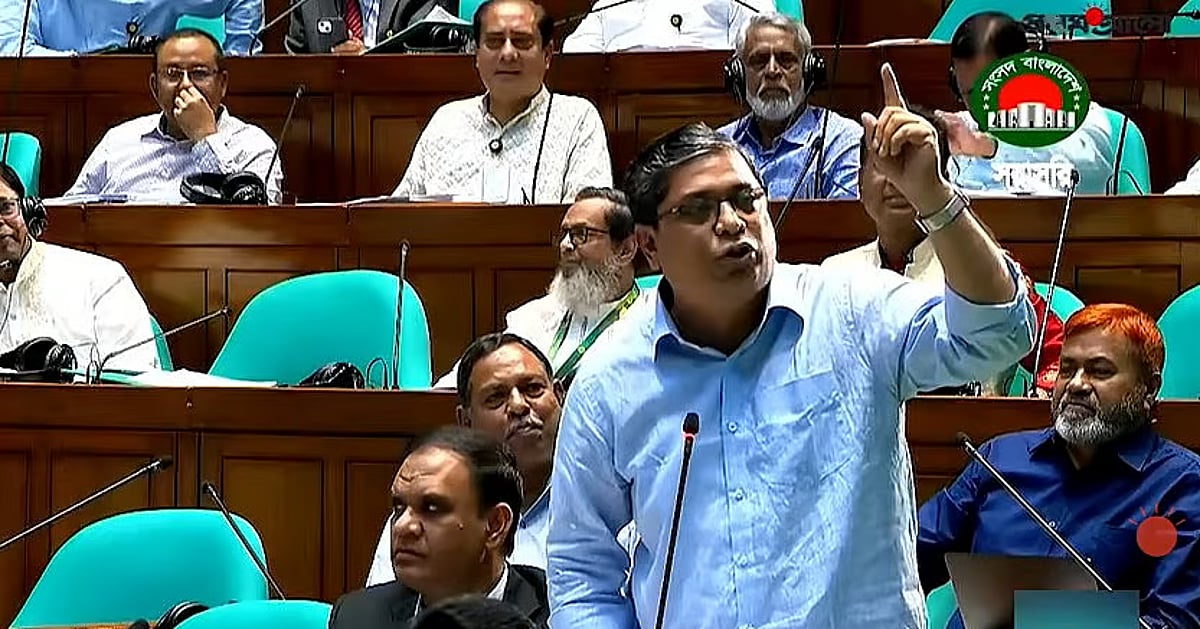
Mir Shahe Alam speaks in the parliament----Taken from video

State Minister for Local Government Mir Shahe Alam has portrayed BNP as the victorious party in the country’s major movements and struggles. He said that the ā€œtrophiesā€ of three movements—1971, 1990, and 2024—belong to BNP. Among them, the ā€œtrophyā€ of the July 2024 movement was taken to London and handed over to BNP Chairman Tarique Rahman.

He made these remarks today, Tuesday, while participating in the discussion on the President’s speech in the National Parliament. The session began at 10:30 am under the chairmanship of Speaker Hafiz Uddin Ahmed.

Mir Shahe Alam, elected from Bogura, highlighted BNP’s contributions to various movements, saying, ā€œThe trophies of the 1971, 1990, and July–August movements are all in our house. Only BNP has such trophies—no other political party can show this. The Awami League can speak about 1971 and 1990, but they do not have the July–August trophy. Friends in the opposition can talk about July–August, but they cannot speak about 1971 or 1990.ā€

When opposition members began protesting, the state minister said they might raise slogans about 1990, but in the 1986 election, they themselves had joined the polls alongside the Awami League with much fanfare.

In the 13th parliamentary election, BNP won and formed the government. Jamaat-e-Islami and the National Citizen Party (NCP), formed by young activists who were at the forefront of the July uprising, took seats as the opposition in parliament. The two parties had contested the election as part of the same alliance.

The state minister said that an NCP leader had earlier remarked outside, ā€œStudents and the public played in the July movement, but BNP took the trophy.ā€

As opposition MPs continued their protests, the Speaker requested that Shah Alam refrain from continuing his remarks.

At that point, opposition leader and Jamaat Ameer Shafiqur Rahman termed parts of the minister’s statements ā€œuntrueā€ and called for them to be expunged from the parliamentary record.

In response, the state minister said, ā€œIn the July–August movement, all of us stood with the students and the people. We did not go to anyone to take the trophy. Who was the captain? The head of the interim government, Dr Muhammad Yunus, was the captain. That is why he went to London, met our captain—Prime Minister Tarique Rahman—and fixed the election date. This proves which party and which leader played the main role in leading the student–people’s movement.ā€

He further added, ā€œWe all took part in the movement—there is no denying that. But there is only one captain. Because the head of the interim government went to London, discussed with that captain, and brought back the election date, a free and fair election was held in this country.ā€

Addressing Speaker Hafiz Uddin Ahmed, a decorated freedom fighter, the state minister said, ā€œSome people here may like seeing you, others may not. But you represent 1971. That credit goes to BNP, because President Shaheed Ziaur Rahman declared independence.ā€

At this point, Shahe Alam mentioned several names from the treasury benches, saying such figures could not be found among the opposition benches. Opposition members again protested loudly.

The Speaker then said, ā€œThere are freedom fighters on the opposition benches as well. I have seen it myself—Gazi Nazrul Islam (Satkhira-3) is a freedom fighter.ā€

Turning to Jamaat, the state minister said, ā€œBegum Khaleda Zia honored them before the nation by allowing opposition MPs to use the national flag on their cars, effectively giving them indemnity and making them part of the government. Yet they never mention this.ā€

In 2001, during the BNP-led four-party alliance government, Jamaat’s then Ameer Matiur Rahman Nizami and Secretary General Ali Ahsan Mohammad Mujahid were made ministers. Both were later convicted of war crimes related to 1971 during the Awami League government and were executed.

BNP MP Shah Alam said, ā€œAfter 2014, you could not be found. For a long time, we were together in the four-party and 20-party alliances. We know each other in many ways—we sat in the same meetings, carried out movements, struggles, and rallies together.

But for some unknown reason, you went underground and reappeared after July–August, now repeatedly invoking July–August to mislead the nation. You want to present July–August in such a way that it seems there was no Liberation War in 1971 or no anti-autocracy movement in 1990.ā€

Although the state minister claimed Jamaat disappeared after 2014, its leaders—including current opposition leader Shafiqur Rahman—contested the 11th parliamentary election under the BNP-led National Unity Front in 2018. Since Jamaat’s registration had been canceled, they ran under BNP’s ā€œsheaf of paddyā€ symbol.

Toward the end of his speech, the state minister called for opposition cooperation in running the government, saying, ā€œWe want to move the country forward in unity to such a stage that people feel that although BNP and Jamaat, once allies, are now separate, they have internally come together again to take the country to a better, more beautiful place.ā€

State minister provided untrue information: Opposition leader

After the minister’s speech, opposition leader Shafiqur Rahman took the floor. He said, ā€œFrom the very first day, we have pledged that this opposition will not be a conventional one. We will cooperate in all just matters and remain uncompromising against injustice and any steps that undermine people’s rights.ā€

Referring to Shahe Alam’s remarks, he said, ā€œToday, while thanking the President, the honorable member (Mir Shahe Alam) has put us in the dock. Numerous untrue statements have been made here. You (Speaker) yourself have objected to a few. We demand that no one present untrue information in parliament.ā€

When Shafiqur Rahman called for parts of the minister’s speech to be expunged, the Speaker said, ā€œI will review the statements. If there is anything unparliamentary or false, it will be expunged.ā€

Later, when Jamaat leader Shahjahan Chowdhury stood to speak, the Speaker urged members to move forward, leaving the past behind. He noted that 50 more hours had been allocated for discussion, where members would have the opportunity to present their arguments and counterarguments.​
 

Don’t let investigation delays derail justice for July uprising

July uprising cases in limbo as probes progress at a snail’s pace

1777336089450.webp

VISUAL: STAR

It is deeply frustrating that nearly 21 months after the tragic events of the July uprising, investigations into most of the cases filed over the killings and violence at the time are still dragging on. According to a report by this daily, of the 1,855 cases filed, police have so far completed investigations into only 176. That means a staggering 90 percent of the cases are still stuck in the investigation phase. Officials at the Police Headquarters blame this sloth-like pace in the probe on the huge lists of accused in these cases, including ā€œunnamedā€ suspects, which make the process more complicated, not to mention time-consuming.

One may recall the case-filing frenzy after the uprising that ousted the autocratic regime of the Awami League on August 5, 2024. On many occasions, media reports highlighted the dubious nature of many of the cases, with people with little to no connection with the events of July uprising getting charged with murder, attempted murder, and violence. Some were made accused simply because of their political affiliations or leanings, while others were victims of personal vendettas. This daily also reported on cases where the scenes of alleged crimes and the locations of the accused did not match.

As a result, the survivors and families of the victims seeking justice have been stuck in a prolonged wait. Meanwhile, wrongly accused individuals have been forced into a legal quagmire, enduring mental duress and financial losses. Many of them have been detained and remain in jail without bail, already being subjected to punishment without even facing trial. What’s worse, the complainants of many cases have been reported to demand money from the accused with the promise of dropping their names or withdrawing the cases, a trend flagged by the police themselves. Not only is this a gross disservice to justice seekers, but it’s also a blatant violation of people’s right to legal protection and fair trial.

This state of affairs must not continue any longer. While we recognise the complicated nature of the July uprising cases, police investigations must pick up speed while ensuring due diligence. To this end, we suggest forming a special task force dedicated to disposing of the July uprising cases. They will be responsible for scrutinising the relevant details to separate genuine cases from the dubious ones so that the judicial process becomes smoother and less time-consuming.

The prevailing fiasco has again brought to light how weak and vulnerable to abuse our criminal justice system is. It needs a complete overhaul to plug in the loopholes that allow people to file cases without reasonable cause, make ā€œunnamedā€ individuals accused in a case, and enlist a large number of people as suspects in a single case. Doing any of these creates unnecessary hassle for the law enforcement agencies as well as those who are wrongly accused, while obstructing the course of justice. A modern criminal justice system must not allow legal procedures based on flimsy accusations or prolonged pre-trial detentions without reasonable cause.​
 

No party can deny the significance of July Uprising: Andaleeve Rahman

Published :
Apr 28, 2026 22:16
Updated :
Apr 28, 2026 23:16

1777419243036.webp


Bangladesh Jatiya Party (BJP) Chairman Andaleeve Rahman on Tuesday asserted that no political party has the right to engage in politics by denying the significance of the July uprising or by labeling the movement as militancy.

Speaking during a discussion on the President's speech in the Parliament, he emphasized that political opportunities for the Awami League remain closed until justice for the July events is ensured, UNB reports.

Addressing the energy sector, the BJP Chairman criticized the current description of the power crisis as merely "fascist mismanagement."

He argued that the term is too weak, claiming the sector was actually characterized by rampant corruption and organized theft. Partho alleged that artificial crises were created while domestic gas extraction through Bapex was neglected in favor of "bluff" policies.

He further stated that "Quick Rental" projects were used to "quickly destroy" the national economy, leaving a massive financial burden.

Andaleeve also touched upon the erosion of institutional independence over the past 17 years.

He claimed that judicial verdicts, including those against Khaleda Zia, were dictated by the executive branch.

He leveled serious allegations against the bureaucracy, citing instances of bribery and political bias in BCS appointments and systemic corruption in agencies like Titas Gas and WASA.

Regarding freedom of expression, Andaleeve described a climate of fear where media owners and social media users lived in constant anxiety under the ICT Act.

He also highlighted the disconnect between the older political generation and the youth, stating that the failure to communicate the extent of past oppression has led to a lack of realization among the younger generation regarding the scale of the recent movement.

Responding to comments from the Leader of the Opposition, Shafiqur Rahman, Partho warned against adopting the same paths of fascism. He remarked that while it took 16 years to remove the previous regime, it would take far less time to oust those who ignore the people's mandate.

The BJP Chief proposed that laws be enacted to treat those who sabotage the national economy as traitors.

He also called for increased diplomatic efforts to withdraw the sanctions imposed on the Rapid Action Battalion (RAB).​