The Light Engineering (LE) sector makes a remarkable contribution to the economy of Bangladesh. The sector has innumerable prospects in poverty alleviation through employment generation; increasing contribution to GDP; growth of the local industries, reduction in import of LE products, and increasi
thefinancialexpress.com.bd
Burgeoning prospect for the light engineering in Bangladesh
NASIM AHMED
Published :
Nov 11, 2023 20:54
Updated :
Nov 11, 2023 21:05
The Light Engineering (LE) sector makes a remarkable contribution to the economy of Bangladesh. The sector has innumerable prospects in poverty alleviation through employment generation; increasing contribution to GDP; growth of the local industries, reduction in import of LE products, and increasing export opportunity. Industry insiders claim that the sector is contributing 3 per cent to the GDP. According to the Ministry of Industries, the sector shares the domestic market worth USD12 billion. The existence of abundant low-cost labour and high domestic and external demand are the dominant reasons behind the burgeoning prospects of the LE sector in Bangladesh.
The LE enterprises are small firms that produce machinery, equipment, tools, metallic household appliances, sanitaryware, electrical, electronic, electro-mechanical, and mechatronic products mainly by metals through engineering and technological processes. The major products are spare parts for paper and cement mills, bicycles, light fittings, construction equipment, batteries, electrical wires and cables, iron chains, cast iron articles, carbon rods, automobile spares, electrical and electronics items, and stainless-steel wares. Around 50,000 LE industries are operating in the country. According to the Bangladesh Engineering Industry Owners Association (BEIOA), the LE sector manufactures 10,000 types of products.
According to the industry insiders, the sector created 3,00,000 direct and 30,00,000 indirect job opportunities in different backward and forward linkage industries. A Dhaka Chamber of Commerce and Industry source predicted export earnings from the sector would be around USD 15 billion by 2041. The source estimated that the world market size is about USD 8 trillion, which has created a burgeoning prospect for Bangladesh to export LE products. Light Engineering Road Map prepared by the SME Development Working Committee of the Business Initiative Leading Development for the Ministry of Commerce, projected the export volume for the sector in 2030 to the tune of USD12.56 billion(BSS, 16 January 2023).
Despite having a brighter prospect, the LE sector faces many challenges in the evolving market and trade globalisation. The sector is mostly based on traditional and indigenous technologies. Apart from competition in the global market, the changes in customer needs and preferences drive LE entrepreneurs to innovate or upgrade products. In the evolving industrial context, the production techniques and processes are trailing the sector uncompetitive except in areas where precision and sophistication are less important. Lack of quality raw materials, shortage of skilled manpower, market information gap, lack of access to finance, and inadequate communication infrastructure are other crucial challenges. The Bangladesh Institute of Development Studies report identified a 33.6 per cent skill gap in the sector.
According to the Bangladesh Investment Development Authority, the sector meets 50 per cent of the overall demand of the country. In the 2021-22 fiscal year, the sector saw a significant year-on-year export growth of 50.4 per cent to USD 795.63 million from USD 529 million in the 2019-2020 fiscal (BBS and EPB). However, the export volume for fiscal 2022-23 dropped to USD 585.85 million. The export target of engineering products for 2023-24 has been fixed at USD 630 million (EPB). The main export markets for light engineering products are Thailand, Japan, the Netherlands, India, South Korea, the United Kingdom, Taiwan, and Pakistan.
However, with the recent government initiatives, the prospect for the sector is getting brighter. In the budget for the 2022-23 fiscal, the government provided a 10-year tax holiday for LE producers. Besides, there was a VAT exemption for the production and commercial distribution of power tiller and the supply of locally collected scrap in the foundry industry. The LE is considered a thrust sector and was given the highest priority in the Export Policy 2021-24.
The government has formulated the Light Engineering Industry Development Policy 2022, which aspires to ensure infrastructural development, easy financing, and industrial incentives for the sector during its implementation between 2022 and 2027. Low-interest loans will be provided from a special fund for the purchase of new technologies as well as the development of existing ones. The policy sets eleven strategic objectives: infrastructural development, modernisation and development of technology, development of forward and backward linkages, human resource development, market development, and expansion, research and development, establishment of industry clusters, development of common facility, quality assurance and certification, access to finance, development of investment climate.
The policy outlines a time-bound action plan for addressing the challenges inhibiting its growth. It is expected that the Finance Division and Bangladesh Bank will take the initiative to establish a venture capital fund to ease the production process of LE products by 2025. A thirty-five-member high-powered Industrial Development Council chaired by the industries minister will review and monitor the implementation of the policy. The policy also intends to help the sector thrive to attain the goal of increasing the industrial sector's contribution to 40 per cent of GDP by 2027.
A dedicated industrial park and industrial cluster, an e-commerce platform for LE entrepreneurs, re-skilling and up-skilling to form a technologically skilled workforce, enforcement of AI, rationalisation of raw material import duty, strategy to attract domestic and foreign investment will further boost the sector both in the domestic and foreign market.
The LE would be more value-adding and can earn substantial foreign currency if provided with adequate financial, technical, infrastructural, and marketing support. With the appropriate policy support, the sector can stride as the backward linkage for many mainstream local industries such as garments, leather and footwear, electronics, food, agro-processing, and pharmaceuticals. The LE sector must harness appropriate technology and infuse more investment to enhance domestic and global competitiveness as well as increase the quantity of production.
Nasim Ahmed, PhD is currently an Associate Professor at the Bangladesh Institute of Governance and Management, Dhaka. nasim.ahmed@bigm.edu.bd
Dholaikhal, Zinzira to be made light engineering hub: Mannan
www.daily-sun.com
Dholaikhal, Zinzira to be made light engineering hub: Mannan
Special Correspondent
Friday, 25 August, 2023,12:00AM
Planning Minister M A Mannan said the country's Dholaikhal and Zinzira will turn into light engineering hubs like Korea, Taiwan, Malaysia, and China due to the government’s business-friendly policy.
“If Korea, Taiwan, Malaysia, China could succeed in the light engineering sector, Bangladesh can also be successful. And we are on the right track now,” he said while speaking at a seminar as the chief guest.
Dhaka Chamber of Commerce & Industry (DCCI) organised the seminar on “Import Substitute Industry in Bangladesh: Perspective of Light Engineering Sector”, held at the DCCI premises in Dhaka on Thursday.
Industries Secretary Zakia Sultana was present as the special guest. DCCI President Barrister Md. Sameer Sattar chaired the event.
The Planning Minister agreed that there are challenges “but the private sector of Bangladesh is resilient enough to overcome these challenges and from the government all possible policy support will be given.”
“Inconsistencies among the government agencies regarding different policies are not good for the private sector,” he said.
MA Mannan said, “If we can formalise the local small light engineering hub at Dholaikhal and Jingira, one day they will be able to contribute to the economy.”
He stressed making policies consistent. According to him, at present the public-private partnership and relationship are at its best as the government is very business-friendly.
Industries Secretary Zakia Sultana said that Bangladesh’s light engineering sector is still import-based.
“The light engineering sector is an untapped sector and it has great prospects of creating a large backward linkage industry ensuring diversified industrial base. The Light Engineering Industry Development Policy 2022 has already indicated a comprehensive action plan for 2022-27.”
She said that the entrepreneurs of this sector should be incentivised to mitigate import reliance.
The secretary pointed out that the government will try to boost policy harmonisation and coordination among the concerned agencies.
According to her, skill development and curriculum upgradation are necessary for capacity building.
“Government is also planning to establish an Automobile Research Institute in Narayangonj with the help of Japan,” she added.
DCCI president Md. Sameer Sattar said that light Engineering sector, if given right policy support, can serve as the backward linkage industry to many mainstream local industries like food, leather and footwear, electronics, agro-processing and pharmaceuticals industries.
He emphasised the need to recognise the light engineering sector as a high-priority sector in the Industrial Policy 2022 to provide sufficient incentives and ensure substantial growth of the sector.
“To secure the target of private investment to 27.35 percent of GDP by FY 2025, development of the light engineering sector is crucial as it will strengthen local value and supply chain in many allied industries.”
DCCI boss said, “The current tariff structure on import of light engineering products is counter-productive for the growth of the local light engineering sector.”
“In this regard, a study is needed to know further the needs and bring appropriate changes in the tariff structure that will protect this sector,” he pointed out.
Walton Additional Managing Director SM Shoyeb Hossain Nobel presented the keynote paper. He highlighted that the light engineering sector of Bangladesh is generating revenue of Tk 200 billion and contributes about 3 percent to the GDP.
“It is increasing at 10 percent every year. The world market is about $45 billion. About 1.6 million people are employed in this sector. 50 percent of our local demand is met by this sector.” In FY 2021-22, the export of light engineering sector was $796 million, he said.
Nobel said that the sector is completely import-based and therefore would need a separate duty structure and backward linkage industry policy for this sector.
“Lack of easy access to finance, quality of products, demand uncertainty, policy inconsistency, no incentives for local manufacturers, lack of lab and R&D, data of actual demand are few of the challenges of this sector.”
In the panel discussion session, President of Bangladesh Steel Manufacturers Association Manwar Hossain said, “Now we have to focus on other promising sectors other than RMG.”
He said that our investment in human capital is still poor. He called for increasing cash incentives to this sector.
Chief Marketing Officer of Fair Group Mohammad Mesbah Uddin said that the light engineering market will reach$ 10 billion by the year 2030.
He called for value addition “as there is a huge scope of investment opportunity.”
Mesbah Uddin emphasised policy guidelines and developing science and technology-based education systems in the country and long-term policy consistency.
Meghna Group Director Muhammad Mushtaque Ahmed Tanvir said that there is a demand of 5 million bicycles in the European market.
“At present we need investment in the local manufacturing of mold and dies because it costs huge for import.”
Managing Director & CEO of Transcom Electronics Limited Arshad Huq said, “Bangladesh’s consumer market is ready. Many global brands want to come to Bangladesh and invest.”
But he laid emphasis on the quality of products that need to be maintained.
Arshad Huq informed that US company Whirlpool has invested in Bangladesh in the form of a joint-venture.
He stressed policy consistency and developing human resources.
Former President of DCCI Matiur Rahman urged the government to reduce import duty in the sector.
He put emphasis on long- term policy, skill development and more technical and vocational training.
A wing of the Ministry of Industries can be established at the NBR, he suggested.
The government can initiate establishing testing labs and R&D for the future growth of this sector, he added.
DCCI’s senior vice president SM Golam Faruk Alamgir (Arman) gave a vote of thanks. DCCI vice president Md. Junaed Ibna Ali was also present on the occasion.
LIGHT ENGINEERING INDUSTRY: FORGING THE PATH FOR A BETTER ECONOMY
Mehedi Hasan Manager Credit Risk Management IDLC Finance Limited
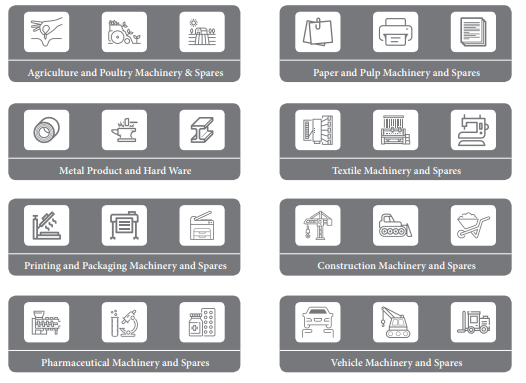
Light Engineering Industry (LEI) is considered as one of the key industries which is going to contribute significantly in the economy of Bangladesh. It has also enormous scope to add value to the economic parameters of this country. It is very obvious that technological advancement has logical power to shift the demand from one product to another and Light Engineering Industry has potential to create value to this technological advancement and participate positively to the economic development of Bangladesh along with reduction of poverty by creating employment opportunities. Our economy is largely concentrated on RMG export. Experts have agreed on a point that concentration of our export of more than 80% on a single sector is not sustainable in the long run and it should be diversified by a long term policy. Light Engineering Industry is considered as a thrust sector which has current contribution in GDP of around 2% and has the potential to become one of the major sources of export earning along with fulfilling the domestic demand. Light engineering mainly deals with manufacturing light (less capital intensive) products which satisfy the demand of end user and other manufacturing entities. It is one of the major sources of spare parts for several industries including agriculture (rice, jute, flour, lentil, sugar, spices, feed & bakery), gas transmission & distribution, construction machineries, kitchenware & bathroom fittings, metal products, mold & dies, transport (road & water), pharmaceutical, paper & pulp, printing & packaging, RMG & textile and others.
This industry started its journey to support the large industrial units in 1950s in East Pakistan. After 1985 the industry got accelerated due to industrialization of other industries. During that time LEI evolved mainly in Dholaikhal, Jinjira, Mirpur, Syedpur, Bogura and other areas. Bangladesh Small and Cottage Industries Corporation (BSCIC) had significant contribution to support the small entrepreneurs during that time. BSCIC provided low interest rate loan to support the LE businesses. It was observed that many prominent players in this industry got BDT 0.1 million/ BDT 0.2 million loan from BSCIC which enabled them to kick-start started their journey during 90s.
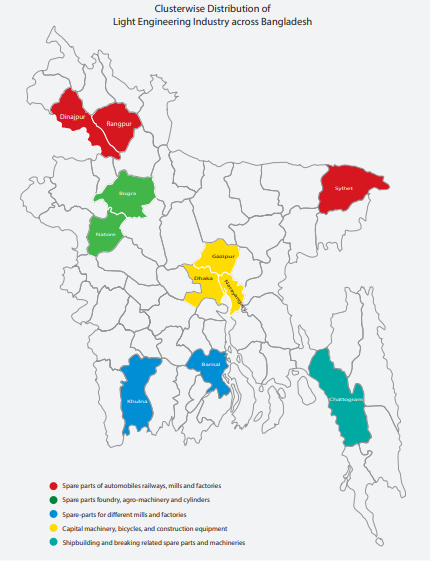
LEIs are located mainly on the industrialized areas of Bangladesh. Light Engineering clusters are based on the districts which consist of Dhaka, Chattogram, Narayangonj, Gazipur, Bogura, Natore, Pabna, and Jashore.
Industry Overview
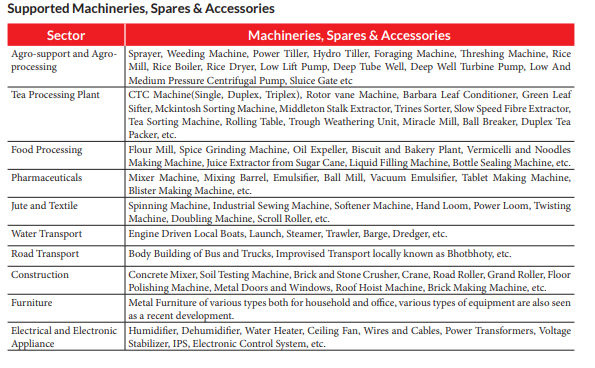
Around 40,000 light engineering workshops/ enterprises are operating in Bangladesh where 10 million people are actively employed. Lion portion of the LE enterprises fall on cottage & micro segment. Market size of this industry is around 25,000 crore per year and before pandemic the growth rate was 20 to 25% per year. Most of the light engineering enterprises support the local need of indigenous industries. Around 90% raw material of this industry is procured from ship breaking industry. It’s been observed that the export performance of LE products has decreased by 14% during the FY 2019-20 which needs to be taken into consideration by policy makers. There are some major steps takens by the Government which will surely boost up the performance of this industry. Government has decided to establish 10 dedicated light engineering industrial parks in Dhaka, Narayanganj, Jashore, Bogura, Narsingdi, Munshiganj, Mymensingh and Madaripur. The major export destinations of LE products are India, UK & Japan, Germany. The industry currently meets up the demand for around 50% substitutes of imported items in the country which positively contributes our BoP (Balance of Payment). As per the estimation of The Business Promotion Council, operating under the commerce ministry, the industry is producing around 3,815 types of machineries, spares and accessories.
Prospects
Light Engineering Industry is considered as ‘the mother of all industries’ since it facilitates backup support of spare parts and repair to almost all industrial sectors including plastic, cement, paper, jute, textile, sugar, food processing, railway, shipping, and garments. On the other hand single sector dependency on export is a challenge for the economy. Moreover, as developing nation, duty free excess will be restricted for RMG after 2025 as it is wise to concentrate on other sectors that could participate in the export as alternative sources and light engineering industry would be one them attractive sources to our export fleet. The backward linkage is very important in an economy and light engineering industry can develop a strong backward and forward linkages between LEI and other sectors. Currently, around 10 million people are working in this industry but it has huge potential to create much more employment opportunity that will help our country reduce poverty and make labor market more efficient. Needless to say that more employment opportunity will directly push our socio-economic development on higher side. LEI can become one of the major contributors in GDP which is now only around 2%. A study showed in 2018 that Bangladesh’s total investment in LE sector is only USD 15 billion against the demand of USD 7 trillion LEI products in the global market. Encouraging this industry will lead to reduce the import of LE products which will have positive impact of our foreign currency exposure. The study also conveyed that most of the developed countries have been focusing to develop LEI that plays as catalyst role for the development of countries’ industrial base. With proper financial, technical, infrastructural, distribution support, it could play a great role in export next to RMG and Agriculture.
Business Dynamics
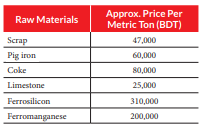
Raw materials used in this industry are metal scrap, pig iron, hard coke, limestone and ferroalloys such as ferrosilicon, ferromanganese and others. The price of raw material has been increased significantly which affects the bottom line profitability of this industry. The current prices of raw materials are given below:
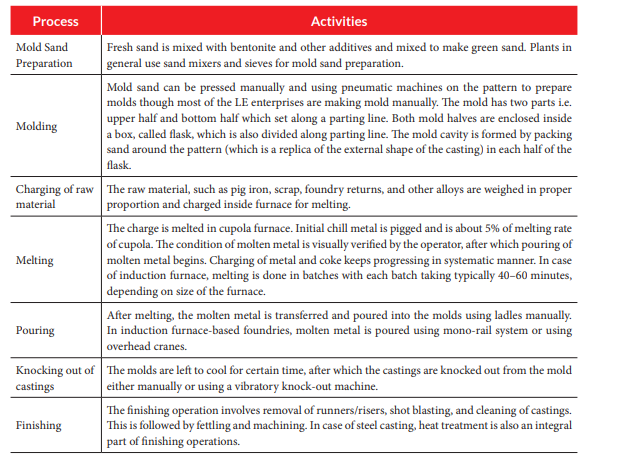
Light engineering products are made in several phases in LE enterprises. A composite factory is fully equipped with machineries including furnace, induction furnace, different types of dice, lathe machine and others. Big players in this industry have full set up from melting raw materials in furnace to finish products. Very few of them are also using CNC (Computer numerical control) machine for perfect finishing. There are many participants in this industry those do not have factory set up with furnace and dices. They normally source unfinished products from the factories and finish in their workshop mainly equipped with several lathe & grinding machines. Production capacity is mainly depended on furnace capacity. The melting capacity of furnace is normally found starting from 5 MT to 20 MT. Based on the melting capacity of furnace, the factory is equipped with dices and other finishing lathe machines.
The production process includes sand molding, charging raw materials, melting, pouring, knocking out & finishing
Challenges
Light Engineering industry is facing many obstacles to grow. These challenges need to be identified properly and proper actions should be taken by the policymakers in order to add more value to the economic indicators of Bangladesh. Major challenges of this industry are discussed below:
Lack of Modern Technology is one the major challenges of LEI. Most of our LE enterprises are using old and backdated machineries from those the quality & competitive product cannot be produced. The leading countries of LE like China, Japan, and India are using modern technologies. They have been using CNC (Computerized and Numeric Controlled) technology since long. Whereas in Bangladesh use of CNC is rare. Normally, LE enterprises of Bangladesh applies trial & error method to develop a product which requires more time and cost as well as preciousness remains a concern.
Price fluctuation of raw materials is another concern. The current price of scrap is around BDT 47/Kg which was normally 32 to 35 before pandemic. Again, the price of imported raw materials like pig iron, hard coke, limestone and ferroalloys has also increased significantly which makes this industry difficult to maintain expected bottom line profitability.
Lack of skilled work force is also a challenge for this industry. The industry is labor intensive and manual process driven as skilled work force is very important for accurate finished products. Proper training and use of advanced technology may reduce this gap.
Price of imported LE products is comparatively lower than the products produced in country. Chinese cheap spares are available in the local market which is another obstacle to grow our indigenous LE enterprises.
Lack of capital and Finance is also a major concern of this industry. Most of the workshops can be categorized as “Small” in terms of initial capital. There are many workshops those have only one or two lathe. Due to lack of access to finance, they do not get the proper opportunity to grow even though Government has arranged some lending program for light engineering enterprises at lower interest rate.
Recent Initiatives
In 2020, Bangladesh Prime Minister Sheikh Hasina announced the LEPs as the “product of the year” during the inauguration program of Dhaka Trade Fair-2020. A 10 year tax holiday will be enjoyed by the LE product manufacturers if they cater to factories with nonfinished products or parts. Bangladesh Automobile Manufacturers and Assemblers Association (BAAMA) is trying to go for joint ventures in components and parts manufacturing and it will certainly mitigate the existing technology issues. Several pre-finance program is going on to create access to finance for LE enterprises. Government has recently decided to establish 10 dedicated light engineering industrial parks in Dhaka, Narayanganj, Jashore, Bogura, Narsingdi, Munshiganj, Mymensingh and Madaripur.
It is obvious that light engineering industry has immense scope to add value to the major economic indicators of Bangladesh. The major goal of an economy is to create employment and LEI is highly labor intensive which can create more employment opportunity and accelerate our expected growth. This industry is already acclaimed as the important sector for the future development considering the backward linkages of almost every industries. There are some challenges ahead to make this industry take off and reach the expected level. However, there are many adroit businessmen operating in this industry whose hard work and business acumen will lead this industry to desired level. Proper policy support, guidance from authority & leading businessmen, access to finance and use of advanced technology can mitigate the limitations and lead this industry to the optimum growth.
Some of the small factories in Bangladesh are making electric testers to compete Chinese ones in the market. If Govt. support is given these factories can modernize and produce much better quality light engineering products.
Indisputably, the country's light engineering sector has immense potential for growth. Yet, while no one has contested this fact, it is still far from assuming the highly important role it is supposed to play.
Despite its informal nature and unregulated patterns of work, light engineering is frequently acknowledged as a promising catalyst for economic activity. Not only does it foster the growth of countless small businesses but also serves as a vital hub for the production of numerous engineering products.
As a feeder sub-sector, light engineering produces machines, equipment, tools of heterogeneous varieties for domestic usage in mills, factories and engineering workshops. Besides providing cost-cutting benefits to the consumers, its all important role is in saving foreign exchange that otherwise the country would have to spend on imports.
It is estimated that the sector currently accounts for around 50 per cent substitutes of imported items in the country. This is reflected in the support it provides to industrial, agricultural and construction sectors by manufacturing a wide range of spare parts, castings, moulds and dices, oil and gas pipeline fittings and light machinery, as well as repairing those. Equally significant is its role in job creation. Rough estimates suggest as many as 600,000 skilled and semi-skilled workers are employed by around 40,000 micro enterprises and 10,000 small and medium enterprises (SMES) under this sub-sector. The sector is reportedly manufacturing products worth Tk250 billion with local technology. The Business Promotion Council, operating under the commerce ministry, estimates that local light engineering industries produce 3,815 types of machinery, spares and accessories.
Despite the highly useful and laudable role, the downside of the sector is its failure to take an institutional shape which undermines its potential for future growth. In order for the sector to attain an institutional shape as well as desired growth and diversification, the key requirements are government policy support, public-private joint initiatives for institutional and financial assistance, availability of technical and business information, innovation and upgrading of technology, capacity building, research and development facilities and removal of a host of growth-impeding factors.
A news item published in this newspaper recently highlighted some of the prospects as well as the potential of the sub-sector that could be capitalised on for its growth as a major import-substitute industry. Quoting experts, it said by investing Tk 60 billion in the improvement of the light engineering sub-sector in a planned and targeted manner, it is possible for the country to save Tk 650 billion as import substitute of light engineering products every year. This also conversely implies that if the light engineering units, spread out all over the country, are not taken care of immediately to suit the varying demands of the consumers, imported products would soon seize the domestic market. The need for the sector's modernisation through incorporation of appropriate technology is all the more important as global competition will spare no effort to take control of niche markets.
These small and medium enterprises are currently facing serious hardships on various counts, according to the Bangladesh Engineering Industry Owners Association (BEIOA). These include a lack of advanced technology, dearth of skilled manpower, absence of product diversification and market promotion measures. Over and above, the entire industry is without any worthwhile credit finance. Industry insiders opine that bringing the innumerable work units under an integrated plan is crucially important, and to do so, a separate policy for the sector is long overdue. Supportive government policy for the sub-sector would also facilitate adoption of work programme for product development and product adaptation for both domestic consumption and export.
Although lacking in institutional shape, light engineering in the country has a solid foundation since long, aided mainly by a considerably big pool of skilled and semi-skilled workforce. While the need to train the workforce to upgrade skills is important, more important is the need to energise it by facilities for large-scale technology upgrading which can happen through increased investment. Insiders are of the view that segmenting the sector along the types of works done might offer the opportunity for the government to look at the prospects of each of the sub-sectors as well as identify the support they need--- not only policy-related, but also technological and financial and so forth. Observers feel that some fiscal incentives are also needed for the sector, such as concession in payment of VAT.
Concerned quarters believe that there is a critical need for basic infrastructural facilities like gas, electricity, water and dumping yards. This may be possible with arrangements for the units to be located in dedicated work zones in clustered forms depending on the types of works performed. So, a good deal needs to be thought out to work on a systematic plan of action to set things right for the industry to keep growing. It is in this context that the PM's declaration, a couple of years ago, of light engineering as the product of the year should be seen as more than just motivational but a pressing call for appropriate policies and actions to equip the sector with the vigour and strength it so badly needs.
বাà¦à¦²à¦¾à¦¦à§à¦¶ বিনিà§à§à¦ à¦à¦¨à§à¦¨à§à¦¨ à¦à¦°à§à¦¤à§à¦ªà¦à§à¦·à§à¦° (বিডা) à¦à¦° à¦à¦¦à§à¦¯à§à¦à§, 'Potentials of the Light Engineering Industry/Sector in Bangladesh' শà§à¦°à§à¦·à¦ à¦à¦¬à§à¦·à¦£à¦¾ à¦à¦¾à¦°à§à¦¯à¦à§à¦°à¦®à¦à¦¿ বাà¦à¦²à¦¾à¦¦à§à¦¶ ফরà§à¦¨...
thefinancialexpress.com.bd
বিএফটিআই এর হালকা প্রকৌশল শিল্প বিষয়ক পরামর্শ সভা অনুষ্ঠিত
এফই অনলাইন ডেস্ক
Published :
May 14, 2024 17:50
Updated :
May 14, 2024 17:50
বাংলাদেশ বিনিয়োগ উন্নয়ন কর্তৃপক্ষের (বিডা) এর উদ্যোগে, 'Potentials of the Light Engineering Industry/Sector in Bangladesh' শীর্ষক গবেষণা কার্যক্রমটি বাংলাদেশ ফরেন ট্রেড ইনস্টিটিউট (বিএফটিআই)-পরিচালনা করছে।
এর অংশ হিসেবে ১৪ মে, ২০২৪ তারিখে বিএফটিআই এর সম্মেলন কক্ষে একটি অংশীজন পরামর্শ সভা অনুষ্ঠিত হয়েছে।
এই সভায় প্রধান অতিথি হিসেবে উপস্থিত ছিলেন বিএফটিআই এর প্রধান নির্বাহী কর্মকর্তা ও বাণিজ্য মন্ত্রণালয়ের সাবেক সিনিয়র সচিব ড. মোঃ জাফর উদ্দীন।
সভায় বিশেষ অতিথি হিসেবে উপস্থিত ছিলেন বাংলাদেশ বিনিয়োগ উন্নয়ন কর্তৃপক্ষের (বিডা) এর পরিচালক (যুগ্ম সচিব) জনাব এম মিজানুর রহমান।
অনুষ্ঠানে সভাপতিত্ব করেন বিএফটিআই এর পরিচালক মোঃ ওবায়েদুল আজম। বিএফটিআই এর এক প্রেস বিজ্ঞপ্তি থেকে এ তথ্য জানা যায়।
প্রধান অতিথি ড. মোঃ জাফর উদ্দীন বলেন, "লাইট ইঞ্জিনিয়ারিং একটি সম্ভাবনাময় শিল্প। এই খাতের উন্নয়নের জন্য সরকার নানাবিধ পদক্ষেপ গ্রহণ করেছে এবং সরকারের সকল মন্ত্রণালয় ও সংস্থা একযোগে কাজ করছে। বাংলাদেশ বিনিয়োগ উন্নয়ন কর্তৃপক্ষের (বিডা) উদ্যোগে এই গবেষণাটি বিএফটিআই কর্তৃক পরিচালনা করতে পারায় আমরা আনন্দিত।"
বিশেষ অতিথি বাংলাদেশ বিনিয়োগ উন্নয়ন কর্তৃপক্ষের (বিডা) এর পরিচালক (যুগ্ম সচিব) জনাব এম মিজানুর রহমান বলেন, "লাইট ইঞ্জিনিয়ারিং শিল্পের পরিধি অনেক বড়। সরকার লাইট ইঞ্জিনিয়ারিং শিল্পকে গুরুত্ব দিচ্ছে। এ শিল্পে বিনিযোগ আকর্ষণের ব্যাপক সম্ভাবনা রয়েছে।"
এছাড়াও সভায় উপস্থিত বাংলাদেশ ইঞ্জিনিয়ারিং ইন্ডাস্ট্রি ওনার্স এসোসিয়েশন এর সভাপতি জনাব আবদুর রাজ্জাক সহ পাবলিক ও প্রাইভেট সেক্টরের প্রতিনিধিবৃন্দ তাদের মূল্যবান মতামত প্রদান করেন।

 Bangladesh Defense