Bangladesh Defense
Saif
Senior Member
- Jan 24, 2024
- 21,704
- 9,794
- Nation

- Residence
- Axis Group


From the Carter Doctrine to the Mecca Pact: A changing Gulf security order
Saudi Arabia’s new defence pact with Pakistan and Türkiye signals a broader shift towards strategic diversification in an uncertain Middle East.
From the Carter Doctrine to the Mecca Pact: A changing Gulf security order
Asif Bin Ali
On August 7, Saudi Arabia, Pakistan and Türkiye signed a defence agreement in Mecca. The three countries that have come together under this agreement each hold distinct importance in the politics of the Middle East and the wider Muslim world. One is the leading economic power of the Arab world. Another is a nuclear-armed South Asian state. And the third is a member of NATO. Like NATO member states, these countries have agreed that an armed attack on any one of them will be considered an attack on all. However, this is a defensive alliance, not an offensive one.
Some argue that this agreement represents an anti-Iran alliance. That interpretation is overly simplistic. In a Reuters analysis of the Mecca Agreement, Burcu Ozcelik, a researcher at the Royal United Services Institute, argued that the framework seeks, on the one hand, to balance Iranian power and, on the other, to create deterrence in relation to Israel. It should not be seen as preparation for war with Tehran. But the more important question is not simply whom this alliance is directed against. The more important question is why Saudi Arabia, after decades of depending primarily on the United States for its security, now feels the need to develop additional security arrangements of its own.
Others argue that this agreement is helping to create the security architecture of a post-American Middle East. There is some truth in this argument, but I think the term “post-American” goes too far. The United States is not leaving the Middle East. Türkiye is still a NATO member. Saudi Arabia’s security remains closely connected to American support. Pakistan also has an important relationship with Washington. What is changing is not the disappearance of the United States, but the assumption that one external security guarantor is enough. Regional countries are increasingly trying to build several layers of security at the same time.
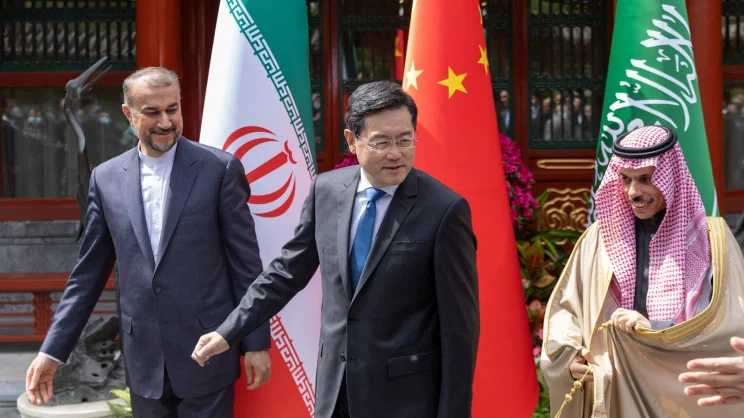
Iranian Foreign Minister Hossein Amir-Abdollahian, Saudi Arabia's Foreign Minister Prince Faisal bin Farhan Al Saud and Chinese Foreign Minister Qin Gang during their meeting in Beijing, China, April 6, 2023. Photo: Saudi Press Agency/ REUTERS
I would therefore see the Mecca agreement as part of a longer process of security diversification, or perhaps more precisely, strategic insurance. Saudi Arabia will maintain its relationship with Washington, but it also wants other military, diplomatic and political options. This change did not begin in Mecca. Its roots can be traced through the weaknesses exposed by the 2019 attacks on Saudi oil facilities, the restoration of Saudi-Iranian relations in 2023, the gradual rebuilding of relations between Riyadh and Ankara, and the Saudi-Pakistan defence agreement of 2025. The Mecca agreement is important because these separate developments are now beginning to acquire a more institutional form.
The strategic alliance between the United States and Saudi Arabia began to deepen during the Second World War. In February 1945, US President Franklin D. Roosevelt met Saudi King Abdulaziz Ibn Saud aboard the USS Quincy. However, the US security role in the Gulf became much more explicit in 1979. Against the backdrop of the Iranian Revolution and the Soviet intervention in Afghanistan, the United States assumed a central security role in the Middle East. In January 1980, President Jimmy Carter spoke of protecting the Persian Gulf from external aggression. Washington pledged to help the countries of the region resist such aggression, using military force if necessary. This later became known as the “Carter Doctrine”. A decade later, its implications became even clearer. In August 1990, Saddam Hussein occupied Kuwait. Saudi Arabia agreed to the deployment of a large number of American troops on its territory to ensure its own security. The US-led coalition later expelled Iraqi forces from Kuwait during the 1991 Gulf War.
The post-Cold War Gulf security system that emerged afterwards was highly unequal. The Gulf monarchies had enormous financial resources and purchased highly advanced weapons, but their ultimate security guarantee came from American military power. Regional states would maintain close relations with Washington, while the United States would ensure that no hostile regional power could establish unilateral dominance over the Gulf.
A change in this arrangement came in September 2019. Attacks on Saudi Aramco facilities at Abqaiq and Khurais temporarily disrupted around 5.7 million barrels per day of Saudi oil production. Washington blamed Iran for the attacks. Tehran denied responsibility. The attacks demonstrated how relatively inexpensive drones could penetrate costly air-defence systems and cause serious damage. For the Saudi leadership, this was a major warning. They realised that buying sophisticated weapons from a great power and receiving an automatic security guarantee from that great power were not the same thing. From that point onwards, the idea of a kind of strategic insurance became increasingly visible in Saudi policy.
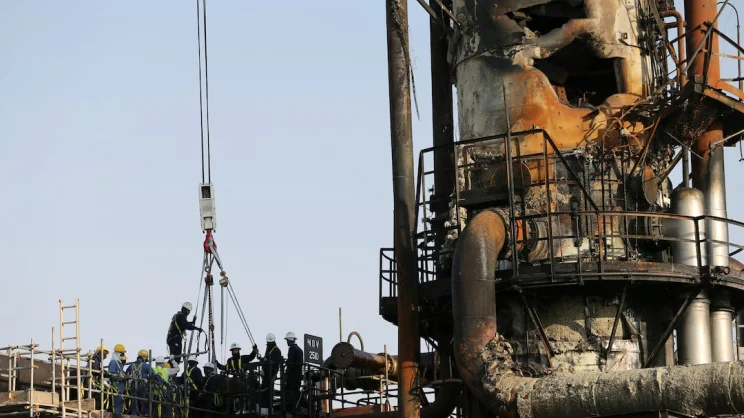
A general view of the damaged site of a Saudi Aramco oil facility in Abqaiq, Saudi Arabia, September 20, 2019. Photo: REUTERS
Several diplomatic developments followed. In March 2023, after a seven-year break, Saudi Arabia and Iran agreed in Beijing to restore diplomatic relations. The fact that China mediated the agreement was itself significant. The Saudi-Iranian rapprochement did not turn the two rivals into friends. What it showed, rather, was that Saudi Arabia was changing parts of its old strategy. Put simply, Riyadh no longer wants only to confront its opponents. It also wants to keep channels of communication open with them so that risks can be reduced to some extent.
The same logic can be seen in Saudi Arabia’s relationship with Türkiye. In the decade following the Arab Spring, Ankara and Riyadh often stood on opposite sides of regional political rivalries. During the 2017 blockade of Qatar, Türkiye stood by Doha. At the time, Saudi Arabia, the United Arab Emirates, Bahrain and Egypt were attempting to isolate Qatar. In 2018, Saudi journalist Jamal Khashoggi was killed inside the Saudi consulate in Istanbul. Saudi-Turkish relations deteriorated further afterwards. By 2022, however, President Erdoğan had begun rebuilding relations with Riyadh. As the political relationship began to thaw, security and economic cooperation also increased. Saudi Arabia signed a major agreement to purchase Turkish drones in July 2023.
Saudi Arabia and Pakistan have had a security relationship for many decades. The two countries signed a Strategic Mutual Defence Agreement in September 2025. The agreement stated that any military attack against one country would be considered aggression against both. Following the agreement, there was broad discussion about whether Pakistan’s nuclear capability might somehow become part of Saudi Arabia’s deterrence framework. However, no such commitment was explicitly mentioned in the published agreement. Moreover, Pakistani officials did not support that interpretation. The 2026 Mecca agreement should therefore not be seen as the creation of an entirely new Saudi-Pakistani security architecture. Rather, an existing arrangement has been expanded. The most important new development is Türkiye’s inclusion in this framework. This is why I do not see the agreement merely as a diplomatic display. It can also be viewed as a form of institutional progress.
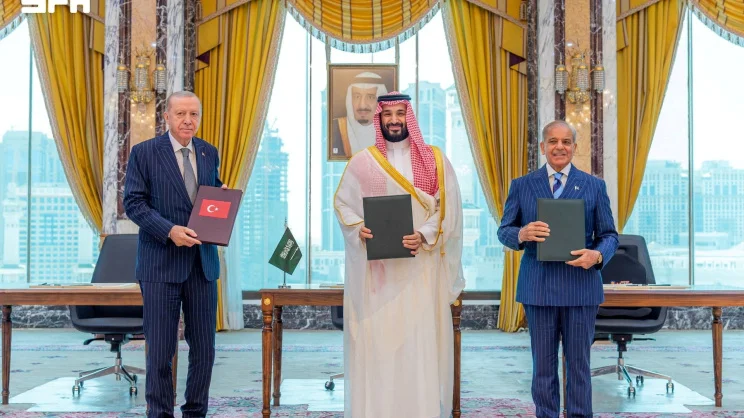
Turkish President Tayyip Erdogan, Saudi Crown Prince Mohammed bin Salman, and Pakistan's Prime Minister Shehbaz Sharif pose after signing a joint defence agreement in Mecca, Saudi Arabia, August 7, 2026. Photo: Saudi Press Agency/REUTERS
Following the Hamas attack on Israel on October 7, 2023, Israel launched the war in Gaza. The war led to widespread destruction in Gaza and spread across the Lebanese border. The United States and Israel attacked Iran on February 28,2026. Iran then launched retaliatory attacks across the region. The war disrupted shipping through the Strait of Hormuz. These conflicts made it very clear to the Gulf states that their existing security arrangements also have limitations.
Saudi Arabia’s economic model, for example, depends on stability. Implementing Vision 2030 requires foreign investment, tourism, new infrastructure, major construction projects and confidence that Saudi territory will remain relatively insulated from regional wars. A Middle East in which missiles regularly cross the Gulf, shipping through the Strait of Hormuz is disrupted, and the Red Sea becomes insecure is fundamentally incompatible with that development strategy. For Riyadh and Türkiye, therefore, security is no longer only a military issue. It is directly connected to their economic futures. Pakistan’s calculation is that deeper security cooperation with Saudi Arabia gives Islamabad greater diplomatic influence, stronger economic relations with the Gulf and a wider regional role.
Asif Bin Ali is a geopolitical analyst and doctoral fellow at Georgia State University in the US.
Asif Bin Ali
On August 7, Saudi Arabia, Pakistan and Türkiye signed a defence agreement in Mecca. The three countries that have come together under this agreement each hold distinct importance in the politics of the Middle East and the wider Muslim world. One is the leading economic power of the Arab world. Another is a nuclear-armed South Asian state. And the third is a member of NATO. Like NATO member states, these countries have agreed that an armed attack on any one of them will be considered an attack on all. However, this is a defensive alliance, not an offensive one.
Some argue that this agreement represents an anti-Iran alliance. That interpretation is overly simplistic. In a Reuters analysis of the Mecca Agreement, Burcu Ozcelik, a researcher at the Royal United Services Institute, argued that the framework seeks, on the one hand, to balance Iranian power and, on the other, to create deterrence in relation to Israel. It should not be seen as preparation for war with Tehran. But the more important question is not simply whom this alliance is directed against. The more important question is why Saudi Arabia, after decades of depending primarily on the United States for its security, now feels the need to develop additional security arrangements of its own.
Others argue that this agreement is helping to create the security architecture of a post-American Middle East. There is some truth in this argument, but I think the term “post-American” goes too far. The United States is not leaving the Middle East. Türkiye is still a NATO member. Saudi Arabia’s security remains closely connected to American support. Pakistan also has an important relationship with Washington. What is changing is not the disappearance of the United States, but the assumption that one external security guarantor is enough. Regional countries are increasingly trying to build several layers of security at the same time.
Iranian Foreign Minister Hossein Amir-Abdollahian, Saudi Arabia's Foreign Minister Prince Faisal bin Farhan Al Saud and Chinese Foreign Minister Qin Gang during their meeting in Beijing, China, April 6, 2023. Photo: Saudi Press Agency/ REUTERS
I would therefore see the Mecca agreement as part of a longer process of security diversification, or perhaps more precisely, strategic insurance. Saudi Arabia will maintain its relationship with Washington, but it also wants other military, diplomatic and political options. This change did not begin in Mecca. Its roots can be traced through the weaknesses exposed by the 2019 attacks on Saudi oil facilities, the restoration of Saudi-Iranian relations in 2023, the gradual rebuilding of relations between Riyadh and Ankara, and the Saudi-Pakistan defence agreement of 2025. The Mecca agreement is important because these separate developments are now beginning to acquire a more institutional form.
The strategic alliance between the United States and Saudi Arabia began to deepen during the Second World War. In February 1945, US President Franklin D. Roosevelt met Saudi King Abdulaziz Ibn Saud aboard the USS Quincy. However, the US security role in the Gulf became much more explicit in 1979. Against the backdrop of the Iranian Revolution and the Soviet intervention in Afghanistan, the United States assumed a central security role in the Middle East. In January 1980, President Jimmy Carter spoke of protecting the Persian Gulf from external aggression. Washington pledged to help the countries of the region resist such aggression, using military force if necessary. This later became known as the “Carter Doctrine”. A decade later, its implications became even clearer. In August 1990, Saddam Hussein occupied Kuwait. Saudi Arabia agreed to the deployment of a large number of American troops on its territory to ensure its own security. The US-led coalition later expelled Iraqi forces from Kuwait during the 1991 Gulf War.
The post-Cold War Gulf security system that emerged afterwards was highly unequal. The Gulf monarchies had enormous financial resources and purchased highly advanced weapons, but their ultimate security guarantee came from American military power. Regional states would maintain close relations with Washington, while the United States would ensure that no hostile regional power could establish unilateral dominance over the Gulf.
A change in this arrangement came in September 2019. Attacks on Saudi Aramco facilities at Abqaiq and Khurais temporarily disrupted around 5.7 million barrels per day of Saudi oil production. Washington blamed Iran for the attacks. Tehran denied responsibility. The attacks demonstrated how relatively inexpensive drones could penetrate costly air-defence systems and cause serious damage. For the Saudi leadership, this was a major warning. They realised that buying sophisticated weapons from a great power and receiving an automatic security guarantee from that great power were not the same thing. From that point onwards, the idea of a kind of strategic insurance became increasingly visible in Saudi policy.
A general view of the damaged site of a Saudi Aramco oil facility in Abqaiq, Saudi Arabia, September 20, 2019. Photo: REUTERS
Several diplomatic developments followed. In March 2023, after a seven-year break, Saudi Arabia and Iran agreed in Beijing to restore diplomatic relations. The fact that China mediated the agreement was itself significant. The Saudi-Iranian rapprochement did not turn the two rivals into friends. What it showed, rather, was that Saudi Arabia was changing parts of its old strategy. Put simply, Riyadh no longer wants only to confront its opponents. It also wants to keep channels of communication open with them so that risks can be reduced to some extent.
The same logic can be seen in Saudi Arabia’s relationship with Türkiye. In the decade following the Arab Spring, Ankara and Riyadh often stood on opposite sides of regional political rivalries. During the 2017 blockade of Qatar, Türkiye stood by Doha. At the time, Saudi Arabia, the United Arab Emirates, Bahrain and Egypt were attempting to isolate Qatar. In 2018, Saudi journalist Jamal Khashoggi was killed inside the Saudi consulate in Istanbul. Saudi-Turkish relations deteriorated further afterwards. By 2022, however, President Erdoğan had begun rebuilding relations with Riyadh. As the political relationship began to thaw, security and economic cooperation also increased. Saudi Arabia signed a major agreement to purchase Turkish drones in July 2023.
Saudi Arabia and Pakistan have had a security relationship for many decades. The two countries signed a Strategic Mutual Defence Agreement in September 2025. The agreement stated that any military attack against one country would be considered aggression against both. Following the agreement, there was broad discussion about whether Pakistan’s nuclear capability might somehow become part of Saudi Arabia’s deterrence framework. However, no such commitment was explicitly mentioned in the published agreement. Moreover, Pakistani officials did not support that interpretation. The 2026 Mecca agreement should therefore not be seen as the creation of an entirely new Saudi-Pakistani security architecture. Rather, an existing arrangement has been expanded. The most important new development is Türkiye’s inclusion in this framework. This is why I do not see the agreement merely as a diplomatic display. It can also be viewed as a form of institutional progress.
Turkish President Tayyip Erdogan, Saudi Crown Prince Mohammed bin Salman, and Pakistan's Prime Minister Shehbaz Sharif pose after signing a joint defence agreement in Mecca, Saudi Arabia, August 7, 2026. Photo: Saudi Press Agency/REUTERS
Following the Hamas attack on Israel on October 7, 2023, Israel launched the war in Gaza. The war led to widespread destruction in Gaza and spread across the Lebanese border. The United States and Israel attacked Iran on February 28,2026. Iran then launched retaliatory attacks across the region. The war disrupted shipping through the Strait of Hormuz. These conflicts made it very clear to the Gulf states that their existing security arrangements also have limitations.
Saudi Arabia’s economic model, for example, depends on stability. Implementing Vision 2030 requires foreign investment, tourism, new infrastructure, major construction projects and confidence that Saudi territory will remain relatively insulated from regional wars. A Middle East in which missiles regularly cross the Gulf, shipping through the Strait of Hormuz is disrupted, and the Red Sea becomes insecure is fundamentally incompatible with that development strategy. For Riyadh and Türkiye, therefore, security is no longer only a military issue. It is directly connected to their economic futures. Pakistan’s calculation is that deeper security cooperation with Saudi Arabia gives Islamabad greater diplomatic influence, stronger economic relations with the Gulf and a wider regional role.
Asif Bin Ali is a geopolitical analyst and doctoral fellow at Georgia State University in the US.