Home Watch Videos Wars Movies Login

[🇧🇩-Land] Military Cooperation Between Bangladesh and Other Nations

[🇧🇩-Land] Military Cooperation Between Bangladesh and Other Nations
78
6K
More threads by Saif

G   Bangladesh Defense
I believe Bangladesh Govt. will not unilaterally sign AQSA and GSOMIA without consulting China, which is the largest military supplier to Bangladesh.
You are right in your observation that the interim government won't sign AQSA and GSOMIA without consulting China.:)
 
Analyze

Analyze Post

Add your ideas here:
Highlight Cite Respond
  • Like (+1)
Reactions: Bilal9
বাংলাদেশ সশস্ত্রবাহিনীর জন্য মার্কিন সমরাস্ত্র? কি কি আসতে চলেছে (A top US general has visited Bangladesh recently. He and the top brass of Bangladesh army have discussed issues like selling US military weapons to Bangladesh.)


Analyze

Analyze Post

Add your ideas here:
Highlight Cite Respond
  • Like (+1)
Reactions: Bilal9
ফিলিস্তিনি সেনাদের প্রশিক্ষন দেয় বাংলাদেশ সেনাবাহিনী (Palestinian cadets receive training from Bangladesh military academy. The cadets from Palestine are regular visitors at BMA):love:

 
Analyze

Analyze Post

Add your ideas here:
Highlight Cite Respond
  • Like (+1)
Reactions: Bilal9

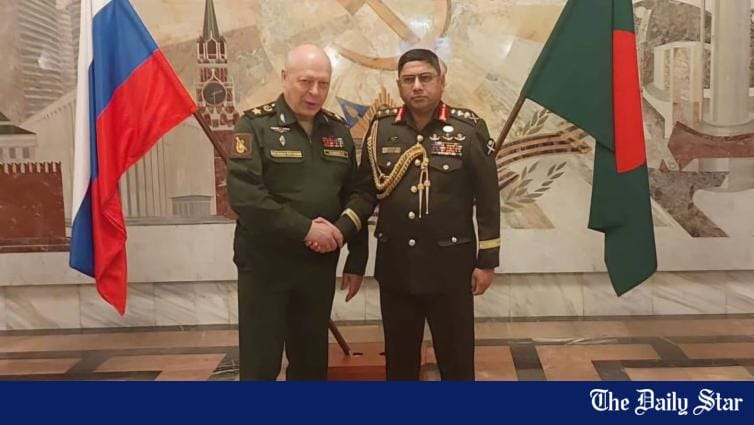
Army chief back home after Russia, Croatia tour

1744506234983.webp

Army chief Waker-uz-Zaman shakes hands with Russian army chief General Oleg Salyukov. Photo: ISPR

Chief of Army Staff General Waker-uz-Zaman returned home yesterday after holding wide-ranging discussions on defence cooperation, training exchange, regional security, and joint military initiatives during his official visits to Russia and Croatia.

During the tour, the army chief met top military and civilian officials, including Russia's deputy defence minister, the chief of the Russian army, and the chief of the Croatian armed forces, said the Inter-Services Public Relations in a release.

According to the ISPR notification, Waker met Russian Deputy Defence Minister General A Fomin on April 7. They discussed matters of mutual interest, including military-to-military cooperation, training support, bilateral relations, mutual confidence-building, skilled manpower export to Russia, higher education, regional security, and prospects for joint training.

The next day, he paid a courtesy call on General Oleg Salyukov, chief of the Russian army. Their discussions focused on future plans for defence cooperation agreements, training assistance, trainee exchanges between military institutions, and joint training initiatives.

The army chief also held a meeting with the Director General of Russia's state nuclear agency ROSATOM Alexey Likhachev where they discussed the timely completion of the physical security infrastructure for the Rooppur Nuclear Power Plant and integrating it with the national grid.

Waker also met senior officials from Rostec and Rosoboronexport and held discussions on enhancing the pace and efficiency of defence exchanges between the two nations, according to the ISPR notification.

On April 10, during his visit to Croatia, the army chief met with Lt Gen Tihomir Kundid, chief of the Croatian armed forces.​
 
Analyze

Analyze Post

Add your ideas here:
Highlight Cite Respond
  • Like (+1)
Reactions: Bilal9

Bangladesh Army Delegation Visits China For Tech Transfer Talks; Bayraktar Tb-2s Already Active Along India Border

China’s defence footprint in Bangladesh, from naval frigates to UAV co-development, is embedding PLA doctrine into Dhaka’s military operations.

Reported by: Yuvraj Tyagi

1745116429558.webp

Bangladesh's drone ties with China and Turkey near Indian borders spark fears of a second surveillance front for New Delhi. | Image: AP

Dhaka, Bangladesh - Bangladesh’s decision to engage in high-level military cooperation with China—India’s primary strategic adversary—marks a significant erosion in the mutual trust built through years of bilateral diplomacy. Despite India’s substantial role in supporting Bangladesh’s Liberation War in 1971 and ongoing investments in infrastructure and defence diplomacy, Dhaka’s outreach to Beijing, especially in dual-use drone technologies, signals a calculated shift away from regional equilibrium and toward opportunistic alignment with external powers.

China's Footprint in Dhaka's Security Sector

China’s historical role as Bangladesh’s primary defence supplier has deepened into a strategic engagement, encompassing naval transfers (like Type 053H3 frigates), submarine sales, and now, UAV co-development. By opening doors to Chinese tech transfers and training protocols, Bangladesh risks embedding the PLA’s influence into its operational doctrines—something India cannot afford in its own neighbourhood.

1745116532169.webp


The December 2024 deployment of Bayraktar TB-2 drones along the India-Bangladesh border in Meghalaya represents a tactical precedent with long-term implications. That these drones reportedly flew 20+ hour reconnaissance sorties—well beyond standard patrol parameters—suggests a deliberate effort by Bangladesh to test Indian radar and border surveillance tolerances. If normalized, such behaviour could lead to a strategic recalibration of India’s eastern border postures, stretching already-thin assets across more sectors.

Strategic Implications for India’s National Security Posture

The deployment of high-end Turkish drones by Bangladesh near India's northeast increases the probability of intelligence vulnerabilities. Bayraktar TB-2s are capable of capturing real-time ISR (intelligence, surveillance, reconnaissance) data with encrypted data links. Their operations close to India’s critical Siliguri Corridor and Assam-Meghalaya belt raise concerns about inadvertent or intentional surveillance leakage. Any cross-data sharing with Chinese or Turkish intelligence would exacerbate this threat.

1745116603648.webp


India already faces massive troop deployments and infrastructure strain in Eastern Ladakh due to the PLA’s assertiveness. A second vector of military-technological pressure from the East (Bangladesh), especially one aligned with China’s interests, creates a scenario akin to a "pressure pincer." This forces India to allocate disproportionate assets along the Meghalaya–Mizoram–Tripura belt, which has traditionally been a low-intensity frontier.

Bangladesh’s growing maritime security engagements with China and Turkey could culminate in enhanced surveillance or even maritime drone deployments in the Bay of Bengal, an area where India seeks naval dominance. Given that China already operates dual-use ports in Gwadar and Hambantota, any future PLA presence in Chittagong or Mongla—under the guise of technical assistance or UAV stationing—would severely erode India’s eastern naval edge.

Missed Opportunities in India’s Bangladesh Policy

India’s diplomatic overtures have often focused on connectivity, energy exports, and infrastructure aid, but have lacked depth in joint military development, leaving space for powers like China and Turkey to step in. The absence of meaningful co-production agreements, drone technology transfers, or counter-terrorism drills with Dhaka has diminished India’s relevance in Bangladesh’s military calculus.

China’s approach is comprehensive: it combines technology transfers, defence loans, and political support, tailored to appeal to smaller nations’ desire for strategic autonomy. India has neither matched this scale nor sophistication. Bangladesh’s latest push for AI-based indigenous drone development with Chinese assistance reveals how New Delhi is getting outpaced in its own backyard.

Bangladesh’s pivot to China and Turkey for military technology—especially in the drone warfare domain—is a strategic inflexion point for Indian policymakers. It demands a calibrated rethinking of India’s eastern security doctrines, backed by urgent initiatives to re-engage Dhaka through high-value military-industrial cooperation, joint exercises, and targeted technology-sharing. Failing to do so will not only weaken India’s influence in its eastern flank but also open the door for a permanent second front of strategic surveillance vulnerability—at the very doorstep of the Indian heartland.​
 
Analyze

Analyze Post

Add your ideas here:
Highlight Cite Respond
There is now talk of assembling Bayraktar TB-3's locally in Bangladesh (improved model). The TB-3s have improved loiter and heavier payload capability for cruise missiles (especially Turkish adaptation of Hellfire type mini-missiles.

In other news, Indian media is claiming that New Delhi has warned Bangladesh of shooting down any drones flown in Bangladesh territory within 10 KM of the border.

Brother @Mainerik and @Saif Bhai, is this legal?
 
Analyze

Analyze Post

Add your ideas here:
Highlight Cite Respond
There is now talk of assembling Bayraktar TB-3's locally in Bangladesh (improved model). The TB-3s have improved loiter and heavier payload capability for cruise missiles (especially Turkish adaptation of Hellfire type mini-missiles.

In other news, Indian media is claiming that New Delhi has warned Bangladesh of shooting down any drones flown in Bangladesh territory within 10 KM of the border.

Brother @Mainerik and @Saif Bhai, is this legal?
This is totally illegal. India cannot shoot down our drones if it operates within our air space.
 
Analyze

Analyze Post

Add your ideas here:
Highlight Cite Respond
  • Love (+3)
Reactions: Bilal9
This is totally illegal. India cannot shoot down our drones if it operates within our air space.

They are apparently still going around threatening us. India behaving like they do - as always...
 
Analyze

Analyze Post

Add your ideas here:
Highlight Cite Respond

Members Online

Latest Posts

Back
 
G
O
 
H
O
M
E