| Global Defense, OSINT & Geopolitics Wire

[🇧🇩] Monitoring Bangladesh's Economy

[🇧🇩] Monitoring Bangladesh's Economy
1K
56K
More threads by Saif

G Bangladesh Defense

Cushioning govt against global shocks
WB raising $2.0b in quick financing within FY26
Bank board may approve multi-sector package by June 29, disbursement begins following day

REZAUL KARIM

Published :
May 22, 2026 23:42
Updated :
May 22, 2026 23:42
1779492668460.webp


Bangladesh expects an off-the-cuff US$1.835-billion financing from the World Bank for use before the close of the current fiscal year to cushion the economy against mounting external shocks, sources say.

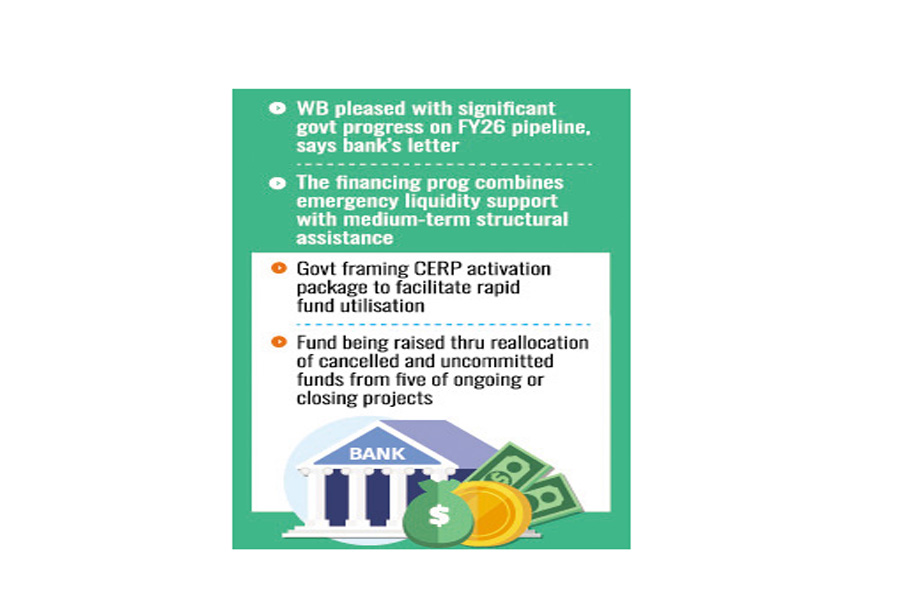
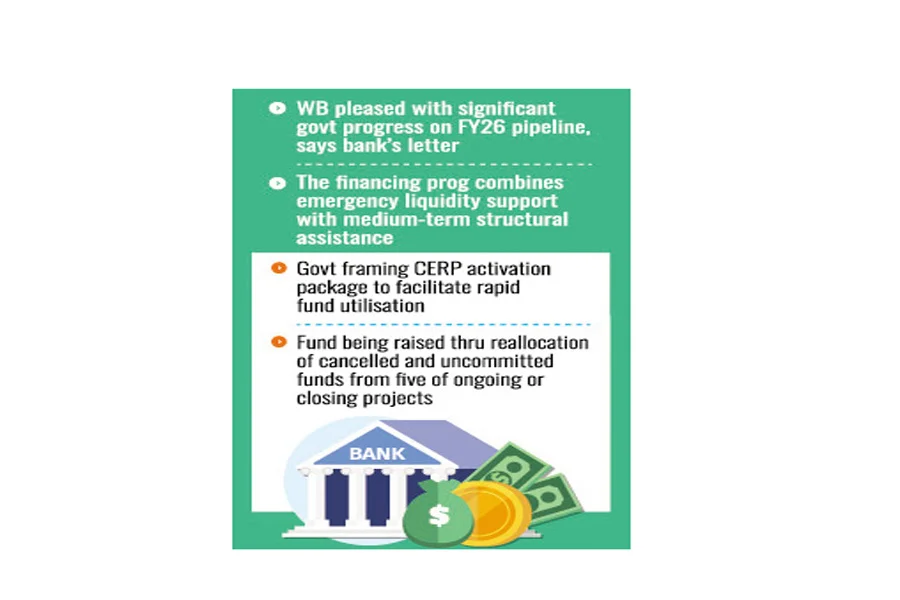
Of the amount, the financier has proposed an emergency financing fund worth up to $250 million for Bangladesh government to tackle fiscal pressures stemming from the ongoing Middle East conflict.

The proposed emergency Investment Project Financing (IPF) would be financed through the reallocation of cancelled and uncommitted funds from five of ongoing or closing projects.

The projects include the Resilience, Entrepreneurship and Livelihood Improvement Project, Dhaka City Neighborhood Upgrading Project, Bangladesh Road Safety Project, Bangladesh Environmental Sustainability and Transformation Project, and Jamuna River Sustainable Management Project-1.

The proposed IPF is expected to be placed before the World Bank Board for approval by June 29, 2026, with disbursement likely to begin the following day, according to officials familiar with the developments.

The multi-sector package, now in an advanced stage of preparation, is intended to support macroeconomic stability, strengthen fiscal resilience, and ensure continuity in key financial-and energy-sector operations.

The government has made significant progress in advancing the FY26 financing pipeline following discussions held during the WB Group and IMF Spring Meetings, according to a recent letter addressed to the government.

The letter complements earlier correspondence dated May 5, 2026.

"We are pleased to observe significant progress on the FY26 pipeline thanks to the leadership of the Minister of Finance and Planning," the letter reads.

The letter mentions: "In sum, up to u$1.835 billion can be processed before the end of FY26."

According to an official communications between the WB and the Economic Relations Division (ERD), the financing programme combines emergency liquidity support with medium-term structural assistance.

The largest component of the package is up to $785 million under the Contingent Emergency Response Component (CERP) Rapid Results Option.

The government has already appointed a project director within the Finance Division and completed the omnibus amendment needed to repurpose funds from host projects for emergency expenditures.

The government is now preparing the CERP activation package, including a crisis action plan and procurement framework, to facilitate rapid fund utilisation.

Another major component is the Financial Sector Support Project-II worth US$450 million, aimed at strengthening financial-sector stability and reform initiatives.

Negotiations on the project concluded on May 11, with minutes signed the following day.

An official says Bangladesh Bank (BB) has sought an additional $50-million allocation as the Deposit Protection Fund has already utilised around 90 per cent of its existing resources.

An addendum to the negotiation minutes is currently under preparation following approval from the finance and planning adviser, keeping the project on course for WB Board approval by June 23.

The pipeline also includes $350 million in additional financing for the Energy Sector Security Enhancement Project to help absorb global fuel-price volatility and support energy-supply security.

A high official concerned says the government has already provided feedback on the project paper and indemnity agreement, while the WB submitted the final project paper for senior management clearance on May 12.

The WB has stressed the need for parallel implementation measures to ensure timely release of the funds before the end of FY2025-26.

Under the proposed arrangement, the Finance Division will deploy experienced officials in procurement, financial management and safeguard compliance to meet the accelerated processing timeline, according to a senior official concerned.​
 

ADP implementation hits just 41.41 per cent in July-April as post-uprising slump lingers

bdnews24.com

Published :
May 24, 2026 00:06
Updated :
May 24, 2026 00:06

1779589989645.webp


The sluggish pace of Annual Development Programme (ADP) implementation following last year’s July Uprising continues to weigh on government spending, the latest official data show.

In the first 10 months of the ongoing 2025-26 fiscal year, ministries and divisions implemented only 41.41 per cent of the total development allocation.

According to data released on Saturday by the Implementation Monitoring and Evaluation Division (IMED) of the Ministry of Planning, total expenditure during the period stood at Tk 865.16 billion.

The Muhammad Yunus-led interim government had initially set an ambitious ADP expenditure target of Tk 2.38 trillion for the fiscal year.

Owing to sluggish implementation, the National Economic Council (NEC) cut the development budget by Tk 300 billion, reducing it to a revised Tk 2.08 trillion on 12 January.

The government will have to spend a staggering Tk 1.22 trillion in the remaining two months of the fiscal year — May and June.

During the same July-April period of the previous 2024-25 fiscal year, the government spent Tk 934.24 billion, representing an implementation rate of 41.31 per cent.

An analysis of the IMED data shows that administrative stagnation caused by law-and-order challenges after the July Uprising, coupled with massive bureaucratic reshuffles, continues to hamper project execution.

The political landscape has since shifted, with the BNP, led by Acting Chairman Tarique Rahman, forming the current elected government. Finance Minister Amir Khosru Mahmud Chowdhury is scheduled to present his government’s first budget for the 2026-27 fiscal year on 11 June.

An NEC meeting chaired by the prime minister on 18 May has already approved a significantly larger ADP of Tk 3.08 trillion for the next fiscal year.

In April alone, ministries spent Tk 109.09 billion, a marginal increase from Tk 105.30 billion in April of the previous year.

The decline in development spending began sharply under the Muhammad Yunus-led interim government. The ousted Awami League administration had originally passed a massive Tk 2.78 trillion ADP for the 2024-25 fiscal year.

The interim administration revised it down to Tk 2.26 trillion, but ultimately spent only Tk 1.53 trillion, resulting in an overall implementation rate of 67.85 per cent — the lowest recorded in 20 years.

The ADP implementation rate was 80.63 per cent in the 2023-24 fiscal year.

The interim government’s policy of aggressively prioritising essential schemes led to funding cuts or outright suspensions for numerous projects initiated by the previous regime, dragging down overall expenditure.

While ADP spending traditionally gathers pace in the final months of a fiscal year, the current execution gap remains extraordinarily wide.

By comparison, the ADP implementation rate during the July-April period was 49.26 per cent in the 2023-24 fiscal year, 50.33 per cent in 2022-23 and 54.57 per cent in 2021-22.

The IMED report showed that the 15 highest-funded ministries and divisions, which collectively account for 70.97 per cent of the revised Tk 2.08 trillion ADP, achieved an average implementation rate of 50.76 per cent so far.

The Ministry of Science and Technology topped the chart, executing 80.20 per cent of its allocation. It was followed by the Energy and Mineral Resources Division at 68.27 per cent and the Ministry of Agriculture at 62.01 per cent.

Among other major ministries and divisions, the Ministry of Water Resources recorded an implementation rate of 61.50 per cent, followed by the Local Government Division at 55.97 per cent, the Power Division at 50.84 per cent and the Bridges Division at 48.42 per cent.

The Secondary and Higher Education Division implemented 44.49 per cent of its allocation, while the Ministry of Shipping recorded 42.79 per cent and the Road Transport and Highways Division 39.93 per cent.

The Technical and Madrasah Education Division posted an implementation rate of 37.67 per cent, slightly ahead of the Ministry of Housing and Public Works at 37.61 per cent.

The Ministry of Primary and Mass Education implemented 28.27 per cent, while the Health Services Division recorded the lowest rate among the major ministries and divisions at 22.15 per cent.​
 

Tax amnesty for whom, exactly?

FE

Published :
May 24, 2026 00:39
Updated :
May 24, 2026 00:39

1779590255932.webp


The government is reportedly on the verge of offering a special tax amnesty that would allow non-resident Bangladeshis to invest undisclosed income in select sectors without facing any scrutiny from revenue authorities or other agencies. Officials argue that the initiative could encourage overseas Bangladeshis to repatriate funds through formal channels and help channel idle capital into productive sectors. These justifications, however, crumble under even the most basic examination of existing law and recent economic data. Under the current Income Tax Act, any income earned abroad by a Bangladeshi natural person taxpayer and brought into Bangladesh through formal remittance channels is entirely tax-exempt. Not only that, the government provides a 2.5 per cent cash incentive on remittances transferred through legal channels, a policy specifically designed to encourage expatriates to use the banking system rather than informal routes. In April alone this year, Bangladeshi expatriates sent home a record $3.12 billion without facing any legal difficulty, demonstrating beyond any reasonable doubt that the existing framework is not a barrier to remittances. The question that naturally arises, then, is for whom exactly this amnesty is being designed, because the legitimate expatriate worker sending money home already enjoys exemptions and incentives that make formal channels both safe and financially rewarding.

If the expatriates already enjoy safe and rewarding channels, the necessity for this amnesty must stem from a different demographic entirely. There are even allegations that unscrupulous individuals already exploit the existing framework by sending money out through illegal channels and bringing it back as legitimate remittance to whiten illicit wealth while claiming cash incentives. Given that mechanisms already exist to facilitate legitimate transfers of funds, and are also misused through circumvention of rules, the proposition of an additional amnesty inevitably points toward a far more concerning set of beneficiaries. This is public knowledge that there are some notorious individuals who have already siphoned billions, if not trillions, out of the country to establish offshore business empires and acquire foreign properties. A blanket amnesty will risk providing them precisely the legal cover they need to reintegrate stolen capital without facing prosecution. The government must weigh this reality seriously, because a policy whose most probable beneficiaries are the very people the state should be prosecuting is far more corrosive to institutional credibility than any short-term revenue gain could justify.

Alongside this deeply problematic amnesty proposal, the government is also considering a reduction in the advance income tax rate on imports of raw materials by commercial importers holding import registration certificates. The current advance tax stands at 5 per cent, which is adjustable against final tax liabilities. The NBR is already staring at a monumental revenue shortfall exceeding Tk 1.04 trillion during the first 10 months of the current fiscal year. At a time when the government should be taking initiatives to increase revenue mobilisation, reducing advance tax collection is bound to negatively impact the overall revenue picture even further.

Policymakers acknowledge that within the prevailing tax culture of Bangladesh, advance taxes and deductions at source constitute a substantial share of actual revenue collection. This heavy reliance on deductions at source inadvertently fosters a widespread, albeit illegal and unethical, practice where many taxpayers calculate their declared income based purely on the taxes they have already paid. However, businesses very often struggle to secure cash refunds if the AIT is paid in excess of their final liability. This prompts them to pass the tax money on to the consumers. There is no denying that the case of AIT is a tricky one. Under the prevailing circumstances, the government will have to generate more revenue while finding solution to problems the businesses have been facing for long.​
 

Bangladesh's trade with regional partners: Oct-Dec'25 deficit falls 15pc

Jasim Uddin Haroon

Published :
May 23, 2026 08:38
Updated :
May 23, 2026 08:48

1779590576569.webp


Bangladesh's trade deficit with its seven neighbouring countries narrowed by more than 15 per cent to $1.70 billion during the October-December quarter of this fiscal year, according to the Bangladesh Bank data.

This reflects a decline in imports from major regional trading partners - India and Pakistan.

The deficit was $2.65 billion in the corresponding period a year earlier, according to the trade data reviewed by this scribe.

The improvement was mainly driven by a contraction in imports from India and Pakistan - Bangladesh's two largest trading partners in the region.

Economists say slower import demand and tighter spending on foreign goods may have contributed to the trend.

The seven neighbouring countries considered in the regional trade analysis are India, Pakistan, Sri Lanka, Nepal, Afghanistan, Myanmar, and Bhutan.

India remained Bangladesh's largest trading partner in the region.

Imports from India stood at $2.044 billion during October-December 2025, marking a decline of 14.6 per cent compared with the same period in 2024.

Imports from Pakistan also registered a decline during the quarter.

Bangladesh imported goods worth $166.7 million from Pakistan during the period, down by 13.5 per cent from the corresponding quarter of the previous year.

Among the regional countries, imports from Afghanistan were the only exception, increasing by $8.3 million during the quarter under review.

Bangladesh's exports to neighbouring countries also witnessed a decline during the period, indicating weaker overall regional trade activity. Exports to India, the country's largest export destination within the region, dropped by 10 per cent to nearly $450 million during October-December, compared with nearly $503 million in the same period a year earlier.

Exports to Pakistan also declined to $17.6 million during the quarter from $19.6 million in the corresponding period of 2024.

Sri Lanka remained Bangladesh's third-largest trading partner in the region, with exports to the island nation amounting to $17.6 million during the quarter.

In contrast, exports to Nepal recorded a sharp increase, rising to $11.0 million during the October-December period from $4.7 million in the same quarter of the previous year.​
 

Remittance is flowing but can it face headwinds?

Hasnat Abdul Hye

Published :
May 24, 2026 00:33
Updated :
May 24, 2026 00:33

1779590716127.webp


As in past years, there are good tidings about remittance payments made by Bangladeshi overseas workers before the next Eid ul Azha. According to newspaper reports quoting Bangladesh Bank source, in seventeen days, from May 1 to 17 this year, the amount remitted stood at $ 2.18 billion or $130 million daily. This is unprecedented and marks a 35 per cent increase over the corresponding period during last year. If the present trend is maintained, the total amount remitted by the end of this year may exceed $33.0 billion dollars, it is estimated by Bangladesh Bank. The amount remitted during the previous month (April) amounted to $ 3.75 billion, which is the highest for a month recorded so far. The amount remitted in April this year recorded an amount higher by $700 million than the previous month of March which indicated that there has been an uptake in remittance independent of exigencies of religious festivals. This is bourne out by the amounts remitted in February ($350 million), January ($360 million) and December last year ($370 million). All told, during the 10 months and 17 days period of the current fiscal (2025-2026) a total of $31.51 billions have been received as remittance. This is 25 per cent higher than the remittance in the corresponding period during 2024-2025 fiscal, according to Bangladesh Bank sources.. The total amount received during the 10 months 17 days period during last fiscal was $ 26.14 billion.

As a result of record remittance the foreign exchange reserve has markedly increased. Till May 14, foreign exchange reserves stood at $ 34.31 billion, which converted into IMF's BPM-6 amounted to $29.65 billion. The increase in the volume of remittance has been assisted by the cash incentives given by the government to remitters of foreign exchange using official channel eschewing hundi. In addition, the policy of buying foreign exchange from commercial banks to maintain a rate of exchange higher than the curb market has been successful in encouraging wage earners abroad to use official channel. Meanwhile, open market operation by Bangladesh Bank has soaked up surplus dollars from the market which would otherwise have dampened the exchange rate. So far, an amount of $5.88 billion has been purchased by Bangladesh Bank from commercial banks this fiscal.

The 20.3 per cent increase in remittance during the current fiscal upto May 17 has improved the balance of payments (BOP) in current account. According to Bangladesh Bank source quoted by a Bengali daily (Amader Somoy, May 19), the balance of payment has a surplus of $3.66 billion dollars covering the first nine months of the current fiscal. In contrast to this fiscal's BOP position, the same during the last fiscal (2024-2025) was a deficit of $1.10 billion. The $ 4.42 billion in excess of last fiscal's remittance upto May 17 has made the difference in the BOP position this fiscal. Increase in remittance during the current fiscal has compensated for decline in export earnings leading to current account deficit. Decrease in exports and export earnings have been exacerbated by increases in volume of imports involving more payments than earnings through exports. During the current fiscal up to the month of May, export earnings amounted to $32.38 billion compared to $ 33.87 billion last fiscal. There has been a decrease in exports by 4.4 per cent this fiscal so far. The negative growth in export earnings has been compensated by increase in remittance, leading to the built up of a comfortable foreign exchange reserve.

Accompanying the improvement in the BOP, there has been an improvement in the Financial Accounts of the government. Against a deficit of $570 million in Financial Accounts during the first nine months last fiscal, the amount for the same period this year has gone up, amounting to $3.81 billion. The good news about remittance up to May 17 this fiscal is overshadowed by ominous developments looming overhead. Bangladesh has about five million workers in the Gulf region engaged in unskilled and semi- skilled works in construction, transport, hospitality sectors, domestic services, cleaning and low-end retailing. The current armed conflict in the Middle-East threatens to bring these jobs to shrink or complete stoppage.

The magnitude of this employment crisis for overseas workers can be analysed under three scenarios. Under the first scenario the current war is expected to be over in 2 to 4 months causing mild disruptions in economic activities. This will see job losses or non-renewal of contracts. Under the the second scenario, the war will continue for 6 months. This scenario will produce: (a) Fewer new visas, (b).Contract non-renewals and (c) Slowdown in construction activities. Overseas workers likely to be laid off have been estimated at 2 to 4 lakhs. The third scenario envisages medium-scale disruptions in economic activities spanning a period of 6 to 12 months. During this period 5 to 10 lakhs of overseas workers will lose their jobs including (a) layoffs, (b) unpaid leaves, (c) forced return migration to home countries and (d) major reduction in recruitments. A report prepared by ILO has noted labour demand in Gulf countries is already falling sharply.

Under the fourth scenario, named 'Severe Disruptions', there will be closure of Hormuz Strait for over one year causing recession in the economies of the Gulf countries. This will adversely impact the jobs of 1.5 to 2 million workers following : (a) stoppage of large cinstruction projects, (b) collapse in tourism and hospitality services, (c) suspension of major projects and (d) forced return migration of a large number of workers to their countries.

The above analytical framework has been prepared to cover the Gulf countries but can be applied to Saudi Arabia also as it has been affected by the Iran war, both directly and indirectly. Though it can bypass Hormuz for export of oil using the pipe line to Red sea, the damage to its oil refineries is such that it will take months to repair and reconstruct them. The financial loss caused by the fall of oil production by 10 per cent following the war has already forced the Kingdom to shelve its mega project Vision 2030. As in the Gulf countries, construction, tourism and service sectors in Saudi Arabia have all been badly hurt leading to near-closure or retrenchments of workers. More than 40 per cent of Bangladeshi workers are employed in Saudi Arabia and the spectre of unemployment for them is likely to appear soon causing a sharp fall in remittance. The question is not when but for how long the catastrophe will last. The fourth scenario delineated above is not considered likely yet. But countries having their wage workers in Saudi Arabia and the Gulf countries have to take into consideration the first three scenarios.

As for the impact on Bangladesh, even the medium case scenario will spell economic disaster impacting significantly on the remittance volume. According to recent record, 46 per cent of total remittance comes from Gulf countries. Bangladesh received roughly $32 billion in remittance in 2025 from the region. If 5 to 10 lakh Bangladeshi workers lose jobs, Bangladesh stands to lose at least half the amount it received in remittance before the war. This would create (a) foreign exchange shortages aggravating balace of payment position, (b) weakening of Taka, (c) slowdown in construction of infrastructures, (d) increase in domestic unemployment, (e) decrease in rural households income and consumption. What is to be done: an emergency drive should be made to diversify and increase the volume of exports to compensate the likely decline in remittance. Government to government negotiations should be made with Japan, South Korea and Malaysia to increase the number of Bangladeshi workers. Finally, Saudi Arabia and the Gulf countries should be requested not to send back Bangladeshi workers and allow them to be employed in alternative jobs.

The latest news about inflow of remittance defies the dire state of economies of the Middle-East countries hosting bulk of Bangladeshi wage earners. From Saudi Arabia to Gulf countries, the winds of war threaten the oil-based economies with declining growth and in the case of smaller states even collapse, with adverse impact on demand for labour.​