Bangladesh Defense
Saif
Senior Member
- Jan 24, 2024
- 21,077
- 9,688
- Nation

- Residence
- Axis Group


Should we keep running after IMF for loans, asks finance minister
Finance and Planning Minister Amir Khasru Mahmud Chowdhury has said the country can no longer be run the way it was running in the past, arguing that the financing structure has changed. “Should we keep running after the International Monetary Fund (IMF) for loans at one to two per cent...
 en.prothomalo.com
Should we keep running after IMF for loans, asks finance minister
Special Correspondent
Dhaka
Published: 21 May 2026, 21: 36
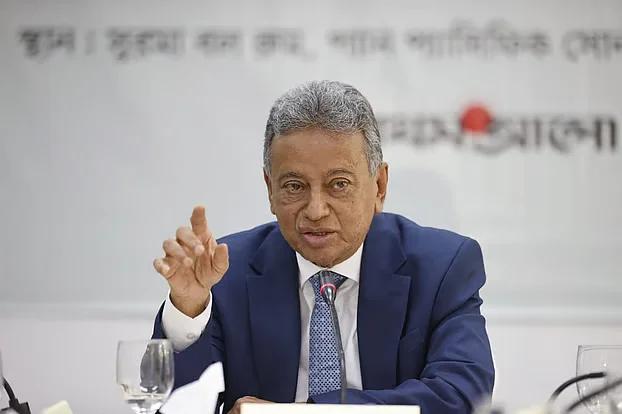
Finance Minister Amir Khasru Mahmud Chowdhury speaks as the chief guest at a roundtable discussion organised by Prothom Alo at the Pan Pacific Sonargaon Dhaka on 21 May 2026. Prothom Alo
Finance and Planning Minister Amir Khasru Mahmud Chowdhury has said the country can no longer be run the way it was running in the past, arguing that the financing structure has changed.
“Should we keep running after the International Monetary Fund (IMF) for loans at one to two per cent interest? Or should we create a fund tomorrow morning and channel it into our own market? If I can earn good returns on investment, why should I wait to see who will give me money, when they will give it, and under what conditions? Why do I even need that?” he asked.
The finance minister made the remarks today, Thursday, while speaking as the chief guest at a roundtable discussion titled ‘Budget in Times of Crisis and Public Expectations’, organised by Prothom Alo at the Pan Pacific Sonargaon Dhaka. Prothom Alo Editor Matiur Rahman delivered the welcome speech at the roundtable.
Among others, PPRC Chairperson Hossain Zillur Rahman, Distinguished Fellow of the Centre for Policy Dialogue (CPD) Debapriya Bhattacharya, BRAC Institute of Governance and Development Professorial Fellow Selim Jahan, Transcom Group CEO Simeen Rahman, HSBC Bangladesh CEO Mahbub ur Rahman, Policy Exchange Chairman Masrur Reaz, TK Group Director Mohammad Mustafa Haider, BKMEA President Mohammad Hatem, Moulvibazar Traders’ Association General Secretary Golam Mowla, and Bangladesh Restaurant Owners Association Secretary General Imran Hassan addressed the roundtable, moderated by Prothom Alo Head of Online Shawkat Hossain.
The finance minister said, “We want to move away from the oligarchic economy. So that, every citizen has equal access to opportunities, meaning the economy is participatory and that its benefits reach everyone. Democratisation of the economy is our philosophy.”
He said a large segment of the creative economy remains outside the tax net. Blacksmiths, potters, weavers and many other traditional workers in rural areas have never been brought under the scope of the budget.
“Generation after generation, they have continued working, but their lives have not improved. These people will be brought under financial and technical support programmes. There will be a fund for them in the budget. They survive hand to mouth, but their products are lacking value addition,” he said.
The finance minister also said cultural groups, including theatre organisations, had never been included in the budget. “We will develop theatres in Dhaka and other major cities. We will create theatre districts. We have failed to progress because we did not do these things. We lack soft power, whereas films, music and other cultural products from neighbouring countries are reaching audiences around the world,” he said.
Citing an example, the finance minister said, “A person from the hill tracts came to me for another purpose. He said he also paints. I asked him to bring some of his work one day. He did. The paintings were beautiful. When I asked the price, he said Tk 5,000. I looked at him and said, what are you saying!”
“Later, at Litu bhai’s request, an exhibition of his paintings was arranged. It was found that each painting sold for between Tk 50,000 and 100,000. These are GDP. His expenditure is GDP, what he sells is GDP, when he exports it that is GDP, even foreign exchange earnings. We are bringing such a large group of people into the budget. That is a feature of the budget,” he added.
Speaking on governance versus reform, the finance minister said, “It is a bit like the question of the chicken and the egg. However, we are moving towards comprehensive reform. It will no longer require 13 approvals to open a restaurant. Even if required, they will be issued from a single point within a fixed timeframe.”
“Referring to customs and the port authority, the finance minister said everything must move towards automation. We have seen that costs start rising from Chattogram port. You have to pay here, pay there, this fee, that charge- doing all this pushes prices up by 10 per cent. Our aim is to reduce the cost of doing business,” he said.
He also spoke about interest rates and the capacity of banks. He said banks can provide working capital loans and loans for purchasing vehicles and houses. Yet they are giving project loans worth Tk 20 billion. If one bank cannot manage, even four banks come together to provide it. These are inefficiencies.
His question was, why should the government fund everything? Why should the government bear the cost of purchasing 12 aircraft for Biman Bangladesh Airlines? Biman is an enterprise. It can raise funds from the capital market.
For large-scale financing, the finance minister advised turning to the capital market. He said that instead of taking loans worth Tk 20 billion from banks at high interest rates, the better option would be to raise funds from the capital market. “Has the capital market collapsed, then? We will make this market effective very quickly,” he said.
He added that borrowing from the capital market does not require paying interest until profits are generated. “Once profits are made, dividends are paid. There is also the bond market. Loans can also be taken from the bond market at seven, eight or nine per cent interest. This is how we will reduce the cost of doing business.”
He also referred to bureaucratic costs, saying these would be eliminated. “If everything goes online, costs will fall further. We will introduce ‘one citizen, one card, one wallet’,” he said.
Describing the tobacco sector as a major source of revenue, the finance minister added, “There is massive theft here. The word may sound harsh. Let’s call it evasion. Whether we call it evasion or theft, multinational companies are paying taxes here, but local companies are paying less. Some are not paying at all. A black market has developed here. Stealing here means becoming rich overnight.”
The finance minister said that in the beverage sector, Coca-Cola and Pepsi pay taxes, but there are many others with significant market share. He said instructions have been given to identify who is not paying taxes in this sector like those in the tobacco sector, as those who do pay taxes are facing unfair competition.
“We are catching them one by one,” the finance minister commented, adding, “We are finalising the tax policy. This is a major problem. Everyone is talking about everything, but no one is talking about tax policy. We have to start making a new cake. That is why I did not allow the previous bill to be passed.”
“I want the people of Bangladesh to understand the tax policy, to understand the DNA of Bangladesh. One must understand industry, trade, customs and the global situation. It cannot be a tax policy that simply says take this much from this sector, take this much from that sector,” he continued.
He also said, “We need a tax policy in which people will want to pay taxes, and after paying taxes, they will feel they are taxpayers. I have been talking about a two-year period. Please be patient and wait for this time. Within this period, the economy will recover. This country will become a welfare state.”
“There is no point in focusing only on the history of how much growth has been achieved. What matters is what ordinary people have gained. There will be growth, but if ordinary people’s lives do not change, it is of no use. I know this is a challenge for us,” he added.
Referring to the political goodwill of the prime minister, the finance minister said, “We are able to work because there is political goodwill. Now everyone is working because results are emerging. Even bureaucrats are working seven days a week. They are seeing that something good is happening. There are many obstacles. Some things will be included in this budget. But we will complete the work within six months.”
Special Correspondent
Dhaka
Published: 21 May 2026, 21: 36
Finance Minister Amir Khasru Mahmud Chowdhury speaks as the chief guest at a roundtable discussion organised by Prothom Alo at the Pan Pacific Sonargaon Dhaka on 21 May 2026. Prothom Alo
Finance and Planning Minister Amir Khasru Mahmud Chowdhury has said the country can no longer be run the way it was running in the past, arguing that the financing structure has changed.
“Should we keep running after the International Monetary Fund (IMF) for loans at one to two per cent interest? Or should we create a fund tomorrow morning and channel it into our own market? If I can earn good returns on investment, why should I wait to see who will give me money, when they will give it, and under what conditions? Why do I even need that?” he asked.
The finance minister made the remarks today, Thursday, while speaking as the chief guest at a roundtable discussion titled ‘Budget in Times of Crisis and Public Expectations’, organised by Prothom Alo at the Pan Pacific Sonargaon Dhaka. Prothom Alo Editor Matiur Rahman delivered the welcome speech at the roundtable.
Among others, PPRC Chairperson Hossain Zillur Rahman, Distinguished Fellow of the Centre for Policy Dialogue (CPD) Debapriya Bhattacharya, BRAC Institute of Governance and Development Professorial Fellow Selim Jahan, Transcom Group CEO Simeen Rahman, HSBC Bangladesh CEO Mahbub ur Rahman, Policy Exchange Chairman Masrur Reaz, TK Group Director Mohammad Mustafa Haider, BKMEA President Mohammad Hatem, Moulvibazar Traders’ Association General Secretary Golam Mowla, and Bangladesh Restaurant Owners Association Secretary General Imran Hassan addressed the roundtable, moderated by Prothom Alo Head of Online Shawkat Hossain.
The finance minister said, “We want to move away from the oligarchic economy. So that, every citizen has equal access to opportunities, meaning the economy is participatory and that its benefits reach everyone. Democratisation of the economy is our philosophy.”
He said a large segment of the creative economy remains outside the tax net. Blacksmiths, potters, weavers and many other traditional workers in rural areas have never been brought under the scope of the budget.
“Generation after generation, they have continued working, but their lives have not improved. These people will be brought under financial and technical support programmes. There will be a fund for them in the budget. They survive hand to mouth, but their products are lacking value addition,” he said.
The finance minister also said cultural groups, including theatre organisations, had never been included in the budget. “We will develop theatres in Dhaka and other major cities. We will create theatre districts. We have failed to progress because we did not do these things. We lack soft power, whereas films, music and other cultural products from neighbouring countries are reaching audiences around the world,” he said.
Citing an example, the finance minister said, “A person from the hill tracts came to me for another purpose. He said he also paints. I asked him to bring some of his work one day. He did. The paintings were beautiful. When I asked the price, he said Tk 5,000. I looked at him and said, what are you saying!”
“Later, at Litu bhai’s request, an exhibition of his paintings was arranged. It was found that each painting sold for between Tk 50,000 and 100,000. These are GDP. His expenditure is GDP, what he sells is GDP, when he exports it that is GDP, even foreign exchange earnings. We are bringing such a large group of people into the budget. That is a feature of the budget,” he added.
Speaking on governance versus reform, the finance minister said, “It is a bit like the question of the chicken and the egg. However, we are moving towards comprehensive reform. It will no longer require 13 approvals to open a restaurant. Even if required, they will be issued from a single point within a fixed timeframe.”
“Referring to customs and the port authority, the finance minister said everything must move towards automation. We have seen that costs start rising from Chattogram port. You have to pay here, pay there, this fee, that charge- doing all this pushes prices up by 10 per cent. Our aim is to reduce the cost of doing business,” he said.
He also spoke about interest rates and the capacity of banks. He said banks can provide working capital loans and loans for purchasing vehicles and houses. Yet they are giving project loans worth Tk 20 billion. If one bank cannot manage, even four banks come together to provide it. These are inefficiencies.
His question was, why should the government fund everything? Why should the government bear the cost of purchasing 12 aircraft for Biman Bangladesh Airlines? Biman is an enterprise. It can raise funds from the capital market.
For large-scale financing, the finance minister advised turning to the capital market. He said that instead of taking loans worth Tk 20 billion from banks at high interest rates, the better option would be to raise funds from the capital market. “Has the capital market collapsed, then? We will make this market effective very quickly,” he said.
He added that borrowing from the capital market does not require paying interest until profits are generated. “Once profits are made, dividends are paid. There is also the bond market. Loans can also be taken from the bond market at seven, eight or nine per cent interest. This is how we will reduce the cost of doing business.”
He also referred to bureaucratic costs, saying these would be eliminated. “If everything goes online, costs will fall further. We will introduce ‘one citizen, one card, one wallet’,” he said.
Describing the tobacco sector as a major source of revenue, the finance minister added, “There is massive theft here. The word may sound harsh. Let’s call it evasion. Whether we call it evasion or theft, multinational companies are paying taxes here, but local companies are paying less. Some are not paying at all. A black market has developed here. Stealing here means becoming rich overnight.”
The finance minister said that in the beverage sector, Coca-Cola and Pepsi pay taxes, but there are many others with significant market share. He said instructions have been given to identify who is not paying taxes in this sector like those in the tobacco sector, as those who do pay taxes are facing unfair competition.
“We are catching them one by one,” the finance minister commented, adding, “We are finalising the tax policy. This is a major problem. Everyone is talking about everything, but no one is talking about tax policy. We have to start making a new cake. That is why I did not allow the previous bill to be passed.”
“I want the people of Bangladesh to understand the tax policy, to understand the DNA of Bangladesh. One must understand industry, trade, customs and the global situation. It cannot be a tax policy that simply says take this much from this sector, take this much from that sector,” he continued.
He also said, “We need a tax policy in which people will want to pay taxes, and after paying taxes, they will feel they are taxpayers. I have been talking about a two-year period. Please be patient and wait for this time. Within this period, the economy will recover. This country will become a welfare state.”
“There is no point in focusing only on the history of how much growth has been achieved. What matters is what ordinary people have gained. There will be growth, but if ordinary people’s lives do not change, it is of no use. I know this is a challenge for us,” he added.
Referring to the political goodwill of the prime minister, the finance minister said, “We are able to work because there is political goodwill. Now everyone is working because results are emerging. Even bureaucrats are working seven days a week. They are seeing that something good is happening. There are many obstacles. Some things will be included in this budget. But we will complete the work within six months.”