Home Watch Videos Wars Movies Login

[🇧🇩] Monitoring Bangladesh's Economy

[🇧🇩] Monitoring Bangladesh's Economy
985
27K
More threads by Saif

G Bangladesh Defense

Machinery imports rise on hopes of political stability
Star Business Report


1771376994085.webp


Imports of capital machinery are picking up, showing signs of renewed business interest on expectations of greater stability in both politics and the economy.

In the first half of the fiscal year 2025-26, the opening of letters of credit (LCs) to import capital machinery increased by 24 percent year-on-year, reaching $1,079 million, according to Bangladesh Bank (BB) data.

This is the highest level in two years.

The rebound comes after three years of decline and sluggish private-sector credit growth, which stood at 6.10 percent in December, among the lowest in recent years.

“Businesses took such decisions hoping that the situation will improve after a political government comes to power following the election. This has triggered investment decisions as it takes months to bring machinery,” said Mir Nasir Hossain, former president of the Federation of Bangladesh Chambers of Commerce and Industry (FBCCI).

He added that a major portion of the machinery may have been imported for BMRE (Balancing, Modernisation, Rehabilitation and Expansion), as new factories are not being set up amid the ongoing gas crisis.

BB data show that LC openings for machinery imports in the leather, pharmaceutical, packaging, and other sectors rose during the July-November period of FY26.

By contrast, imports of capital goods for the textiles and garment sector, the country’s main export earner, continued to decline.

Md Fazlul Hoque, former president of the Bangladesh Knitwear Manufacturers and Exporters Association (BKMEA), expressed hope that the trend would reverse as the newly elected government took office yesterday.

Despite the increase in LC openings, settlements for machinery imports fell 16 percent year-on-year to $904 million during July-December. Openings and settlements of intermediate goods also declined, according to BB data.

M Masrur Reaz, chairman of Policy Exchange Bangladesh, said businesses began regaining confidence after the interim government announced parliamentary elections on August 5 last year.

He said the Election Commission’s announcement of the poll date in the second week of December gave the private sector further clarity. “Since then, some orders for the import of capital machinery have started to be placed,” he said.

Reaz described the election as a key milestone in restoring confidence. “A political and elected government has come to power, and it will be in power for five years. It gives predictability, which is important for businesses.”

“The sustainability of the confidence boost will depend on government actions and the carrying out of reforms,” said the economist.​
 
Analyze

Analyze Post

Add your ideas here:
Highlight Cite Respond

ADP spending teeters to 21 per cent in seven months

bdnews24.com
Published :
Feb 19, 2026 00:36
Updated :
Feb 19, 2026 00:36

1771460958437.webp


Implementation of the Annual Development Programme (ADP) has slowed to one of its weakest levels in two decades, with only 21 percent of the allocation spent in the first seven months of the 2025-26 fiscal year.

Data released on Wednesday by the Implementation Monitoring and Evaluation Division shows 21.18 percent of the ADP was utilised between July and January, slightly lower than 21.52 percent in the same period a year earlier despite last year’s political turmoil.

The rate also trails the previous three fiscal years -- 27.11 percent in 2023-24, 28.16 percent in 2022-23, and 30.21 percent in 2021-22.

In absolute terms, spending stood at Tk 505.56 billion, down from Tk 598.76 billion in the corresponding period of FY2024-25.

Monthly expenditure showed marginal improvement, with 3.64 percent spent in January compared with 3.55 percent in the same month last year.

A new government has taken office amid the slow pace of implementation.

Wednesday was its first working day, but there has been no clear indication yet on how development work will be accelerated.

Due to the slow spending, the government has reduced the ADP allocation by Tk 300 billion in the revised programme, cutting 13.04 percent of the total.

After taking power following the political change in July, the interim government set the ADP at Tk 2.30 trillion for the current fiscal year, scaling back policies of the previous administration.

By January, the revised ADP was reduced to Tk 2 trillion.

The largest cuts were made in the health and education sectors.

Health allocations dropped by 73 percent, while secondary and higher education saw a 55 percent cut.

ADP spending is usually low at the start of a fiscal year and increases later.

But in July 2024, anti-government protests, curfews, and shutdowns disrupted development work.

After the Awami League government’s fall in August 2024, many contractors linked to the previous administration went into hiding.

The new authorities also began reviewing projects, which slowed development activities throughout the year.

Several projects were also suspended for political reasons, pushing implementation rates to one of the lowest levels in two decades.

By the end of FY2024-25, 67.85 percent of the revised ADP allocation had been spent, almost 13 percentage points lower than the previous year.

In 2023-24, the ADP implementation rate was 80.63 percent.

Data from FY2004-05 and onwards shows no previous year with such a low implementation rate as 2025-26.​
 
Analyze

Analyze Post

Add your ideas here:
Highlight Cite Respond

Overcoming tax reform challenges

Atiqul Kabir Tuhin
Published :
Feb 19, 2026 01:03
Updated :
Feb 19, 2026 01:03

1771461368205.webp


The Bangladesh Nationalist Party (BNP) has taken the helm of the country at a time when the economy is caught on the horns of a fiscal dilemma. On the one hand, the new government has a plethora of election pledges to keep in areas such as infrastructure development, social welfare, education and healthcare sectors. On the other hand, limitations in revenue generation could seriously constrain its spending capacity.

For example, the government's pledge to provide "Family Card" to all women across the country, disbursing Tk 2,500 monthly, would require a substantial amount of funding. If the government intends to finance this scheme without relying on high-interest or conditional foreign loans, it must mobilise significant amount of revenue. Conversely, if the government is forced to tighten its belt due to revenue deficit, some of the ambitious plans may have to be compromised.

Navigating this will require bold leadership to follow through on the deep structural reforms in the revenue department initiated by the previous administration. Chief among them is the separation of tax policy from tax administration, alongside comprehensive reforms to make the tax regime more efficient, equitable, transparent and simple.

For decades, the country's tax-to-GDP ratio has remained among the lowest in the world. Data from the World Bank show that in 2021 Bangladesh's Tax-to-GDP ratio stood at just 7.6 per cent. In contrast, India collected around 11-12 per cent of GDP in taxes, Vietnam more than 16 per cent. In more developed nations, specifically those within the Organisation for Economic Co-operation and Development (OECD), the tax-to-GDP ratio typically averages between 25 per cent and 30 per cent, providing them with the fiscal space to deliver better public services.

The size of Bangladesh's economy is growing, but revenue collection is not increasing at a pace commensurate with GDP growth. The latest data suggests that the tax-to-GDP ratio is declining, rather than improving. According to the Centre for Policy Dialogue (CPD), the ratio has fallen further to 6.6 per cent in FY2024-25, highlighting a widening gap between revenue target and achievement.

Successive governments have set ambitious targets for raising the tax-to-GDP ratio. However, the governments have always fallen short fulfilling the target. A research report by IDLC Finance Limited noted that in the FY2024 budget the tax-to-GDP target was fixed at 9.6 per cent. Meanwhile, under the $4.7 billion loan agreement with the International Monetary Fund (IMF), Bangladesh has committed to increasing the ratio by at least 0.5 percentage points in both FY2023-24 and FY2024-25. However, the ratio has been on a reverse gear, declining further. This underlines a bitter truth: revenue growth target will remain elusive without a comprehensive overhaul of the existing tax structure.

Widening the tax base, bringing informal businesses into the net, cracking down on evasion and ending unjustified exemptions are some crucial steps to boost revenue mobilisation. Currently, there are over 10 million TIN holders, but only about one-third file returns regularly. Many affluent individuals lead lavish lifestyles yet evade taxes by reporting little or no income on their income tax returns. To increase compliance, the NBR has made it mandatory to show proof of tax return submission when availing 45 services. But yet, tax evasion remains reportedly rampant among many professionals and businesses.

It is alleged that to evade taxes, businesses often maintain two sets of ledger books: one for the tax authorities showing minimal profits, and another for internal use recording actual earnings. This practice of underreporting income and overstating expenses is often facilitated by administrative weaknesses and, more nefariously, the collusion of corrupt officials who facilitate evasion in exchange for kickbacks. Such a system punishes genuine taxpayers, demotivating the honest while rewarding the tax dodger.

Addressing this does not mean simply raising tax rates, which often only further burdens those already in the system. Instead, the solution lies in expansion and digitization of tax collection. Nearly 40 per cent of the Bangladesh economy operates in the informal sector, largely untouched by the tax net. Small business owners often avoid the system not to evade tax, but out of a legitimate fear of complex paperwork and harassment by officials. A simplified tax regime, say, a flat one-percent VAT and a one-page return submitted via a mobile app for small enterprises could bring millions into the fold. The success stories of India and Indonesia prove that when the state makes tax submission process simple and hassle-free, people are more likely to comply.

Besides, in this digital era, technology must form the backbone of efforts to modernise tax collection. In the retail sector, absence of sales receipts creates opportunities for VAT evasion. Introducing mandatory e-invoicing, QR-coded receipts and integrated point-of-sale (POS) systems can ensure that each transaction is automatically recorded in a central database. Linking these systems to tax authority servers in real time would drastically reduce the scope for underreporting sales. Furthermore, the implementation of AI-based cross-checking could allow the NBR to match tax filings against electricity bills, bank transactions, and foreign travel records, a method that has seen great success in South Korea and Singapore.

Ultimately, the BNP's success in revitalising the economy depends on its ability to build a bridge of trust. If citizens believe their hard-earned money is merely lining the pockets of the corrupt, they will continue to hide it. If they see a transparent, technology-driven system where tax revenue clearly translates into better schools, safer roads and functional hospitals, they will participate willingly. So, for the new government, fixing the tax system is not just a fiscal necessity; this could be a stepping stone for a sustainable, development-oriented economy.​
 
Analyze

Analyze Post

Add your ideas here:
Highlight Cite Respond

Remittances reach $1.81b in 16 days, forex reserves rise to $34.53b

Staff Correspondent Dhaka
Published: 18 Feb 2026, 15: 34

1771462643837.webp


In the first 16 days of February, the country received 1.807 billion US dollars in remittances, which is 21 per cent more compared to the same period last year.

Meanwhile, due to the increase in remittances, Bangladesh Bank is purchasing dollars from banks. As a result, the total foreign currency reserves have increased to 34.53 billion dollars.

Bangladesh Bank provided this information yesterday, Tuesday.

According to the Central Bank's data, from 1 to 16 February in 2025, the remittance was 1.49 billion dollars.

During the same period this year, it increased to 1.807 billion dollars. Out of this, 152 million dollars alone came on 16 February.

As of Tuesday, the total foreign currency reserves at Bangladesh Bank increased to 34.53 billion dollars, which, according to the IMF''s BPM6 calculation method, stands at 29.85 billion dollars.

On 7 February, the reserves were 34.06 billion dollars, which according to the IMF''s BPM6 calculation method was 29.47 billion dollars.

In anticipation of the election, expatriates are remitting an average of 112.5 million dollars per day this month. Expatriate income or remittances have increased over the past two months around the election.

In the first month of this year, in January, remittances amounted to 3.17 billion dollars. In the previous month, December, 3.22 billion dollars were received.

Before that, in the five months preceding them, remittances were less than 3 billion dollars.

Several bank officials said that generally, more remittances come before the two Eids in the country.

Recently, remittances have increased primarily due to the upcoming election.

The highest remittances come from places where there is a larger Bangladeshi population.

Funds are often raised abroad for many candidates, which come into the country under the name of remittances.​
 
Analyze

Analyze Post

Add your ideas here:
Highlight Cite Respond

High interest, extortion, energy crisis ‘suicidal’ for economy: DCCI President

UNB
Published :
Feb 23, 2026 16:33
Updated :
Feb 23, 2026 16:33

1771849625255.webp


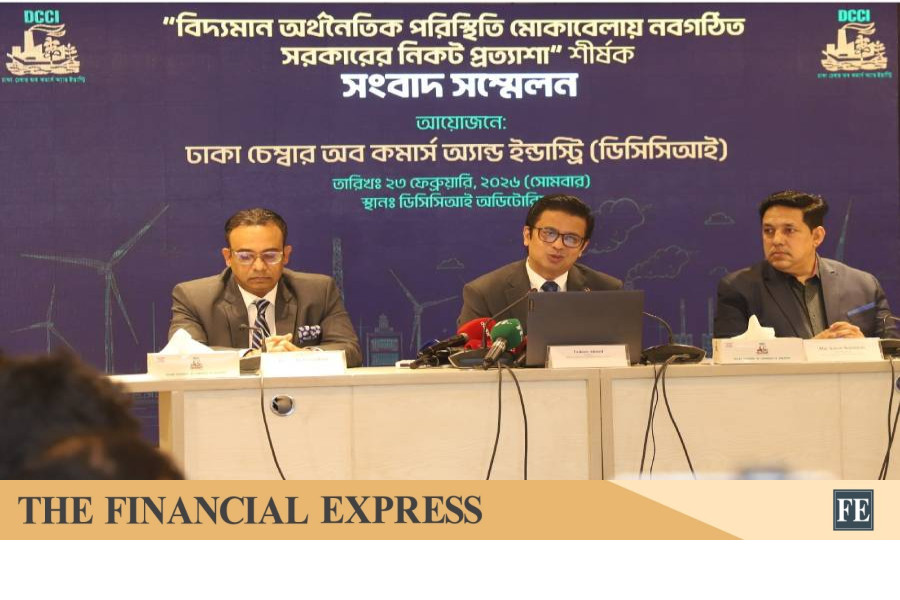
High bank lending rates, unstable law and order marked by extortion, energy uncertainty and lack of coordination in revenue management are proving ‘suicidal’ for the economy, President of the Dhaka Chamber of Commerce & Industry (DCCI) Taskeen Ahmed said on Monday.

Taskeen made the remarks at a press conference titled ‘Expectations from the New Government to Address the Current Economic Situation’ held at the DCCI auditorium in the city.

He said the unchanged policy rate has forced businesses to borrow from banks at 16–17 percent interest, creating mounting pressure on the private sector.

“The high volume of non-performing loans (NPLs) and the reduction of the loan classification period from nine months to three months have further destabilised the financial sector,” the DCCI president said.

“Industrial production is being hampered due to inadequate gas supply and the recent increase in gas prices for new industries and captive power plants by Tk 40 and Tk 42 per unit respectively,” he said, mentioning that both domestic demand and export targets are being missed as a result.

He warned that the absence of policy continuity in industrial regulations and an “unbearable” level of extortion have eroded investor confidence, affecting both local and foreign investments.

The DCCI president also pointed to structural weaknesses in the revenue management system, saying the lack of automation leads to harassment of compliant taxpayers while many remain outside the tax net, depriving the government of due revenue and slowing collection growth.

Taskeen said delays in land acquisition, high land prices, a 41 percent average increase in service charges by the Chattogram Port Authority and underutilisation of inland waterways have significantly raised the cost of doing business. “Rising production and distribution costs are also fuelling inflationary pressures.”

On Bangladesh’s graduation from the least developed country (LDC) status, Taskeen said estimates by the United Nations Conference on Trade and Development (UNCTAD) suggest exports could decline by 5.5–7 percent, equivalent to around $2.7 billion.

Given the current domestic and global economic uncertainties, such a setback would be highly undesirable, he said, urging the government to seek at least a three-year deferment of LDC graduation.

Referring to the recently signed agreement with the United States, he said it does not guarantee duty-free access for the ready-made garment sector, while conditions related to LNG and other imports may increase business costs.

Taskeen called on the government to renegotiate the terms with the US administration.

During the question-and-answer session, the DCCI president stressed the need for effective measures to curb extortion and improve law and order.

He noted that over two million educated youths remain unemployed, warning that prolonged joblessness could lead to social instability.

He emphasised strengthening skill development programmes, simplifying business procedures and ensuring easier access to bank loans, particularly for young entrepreneurs and startups.

DCCI Senior Vice President Razeev H Chowdhury, Vice President Md Salem Sulaiman and members of the Board of Directors were present at the event.​
 
Analyze

Analyze Post

Add your ideas here:
Highlight Cite Respond

NBR misses target by Tk 60,110 crore despite 13% growth

Star Business Report

1771893796460.webp


Revenue collection by the National Board of Revenue (NBR) grew 13 percent year-on-year to Tk 2.24 lakh crore in the July-January period of fiscal year 2025-26 (FY26), driven largely by strong VAT receipts from domestic trade and economic activity.

Yet, the country’s largest tax collector missed its target by 27 percent, a shortfall of Tk 60,110 crore, for the period, according to provisional data.

The immediate-past interim government in late November revised NBR's full-year revenue target to Tk 5.54 lakh crore after a strong first quarter, up from Tk 4.99 lakh crore.

To meet the full-year target, the board would need to collect Tk 3.30 lakh crore in just the remaining five months of the fiscal year, which economists say is an unrealistic goal.

Persistent inflation, sluggish implementation of development projects, and a broader economic slowdown make such a surge virtually impossible.

According to a paper by Towfiqul Islam Khan, additional director (research) at the Centre for Policy Dialogue (CPD), the total revenue shortfall for FY26 will exceed Tk 1 lakh crore, much like what was recorded in FY25.

“Bangladesh is now in a position where it cannot meet recurrent operating expenditure with domestic revenue mobilisation,” Khan said while presenting a paper at a Citizen's Platform for SDGs briefing last week.

He described the country as facing "diminishing fiscal space," with borrowing for debt repayment rising significantly and non-development expenditure squeezing policy room further.

“The budget for FY26 has also made some lofty fiscal framework targets,” he said.

Additional pressure is mounting from election-related costs and the need to inject capital into distressed financial institutions.

A recourse to bank borrowing reflects this tightening.

Net borrowing from the banking sector crossed Tk 48,800 crore by January 25, nearly five times the Tk 10,558 crore borrowed in nearly the same period a year earlier, according to Bangladesh Bank provisional data.

Within the July-January tax receipts, VAT (value-added tax) from domestic activity was the largest contributor at 38 percent of total collection, rising 16.45 percent year on year to Tk 85,769 crore.

Direct taxes -- income and corporate -- accounted for 33.5 percent, climbing 13 percent to Tk 75,055 crore. Import tariffs grew more modestly, up 8 percent to Tk 62,813 crore.

Overall receipts increased at a faster pace in the July-January period of FY26 than a year ago, when the tax administration logged only 2 percent growth.

Growth in January 2026, however, slowed sharply to just 3.21 percent compared to the same month last year.​
 
Analyze

Analyze Post

Add your ideas here:
Highlight Cite Respond

Micro and macroeconomic sustainability

FE
Published :
Feb 25, 2026 23:58
Updated :
Feb 25, 2026 23:58

1772065980241.webp


The outcome of the February 12 general election, according to the British-American Ratings agency Fitch Ratings, has assuaged to a large degree the growing political and policy uncertainties during the last leg of the interim government. A turnaround in the political arena marked by the Bangladesh Nationalist Party's (BNP's) landslide victory has offered an opportunity to pursue a sound policy based on healthy democratic norms leading to an economic recovery from its current sluggishness. Particularly, the macroeconomic dynamism can be restored if the advantage of political dividend can be wisely taken over to policy frameworks. The Fitch Ratings has emphasised the easing of near-term political uncertainties. Indeed, the new government will have to exploit the initial political bonhomie in order to plan for long-term economic stability and social benefits.

It is highly important that the achievement of short-term objectives will set the tone of the course this government will follow over the next five years. Macroeconomic stability is not all. Social justice and equitable distribution of wealth in order to bridging the yawning gap between and among social classes come next. The July Charter espouses narrowing the existing social disparities. Right now the introduction of the Family Card and the Farmers' Smart Card may be a timely government intervention but such injection of small doses of blood into an emaciated and fragile social body is not a permanent solution. There is a need for employment and reviving the manufacturing and productive sectors as much as possible. If an enabling environment can be created for small and medium enterprises, circulation of money at the grassroots level will augment. So the main task is to create opportunities for employment.

The Fitch Ratings rightly observes the political risks still in existence and warns of the danger if the economic crises and disparities are not carefully handled. Here comes the question of respecting the majority 'yes' verdict in the referendum held alongside the national election. It lists the negative aspects and challenges the new government is going to face shortly. Absence of prolonged investments, shrinkage of credits, weak governance, fragility in the banking sector, vulnerability in external liquidity and huge debt-servicing liability have to be addressed gradually in order to execute the government's macroeconomic and fiscal reform agenda. The reform agendas in various areas the interim government has collated courtesy of different reform commissions have to be carried on phase by phase in the interest of sustainable social and economic development.

Sure enough, not all recipes recommended by multilateral bodies for a nation's troubles are appropriate for countries like Bangladesh. For example, the graduation from least developed countries (LDCs) is a spicy subject but if it is not backed by commensurate domestic productivity and improvement in living standards, countries are sure to fall into the "middle-income trap". Let Bangladesh not fall into this trap. Blessed with a majority of working manpower resource, Bangladesh has failed to reap the demographic dividends. The potential awaits wise exploitation through well-planned systems. Experts in this area have long been raising their voice in favour of redesigning its education system up to class XII. Both micro- and macroeconomic sustainability will be achieved if radical reforms can be brought about on this human development front.​
 
Analyze

Analyze Post

Add your ideas here:
Highlight Cite Respond

Bangladesh's inflation puzzle

Syed Abul Basher
Published :
Feb 25, 2026 23:57
Updated :
Feb 25, 2026 23:57

1772066090391.webp

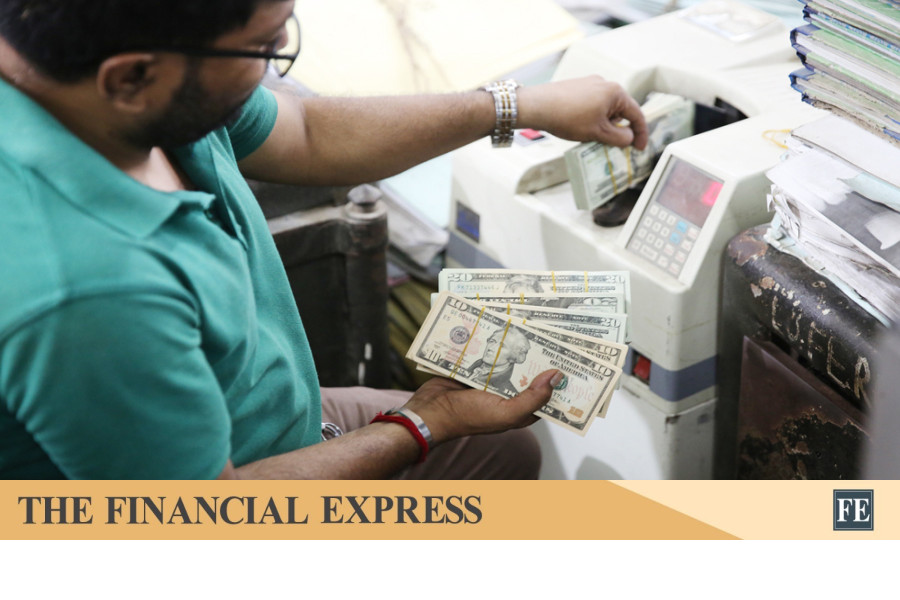
A teller is counting dollar bills at a bank branch in Dhaka. Exchange rate plays an important role to contain inflation —FE File Photo

A recent analysis by economist Dr Zahid Hussain in an English Daily (TBS, January 31, 2026) offers a useful perspective on Bangladesh's inflation dynamics. He argues that food inflation largely operates independently of monetary policy, yet contributes to persistence in headline inflation. He further suggests that monetary policy in Bangladesh works mainly through the exchange rate rather than domestic demand: credit expansion raises import demand, weakens the taka, and pushes up non-food prices. This reasoning is sensible as far as it goes.

But a question remains. The taka lost about 40 per cent of its value against the greenback between mid-2022 and late 2024-falling from roughly per US dollar at Tk 86 to Tk 122-and has since stabilised. If tight policy works by holding the exchange rate steady, and if the effects of past depreciation should have passed through by now, why is inflation still so persistent? It peaked at around 12 per cent but has only slowly eased to about 8.5 per cent. On 9 February 2026, Bangladesh Bank held the policy rate at 10 per cent for the fourth consecutive time, acknowledging that inflation remains above target. Either pass-through is much slower than standard models suggest, or something else is keeping prices elevated that the exchange-rate story alone cannot capture.

Research by the International Monetary Fund (IMF) and others shows that monetary transmission in developing economies depends heavily on central bank credibility. Bangladesh Bank has faced such challenges in recent years. Under the previous regime, interest rate caps distorted market signals, multiple exchange rates created confusion, and the central bank's independence was compromised. The current governor has moved to address some of these issues, but credibility takes time to rebuild. When businesses and households doubt that tight policy will last, they have less reason to change how they set prices. The scholarly literature on inflation expectations confirms this.

But even if credibility improves, a puzzle remains. Bangladesh Bank's own quarterly reports acknowledge that wage growth has consistently lagged inflation, meaning real incomes have been falling. If purchasing power is declining, how can demand-pull pressure sustain elevated prices? The textbook story says inflation should ease when consumers cannot afford higher prices. Yet food prices, which take up the largest share of household budgets, have stayed elevated even as real wages have fallen. Something other than excess demand seems to be at work.

One possibility is that inflation has become substantially detached from aggregate demand conditions-consistent with the emphasis on supply-side and structural factors. But this creates a tension in the policy framework. If food inflation is driven by market structure and supply chain dynamics rather than monetary conditions, then holding the policy rate at 10 per cent imposes real costs on credit-dependent sectors without doing much to moderate food prices. It is not obvious that the non-food channel alone justifies these costs.

The banking crisis makes matters worse. Non-performing loans (NPLs) have reached 36 per cent of total outstanding credit, the highest level in 25 years. Private sector credit growth has fallen to around 6 per cent, something not seen in decades. Many banks are effectively insolvent and cannot extend new loans regardless of the policy rate. Normally, when the central bank raises rates, borrowing becomes expensive and spending slows. But that logic breaks down when banks cannot lend in the first place. Credit is not flowing because banks are crippled, not because borrowers are put off by high interest rates.

This creates a curious situation. The policy rate stays at ten percent to combat inflation, yet it is the government, not the private sector, that is borrowing. Public sector credit is growing at over twenty percent compared with six percent for the private sector. And when Bangladesh Bank lends directly to the government, it pumps new money into the economy, potentially fueling the very inflation that tight policy is meant to control.

There is also an asymmetry in how prices respond to the exchange rate: when the taka weakens, prices rise quickly, but when it stabilizes, prices do not fall back as fast. This means households will keep feeling the pinch of high living costs even as measured inflation declines. Research from the Bank for International Settlements (BIS) finds that what people perceive as inflation tends to run ahead of official figures during such episodes, and this gap closes only slowly. In Bangladesh, where inflation has exceeded nine percent for over two years, even successful disinflation may leave people feeling that prices remain too high.

The recommendation to improve trade finance for essential food imports makes sense but goes only so far. Even if opening letters of credit were easier, private importers have been reluctant to bring in rice because it costs more to import than to buy domestically-once shipping, currency costs, and fees are factored in. Despite approval for over a million metric tons of rice imports, actual imports have been a small fraction of this. Domestic prices are high by historical standards, but not high enough to make importing worthwhile. This complicates the usual prescription that opening up imports will bring prices down. When imported rice costs more than local rice, liberalisation alone cannot provide the expected competitive pressure.

A related timing puzzle deserves attention. What we call persistent food inflation has occurred alongside several years of good harvests. Bangladesh has produced record rice crops recently, yet rice prices have continued to rise. Basic supply-and-demand logic offers no answer: why didn't record harvests bring prices down? The explanation points to market structure-powerful middlemen who can set prices, and weak competition-well documented in Bangladesh Bank's own studies of food markets. But once we accept this diagnosis, the policy question becomes uncomfortable. If monetary policy cannot fix food inflation, and if structural reforms require political will and institutional capacity that may be in short supply, what can monetary policy actually do?

This does not mean monetary policy is irrelevant, or that cutting interest rates would be wise. The exchange rate still matters, and loosening policy too quickly could weaken the currency and push prices up again. At the same time, the limits of tight policy need to be acknowledged. Higher interest rates carry real costs, and the channels through which they are supposed to work are badly impaired.

What is needed is better coordination across policies to keep inflation under control. Fiscal policy should rely less on borrowing from the banking system so that tight monetary policy is not quietly undone. Trade policy should make imports easier in practice, including by fixing exchange-rate margins that discourage them, so domestic prices face real competition. Banking reforms should focus on strengthening sound banks and closing those that no longer work, so credit policy can actually take effect. Competition policy should reduce rent-seeking in food markets, where prices often stay high because competition is too weak to push them down. None of these steps would work on their own, but together they would amount to a clear and consistent approach, rather than policies moving at cross-purposes.

The author is an economist and independent researcher.​
 
Analyze

Analyze Post

Add your ideas here:
Highlight Cite Respond

Members Online

No members online now.

Latest Posts

Back
 
G
O
 
H
O
M
E