New Tweets

[🇧🇩] Monitoring Bangladesh's Economy

G Bangladesh Defense
[🇧🇩] Monitoring Bangladesh's Economy
989
27K
More threads by Saif


Forex reserves cross $35b ahead of Eid
Central bank dollar purchases bolster buffers, bond yields ease


Siddique Islam
Published :
Feb 25, 2026 08:25
Updated :
Feb 25, 2026 08:47

1772066411539.webp


Bangladesh's gross foreign- exchange reserves surpassed the $35-billion mark on Tuesday, supported by sustained US dollar purchases by the central bank amid stronger remittance inflows ahead of Eid-ul-Fitr.

Officials said the interventions are aimed at stabilising the dollar-taka exchange rate while gradually rebuilding reserve buffers to meet global adequacy standards.

Reserves rose to $35.04 billion on Tuesday, up from $34.86 billion the previous day, according to the latest traditional calculation by Bangladesh Bank.

"We are working to increase the reserves to $36.50 billion after settling the Asian Clearing Union (ACU) payment obligation," a senior central banker told The Financial Express in response to a query.

He explained that reserves at $36.50 billion would allow the country to cover around six months of import payments, broadly in line with international benchmarks.

Over the past seven months, the central bank has purchased nearly $5.50 billion from banks to help maintain exchange rate stability and encourage exporters and remitters.

1772066447173.webp


As part of its ongoing intervention, the banking regulator bought a further $87 million from eight banks through an interbank spot market auction on Tuesday.

The amount was purchased under the Multiple Price Auction method at a cut-off rate of Tk 122.30 per dollar, officials said.

Earlier, on 22 February, the central bank had bought $123 million from eight banks in a similar auction.

Latest data show the central bank has purchased a total of $5.47 billion directly from banks since 13 July last year under the prevailing free-floating exchange rate arrangement.

"We are purchasing US dollars from banks to absorb higher remittance inflows ahead of Eid," another senior official said, explaining the market dynamics.

Inward remittances rose by nearly 24 per cent to $2.57 billion during February 1-23this year, compared with $2.08 billion in the same period last year.

Officials said such interventions have helped keep the dollar-taka exchange rate stable, thereby supporting export competitiveness and encouraging remittance inflows.

The continued purchases have also contributed to a gradual strengthening of the country's foreign exchange reserves.

Meanwhile, yields on long-term treasury bonds declined on Tuesday as banks channelled surplus liquidity into government securities amid subdued private sector credit demand.

The cut-off yield on 15-year Bangladesh Government Treasury Bonds (BGTBs) fell to 10.34 per cent from 10.55 per cent, while the yield on 20-year BGTBs dropped to 10.44 per cent from 10.67 per cent, according to auction results.

The government raised Tk 20 billion through the issuance of BGTBs to partially finance its budget deficit.

"Most banks are showing interest in investing excess liquidity in government securities, as private sector credit demand remains weak following the just-concluded national election," a central banker said.

Currently, five government bonds, with maturities of two, five, 10, 15 and 20 years, are traded in the market.

In addition, four treasury bills are auctioned to manage government borrowing from the banking system, with maturities of 14, 91, 182 and 364 days.​
 

Stabilised economy, but many reforms left unfinished

Economists credit departing governor Ahsan H Mansur with diagnosing financial ills, and tackling distressed assets, though long-term restructuring remains incomplete


Ahsan Habib

1772068914661.webp


When Ahsan Habib Mansur assumed office in the second week of August 2024 following a mass uprising, the financial reality was precarious.

Cheques of some banks were bouncing, many ATMs across the country were shuttered while others were awaiting routine cash supply, and the balance sheets of nearly a dozen banks were hollowed out.

Remittances and export receipts were lacklustre, commodity prices were on a wild ride, and the country had barely enough dollars to cover three months of essential imports.

By the time he left office yesterday and subsequently announced his abrupt resignation, the financial situation had somewhat stabilised, though many economic wounds were yet to be fully healed.

During his roughly 18-month tenure as the governor of the Bangladesh Bank (BB), Ahsan H Mansur, a former International Monetary Fund (IMF) economist, was able to diagnose the economy’s ills, but he could not complete his reform agenda, according to economists and top bankers.

When Mansur took charge, gross reserves were $25.92 billion, and reserves as per the BPM6 count were $15 billion. Understandably, foreign exchange management was a particular area of his focus.

Mansur worked to strengthen reserves while bringing a more market-based exchange rate, a condition linked to the ongoing loan package by the IMF.

By the time he stepped down, gross reserves had risen to $35.04 billion, while the amount was $30.3 billion as per the BPM6 count. And the exchange rate has stabilised at Tk 122.20 per dollar.

Controlling inflation was another priority. It was 10.49% in the month he took office. He pursued a tight monetary policy and raised the policy rate to 10 percent swiftly after assuming office.

However, the former governor had to inject funds into ailing banks to protect depositors.

Inflation fell to 8.58 percent by January 2026, though supply-side constraints meant the decline fell short of expectations.

The banking sector presented a deeper challenge. Around a dozen of banks were sinking under heavy non-performing loans, while non-bank financial institutions were refusing to return deposits. Many bank boards were heavily influenced by politically affiliated figures.

Many bank directors reportedly fled the country with huge funds. Mansur responded with forensic audits to determine the real health of the sector and initiated reforms, though deep restructuring remained incomplete.

As long-buried toxic loans surfaced, the volume of non-performing loans (NPL) reached Tk 6.44 lakh crore in September last year from Tk 2.11 lakh crore in June 2024.

As part of his financial mess cleanup agenda, the former governor oversaw the merger of five ailing shariah-based banks, enacted the Bank Resolution Ordinance and the Deposit Insurance Ordinance. He also pushed for amendments to the Bangladesh Bank Order and the Bank Company Act, though those got stuck at the finance ministry.

While his public warnings on bank weaknesses initially spooked depositors, the measures ultimately strengthened transparency and governance.

Mustafa K. Mujeri, former director general of BIDS and ex-chief economist at the Bangladesh Bank, said, “When Mansur assumed office, it was a challenging time as the whole financial sector was on the edge of a cliff.”

“The sector had been looted. Mansur had to spend considerable time uncovering the true state of affairs,” he added.

Fahmida Khatun, executive director at local think tank Centre for Policy Dialogue (CPD), echoed similar views.

She said Mansur inherited a fragile banking sector with many banks burdened by massive non-performing loans. Bangladesh Bank had functioned largely as an implementing agency of the government, and the sector’s true health had been disguised.

“He had to run forensic audits to review asset quality and find the real health of the banking sector,” she said.

Mustafizur Rahman, distinguished fellow at CPD, said that the outgoing BB governor made serious efforts to reform the banking sector and restore discipline during a critical period for the economy.

“His initiatives included restructuring bank boards, promoting mergers among weak institutions, setting up an asset recovery company for distressed assets and curbing illicit financial outflows, although some changes were not fully endorsed by the interim government.”

Rahman described these steps as essential not only for immediate stability but for laying the foundation for long-term governance in the sector.

Speaking on condition of anonymity, a former senior banker said Mansur demonstrated “earnest dedication and great sincerity” in his duties.

He described the former BB governor as an accomplished economist who stabilised fragile macroeconomic indicators amid post-Covid pressures, fallout of Russia-Ukraine war, and volatile global commodity prices.

“From a very dire situation, Mansur improved foreign exchange reserves and helped stabilise the taka-US dollar exchange rate,” the banker said. He added that Mansur also managed overdue petroleum and gas import liabilities and cleared remittance backlogs for airlines and shipping firms.​
 

Economic priorities the new government should focus on
26 February 2026, 00:31 AM
Sayema Haque Bidisha

1772154874720.webp

VISUAL: SALMAN SAKIB SHAHRYAR

The newly elected BNP government has inherited an economy with diverse challenges. The crises of persistent inflationary pressure, sluggish private investment, and unemployment needs to be dealt with simultaneously, with careful policy planning. In addition to such macro challenges, the country’s long-standing struggle with domestic resource mobilisation is another area for which policy emphasis is mandatory. Stabilising the economy against these challenges should, therefore, be the new government’s top priority.

In the aftermath of the July uprising in 2024, the hardest economic challenge faced by the interim government was taming the double digit inflation, which escalated to as high as 11.66 percent in July 2024. By employing contractionary monetary and fiscal policies, the almost uncontrollable trend of inflation was brought down within the range of eight to nine percent, with the Bangladesh Bureau of Statistics data of January 2026 showing point-to-point inflation at 8.58 percent (food inflation at 8.29 percent and non-food inflation as 8.81 percent). However, it should be noted that, with a slump in private investment and employment generation, monetary and fiscal instruments previously used to curb inflation no longer appear to be sustainable policy tools.

The newly elected government should, therefore, opt for a balanced mixture of monetary instruments and efficient market management. The latter means ensuring a competitive environment in the market and constraining non-competitive and collusive behaviour and hoarding practices. Additionally, ensuring the availability of demand and supply data, effective coordination among relevant authorities/ministries, reducing time lag of imports at ports, and the overall efficient management of supply chain should be considered.

From the economic management point of view, sluggish private sector investment stands as a major challenge, resulting in low GDP growth and job creation. The private sector credit growth plummeted to as low as 6.49 percent in 2024-25, according to the Bangladesh Bank. This has been caused by a wide range of factors, including infrastructural bottlenecks, high interest cost of borrowing, and high cost of doing business. The slowed pace of private sector investment correlates to sluggish industrialisation, which is argued to be linked with political uncertainty in the absence of an elected government. The new government should, therefore, prioritise ensuring stability in its policy design and a private sector-friendly environment.

An often overlooked yet fundamental economical challenge is persistent unemployment and low absorptive capacity of the economy. A fall in public and private sector investment, caused by contractionary policies, has arguably led to lack of job creation in recent years. The demand side story is, however, more complex: data of the employment elasticity of growth, which measures the pace of employment generation in relation to the growth of an economy, reveals low elasticity for the economy as a whole (0.34) with negative elasticity in the manufacturing sector (-0.05) from 2016-17 to 2022. On the other hand, there is a large youth population in the country who are unemployed (youth unemployment rate 8.07 percent) and a high prevalence of NEET (youth not in education, employment or training at 20.3 percent). Another important factor in the context of the labour market is a relatively high unemployment rate among those with tertiary education—13.54 percent, with the national rate being 3.66 percent, according to the Labour Force Survey 2024.

To tackle this, the new government needs to adopt a wide range of strategies primarily focusing on expanding the Cottage, Small and Medium Enterprises (CSME) sector by supplying credit at flexible rates and terms and conditions, establishing a strong linkage with the market, and strategising favourable policies for the sector as a whole. In addition, it must emphasise boosting up private investment and large-scale industrialisation, policies facilitating industry-academia collaboration to deal with skill mismatches, establishing start-up funds for young entrepreneurs and freelancers, and concentrating on modernising technical and vocational education.

Besides the macro challenges, a major concern for economic management in Bangladesh is persistently low domestic resource mobilisation. The tax-GDP ratio is argued to be one of the lowest in the world (less than seven percent in FY2024-25). Such a poor state of revenue mobilisation acts as an impediment towards government spending in critical sectors, i.e. education, healthcare, and safety net. Improving domestic resource mobilisation goals through suitable instruments while maintaining the inflation and inequality levels is crucial. To this end, greater emphasis should be given on direct taxation with digitalisation of the tax structure. Bringing all potential taxpayers into the tax bracket will be a complex task; the government must put all its efforts into achieving that.

In addition to these challenges, it must be noted that, despite successes in poverty reduction between 2010 and 2022, the pace has slowed down after 2016 and around one-third of the population are found to be at risk of falling below the poverty line (World Bank, 2025). This notion appears to be consistent with some recent estimates, which indicate a reversal of the poverty reduction trend. These statistics should be carefully considered, especially keeping in mind the challenges following the LDC graduation. Timely attention is needed not only to reduce reduction, but also to shrink inequality. Income inequality has increased over time, with the richest decile of the population holding 40.92 percent of income, according to the Household Income and Expenditure Survey 2022. Against this backdrop, generating productive employment, revitalising rural economy, increased and transparent allocation for social safety net programmes, and a progressive and equitable tax structure must be prioritised.

Having come to power through a landslide victory in the February 12 election, the BNP government should set its initial economic priorities by focusing on containing inflation, accelerating private sector investment, generating decent and productive employment, and mobilising domestic resources to attain the development goals. Strong political commitment as well as efficient and timely policy direction and resource mobilisation can accomplish such daunting tasks, thereby ensuring inclusive development for the entire population.

Dr Sayema Haque Bidisha is pro-vice chancellor and professor in the Department of Economics at the University of Dhaka.​
 

Local and foreign investment vital for jobs, economic transition, says finance minister

bdnews24.com
Published :
Feb 27, 2026 20:03
Updated :
Feb 27, 2026 20:03

1772238239828.webp


Finance and Planning Minister Amir Khosru Mahmud Chowdhury has stressed the importance of domestic and foreign investment for Bangladesh’s economic recovery.

Speaking on Friday during a visit to a proposed hospital site at Patenga Marine Drive in Chattogram, he said boosting investment is “essential” for increasing employment.

“The priority is to raise tax revenue, and the only way to do that is through higher investment, both inside and outside the country,” he said. “Employment is another key programme. In the BNP’s election manifesto, employment is a major focus.

“Without investment, where will jobs come from? That is why we are emphasising investment. Domestic and foreign investment is our focus.”

“Once again, I say employment is our priority,” he added.

When asked about priorities for the next national budget, Khosru said: “We will start with employment. Everything needed to achieve this will be done.”

The minister also said the government plans to increase investment in the health sector. “The initiative to build a hospital at Patenga Marine Drive is timely. The government has been working steadily to improve Chattogram’s medical infrastructure.”

“A large hospital will be built. Alongside it, there will be a nursing institute and another institute for technologists. This has long been a demand of people in this part of Chattogram. We are looking at land, and it requires a sizeable area,” he said.

He added that a few more potential sites are being considered to ensure suitability, and the government wants to move ahead with the hospital project as quickly as possible.​
 

BD ECONOMIC DYNAMICS IN OXFORD INDICES
GDP growth may be 4.5pc this fiscal year
Growth to increase in FY27 to 5.7pc, agency predicts

Jasim Uddin Haroon
Published :
Feb 27, 2026 08:55
Updated :
Feb 27, 2026 08:55

1772239116002.webp


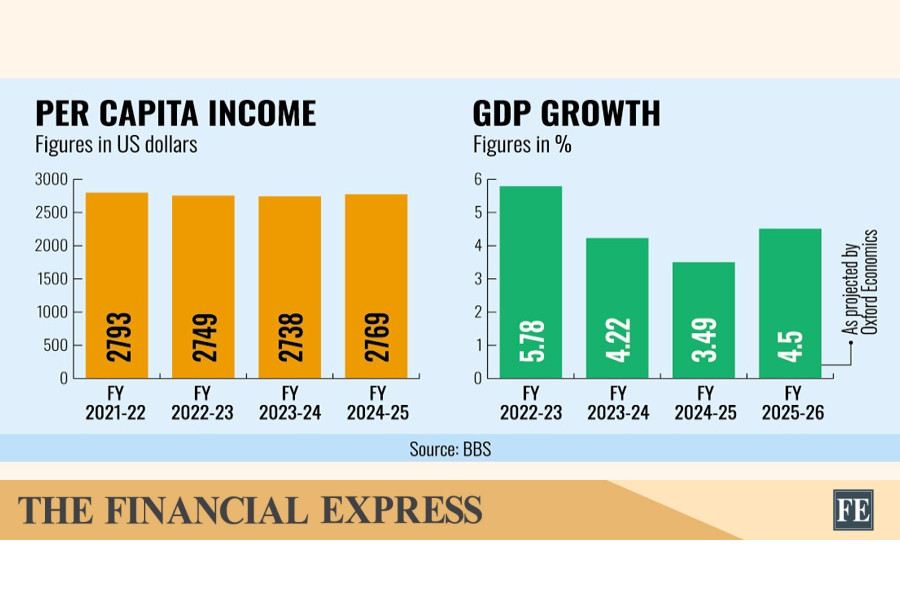
Bangladesh's economy is expected to grow by 4.5 per cent this fiscal year, a little below earlier projections by Oxford Economics, as it believes the second-quarter growth ending December slowed alongside poor export growth in key markets.

However, the growth in fiscal year 2025-26 picks up above 3.49-percent mark determined for the past fiscal year by final official count.

Founded in 1981, Oxford Economics is a global economic advisory firm providing forecasting and analytical services covering more than 200 countries and a wide range of industries and cities.

"We've downgraded our GDP-growth forecast for Bangladesh to 4.5 per cent in FY2025-26 from 4.7 per cent previously," it said Thursday.

The agency predicts activity should continue to recover in FY2026-27, albeit at a relatively moderate pace of 5.7 per cent year on year.

Following a slowdown in FY2024-25, economic momentum improved temporarily in the third quarter of 2025, supported by stronger activity in manufacturing and construction.

However, it says trade data indicate a renewed loss of momentum in the fourth quarter ending December, with goods exports to the United States and Germany falling by 4.1 per cent and 12.8 per cent year on year, respectively.

Inflation remained stubbornly high, with price pressures intensifying since October despite the fact the central bank has been pursuing a tight monetary stance.

Consumer prices rose 8.6 per cent year on year in January.

"Although wage growth remained broadly stable at around 8.0 per cent, stronger remittance inflows provided some support to household incomes."

The Oxford Economics says February's general election, which delivered a decisive victory for the Bangladesh Nationalist Party (BNP), along with the passage of a constitutional reform referendum, could support business confidence.

The firm expects the new administration to maintain its reform agenda through continued engagement with the International Monetary Fund.

"A peaceful transition of power and policy continuity are expected to provide near-term support to economic sentiment," says Oxford Economics report.

However, the outlook for consumer spending remains uneven as wage increases continue to lag behind inflation, eroding real incomes.

Private investment is also likely to remain constrained by restrictive monetary policy.

Bangladesh Bank has kept policy rates unchanged, maintaining a tight stance aimed at containing inflation and rebuilding foreign-exchange reserves.

The restrictive policy environment has helped stabilise reserves, which have risen to about $30 billion, from roughly $17 billion in 2024, marking progress under the IMF-supported reform programme.

The central bank has indicated that inflation needs to fall below 7.0 per cent before policy easing can be considered.

External risks remain significant.

While lower US tariffs could support exports in the near term, the gradual erosion of trade preferences associated with Bangladesh's graduation from least-developed-country status poses a challenge to medium-term export prospects.

Some export orders may be front-loaded ahead of the transition.

Meanwhile, the country's economy expanded by 3.49 per cent in fiscal year 2024-25, as tight monetary policy and restrained government spending weighed on activity, while inflationary pressures remained elevated, says Bangladesh Bureau of Statistics (BBS).

According to final estimates released Thursday by the statistical bureau, gross domestic product (GDP ) reached US$456 billion, with growth slowing from 4.22 per cent in FY2023-24 and falling short of the provisional estimate of 3.97 per cent.

The weak performance followed an unprecedented mass uprising in July-August 2024 that disrupted economic activity and forced the temporary closure of many factories during the fiscal year.

Sluggish consumer demand and subdued private investment also damped growth, reflecting persistently high inflation and prolonged political uncertainty during the period under review.

"The disappointing end to the year largely reflected a self-inflicted drag from consumption and investment following higher inflation and political uncertainty," says Dr Zahid Hussain, an independent economist, about the deceleration reasons.

He adds that the contraction in public spending is expected to reverse by FY2027 as political uncertainty has been eased following polls just held this month.

The slowdown in output occurred alongside continued price pressures.

External projections had been more optimistic.

Global agency S&P Global Ratings forecast growth of 3.97 per cent for the year, while Moody's had projected around 4.5 per cent before revising its outlook downward.

Sectoral data show uneven performance across the economy.

Agricultural output expanded by 2.82 per cent, up 0.63-percentage points from a year earlier.

Industrial growth slowed to 3.35 per cent, down 0.63-percentage points, while the services sector contracted by 4.35 per cent, 0.16-percentage points lower than in the previous year.

Expenditure-based measures indicate weakening macroeconomic fundamentals.

The three main components of GDP -- investment, domestic savings and national savings -- all declined compared to the previous fiscal year.

Total investment fell to 28.54 per cent of GDP, from 30.70 per cent a year earlier.

Domestic savings declined to 21.98 per cent, from 23.96 per cent, while national savings, which include remittance income, dropped to 27.67 per cent from 28.42 per cent despite the fact that after the August 05, 2024 uprising the remittances were robust.

Per-capita income under the final estimate stood at $2,769, reflecting the slower pace of economic expansion.​
 

Compliance shock for Bangladesh’s exports

THE era of securing global market access through cheap labour and aggressive pricing is drawing to a close. International trade is entering a structural phase in which competitiveness is increasingly measured not only by unit cost, but by the carbon footprint embedded in production. For Bangladesh, an economy structurally tied to export-led growth, the message from major consumer markets is clear: environmental compliance is fast becoming a condition of market access.Bangladesh travel guide

At the centre of this shift is the European Union’s Carbon Border Adjustment Mechanism. Framed as a tool to prevent ‘carbon leakage,’ where industries relocate to jurisdictions with weaker environmental rules to avoid domestic carbon costs, the Carbon Border Adjustment Mechanism operates, in effect, as a carbon-pricing filtre on imports. The mechanism is designed to ensure that goods entering the EU face carbon-cost realities comparable to those faced by producers within Europe.

The initial sectoral coverage of the Carbon Border Adjustment Mechanism is narrow — iron and steel, cement, fertilisers, aluminium and other carbon-intensive products. This narrowness has encouraged a potentially costly complacency in some policy-making circles in Dhaka: the assumption that Bangladesh, as an apparel-dominant exporter, is insulated for now. That assumption ignores how supply chains respond. Procurement standards often shift faster than statutory timelines. With close to 60 per cent of Bangladesh’s exports destined for Europe, and with the country set for LDC graduation and a consequential GSP+ transition, the compliance spillovers will not remain confined to the sectors listed in the first phase of the Carbon Border Adjustment Mechanism.Geographic Reference

A key reason is the rapid expansion of corporate climate disclosure expectations. European brands and retailers are increasingly tracking Scope 3 emissions — the upstream and downstream emissions across a firm’s value chain. In practice, this means buyers will increasingly ask not only about factory-level electricity use, but also about the energy sources that power the mills, the chemical inputs, the logistics chain and the broader production ecosystem that feeds the final shipment. Even where a product is not directly covered by the Carbon Border Adjustment Mechanism at first, procurement logic can still penalise suppliers who cannot provide credible, verifiable emissions data.

From a geopolitical standpoint, many developing countries view carbon border measures as a refined form of green protectionism — new trade barriers justified through climate imperatives. The paradox is hard to ignore. Countries like Bangladesh, among the most climate-vulnerable, have contributed a negligible share of historical emissions, yet are now expected to absorb new compliance costs created largely by the industrial histories of the global north. The argument for climate justice is strong. But markets do not adjudicate historical responsibility; they price present-day risk. European regulators, investors and consumers increasingly demand verifiable proof of sustainability. In this architecture, compliance risk quickly becomes commercial risk — and commercial risk can translate into lost orders.

Bangladesh’s most serious vulnerability in this emerging regime is a data deficit. Carbon compliance is, fundamentally, a measurement problem. Under Carbon Border Adjustment Mechanism-shaped expectations, exporters must be able to map emissions across production stages with credible accounting and third-party verification. This requires a robust, internationally recognised measurement, reporting and verification system — one that is interoperable, auditable and aligned with prevailing standards.

At present, Bangladesh lacks a centralised, integrated emissions data architecture that can credibly serve export-facing industries. Institutions operate in silos: the commerce ministry, the environment department, energy-related agencies and the National Board of Revenue do not consistently function under a unified data strategy. If exporters cannot produce reliable, sensor-backed energy and emissions data, European authorities and buyers may fall back on ‘default values’ — standardised carbon assumptions that can be punitive relative to actual performance. This is not a technical inconvenience; it can become a pricing disadvantage, particularly against competitors that are upgrading data systems and verification capacity more aggressively.Bangladesh travel guide

In this context, a measurement, reporting and verification system is not administrative paperwork; it is economic leverage. A supplier that can document emissions precisely becomes a lower-risk supplier. In today’s procurement environment, lower risk is increasingly valued over lower cost.

A second constraint sits in Bangladesh’s financial architecture. Decarbonising manufacturing requires capital: upgrading legacy machinery, adopting energy-efficient technologies, improving water and waste management and investing in renewable integration. Yet green finance often remains more rhetorical than operational. Where green financing windows exist, many are constrained by complex processes and collateral requirements that make them inaccessible to the very segment most exposed to transition risk: small and medium enterprises. If small and medium enterprises fail to access transition finance, the broader export ecosystem, especially backward linkages that support apparel, faces systemic fragility.

Financial institutions, therefore, need to pivot from conservative, compliance-only postures to strategic partnership models. The central bank can play a catalytic role by enabling blended finance instruments, strengthening credit-guarantee mechanisms for SME transition and encouraging performance-linked credit products that reward verified emissions reductions. Without such financial plumbing, de-carbonisation remains a mandate without a pathway.

Energy structure is the third binding constraint. Factory-level efficiency improvements have limited impact if the national power mix remains heavily fossil-dependent. A ‘green’ factory powered by high-carbon electricity will still produce a carbon-intensive product. This is why energy policy and export strategy are inseparable. Rooftop solar in industrial zones, energy-efficiency enforcement and grid-integration reforms are no longer peripheral environmental objectives; they are macro-competitiveness imperatives.

Externally, Bangladesh’s climate diplomacy must also become more policy-specific. It is not enough to restate vulnerability at global summits. Dhaka should pursue structured engagements with the European Union around technology transfer, measurement, reporting and verification system capacity-building and transition finance linked to compliance realities. European supply chains depend heavily on sourcing hubs like Bangladesh. Stabilising those supply chains in a carbon-accountable world requires practical investment in the greening of production bases — not symbolic commitments.

The global trade order is being rewritten along environmental lines. Bangladesh cannot afford policy drift or bureaucratic inertia. A credible green export strategy — anchored in measurement, reporting and verification capability, scalable green finance, cleaner energy integration and targeted economic diplomacy — is the most viable route to mitigate an approaching compliance shock.Geographic Reference

Three interventions are particularly urgent: the establishment a centralised, internationally credible measurement, reporting and verification framework that integrates export-facing emissions data with energy and customs-related reporting; ensuring green finance becomes accessible transition capital for SMEs through workable credit products and risk-sharing instruments; and accelerating industrial rooftop solar and energy-efficiency upgrades through targeted fiscal incentives and streamlined grid integration.

The metric of trade success is changing. The decisive question is not only how much Bangladesh exports, but how credibly it can document the carbon embedded in what it exports. In a carbon-accountable marketplace, competitiveness will increasingly be won by those who can measure, verify and reduce emissions with transparency.

Md Imdadul Haque Sohag is a geopolitical and policy analyst.​
 

Members Online

Latest Posts

Back
PKDefense - Recommended Toggle