New Tweets

[🇧🇩] Earthquake in Myanmar----Lessons for Bangladesh

G Bangladesh Defense
[🇧🇩] Earthquake in Myanmar----Lessons for Bangladesh
36
860
More threads by Saif


Dhaka jolted by early morning earthquake

1764812002404.webp


An earthquake shook Dhaka and surrounding areas at 6.15am this morning.

According to Indian Center for Seismology, the tremor had a 4.1 magnitude on Richter Scale. The epicenter of the quake was Narsingdi. USGS was yet to report on it.

Bangladesh faces a high risk of major earthquakes due to its location along three active tectonic plate faults, experts warned recently following major tremors, stressing that preparedness, public awareness and modern technology are crucial to reducing casualties and damage.​
 

Bangladesh shaken again as 5.9 magnitude quake hits near Myanmar border

bdnews24.com
Published :
Feb 03, 2026 22:45
Updated :
Feb 03, 2026 22:45

1770165880306.webp


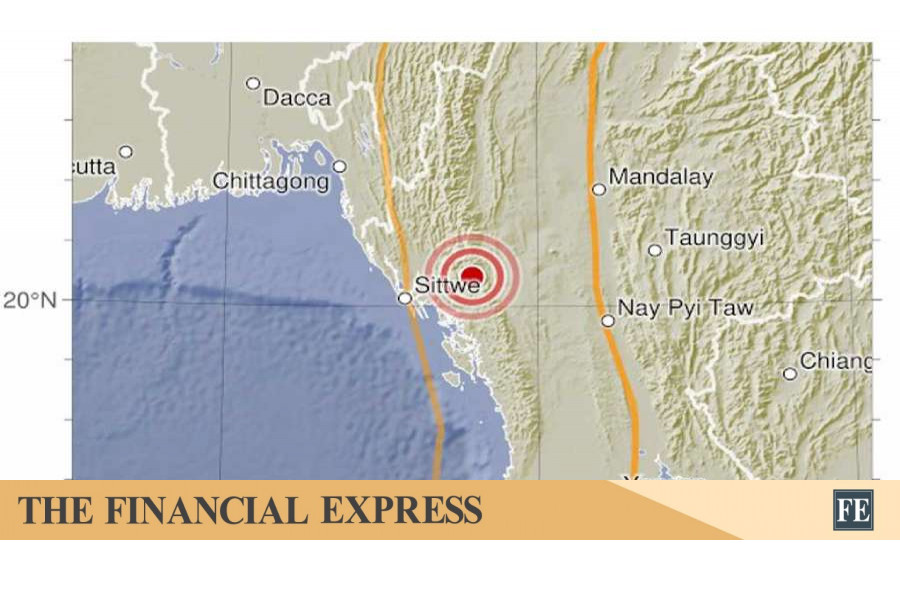
Bangladesh has experienced its second earthquake in a single day, this time originating near the Myanmar border.

According to GFZ Earthquake Explorer, the tremor struck at 9:34pm Bangladesh time with a magnitude of 5.9 on the Richter scale.

No immediate reports of casualties or damage have emerged.

This follows an earlier tremor in the day.​
 

Magnitude 5.1 earthquake in Myanmar shakes Bangladesh

bdnews24.com
Published :
Feb 26, 2026 00:20
Updated :
Feb 26, 2026 00:20

1772065770296.webp


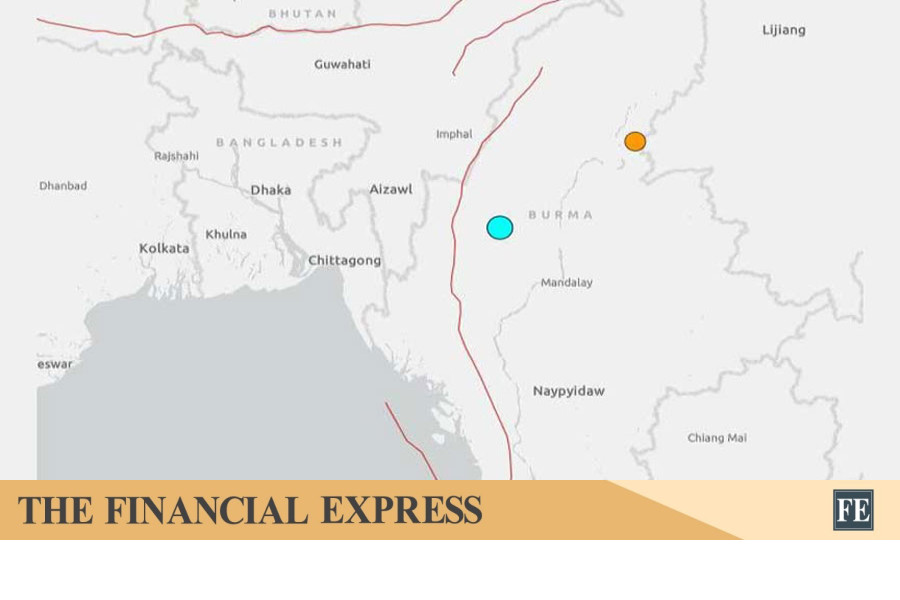
A magnitude 5.1 earthquake in Myanmar have shaken Dhaka and several other parts of Bangladesh.

The tremor struck at 10:51pm on Wednesday, according to the Bangladesh Meteorological Department’s earthquake monitoring centre.

Assistant Meteorologist Farzana Sultana said the epicentre was in Myanmar, 462 kilometres from the Agargaon Met Office in Dhaka.

The US Geological Survey (USGS) also recorded the quake at magnitude 5.1, with its origin 129 kilometres below the surface.

No immediate reports of damage or casualties were available.​
 

Earthquake: Satkhira resident says building ‘swayed like a tree branch’

Staff Correspondent
Dhaka
Published: 27 Feb 2026, 16: 43

1772240022320.webp

Bangladesh Meteorological Department (BMD) reported Asshashuni Upazila of Satkhira to be the epicentre. USGS

Mrityunjoy Roy, a resident of Satkhira Sadar upazila, has described his frightening experience during the earthquake that was felt in different parts of the country including Dhaka at 1:52:29 pm today, Friday.

According to the Bangladesh Meteorological Department (BMD), the epicentre of the earthquake was in Ashashuni Upazila of Satkhira. The earthquake measured 5.4 on the Richter scale and was of moderate intensity.

Speaking to Prothom Alo over the phone, Mrityunjoy Roy, who is a journalist by profession, said he was lying on his bed when the quake struck. Suddenly, he felt the entire bed shaking.

“I wondered what was happening. Then I rushed outside shouting,” he said.

Mrityunjoy added that it felt as though the five-storey building was swaying from side to side. The strong tremor made it seem as if the building was moving the way tree branches sway back and forth during a storm.

According to a report by media outlet Anandabazar Online, tremors were also felt in Kolkata and other districts of West Bengal in India, where the magnitude was recorded at 5 on the Richter scale.​
 

Earthquake contingency plans must be foolproof

RECURRING earthquakes of varying magnitudes require the government to revisit its preparedness and mitigation plans. A 5.4-magnitude earthquake, originating in Satkhira, was felt on February 27. With the latest event, there were nine earthquakes in February, two of which had the epicentre in Satkhira. The Department of Meteorology says that 32 earthquakes have occurred in the country and in neighbouring areas since mid-February 2025. In November 2025, at least 10 people, including two children, died and several hundred became injured after a 5.7-magnitude earthquake struck Dhaka and surrounding districts. The worrying issue is that the frequency of earthquakes has recently increased. Earthquakes have, in particular, risen in Bangladesh’s south-west, traditionally considered a low-risk area. Experts have differing views on the cause of the earthquake. While some believe that the earthquake in Satkhira was an aftershock of the Narsingdi earthquake, others think that it resulted from the south-west, being subjected to opposing tensile forces between the two tectonic plates at the eastern and western edges of Bangladesh. At this time of heightened risk, the government should urgently focus on strengthening earthquake resilience.

Bangladesh, with major seismic activities in the region, is considered an earthquake-prone region because of its location at the junction of the Indian, Eurasian and Burmese plates. An earlier survey of Rajdhani Unnayan Kartripakkha estimated that around 865,000 buildings could collapse in an earthquake of a magnitude of 6.9 originating in the fault line in Tangail. In March 2025, the Fire Service and Civil Defence issued an official alert identifying Dhaka, Chattogram, Mymensingh and Sylhet as high-risk regions and urged all concerned to take a nine-point measure that included constructing earthquake-resistant buildings, strengthening vulnerable buildings, ensuring proper maintenance of gas, water and electric lines and improving public awareness and skills in earthquake prevention and response. Bangladesh has an earthquake contingency plan, but its implementation is uncertain. The awareness programmes are irregular. Efforts to reduce long-term risks through measures such as strengthening building codes and improving land-use planning barely exist. The government’s plan also appears ineffective given the way it has responded to recent injuries and fatalities from the earthquake, especially the one in Narsingdi.

It is almost impossible to predict when a major earthquake will occur. This means that the government must have a system that is ready to respond any time. The primary emphasis should be given to extensive awareness and practical training. This includes regular drills in all public and private establishments, retrofitting risky buildings, enforcing earthquake safety technologies in new buildings and implementing the government’s guidelines on how to deal with the aftermath of an earthquake. The government must build capacity for prompt response, rescue and evacuation operations and treatment facilities in hospitals.​
 

Members Online

Latest Posts

Back
PKDefense - Recommended Toggle