| Global Defense, OSINT & Geopolitics Wire

[🇧🇩] Monitoring Bangladesh's Economy

[🇧🇩] Monitoring Bangladesh's Economy
1K
57K
More threads by Saif

G Bangladesh Defense

Taka gains as dollar demand softens on US-Iran truce

Star Business Report

1775697323709.webp


The taka edged up against the US dollar yesterday, buoyed by a two-week ceasefire between the United States and Iran that eased pressure on the foreign exchange market.

The weighted average exchange rate stood at Tk 122.75 per dollar, down from Tk 122.84 the previous day, according to Bangladesh Bank (BB) data.

A senior treasury official at a private commercial bank said the market turned volatile in recent weeks as importers rushed to buy dollars amid fears of a prolonged war. That anxiety appears to have subsided following the ceasefire.

When importers scramble for forward buying, rates tend to climb. As tensions cool, demand for forward trading of US dollars is expected to ease, he said.

Forward buying means agreeing today to purchase dollars at a fixed rate on a future date. Forward trading refers to buying or selling dollars now at a pre-agreed rate for delivery later, usually to hedge against exchange rate swings.

In its Bangladesh Bank Quarterly published yesterday, the central bank, however, cautioned that the economy remains exposed to external oil price shocks and currency depreciation.

“A sharp increase in global oil prices, particularly when combined with exchange rate depreciation, could exert significant upward pressure on inflation and lead to a decline in foreign exchange reserves,” it said.

The BB report said that allowing some exchange rate flexibility could help ease pressure on reserves. At the same time, balancing fiscal costs and inflationary pressures may require a partial adjustment to global oil prices.

“Rising geopolitical tensions -- particularly the Iran-Israel-USA conflict -- have already disrupted global energy and food supply chains and may exert additional pressure on both the external balance and domestic inflation. These developments pose near-term risks to price stability, export demand, and import costs,” said the report.

Mirza Elias Uddin Ahmed, managing director of Jamuna Bank, told The Daily Star that Bangladesh’s external position has not fundamentally weakened, although panic driven demand had unsettled the market.

The country’s gross foreign exchange reserves stand at about $34.35 billion, which the central bank described as a strong buffer for external trade payments. Usable reserves were $29.81 billion on April 2, enough to cover more than five months of imports.

The BB report said the central bank has maintained monetary tightening in response to stubbornly high inflation.

“However, inflation remains above the comfort threshold, disproportionately affecting low- and middle-income households,” it said, adding that the government and the central bank have taken several steps to rein in price pressures.

The BB has withdrawn LC margin requirements for imports of essential commodities, including rice, onions, dates, sugar, pulses and edible oil, it added.

Alongside truck sales by the Trading Corporation of Bangladesh (TCB), relevant agencies are working to curb hoarding, syndication and other illegal practices to ease supply bottlenecks.

On money and credit markets, the report said the near-term outlook depends on striking a balance between maintaining adequate liquidity, containing inflation and reviving private sector credit growth.

It said that public sector credit is likely to remain the main driver of overall credit expansion in the short term, potentially crowding out private investment and complicating efforts to sustain growth.

“A recovery in private-sector credit will depend on further moderation of lending rates, improved investor confidence, and greater political stability,” said the BB.​
 

The worrying contraction of manufacturing sector

FE
Published :
Apr 10, 2026 00:24
Updated :
Apr 10, 2026 00:24

1775780776209.webp


Bangladesh's manufacturing sector appears to be undergoing a structural shift -- one that raises concerns about the country's long-term industrial trajectory. The recently released Economic Census report highlights a complex transformation in the economy, marked by rapid expansion in the number of economic units but a noticeable decline in the relative importance of manufacturing. This divergence signals deeper structural challenges that warrant urgent attention. According to the report, the total number of economic units has surged to over 11.7 million, up significantly from 7.82 million in 2013. At first glance, this growth suggests a vibrant and expanding economy. However, a closer look reveals a less encouraging trend: the share of manufacturing has fallen from 11.1 per cent in 2013 to 9.57 per cent in 2024. This contraction indicates that while more businesses are being created, fewer are engaged in manufacturing -- traditionally a key driver of productivity, exports, and employment. Interestingly, despite the decline in its share of total economic units, manufacturing has managed to maintain -- and slightly increase -- its share of employment. This suggests that existing manufacturing enterprises may be absorbing more labour, even as the sector fails to attract a proportionate number of new firms. Nevertheless, manufacturing now ranks only as the fourth-largest category in terms of economic units, far behind wholesale and retail trade (40.19 per cent), transportation and storage (22.22 per cent), and other service activities (10.31 per cent).

The underlying reasons for this shift are not difficult to identify. The census paints a stark picture of the challenges faced by businesses, particularly in the manufacturing sector. A staggering 85.89 per cent of economic units report insufficient access to capital as their most significant constraint. Compounding the problem, 34.42 per cent of enterprises cite difficulties in obtaining loans from formal financial institutions, pointing to persistent inefficiencies in the credit delivery system. Beyond financing, businesses grapple with a host of operational challenges. Infrastructure deficiencies, rising production costs, dearth of skilled labour, and unreliable electricity and fuel supplies further undermine competitiveness. These barriers collectively discourage investment in manufacturing, which is typically more capital-intensive and risk-prone than service-oriented activities.

At the same time, the service sector continues to dominate the economic landscape, accounting for over 90 per cent of all economic units. The industrial sector, by contrast, comprises less than 10 per cent. The structure of the economy is also heavily skewed toward micro and cottage enterprises, which together make up more than 95 per cent of all units. The expansion of economic activity in both rural and urban areas is a positive development, with rural units outnumbering their urban counterparts. However, without a dynamic manufacturing base, this growth may not translate into sustained economic transformation.

While the dynamism of service sector is commendable, the contraction of manufacturing is undeniably troubling. Revitalising this sector requires targeted policy interventions -- particularly in improving access to credit, upgrading infrastructure, and developing skilled human capital. Without such measures, Bangladesh risks undermining the very foundation needed for long-term, inclusive, and export-led growth.​
 

Govt firmly committed to make country’s economy advancing, inclusive, sustainable: Finance Minister

1775867752515.webp


Finance Minister Amir Khosru Mahmud Chowdhury today told the Jatiya Sangsad that the government is firmly committed to transforming Bangladesh’s economy into an advancing, inclusive and sustainable one, while fulfilling its election pledges, achieving a trillion-dollar economy by 2034 and tackling emerging global challenges, including the ongoing war in the Middle East.

Presenting a comprehensive statement in the House today under Section 300 of the Rules of Procedure, the finance minister said the government assumed office with a strong public mandate and immediately initiated steps to stabilize the economy, restore institutional strength and ensure equitable development for all citizens.

“The people have placed their trust in us, and our responsibility is to deliver on that trust by building an advancing, inclusive and sustainable economy for Bangladesh,” he told the House.

The Finance Minister said the Bangladesh Nationalist Party (BNP) has long served as a platform for fulfilling the expectations of the people under the leadership of Shaheed President Ziaur Rahman.

He said BNP introduced multiparty democracy in this country and initiated the journey towards economic emancipation.

Later, he said uncompromising leader Begum Khaleda Zia infused life (dynamism) into a fragile economy by developing the garment industry, expanding Bangladesh’s presence in the global labor market, and fostering the growth of labour market in the middle class, thereby initiating a long-term path of economic growth.

“Through the introduction of the VAT system, modernization of the tariff and import structure, and pro-private investment policies, she (Khaleda Zia) strengthened the foundation of the economy,” he said.

Carrying forward that legacy and experience, Khosru said, “We’re now firmly committed to steering Bangladesh’s economy toward an advancing, inclusive, and sustainable path. We want to achieve this based on transparency, integrity, and accountability.

Listing the current status of the country’s economy amid the global geopolitical uncertainties, he said the government inherited a fragile economic structure marked by structural weaknesses, high inflation, external sector pressure, slow investment, institutional erosion and governance challenges, which require urgent and coordinated reforms.

Highlighting the government’s development vision, the finance minister said the main objective is to ensure economic democratization and deregulation so that the benefits of growth reach every citizen.

“Our goal is not only higher growth, but also a progressive, inclusive and sustainable economy built on transparency, accountability and good governance,” he told the House.

He said the government has already started implementing key election pledges to improve livelihoods and strengthen economic resilience.

As part of social protection and inclusive development, the government has begun distributing 50 lakh family cards and plans to gradually bring all families under the programme, while farmer cards are being introduced for genuine farmers, fishermen and livestock producers.

The minister said agricultural loans up to Tk 10,000 have already been waived, while targeted support is being extended to rural producers to enhance productivity and income.

To generate employments, the government has undertaken a plan to create one crore jobs through ICT expansion, modernization of transport and communication infrastructure, blue economy development, eco-tourism and regional creative hubs.

He said the government is also working to introduce the “Created in Bangladesh” brand in the global market to strengthen export competitiveness and diversify economic opportunities.

Focusing on fiscal reforms, the finance minister said the government is prioritizing revenue transparency and automation to improve tax collection and reduce dependence on borrowings.
He said the government aims to raise the tax-GDP ratio to 10 percent in the medium term and 15 percent by 2034 through ensuring visible public benefits and efficient public spending.

“We want people to see the benefits of their taxes through improved services, governance and infrastructure,” he added.

The minister said efficient debt management, development of the domestic bond market and coordination between deficit financing sources will help maintain fiscal sustainability and reduce long-term risks.

He said the government is strengthening macro-fiscal planning through a dynamic macro-fiscal model to support medium-term budgeting and ensure credible projections for achieving a trillion-dollar economy by 2034.

On financial sector reforms, the finance minister said steps have been taken to restore discipline in the banking system and strengthen the legal framework of the central bank.

He said commercial bank management is being improved, capital shortages are being addressed and strict measures are being taken to restore confidence in the financial sector.

The government is also focusing on developing the capital market by ensuring the independence of the securities regulator, preventing market manipulation and introducing corporate bonds, Sukuk and green bonds to diversify investment sources, he added.
The finance minister said strengthening SMEs, improving the business climate and ensuring easy access to credit will help boost investment, production and employment, creating a sustainable growth cycle.

He also emphasized increased spending on education, health and social protection to ensure inclusive human development.

Referring to the ongoing war in the Middle East, the minister said the conflict has created new uncertainty in global energy markets, supply chains and international trade, posing a major challenge for Bangladesh.

He said international oil and LNG prices have more than doubled, forcing the government to provide an additional Tk 36,000 crore in subsidies for power and energy during March-June of the current fiscal year.

“This will increase budgetary pressure and require around three billion US dollars in additional import payments, affecting foreign exchange reserves,” he said.

To address the situation, Khosru said the government has adopted several energy-saving and financial measures, including reducing office hours, encouraging daylight use, limiting electricity consumption, closing markets earlier, securing alternative fuel sources and ensuring timely subsidies for uninterrupted energy supply.

The minister said the government is also seeking additional budget support from development partners to maintain balance of payments stability and manage fiscal pressure.

Despite the global crisis, the government has decided to keep energy prices unchanged to reduce the burden on citizens, he added.

Khosru said Bangladesh, as an import-dependent economy, cannot remain isolated from global geopolitical developments, but the government is determined to overcome these challenges through prudent policies and efficient management.

The finance minister said the upcoming national budget for 2026-27 will focus on stability, transparency and inclusive growth while addressing inherited economic challenges.

He expressed hope that the people would consider the limitations inherited from the past and support the government’s reform efforts.

Khosru reiterated that the government remains committed to ensuring good governance, restoring institutional strength and putting the economy on a strong and sustainable path for future generations.​
 

Relevance of a single VAT rate in BD

Md Abdur Rouf

Published :
Apr 10, 2026 23:13
Updated :
Apr 10, 2026 23:13

1775868929996.webp


Much has been said about value added tax (VAT) reform in Bangladesh, and considerable work has also been undertaken so far. However, the ultimate result is that our tax-GDP ratio remains one of the lowest in the world. This demonstrates that the reform measures were not properly aligned with field-level realities. Having worked in Bangladesh’s VAT management system for more than 30 years, I have come to understand that less important issues are discussed more, and less important initiatives are started. These initiatives neither progress well nor conclude effectively. Introduction of VAT software, Electronic Cash Registrar (ECR), Electronic Fiscal Devise (EFD), policy-implementation separation efforts are the examples. The most crucial step needed in our VAT administration is rarely discussed and scarcely implemented.

The reason is that discussions on VAT reform in Bangladesh are often initiated by donor groups and agencies. Subsequently, some economists, researchers, civil society activists and intellectuals in our country merely echo those discussions. As a result, less important issues come to the forefront, while more critical issues remain overlooked.

One of the most frequently discussed topics about VAT reform in Bangladesh is the introduction of a single VAT rate. Currently, Bangladesh has essentially 10 VAT rates: 15, 10, 7.5, 5, 4.5, 4, 2.4, 2, 1.5, and 0 (per cent). However, 15 per cent VAT is applicable to the majority of VATable economic activities. The other reduced rates have relatively narrow bases. Despite this, there are repeated calls to introduce a single VAT rate—meaning that the reduced rates should be raised to 15 per cent which is considered as a major VAT reform.

In terms of the number of goods and services, most are currently subject to 15 per cent VAT. The Third Schedule of the VAT Act lists goods and services subject to reduced VAT rates. According to the schedule, 5 per cent VAT rate applies at the production stage to goods under only 60 headings and to just 7 services. Seven and half (7.5) per cent VAT rate applies to goods under only 7 headings and to 2 services. No goods at the production stage are now subject to 10 per cent VAT; only 5 services fall under that rate. Fixed VAT applies to goods under 22 headings at the production stage and to 1 service only. Beyond these, hundreds and thousands of goods at import and production stages, as well as other services, are subject to 15 per cent VAT rate. At the trading stage, the application of 15 per cent VAT is left to the seller’s discretion.

From revenue perspective, the major VAT-contributing goods and services are already taxed at 15 per cent. These include cigarettes, gas, pharmaceuticals, petroleum products, bidis, cement, beverages, soap and detergents, telecommunications, banking, leasing, warehousing, insurance, hotels etc. Only three major VAT-contributing services are now subject to reduced rates. Those are construction contractor (10 per cent), procurement provider—commonly known as supplier (10 per cent), and electricity distributor (5 per cent).

An analysis of VAT rates in 142 countries worldwide shows that 70 countries maintain reduced VAT rates. Countries such as Austria, Belgium, Brazil, France, Finland, Germany, Greece, Hungary, Ireland, Italy, Luxembourg, Norway, Poland, Portugal, Spain, and Sweden all have reduced VAT rates. Reduced VAT rates are, therefore, a global reality. Economic, social, cultural, and geographical considerations often justify reduced rates. The existence of reduced VAT rates is not inherently problematic, nor does eliminating them automatically solve all issues of VAT management.

In homogeneous economies, a single VAT rate is generally easier to implement. Countries such as Australia, Canada, Denmark, Fiji, Georgia, Israel, Jamaica, South Korea, Lebanon, Mauritius, the Netherlands, Singapore, Switzerland, and Taiwan have adopted a single VAT rate.

In contrast, heterogeneous economies often require multiple VAT rates, and implementing a single rate can be challenging. Countries such as Algeria, Brazil, Cyprus, the Czech Republic, France, Finland, India, Ireland, Italy, Mongolia, Nigeria, Pakistan, Panama, Tunisia, and Venezuela operate multiple VAT rates. Bangladesh’s economy is not homogeneous; therefore, like many other similar countries, maintaining multiple VAT rates is in conformity with the local realities.

In the United Kingdom, the standard VAT rate is currently 20 per cent. Historically, the UK has tested VAT rates at 15 per cent, 20 per cent, and 25 per cent at different periods. After evaluation of revenue impact, economic stability, and consumer response, policymakers concluded that 20 per cent was the most balanced and beneficial standard rate for the country’s economic structure. The UK also maintains reduced and zero rates for certain goods and services. This demonstrates that VAT rate decisions are context-specific and depend on national economic realities rather than universal formulas.

As mentioned earlier, most goods and services in Bangladesh are already taxed at 15 per cent. Has that solved all problems? Is there no VAT evasion in these sectors? The answer is clear. Problems persist, and VAT evasion remains widespread. Therefore, extending the 15 per cent rate to all remaining goods and services would not resolve systemic issues.

On January 09, 2025, a good number of goods and services attracting reduced rates were brought under 15 per cent rate. So far, we have not heard any report that the presumed objectives have been met.

The core problem is not whether the VAT rate is 15 per cent or less. The fundamental problem in our VAT management system is underreporting of sales. It is difficult to find any business that fully reports its actual sales. If true sale volumes were accurately determined, VAT revenue could multiply even under the existing rates.

Although it may sound surprising, reduced VAT rates sometimes generate more net revenue than the 15 per cent rate. Under the 15 per cent rate, businesses are allowed input tax credit. In practice, they often claim input tax credit amounting to 10–12 per cent, meaning that effectively only 3–5 per cent VAT is paid. Under reduced VAT rates, input tax credit is not allowed. Therefore, businesses pay the full 5 per cent, 7.5 per cent, or 10 per cent directly to government coffer. In many cases, this results in higher effective revenue for the government.

Thus, converting reduced rates to 15 per cent could potentially decrease revenue. Proponents of a uniform 15 per cent rate often cite international best practices. However, international practices require to be adapted to domestic realities. Otherwise, reforms may cause more harm than benefit as is evident in the current performance of our VAT management system.

Another argument is that universal input tax credit would create an ideal VAT system. However, this requires universal issuance of VAT invoices. Without ensuring proper invoicing, implementation of a single VAT rate would likely become another failed reform attempt. Conversely, ensuring proper invoicing under current rates could significantly increase VAT collection.

Regardless of the VAT rate, if all sales were properly recorded, VAT collection in Bangladesh would increase several times. Most sellers do not pay VAT on their actual sales. Discrepancies are often found between the turnover declared in CA audit report and VAT returns. Market observations clearly indicate substantial VAT evasion in our trading and service sectors.

The culture of issuing and demanding VAT invoices has not yet developed in Bangladesh. Therefore, the main focus of VAT reform should be proper recording of sales information through invoice automation. Invoice automation is the most critical step in our VAT reform. Issuing all VATable and non-VATable sales invoices through automated systems and storing data on central servers would create transformative success in our VAT collection. This task is not difficult. What is required is decisive commitment and initiative.

Md. Abdur Rouf is Chairman, Bangladesh VAT Professionals Forum and International VAT Training Institute.​
 

Jul-Jan fiscal deficit narrows 5.0pc

FE REPORT
Published :
Apr 11, 2026 08:36
Updated :
Apr 11, 2026 08:36

1775952955394.webp


Bangladesh's fiscal deficit narrowed slightly during the first seven months of the current fiscal year compared to the same period a year earlier, although government spending continued to outpace revenue collection.

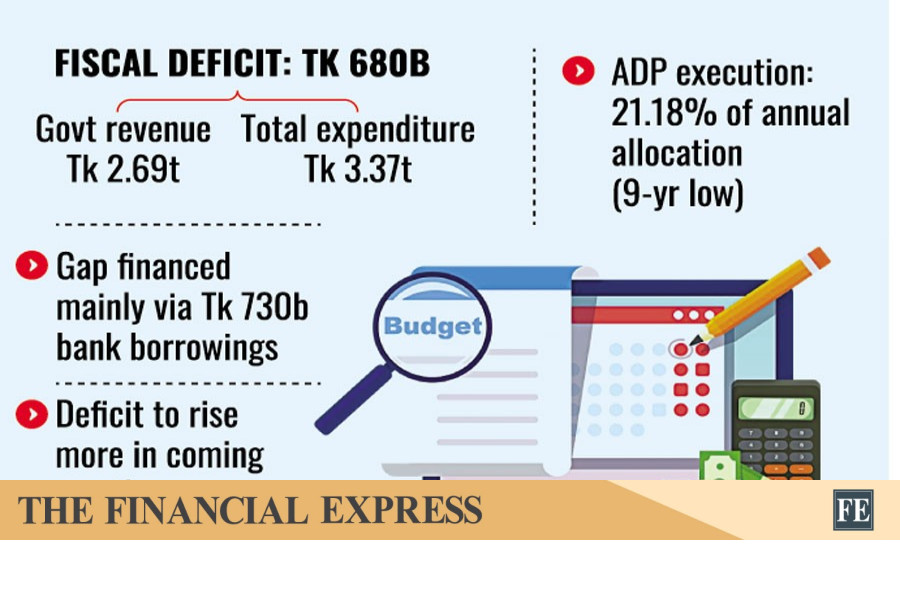
Data from the Bangladesh Bank shows the deficit stood at Tk 680 billion during July 2025-January 2026, about 5.0-percent lower than the Tk 717 billion recorded in the same period of the previous fiscal year.

Government revenue during the period under review totalled Tk 2.69 trillion, including both tax and non-tax receipts, while total expenditure reached Tk 3.37 trillion, resulting in the deficit.

Public spending, however, remained subdued in the development sector.

The implementation of the Annual Development Programme (ADP) - the government's main public investment programme - fell to a nine-year low during the period.

In the first seven months of the 2025-26 fiscal year, ADP implementation reached only 21.18 per cent of the annual allocation, reflecting slower progress in executing development projects.

According to official figures, development expenditure amounted to about Tk 420 billion during July-January, compared with the total ADP allocation of Tk 2.39 trillion for the whole FY26.

People familiar with the development say weak implementation of development projects has become a recurring issue, often linked to bureaucratic delays, slow procurement processes, and limited project readiness at the beginning of the fiscal year.

They, however, say in the coming months, the deficit will be higher, including higher subsidies and fuel payments.

The fiscal gap was financed mainly through domestic sources, particularly borrowing from the banking sector.

The Bangladesh Bank data shows net bank borrowing by the government reached around Tk 730 billion during the period under review.

However, the government also made repayments against earlier borrowings, partly offsetting the overall increase in bank-based financing.

Higher borrowing from the banking sector can help bridge the government's financing needs in the short term, but economists warn that excessive reliance on banks could put pressure on liquidity in the financial system and potentially crowd out private sector credit.

With several months remaining in the fiscal year, the pace of revenue collection and development spending will be closely watched to assess whether the government can maintain fiscal stability while supporting economic growth, which has already been forecast by the World Bank at 3.9 per cent.​