[🇧🇩] Monitoring Bangladesh's Economy

Afghanistan Albania Algeria Andorra Angola Antigua Austria Azerbaijan Bahamas Bahrain Bangladesh Barbados Canada China Egypt Finland Germany India Iran Israel Japan Lebanon North Macedonia Pakistan Palestine Qatar Russia Syria Turkey Ukraine United Kingdom United States Yemen
[🇧🇩] Monitoring Bangladesh's Economy
1K
39K
More threads by Saif

G Bangladesh Defense

High-level IMF delegation arrives in Dhaka Sunday on five-day visit to discuss new loan programme
1783813446347.webp


A high-level delegation from the International Monetary Fund (IMF) is scheduled to arrive in Dhaka tomorrow (July 12) on a crucial five-day visit.

The visit will focus on the feasibility and size of a new financial assistance package and evaluating vital macroeconomic structural reforms proposed by the government.

The mission comes at a critical juncture as the newly formed government has practically moved away from the previous IMF facility and requested a fresh three-year loan program tailored to current macroeconomic realities. The primary goal of the tour is not to finalise a credit arrangement immediately, but rather to evaluate the current macroeconomic conditions, the government's policy priorities, and its capacity to execute necessary reforms.

According to Ministry of Finance sources, the IMF delegation will hold a series of meetings with the Ministry of Finance, Bangladesh Bank, the National Revenue Board (NRB), and other relevant stakeholders.

The team will review a broad spectrum of the economy, including the current status of Bangladesh's macroeconomic indicators. the roadmap for rebuilding the banking sector and curbing non-performing loans, progress in revenue collection and tax administration reforms, the position of the country's foreign exchange reserves and public debt management, and the structure and volume of the proposed new loan program.

Dr. Ahsan H. Mansur, former IMF official and former Governor of Bangladesh Bank, stated that the principal objective of this five-day visit is to physically evaluate the government’s sincerity and commitment toward implementing deep economic overhauls.

He noted that several crucial reforms under the previous program stalled as they were left unimplemented. Consequently, if Bangladesh intends to secure a fresh IMF facility, the delegation will place utmost emphasis on the new strategic roadmap designed by the administration.

Dr. Mansur highlighted that the overhauling of the NBR, eliminating vulnerabilities in the banking sector, and fully materializing a market-driven foreign exchange rate will dominate the discussions.

Furthermore, following the announcement of the national budget, the delegation will hold detailed talks on the financial viability and funding sources of the proposed 9th National Pay Scale.

Ultimately, the IMF mission intends to gauge both the administrative and political readiness of the state to handle structural adjustive measures in the days ahead.​
 

Creative economy can drive Bangladesh growth: experts

Ensuring right policies emphasised

Staff Correspondent 12 July, 2026, 01:21

1783817125071.webp


Bangladesh’s creative economy has the potential to emerge as one of the country’s next major drivers of growth, employment, and exports, but only if long-standing policy, taxation, and regulatory barriers are removed, experts said on Saturday.

They argued that despite abundant creative talent in the country, sectors such as film, OTT platforms, publishing, theatre, music, design, and handicrafts had remained underdeveloped because they had largely been treated as cultural pursuits rather than economic industries deserving strategic policy support.

The observations came at the latest episode of Ajker Agenda, organised by the Power and Participation Research Centre, titled ‘Creative Economy: Slogan or Untapped Potential?’ The episode was moderated by PPRC executive chairman Hossain Zillur Rahman.

The discussion came as the government, for the first time, included a Tk 800 crore work plan for the creative economy in the FY2026-27 national budget, comprising a direct allocation of Tk 300 crore and another Tk 500 crore through Bangladesh Bank’s corporate social responsibility fund.

The initiative is aimed to increase the sector’s contribution to the gross domestic product, generate employment for nearly five lakh people, and globally promote a ‘Made in Bangladesh’ brand.

Filmmaker Tanim Noor said that Bangladesh’s film industry could attract substantial investment if the government introduced sector-specific tax incentives.

‘A 50 per cent tax exemption for the film industry could significantly increase investment in Bangladeshi cinema, making the sector more lucrative to both existing and new investors,’ he said.

The country’s film industry, Tanim pointed out, employed around two lakh people during its peak in the 1970s and 1980s.

With the expansion of OTT platforms, modern production technologies, post-production services, and visual effects, the sector now has the potential to create employment for as many as 10 lakh people.

He estimated that the industry’s market size could reach between Tk 5,000 crore and Tk 10,000 crore, enabling the government to earn Tk 500 crore to Tk 1,000 crore in annual revenue, provided that appropriate policy support and state patronage are ensured.

According to Chorki chief executive officer Redwan Rony, domestic OTT platforms are operating at a competitive disadvantage because they are taxed under the general corporate tax structure, while foreign streaming platforms such as Netflix and Amazon continue to earn revenue from Bangladeshi audiences without facing similar tax obligations.

Producing OTT content worth Tk 1 crore currently, he added, requires paying around Tk 27 lakh in taxes.

Rony also pointed to the absence of a dedicated registration system and sector-specific policy framework for OTT platforms, observing that these gaps had created an uneven playing field for local companies.

Bengal Foundation director general Luva Nahid Choudhury said that Bangladesh possessed creative talent across the country, but lacked an institutional ecosystem necessary to nurture, commercialise, and sustain the talent.

She urged the government to undertake structural reforms while extending support not only to artistes but also to the wider workforce employed throughout the creative value chain.

According to Bakar Bakul, the playwright, actor, and creative director of theatre ‘Tarua’, theatre has long been viewed as a voluntary cultural activity rather than an industry capable of generating economic value.

‘As long as theatre depends primarily on unpaid work, it will remain difficult to build the activity as a professional, financially sustainable sector,’ he said, adding that state patronage had too often been used for political purposes instead of developing the arts as an industry.

UPL managing director Mahrukh Mohiuddin described publishing as one of Bangladesh’s most neglected industries, citing the absence of an updated national book policy and weak enforcement of copyright laws.

Widespread digital and print piracy, she viewed, continues to undermine the sector while limiting its international growth prospects.

Classical Handmade Products managing director Md Tauhid Bin Abdus Salam observed that quality certification, compliance, and strong branding were essential for expanding handicraft exports and achieving sustainable growth.

Hossain Zillur Rahman said that Bangladesh now needed a comprehensive policy ecosystem to unlock the creative economy’s full potential.

He called for reforms in taxation, copyright protection, royalty sharing and licensing, alongside quality infrastructure supported through public-private partnership.

Zillur Rahman also urged stakeholders in the sector to form a broad coalition to develop a strategic road map, saying coordinated action between the government and the industry would be essential for translating policy ambitions into sustainable economic outcomes.​
 

Remittance inflow registers 11.6pc growth, reaches $1.15b in July’s first 11 days

Bangladesh’s inward remittance recorded a robust double-digit growth at the start of the new fiscal year 2026–27, with US$1.15 billion in the first 11 days of July, according to the latest data released by Bangladesh Bank.

This marks a significant 11.6 percent monthly growth compared to the corresponding period of the previous fiscal year, when the country received $1.03 billion between July 1 and July 11, 2025.

The central bank’s detailed breakdown indicates that the flow of foreign currency picked up pace significantly toward the end of the first week of July. In just a three-day window between July 9 and July 11, 2026, Bangladeshi expatriates sent$191 million through banking channels.

Financial analysts and central bank officials attribute this strong upward trajectory to the recent stabilization of the interbank foreign exchange market and competitive exchange rates offered by commercial banks. The steady use of banking channels instead of informal networks (like Hundi) has significantly buoyed the state’s incoming foreign currency receipts.

The sustained surge in remittance inflows brings a much-needed sigh of relief for macroeconomic policymakers.

This steady influx is expected to provide a crucial buffer to Bangladesh’s gross foreign exchange reserves and help ease the ongoing balance of payment pressures during the first quarter of the current fiscal year.​
 

VAT schedule change may widen revenue gap

Fear field officials

1784071329205.webp


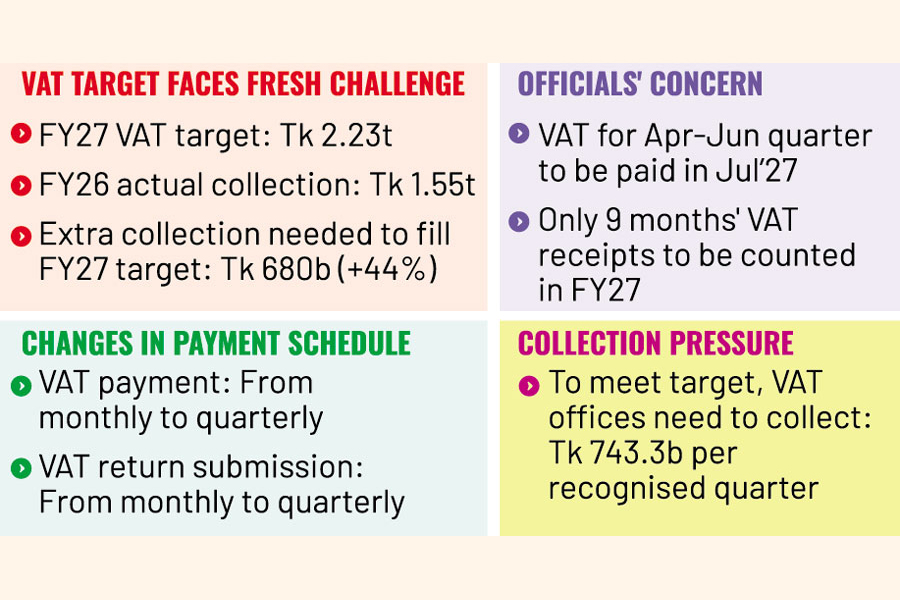
Changes to the VAT-payment schedule could put immense pressure on field officials to achieve the government's ambitious VAT-collection target of Tk 2.23 trillion in the current fiscal year, according to tax officials.

Field-level VAT officials say they would effectively have only nine months of revenue reflected in this fiscal year's collection as VAT for the final quarter would be deposited in July - the first month of the following fiscal year - under the revised payment schedule.

In the Finance Bill 2027, the government has made VAT payment and VAT return submission simpler by extending payment and submission schedules to three months from every month.

It was the long-awaited demand from businesses who found the monthly compliance requirements time-consuming.

Officials say VAT zones would have to mobilise exceptionally high revenue every quarter -- and every month -- to meet the target, making the goal extremely difficult unless the government amends the provision or makes special arrangements for the current fiscal year.

The original VAT collection target for FY26 was Tk 1.86 trillion, but actual collection reached Tk 1.55 trillion.

To achieve the FY27 target of Tk 2.23 trillion, the VAT wing will have to raise collections by approximately 44 per cent over last year's actual receipts.

This means an additional Tk 680 billion must be mobilised during the current fiscal year.

VAT contributes around 37 per cent of the total domestic revenue mobilisation.

Field officials say because the revised payment schedule would effectively leave only three revenue-generating quarters within the fiscal year, the burden would be even heavier.

They estimate VAT offices would need to mobilise around Tk 743.3 billion in each of the three recognised quarters to remain on track.

Unless there is a significant expansion of economic activity, stronger VAT compliance, resolution of pending litigation, improved enforcement, and substantial gains from digitalisation, and anti-evasion measures, achieving the target will be extremely challenging, officials say.

The new target is also substantially higher than last year's original target of Tk 1.86 trillion, underscoring the government's increasing reliance on VAT to meet its overall revenue objectives.

"The last quarter is traditionally the strongest period for VAT collection, with revenue often nearly doubling compared to that of the other quarters," a senior field-level VAT official says.

"If those receipts are shifted to the next fiscal year because of the revised payment schedule, the revenue shortfall this year could be significant."

Officials note that the FY27 VAT target is around 44 per cent higher than last year's actual collection, placing unprecedented pressure on field offices.

They warn that unless the government introduces a special transition arrangement for the current fiscal year, VAT collection is likely to fall well short of the target.

However, they believe the problem would largely disappear from the following fiscal year once the new payment cycle becomes fully operational.

Former VAT officials, however, downplay the concern, arguing that the impact may not be as severe because a substantial portion of VAT is collected at source.

A former VAT member says VAT deducted at source would continue to provide a steady stream of revenue despite the change in payment timing.

Current field officials disagree with this, saying only about 30 per cent of VAT is collected at source -- primarily through government entities -- while the remaining 70 per cent depends on regular payments by businesses.

The government has set a VAT collection target of Tk 2.23 trillion for FY27, up from the actual collection of Tk 1.55 trillion in the previous fiscal year.

In parliament, Finance Minister Amir Khosru Mahmud Chowdhury said on Monday the government collected Tk 4.10 trillion in total revenue during FY26 against a target of Tk 5.03 trillion, achieving 81.6 per cent of its overall revenue goal.

According to the minister, income tax collection stood at Tk 1.42 trillion against a target of Tk 1.86 trillion, representing an achievement rate of 76.7 per cent.

VAT collection reached Tk 1.55 trillion against a target of Tk 1.86 trillion, achieving 83.7 per cent of the target.

Meanwhile, customs revenue amounted to Tk 1.11 trillion against a target of Tk 1.30 trillion, meeting 85.3 per cent of its target.

Former VAT member Farid Uddin says the changes in VAT payment schedule would not be a problem; it would rather help businesses reduce time and cut the cost of doing business. Some 95 per cent of domestic VAT comes from tobacco, mobile, and pharmaceuticals companies and VAT deducted at source, he says.

The rest of the businesses pay a negligible amount of VAT that would not affect the collection much, he adds.​
 

We must adapt to the changing rules of global trade and development

Fahmida Khatun

1784332259140.webp

VISUAL: SALMAN SAKIB SHAHRYAR

The global trading system has been experiencing significant transformation since the World Trade Organization (WTO) was created in 1995. The rules-based trade framework and export-oriented growth model that defined the WTO era were suited for a world in which trade liberalisation, global value chains, and economic efficiency fuelled growth. In today’s world, however, trade is increasingly influenced by geopolitical divisions, industrial policies, tariffs and trade disputes, climate regulations, digital advances, artificial intelligence, and security concerns. The main challenge is not just to reform the WTO but to redesign the trading system to foster development amid a rapidly evolving global landscape.

The WTO-era trading system was built on a simple proposition: accelerating economic growth by lowering trade barriers, expanding market access, and deepening integration into global value chains. This strategy delivered remarkable results: global merchandise trade expanded rapidly. Developing economies significantly increased their share of world exports and became more deeply integrated into global value chains, which contributed to faster growth, industrialisation and significant poverty reduction in many parts of Asia.

However, the conditions underpinning that success have changed. The 2025 World Development Report by the World Bank argues that international standards have become a defining feature of modern trade. Nearly 90 percent of global trade is now covered by non-tariff measures, many linked to technical, environmental, and quality standards. This means that competitiveness increasingly depends not just on market access but also on the countries’ ability to meet complex regulatory and standards requirements.

Today, competitiveness is increasingly shaped by industrial policies, technological capabilities, climate-related regulations, digital transformation, and supply chain resilience, not just tariffs alone. Governments are investing heavily in strategic industries, environmental standards are becoming conditions for market access, and AI is reshaping production and services. At the same time, geopolitical fragmentation is creating new uncertainties for trade and investment.

The Trade and Development Foresights 2026 report by the United Nations Conference on Trade and Development (UNCTAD) argues that the greatest risk to the global economy has shifted from trade uncertainty to geopolitical instability. After a 2.9 percent growth in 2025—driven by robust trade, resilient industrial output in developing nations, and AI-enhanced manufacturing—the global outlook worsened due to conflicts in the Middle East. These conflicts have disrupted energy supplies, shipping lanes, and financial markets, likely reducing global growth to 2.6 percent in 2026.

UNCTAD cautions that the ongoing geopolitical tensions could have broad impacts on trade, investment, energy security, financial stability, and the world economy.

Per the UNCTAD report, developing economies are expected to grow by 4.1 percent in 2026, surpassing the 1.5 percent growth forecast for developed economies. However, their outlook has significantly weakened: these nations will face the greatest impact from geopolitical instability due to their reliance on fuel, food, and fertiliser imports. Rising import costs, falling export demand, increasing global interest rates, capital outflows, and currency depreciation are intensifying macroeconomic vulnerabilities and debt levels. In response, countries such as Bangladesh, India, Pakistan, Sri Lanka, Indonesia, Thailand, Vietnam, Egypt, and Ethiopia have implemented measures like fuel subsidies and price controls—initiatives that strain their already limited fiscal resources.

Meanwhile, the July 2026 World Economic Outlook Update by the International Monetary Fund forecasts a decline in global economic growth from an average of 3.5 percent in 2024-25 to 3 percent in 2026, before slightly rising to 3.4 percent in 2027. It also anticipates world trade volume growth to drop to 3.5 percent in 2026 from 5 percent in 2025, before rebounding to 4.3 percent in 2027. Ongoing geopolitical tensions, trade fragmentation, tariffs, and supply chain disruptions continue to hinder global commerce. Nevertheless, technology-driven trade—especially semiconductors, AI hardware, and digital services—is expected to significantly drive growth.

Per the IMF forecasts, in 2026, crude oil prices could increase by 32 percent, natural gas by 22 percent, fertiliser by 26 percent, and food by 8 percent. For countries like Bangladesh, which relies heavily on energy imports, this will lead to higher import costs, strain on foreign exchange reserves, increased need for subsidies, rising production expenses, and renewed inflation risks. All these factors will complicate macroeconomic management.

Furthermore, Bangladesh is not yet a significant part of the global AI and advanced technology value chain, which is considered to be the main driver of growth in the coming years. Countries like Vietnam, Malaysia, Thailand, South Korea, and the territory of Taiwan benefit from exporting semiconductors, electronics, and AI hardware or by attracting large data centre investments. In contrast, Bangladesh’s exports are still mostly focused on ready-made garment (RMG) products. While the RMG sector has become more advanced than before, it has not yet tapped into the productivity improvements from AI-enabled manufacturing or digital hardware exports. As a result, the country incurs higher energy costs but does not benefit from the ongoing technology cycle.

The challenge, therefore, is not just reducing trade barriers but also ensuring that trade fosters development. This requires the understanding that market access alone is insufficient. Many developing countries are constrained by issues in productivity, infrastructure, technology, skills, energy, and finance access. Without tackling these structural problems, trade liberalisation alone cannot lead to lasting economic transformation.

This highlights the limitations of the current trading structure. The WTO remains essential as the backbone of a rules-based multilateral trade system. But it needs a more effective dispute settlement process, revised rules for digital trade, and increased transparency around subsidies and trade measures.

In addition to WTO reforms, development should be placed at the centre of international trade by better aligning trade governance with finance, technology, and sustainability. First, trade policy should be more closely linked with development finance as export competitiveness increasingly depends on infrastructure, energy, digitalisation, and industrial capabilities. Second, developing countries need sufficient policy space to diversify exports, upgrade industries, and build productive capacity within transparent multilateral rules. Third, climate-related trade measures should be accompanied by increased climate finance, technology transfer, and capacity-building to ensure that developing countries can compete in the emerging green economy, not be excluded from it. Bangladesh shows why an integrated approach is crucial. Over the past 40 years, export-driven growth has transformed its economy and significantly reduced poverty. As the country awaits LDC graduation and faces a rapidly evolving global trade landscape, its future competitiveness will rely less on preferential market access and cheap labour and more on productivity improvements, technological advancements, renewable energy, digital infrastructure, regulatory reforms, and innovation. Developing these capabilities will be key not only to maintaining export growth but also to attracting high-quality investments, integrating into advanced global value chains, and creating better-paying jobs. Essentially, Bangladesh’s journey reflects a common challenge for many developing nations: succeeding in the next phase of globalisation requires building the skills and capabilities to compete in a world driven by technology, knowledge, and sustainability.

Dr Fahmida Khatun is an economist and executive director at the Centre for Policy Dialogue (CPD).​
 

Does export target matter?

1784415985308.webp


Though earnings from exports of goods and services are critical to the country's balance of payments (BoP), it is not possible to increase them significantly within a few years. The growth of exports depends on factors including the strength of export-oriented sectors, global demand, barriers to market access, the domestic business environment, and the country's trade policy. If global demand slows, a strong industry may not realise its full capacity. Also, due to supply-side constraints, higher international demand is unlikely to boost export earnings.

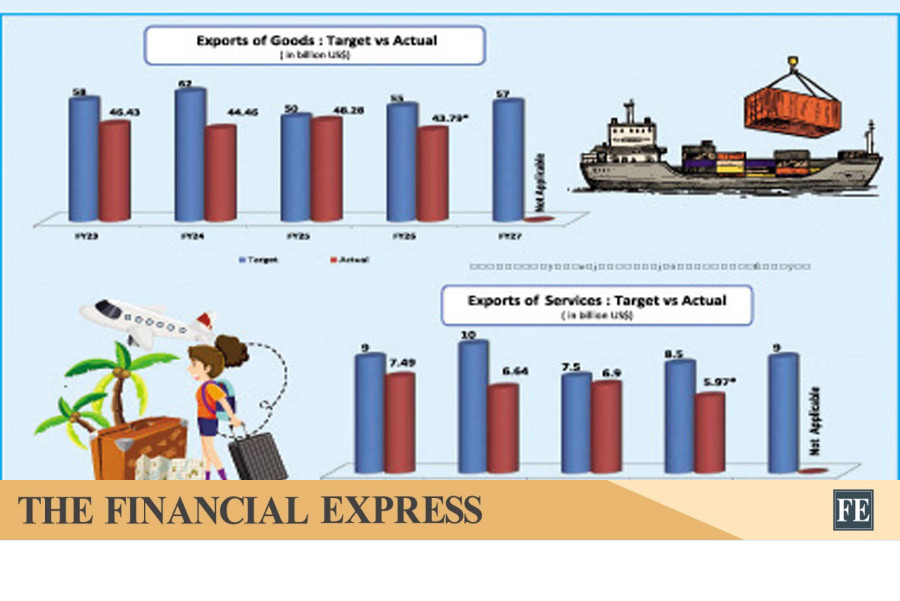
Nevertheless, there is a tradition in Bangladesh and other countries of setting an annual target for export earnings. For the current fiscal year (FY27), the government has set targets of US$57 billion in earnings from exports of goods and US$ 9 billion from exports of commercial services. Thus, the total export earnings target for the current fiscal year is set at $66 billion.

Statistics from the Export Promotion Bureau (EPB) revealed that actual export earnings did not meet targets in the last couple of years. For instance, the government set a target of $58 billion for FY23, but actual earnings from goods exports stood at $46.43 billion. In FY24, the target was $62 billion, while actual export earnings reached $44.46 billion. The autocratic regime of the now-ousted Hasina government set overambitious targets to secure political applause.

In a bid to set a rational target, the government set it at $50 billion for FY25, and final earnings from merchandise exports were $48.28 billion. The target for FY26 was $55 billion, and actual earnings in 11 months reached $43.79 billion, according to EPB. Even if export earnings in June were $5 billion, total annual exports would still fall short of the FY26 target.

There is, however, a persistent decline in exports to gross domestic product (GDP) ratio over the last couple of years. The ratio of exports of goods and services to GDP was 13.16 per cent in FY23, which fell to 10.46 per cent in FY24 and improved modestly to 11.12 per cent in FY25. It then again dropped to 10.18 per cent in FY26, according to an estimate by the Bangladesh Bureau of Statistics (BBS). This means the contribution to GDP is slowly declining, as real export growth does not keep pace with the economic growth. It also indicates vulnerability of the export sector. Finance and Planning Minister Amir Khosru Mahmud Chowdhury, in his budget speech last month, said: "Our export sector remains highly vulnerable due to an overdependence on a narrow product base and limited market diversification."

Nevertheless, it is important to set an annual target for earnings from exports, as the target reflects the country's ambition to widen the international market for its various products. It also indicates the productivity of the country's export-oriented industries, though sector-wise targets provide a better indication. For policymakers, the target serves as a performance benchmark for the external sector. For exporters, it is a yardstick for measuring their overall success.

For many years, the Ministry of Commerce has been setting annual export targets for goods. Setting the target for services started in FY22. Commercial services account for the majority of total services, while the remaining services are divided into government and other services.

Commercial services are usually divided into four broad sectors: (i) transport, (ii) travel, (iii) goods-related services, and (iv) other commercial services. The trade in commercial services refers to intangible transactions involving services or related activities across nations.

Setting the target for exports of goods is easier than for services. This is because the nature of services trade is more complicated and harder to estimate. Physical movement of goods is visible and can be counted by volume and value, whereas services are largely intangible, making them difficult to quantify. Measuring service exports requires sophisticated tools and skills.

At present, one-fourth of the global trade is trade in services. According to the World Trade Organization (WTO), last year, the value of world merchandise trade, as measured by exports, was US$26.26 trillion, while trade in services reached US$9.56 trillion. Thus, the total value of goods and services trade last year stood at $34.65 trillion.

In Bangladesh, trade in services is also growing gradually, and at present it accounts for 14 per cent of total trade on average. Exports of services stood at around $7 billion in FY25 and $6 billion in the first 10 months of FY26, as per statistics furnished by EPB. The BoP data on services trade, estimated by Bangladesh Bank, is slightly lower than the EPB data due to some adjustments.

In the coming days, trade in services will be more critical as rapid digitalisation and the expansion of artificial intelligence (AI) are changing the landscape of global trade. That's why the WTO, in its Global Trade Outlook and Statistics released four months ago, pointed out that the growth of AI-related investment, as a larger share of investment, could boost the trade intensity of growth in the near future.

The outlook report, however, projected that world trade is set to slow this year after a strong surge last year. Merchandise trade volume growth may slide from 4.6 per cent in 2025 to 1.9 per cent in 2026, but is likely to increase up to 2.6 per cent in 2027, according to the WTO's primary forecast. The volume of trade in services is also expected to grow by 4.8 per cent in the current year, from 5.3 per cent last year, though it may rise by 5.1 per cent next year. The forecast was released when the Middle-East conflict had intensified due to the US-Israel's joint attack on Iran. Taking the negative impact of the war into consideration, the report said: "Given that the Gulf region is a major exporter of both energy and fertilizers, a prolonged interruption in supply could ripple across food systems, exacerbating the effect of pre-existing export restrictions."

Meanwhile, the UN Conference on Trade and Development (UNCTAD), in its Global Trade Update (April 2026), also cautioned that global trade growth is expected to slow later in 2026 due to persistent trade tensions and rising trade costs. The report also cautioned that the ongoing conflict in the Middle East and the shipping disruptions in the Strait of Hormuz would intensify inflationary pressures. "Rising energy prices, together with higher trade costs linked to tariffs, regulatory changes and the erosion of trade rules, further cloud the outlook," it added.

The Middle East has intensified further, after a brief pause, as the United States (US) resumed attacks on Iran last week. Iran has also started to retaliate by attacking US bases and infrastructure in the region. As a result, global trade growth has come under serious threat, which may prompt many countries to adopt protectionist trade policies. This will also shrink exports from countries like Bangladesh, making the attainment of export targets more difficult in the coming days.​
 

Backward linkage paradox in high-tech manufacturing


1784416508770.webp


Bangladesh, like many less-developed countries, entered the industrial economy by producing finished goods through the assembly of imported components. Low-cost labour and minimal requirements for capital-intensive machinery-often referred to as "screwdriver technology"-enabled local producers to attach the "Made in Bangladesh" label to high-tech products such as mobile phones, laptop computers, and television sets.

However, this opportunity is gradually diminishing due to the declining need for labour in the assembly stage of production. For instance, Apple reportedly spends only about $1.5 on direct labour for assembling a device, while paying approximately $485 to component suppliers for manufacturing parts for a 256GB iPhone 16 Pro Max.

This disparity may create a temptation to pursue backward linkages in order to increase local value addition through component manufacturing. Yet, the negligible role of labour in component production, the high cost of capital-intensive machinery, and the near-monopolistic structure of global supply chains raise serious questions about the economic feasibility of such a transition.

A closer dissection of mobile phone handsets offers further insight. The major cost components of smartphones include the system-on-chip (SoC), modem, display panel, rear camera, casing, storage, and battery. Manufacturing each of these components requires access to a wide array of licensed patents and the deployment of highly expensive capital-intensive machinery. For example, establishing a memory fabrication facility can require investments exceeding $10 billion. Moreover, the effective economic lifespan of such plants is only a few years, necessitating continuous reinvestment and upgrades. As a result, achieving large-scale production is critical for viability.

This dynamic has led to a highly concentrated global memory chip market, now dominated by just three producers: Micron Technology, SK Hynix, and Samsung Electronics. Over time, increasing scale and specialisation have driven consolidation, reducing the number of producers from around 20 in the 1990s to only a handful today.

A similar pattern of concentration prevails across other key components, from modems to storage, reflecting the structural barriers to entry and the dominance of a few global players.

One possible argument is to attract major global players through foreign direct investment (FDI) or joint ventures. However, as the need for labour declines and scale requirements for capital investment rise, neither access to a domestic market nor the availability of low-cost labour remains economically compelling. Consequently, a fierce global subsidy race has emerged for alluring FDI to enter high-tech component manufacturing. For example, India's large domestic market alone was insufficient to attract Micron Technology to establish a memory plant in Gujarat. To secure the investment, India reportedly offered subsidies covering up to 75 per cent of the $2.5 billion capital cost. In addition, the government has provided production-linked incentives amounting to 4-6 per cent of invoice value. In total, India's support package amounts to approximately $1.95 billion to attract a $2.5 billion facility-one expected to generate only around 5,000 relatively low-paying jobs. Such realities raise fundamental questions about the economics of increasing local value addition through backward linkages.

Does this imply that Bangladesh has no viable path to enhancing high-tech value addition through backward integration? If so, how have relatively small firms in other countries managed to emerge as globally competitive and highly profitable component suppliers? These questions warrant deeper investigation.

Becoming a preferred component supplier in the global high-tech industry may require a trajectory similar to that of Zhou Qunfei. She drew global attention when seated between Tim Cook and Elon Musk at a state dinner hosted by Xi Jinping during the recent visit of Donald Trump. Her success in supplying glass panels for display modules for smartphones is not merely about cutting and polishing glass sheets. Founded in 1993, her company, Lens Technology, has built a formidable intellectual property base, holding over 2,200 authorised patents worldwide. Its portfolio spans advanced processing technologies, new materials such as sapphire and ceramics, smart manufacturing systems, anti-fingerprint coatings, as well as Computer Numerical Control (CNC) and screen-printing capabilities.

A similar story can be seen in Largan Precision. Starting from modest beginnings, Largan has grown into the world's leading producer of smartphone camera lenses and a long-standing supplier to companies such as Apple. To reach and sustain its position as a high-tech component manufacturer, Largan has accumulated more than 4,300 patents globally.

Since Bangladesh cannot outcompete large economies like India in terms of subsidies or domestic market size, it should instead draw lessons from the rise of companies like Lens Technology and Largan Precision. This raises a critical question: what is the "secret sauce" behind such success?

Conventional industrial development strategies-such as labour-intensive manufacturing, import substitution of mature products, and reliance on foreign direct investment-appear increasingly inadequate. Notably, both Lens Technology and Largan Precision capitalised on technological discontinuities, avoiding head-on competition with established incumbents. For instance, when Motorola sought glass panels for its Razr series phones, existing plastic panel suppliers were neither capable nor interested. Leveraging its expertise in watch glass, Lens Technology identified an entry point and scaled up through building a proprietary technology base.

Similarly, Largan seized the emerging demand for aspherical plastic lenses in mobile phone cameras. Like Lens Technology, it built scale through the cumulative development of ideas, capabilities, and specialised knowledge-rather than relying on low-cost labour or protected domestic markets.

Unfortunately, Bangladesh suffers from a lack of the capabilities, management competence, culture, and theoretical grounding required to follow the paths of companies like Largan Precision or Lens Technology in building firms that can increase local value addition through component innovation and manufacturing. It is important to note that the backward linkage strategy applied in the ready-made garments (RMG) sector does not readily translate to high-tech industries. Moreover, the economic frameworks currently guiding development planners and lenders are insufficient for this transition. Investments in R&D, setting up specialised technology university or the establishment of high-tech parks, in isolation, are also unlikely to deliver the desired outcomes.

Bangladesh requires a fundamental shift in education, mindset, culture, and industrial economic thinking to move up the value chain in high-tech manufacturing. This shift should begin with a deeper understanding of the mechanics of wealth creation-particularly how value emerges from the evolution of inventions and innovations, and how modest new entrants grow into large firms through a flywheel effect driven by the cumulative flow of ideas. This stands in contrast to the prevailing approach of asset accumulation through loans, subsidies, protection, and infrastructure expansion.

Given the rise in non-performing loans, increasing graduate unemployment, expanding debt for infrastructure, and the declining contribution of factory-floor labour to value addition, Bangladesh must first develop a clear understanding of how to enhance value creation at the component level-before setting targets, issuing regulatory directives, or committing substantial resources.

konuzzaman, Ph.D is academic, researcher and activist on technology, innovation and policy.​
 

Latest Posts

Back