Bangladesh Defense

Saif
Senior Member
- Joined
- Jan 24, 2024
- Messages
- 22,294
- Likes
- 9,869
- Nation

- Axis Group

NBR sets ambitious targets sans reality assessment
An ambitious government target to ramp up Bangladesh's lowly tax-to-GDP ratio looks hard to achieve as the principal revenue authority is more interested in enhancing tax receipts sans reality checks. The revenue board sets tax targets, change tax policies and attempt revenue reforms without an ad
GOVT MOVE TO RAMP UP TAX-GDP RATIO LOOKS ELUSIVE
NBR sets ambitious targets sans reality assessment
An ambitious government target to ramp up Bangladesh's lowly tax-to-GDP ratio looks hard to achieve as the principal revenue authority is more interested in enhancing tax receipts sans reality checks.
The revenue board sets tax targets, change tax policies and attempt revenue reforms without an adequately functioning institutional research and analytical mechanism, analysts say.
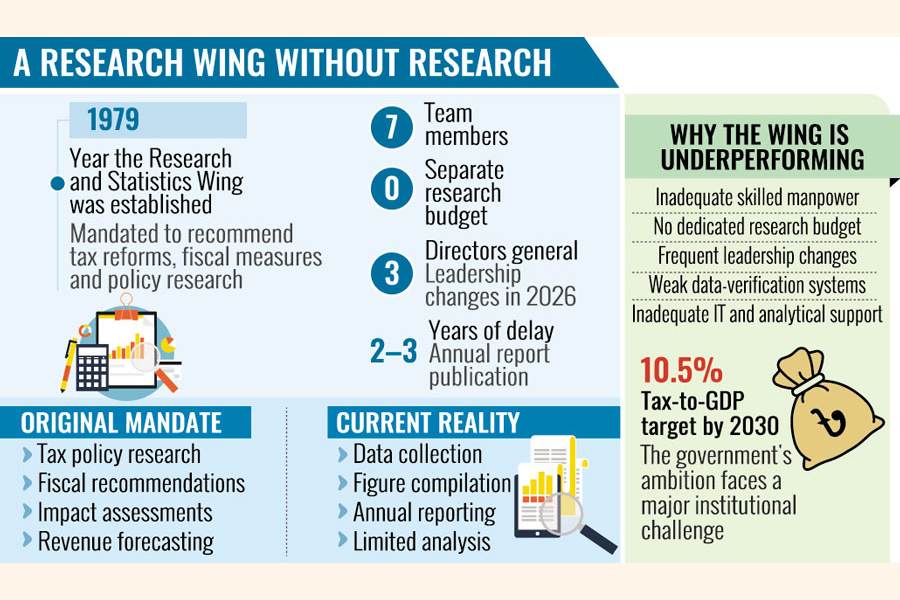
Though it has a Research and Statistics (RnS) wing established in 1979 with a mandate to recommend reforms to the tax structure, suggest fiscal measures for national budgets and conduct studies on income tax, customs and VAT, the National Board of Revenue's (NBR) wing appears to have lost sight of its core purpose.
Despite the government's growing need for evidence-based policymaking to raise the country's tax-to-GDP ratio, the wing has failed to establish itself as a research institution, with virtually no substantive policy research undertaken during its nearly five decades of existence as a virtual do-nothing.
Economists and revenue officials say institutional neglect, frequent leadership changes, inadequate resources and a lack of government demand for independent analysis have reduced the wing largely to a statistics-gathering unit.
The NBR, the country's principal domestic revenue-mobilisation agency, accounts for around 85 per cent of total domestic revenues for financing government budget.
Revenue officials say the wing is now primarily engaged in collecting and compiling data from field offices and publishing the NBR's annual report, with little capacity to undertake meaningful research or policy analysis.
The wing currently has a seven-member team and operates without a separate research budget, adequate logistics, IT support or sufficient manpower.
Its leadership has also suffered from frequent changes, disrupting institutional continuity. In 2026 alone, the wing had to receive three directors-general (DGs).
The incumbent DG, Abul Bashar Md Shafiqur Rahman, took charge on October 27, 2026, after his two predecessors had served for around five months each before getting their marching orders.
He had previously served as DG of the wing from February 22 to November 19, 2023.
A senior NBR official described the position as a "dumping post", saying cadre officials posted there have limited opportunities to contribute to revenue administration.
"Few cadre officials are willing to stay long as DG of the Research and Statistics Wing, resulting in frequent leadership changes," he said.
The wing publishes an annual report of nearly 300 pages, but the publication process itself is considerably delayed, often taking two to three years.
The latest available report covers 2022-23, while a draft report for 2023-24 is just being prepared for publication.
A review by The Financial Express of the annual reports for the previous five years, alongside discussions with field-level officials, found inconsistencies in the reporting formats and figures.
Some officials said neither the NBR headquarters nor the relevant field offices could independently verify or take responsibility for certain figures.
For example, the data on taxpayers having different income ceiling or data of public limited companies' tax have no authenticity.
Although field offices signed and returned the prescribed reporting forms, some officials admitted they had done so without properly checking the figures, citing a lack of appropriate tools and resources for verification.
"When the Research and Statistics Wing sends us a format, field officials somehow fill it in with anticipated figures," said a tax commissioner at the field level, requesting anonymity.
He questioned the usefulness of publishing reports that have played little role in revenue planning or policymaking.
The limitations were also exposed during a recent meeting with an International Monetary Fund (IMF) mission, when the wing was asked whether it maintained data on personal income tax and corporate tax collections.
Officials reportedly answered in the negative.
Officials have confirmed data on different income ceilings of individual taxpayers or public limited companies, outstanding revenue, pending court cases, corporate-tax payment and the number of individuals and corporate taxpayers of different income ceilings are fabricated and cooked.
The wing's approved organogram provides for a deputy director-general as the second-in-command and four research officers. Those positions, however, have remained vacant, leaving the unit without the professional manpower required to fulfill its mandate.
Wing officials have also received no basic training in business-process analysis, according to revenue officials.
The absence of institutional research has wider implications for revenue planning. The NBR frequently sets ambitious collection targets that prove difficult to achieve, without conducting adequate studies to establish its actual revenue-mobilisation capacity.
Despite having a dedicated research wing, the revenue authority has not undertaken comprehensive assessments of its capacity to collect taxes or the potential revenue available from different sectors.
The government target of raising the tax-to-GDP ratio to 10.5 per cent by 2030 may remain elusive unless the revenue administration is equipped with adequate logistics, automation, transparency and analytical capacity.
Many revenue policy decisions are taken without prior impact assessments, only for the NBR to reconsider or reverse them later.
With skilled professionals and proper institutional supervision, the research wing could independently conduct such assessments, helping policymakers understand the revenue, economic and distributional implications of proposed tax measures.
An earlier initiative sought to reconcile discrepancies in revenue data, but the Integrated Budget and Accounting System (iBAS) has since emerged as the primary source of government revenue information.
The income tax, customs and VAT wings of the NBR also conduct research-related exercises independently, but officials from the Research and Statistics Wing are often not involved in those activities.
"Only addition and subtraction have been the wing's work since its inception," said a revenue official.
Research Director of CPD Towfiqul Islam Khan, head of the research wing, said the RnS Wing was one of the key institutional components needed for meaningful revenue reform, but its limited capacity and conventional data-collection methods had prevented it from addressing major tax-policy challenges.
He said political and administrative considerations strongly influenced revenue planning, reducing the demand for independent research and evidence-based policy decisions.
"Vested interests play a significant role in revenue policymaking, while political and administrative considerations often dominate decisions," he said.
The absence of transparent and credible revenue data also weakened accountability in tax policymaking, he added.
Mr Khan, however, views the NBR's ongoing move to digitise its databases as an opportunity to establish an authentic and reliable revenue-information system.
Dr Rashed Al Titumir, adviser to the Prime Minister on Finance and Planning, has said the IMF had given Bangladesh a 'C' grade on data credibility, an assessment that the country needed to take seriously.
"It is shameful for us that the authenticity of our data is being questioned."
He said NBR revenue data must follow the iBAS system to ensure consistency and credibility.
"We have instructed the NBR not to use administrative data," he said, adding that the fundamental problem lay in the sources and methods of data collection.
He also pointed to instances of overestimation and inaccurate reporting, saying that the country needed to address the underlying weaknesses in its revenue-data system.
Following the proposed bifurcation of the NBR, the Research and Statistics Wing could potentially become part of the policy wings of income tax, customs and VAT, where economists, tax specialists and other experts would work together, officials indicated.
Former NBR Commissioner Md Anwar Hossain, the longest-serving DG of the Research and Statistics Wing for around three years, says the institution has historically suffered from neglect and underutilization.
"With a few notable exceptions, the wing has lacked sustained strategic focus, largely due to limited institutional incentives and a lack of motivation among both its permanent staff and the leadership posted there over the years," he told The Financial Express.
As a result, its core mandate has often been sidelined by routine administrative duties rather than high-level analytical work, he said.
"The wing possesses immense latent potential to serve as the analytical backbone of our fiscal policy. However, realising this requires deliberate government backing, structured capacity building and modern management."
If formally integrated into the macroeconomic policy-planning process and empowered to conduct rigorous impact assessments, the wing could become a vital driver of sustainable revenue mobilisation, he added.
In modern tax administrations around the world, data analytics and policy research are indispensable, Mr Anwar said.
He has suggested targeted structural reforms, including the recruitment of specialised professionals, clearly-defined operational mandates and institutional autonomy, to enable the wing to function as a credible think-tank within the NBR.
Responding to criticism of the annual report, he acknowledged that concerns over its presentation, formatting and analytical depth were justified and that the publication required a comprehensive overhaul to meet modern reporting standards.
However, he said the weaknesses in the reports reflected broader systemic shortcomings rather than merely the limitations of the research wing.
"Until the NBR and its field offices, alongside allied financial and regulatory agencies, undergo complete automation with seamless API-based data sharing, the wing will remain constrained in its ability to gather real-time, granular data."
Once such digital integration is achieved, both the accuracy of the data and the quality of the annual report will improve significantly, he hopes.
NBR sets ambitious targets sans reality assessment
An ambitious government target to ramp up Bangladesh's lowly tax-to-GDP ratio looks hard to achieve as the principal revenue authority is more interested in enhancing tax receipts sans reality checks.
The revenue board sets tax targets, change tax policies and attempt revenue reforms without an adequately functioning institutional research and analytical mechanism, analysts say.
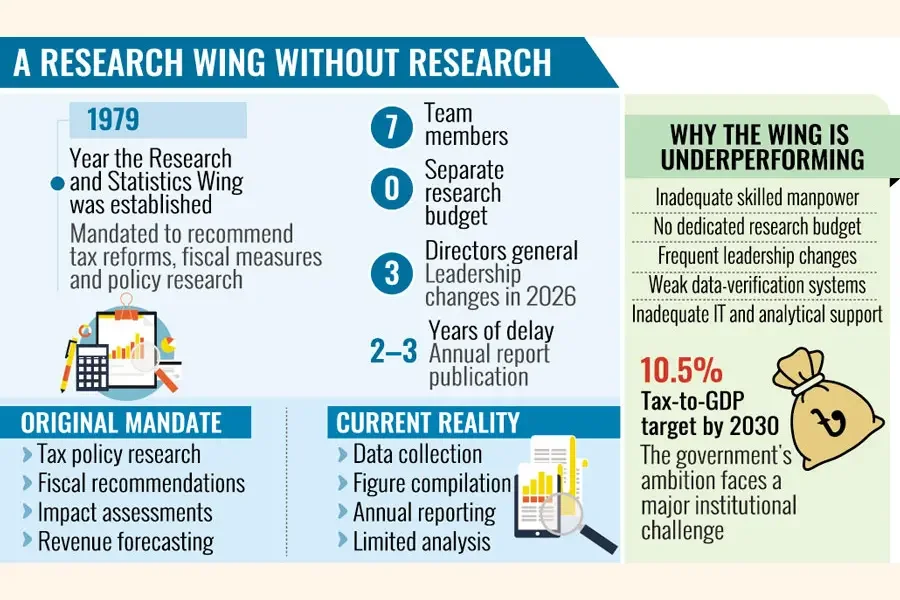
Though it has a Research and Statistics (RnS) wing established in 1979 with a mandate to recommend reforms to the tax structure, suggest fiscal measures for national budgets and conduct studies on income tax, customs and VAT, the National Board of Revenue's (NBR) wing appears to have lost sight of its core purpose.
Despite the government's growing need for evidence-based policymaking to raise the country's tax-to-GDP ratio, the wing has failed to establish itself as a research institution, with virtually no substantive policy research undertaken during its nearly five decades of existence as a virtual do-nothing.
Economists and revenue officials say institutional neglect, frequent leadership changes, inadequate resources and a lack of government demand for independent analysis have reduced the wing largely to a statistics-gathering unit.
The NBR, the country's principal domestic revenue-mobilisation agency, accounts for around 85 per cent of total domestic revenues for financing government budget.
Revenue officials say the wing is now primarily engaged in collecting and compiling data from field offices and publishing the NBR's annual report, with little capacity to undertake meaningful research or policy analysis.
The wing currently has a seven-member team and operates without a separate research budget, adequate logistics, IT support or sufficient manpower.
Its leadership has also suffered from frequent changes, disrupting institutional continuity. In 2026 alone, the wing had to receive three directors-general (DGs).
The incumbent DG, Abul Bashar Md Shafiqur Rahman, took charge on October 27, 2026, after his two predecessors had served for around five months each before getting their marching orders.
He had previously served as DG of the wing from February 22 to November 19, 2023.
A senior NBR official described the position as a "dumping post", saying cadre officials posted there have limited opportunities to contribute to revenue administration.
"Few cadre officials are willing to stay long as DG of the Research and Statistics Wing, resulting in frequent leadership changes," he said.
The wing publishes an annual report of nearly 300 pages, but the publication process itself is considerably delayed, often taking two to three years.
The latest available report covers 2022-23, while a draft report for 2023-24 is just being prepared for publication.
A review by The Financial Express of the annual reports for the previous five years, alongside discussions with field-level officials, found inconsistencies in the reporting formats and figures.
Some officials said neither the NBR headquarters nor the relevant field offices could independently verify or take responsibility for certain figures.
For example, the data on taxpayers having different income ceiling or data of public limited companies' tax have no authenticity.
Although field offices signed and returned the prescribed reporting forms, some officials admitted they had done so without properly checking the figures, citing a lack of appropriate tools and resources for verification.
"When the Research and Statistics Wing sends us a format, field officials somehow fill it in with anticipated figures," said a tax commissioner at the field level, requesting anonymity.
He questioned the usefulness of publishing reports that have played little role in revenue planning or policymaking.
The limitations were also exposed during a recent meeting with an International Monetary Fund (IMF) mission, when the wing was asked whether it maintained data on personal income tax and corporate tax collections.
Officials reportedly answered in the negative.
Officials have confirmed data on different income ceilings of individual taxpayers or public limited companies, outstanding revenue, pending court cases, corporate-tax payment and the number of individuals and corporate taxpayers of different income ceilings are fabricated and cooked.
The wing's approved organogram provides for a deputy director-general as the second-in-command and four research officers. Those positions, however, have remained vacant, leaving the unit without the professional manpower required to fulfill its mandate.
Wing officials have also received no basic training in business-process analysis, according to revenue officials.
The absence of institutional research has wider implications for revenue planning. The NBR frequently sets ambitious collection targets that prove difficult to achieve, without conducting adequate studies to establish its actual revenue-mobilisation capacity.
Despite having a dedicated research wing, the revenue authority has not undertaken comprehensive assessments of its capacity to collect taxes or the potential revenue available from different sectors.
The government target of raising the tax-to-GDP ratio to 10.5 per cent by 2030 may remain elusive unless the revenue administration is equipped with adequate logistics, automation, transparency and analytical capacity.
Many revenue policy decisions are taken without prior impact assessments, only for the NBR to reconsider or reverse them later.
With skilled professionals and proper institutional supervision, the research wing could independently conduct such assessments, helping policymakers understand the revenue, economic and distributional implications of proposed tax measures.
An earlier initiative sought to reconcile discrepancies in revenue data, but the Integrated Budget and Accounting System (iBAS) has since emerged as the primary source of government revenue information.
The income tax, customs and VAT wings of the NBR also conduct research-related exercises independently, but officials from the Research and Statistics Wing are often not involved in those activities.
"Only addition and subtraction have been the wing's work since its inception," said a revenue official.
Research Director of CPD Towfiqul Islam Khan, head of the research wing, said the RnS Wing was one of the key institutional components needed for meaningful revenue reform, but its limited capacity and conventional data-collection methods had prevented it from addressing major tax-policy challenges.
He said political and administrative considerations strongly influenced revenue planning, reducing the demand for independent research and evidence-based policy decisions.
"Vested interests play a significant role in revenue policymaking, while political and administrative considerations often dominate decisions," he said.
The absence of transparent and credible revenue data also weakened accountability in tax policymaking, he added.
Mr Khan, however, views the NBR's ongoing move to digitise its databases as an opportunity to establish an authentic and reliable revenue-information system.
Dr Rashed Al Titumir, adviser to the Prime Minister on Finance and Planning, has said the IMF had given Bangladesh a 'C' grade on data credibility, an assessment that the country needed to take seriously.
"It is shameful for us that the authenticity of our data is being questioned."
He said NBR revenue data must follow the iBAS system to ensure consistency and credibility.
"We have instructed the NBR not to use administrative data," he said, adding that the fundamental problem lay in the sources and methods of data collection.
He also pointed to instances of overestimation and inaccurate reporting, saying that the country needed to address the underlying weaknesses in its revenue-data system.
Following the proposed bifurcation of the NBR, the Research and Statistics Wing could potentially become part of the policy wings of income tax, customs and VAT, where economists, tax specialists and other experts would work together, officials indicated.
Former NBR Commissioner Md Anwar Hossain, the longest-serving DG of the Research and Statistics Wing for around three years, says the institution has historically suffered from neglect and underutilization.
"With a few notable exceptions, the wing has lacked sustained strategic focus, largely due to limited institutional incentives and a lack of motivation among both its permanent staff and the leadership posted there over the years," he told The Financial Express.
As a result, its core mandate has often been sidelined by routine administrative duties rather than high-level analytical work, he said.
"The wing possesses immense latent potential to serve as the analytical backbone of our fiscal policy. However, realising this requires deliberate government backing, structured capacity building and modern management."
If formally integrated into the macroeconomic policy-planning process and empowered to conduct rigorous impact assessments, the wing could become a vital driver of sustainable revenue mobilisation, he added.
In modern tax administrations around the world, data analytics and policy research are indispensable, Mr Anwar said.
He has suggested targeted structural reforms, including the recruitment of specialised professionals, clearly-defined operational mandates and institutional autonomy, to enable the wing to function as a credible think-tank within the NBR.
Responding to criticism of the annual report, he acknowledged that concerns over its presentation, formatting and analytical depth were justified and that the publication required a comprehensive overhaul to meet modern reporting standards.
However, he said the weaknesses in the reports reflected broader systemic shortcomings rather than merely the limitations of the research wing.
"Until the NBR and its field offices, alongside allied financial and regulatory agencies, undergo complete automation with seamless API-based data sharing, the wing will remain constrained in its ability to gather real-time, granular data."
Once such digital integration is achieved, both the accuracy of the data and the quality of the annual report will improve significantly, he hopes.