Home Watch Videos Wars Login

[🇧🇩] Monitoring the political activities of BNP

[🇧🇩] Monitoring the political activities of BNP
399
10K
More threads by Saif

G Bangladesh Defense

Farm loan relief, Padma barrage if BNP elected: Tarique promises at Rajshahi rally

By Sajjad Hossain

1769736373912.webp

Photo: BNP Media Cell

The BNP, if voted to power, will waive agricultural loans of up to Tk 10,000 with interest and build the Padma Barrage to benefit the people of the Rajshahi region, party Chairman Tarique Rahman told a campaign rally in Rajshahi city yesterday.


“We have checked all the calculations and decided that those who have agricultural loans of up to Tk 10,000 at this moment -- if the paddy sheaf wins and forms the government -- we will waive those loans with interest.

“We also want to start work on building the Padma Barrage. If we can… people of this area, including farmers, will benefit from it.”

Among other pledges were building cold storage facilities, reviving the Barind Multipurpose Development Authority and the IT park, establishing a specialised hospital, and re-excavating canals.


Later in the day, he attended a rally in Naogaon and spoke about a party that had been absent from movements over the past 16 years and is now trying to obstruct the polls.

Tarique’s visit to Rajshahi for the rally came after around 22 years, drawing large crowds including leaders, activists and supporters.


“Over the last 16 years, did you see them [a certain party] anywhere on the streets or in movements?... They were nowhere. But secretly, they were with them [those who fled]... Now they have started new conspiracies.”----BNP Chairman Tarique Rahman

He reached Rajshahi airport at 12:20pm. Travelling on a red and green bus, he first visited the shrine of Shah Makhdum (R) and then went to the rally venue. His motorcade faced heavy congestion as security personnel struggled to clear the crowd.

Accompanied by his wife Zubaida Rahman, he took to the stage on the madrasa grounds at 1:54pm. Supporters welcomed them by chanting slogans.

From morning, party leaders and activists arrived at the venue from Naogaon, Chapainawabganj, and surrounding districts by bus and truck, carrying party flags and wearing colourful caps and T-shirts. Small processions, some accompanied by musical bands, continued to arrive throughout the day.

A large number of supporters gathered at the field to catch a glimpse of Tarique; some even climbed nearby trees to listen to his speech.

Addressing the crowd, he promised to revive development projects in the Barind region to ensure sustainable agricultural growth.

“Among state-owned institutional projects, the Barind Project was the largest, with its own budget of about Tk 1,000 crore…. Over the past 16 years, no real work has been done. Today, it is almost shut down.

“If the BNP comes to power, it will be properly revived.”

He further pledged to establish cold storages for mangoes in Rajshahi and Chapainawabganj to help farmers preserve their produce and secure better prices.

Referring to employment, he said, “Although there is an IT park in Rajshahi, it is practically inactive. We will make the IT park functional and provide skills training to youths for employment.”

He added that entrepreneurs would be given special support to establish agriculture-based industries to create jobs across the northern region.

Calling the February 12 election “very important”, Tarique said it will be the day the people of Bangladesh must decide which direction the country will move.

“We have to decide whether we will take the country towards democracy or let it move in another direction…. If we run the country in a democratic way, then it will be possible to implement the plans I have placed before you.

“But if we fail to protect democracy, there will be ‘mega projects’, but none for the people.”

He added that accountable governance can only be achieved when the foundation of democracy is strong. “Those who are accountable to the people will work for the people. In the past, those who held power were not accountable. That is why we saw corruption, oppression, enforced disappearances, killings, and millions of people becoming victims of cases and repression.”

Referring to recent incidents of political violence, Tarique said, “If any unwanted incident occurs anywhere, there is an interim government… I request it to conduct a fair and proper investigation. If the investigation finds any role of the BNP, we will cooperate in the probe.

“But the investigation must be proper, and justice must be served according to the country’s law.”

He ended his speech by introducing the 13 BNP candidates from Rajshahi, Natore and Chapainawabganj. He told the crowd, “Your job is to watch over them until the 12th. From the 13th, they will watch over you.”

Speaking at a rally in Naogaon’s Etim grounds later in the day, Tarique Rahman said a party had stayed away from public movements and protests over the past 16 years, but had all along been secretly aligned with those who have fled the country.

“Over the last 16 years, did you see them anywhere on the streets or in movements? Did you see them in protests? They were nowhere. But secretly, they were with them all the time. Now they have started new conspiracies. That is why you must keep your eyes and ears open, so that they cannot move your votes here and there.

“You must guard the ballot boxes. Do you remember what happened in 2008? In 2008, that ‘magic’ happened -- one moment the box was empty, the next moment it was full. You remember, right? So, you must be careful.”

Addressing voters in Naogaon and Joypurhat, he said there has been no development in the areas over the last 16 years.

“Yes, there were some big flyovers and tall buildings in Dhaka and a few other cities. There were mega projects. But mega projects also meant mega corruption.

“We want to change the fate of people living in the villages. We want to change the fate of district towns. We want to change the fate of upazila towns. We want to ensure education for our students. We want to make our women and mothers self-reliant. We want to create jobs for unemployed youth. We want to create a safe situation where people can walk safely, do business safely, and sleep safely at night.”

Tarique urged voters to ensure the BNP’s victory so that the party can meet their demands, including railway connectivity in Naogaon.

Around 12:00am, Tarique reached his ancestral district Bogura after 19 years.

Bogura-6 is also the constituency from which Tarique is contesting the election.

At 12:23am, he addressed the rally saying, “I want to thank Allah because after 19 years I have come to my own home, Bogura. I do not know what to say to you. I have become emotional. I cannot understand what speech to give.”

He said that during the 2001–2006 BNP government, Bogura saw better development than many other districts of Bangladesh, something to be proud of.

“The work in the area was carried out by my mother, Khaleda Zia. Today she is no longer here. I am standing here in her place. Should I speak as a son or as a candidate?”

The crowd answered, “Son!”

Tarique then said, “You are my own people. I want to share this with you -- in 2001–2006, my situation was one, but now it is another. Now the whole of Bangladesh is deprived.

“The people of Bogura must be serious about this election.”

“Jobs and business will be based on merit. No one should say that someone is getting advantages just because they are from Bogura district!”

(Our Rajshahi and Bogura correspondents also contributed to the report.)​
 
Analyze

Analyze Post

Add your ideas here:
Highlight Cite Fact Check Respond

Tarique asks why Jamaat was in alliance for five years if BNP was ‘bad’

bdnews24.com
Published :
Jan 30, 2026 22:54
Updated :
Jan 30, 2026 22:59

1769818959322.webp


Tarique Rahman has publicly challenged Jamaat-e-Islami over its past alliance with the BNP, asking why the party remained in coalition for five years if it now portrays the BNP as “bad”.

Speaking at a campaign rally at Rangpur’s Collectorate Eidgah Ground on Friday night, the BNP chairman accused Jamaat leaders of spreading false narratives about his party in recent days.

“There is a party that has been lying about the BNP for several days. They repeated it again today,” Tarique said, addressing the issue directly.

Referring to the BNP-led government that came to power through the eighth parliamentary elections from 2001 to 2006, he highlighted that Jamaat was the main coalition partner during that period.

“They were with us, two of them, from 2001 to 2006,” Tarique said.

“My question is, good people stay with good people, right? If BNP really were a bad party, why were they with us for five years?”

He added, “Either the party leaders have lost their minds, or they are speaking falsely about their own leadership.”

Earlier on Friday evening, Tarique visited the grave of Abu Sayed in Pirganj, met with his family, and then set out for the Collectorate Eidgah Ground.

It took him nearly two hours to reach the rally venue, navigating through crowds of party activists.

Once at the Collectorate Eidgah Ground, Tarique ascended the stage at 8:30pm and began his speech around 8:45pm.

During his roughly 25-minute address, he promised that if BNP came to power, agricultural loans up to Tk 10,000 for farmers would be repaid by the government, including interest.

“Farmers will not have to pay these loans themselves,” he said.

He added, “Many people say Rangpur is a poor region. But I think this area has the greatest potential. To realise that potential, we need the right leadership.”

Turning to party workers, he urged: “On the 13th parliamentary elections, please vote ‘yes’ in the referendum alongside the Sheaf of Paddy symbol.”

Tarique arrived in Rangpur by road from Bogura on Friday afternoon, on the second day of his tour of northern Bangladesh.​
 
Analyze

Analyze Post

Add your ideas here:
Highlight Cite Fact Check Respond

BNP chief Tarique pledges barrage, factories and revival of jute industry in Tangail

bdnews24.com
Published :
Jan 31, 2026 22:57
Updated :
Jan 31, 2026 23:08

1769906081139.webp


BNP Chairman Tarique Rahman has outlined plans for constructing a barrage on the Jamuna River, establishing juice processing plants, and setting up different factories, alongside initiatives to revive the jute industry in Tangail.

Speaking at the last rally of his three-day tour to the north on Saturday, Tarique pledged to improve local living standards through these projects if the BNP comes to power.

He said, “If we all work together, and adopt plans collectively, God willing, we will be able to bring our desired change not just in Tangail, but across Bangladesh.

“But for this change to happen, the true owners of this country -- the people -- must stand with us. No work can succeed without the owners.

“If the people support the BNP and push us forward, God willing, the BNP will gradually be able to change the fortunes of the people.”

At the rally beside the Dhaka–Tangail Highway, Tarique sought votes for BNP candidates from Tangail’s eight constituencies.

Tarique also accused unnamed groups of plotting to disrupt the election and warned the public to stay alert.

He said, “I appeal to all of you: some groups are still trying to obstruct voting in different ways.

“Their agents are approaching households, especially mothers and sisters, trying to collect NID numbers and mobile numbers, attempting to mislead them. The public must remain vigilant against such tactics.”​
 
Analyze

Analyze Post

Add your ideas here:
Highlight Cite Fact Check Respond

We will have to go in the opposite direction if right govt not elected: Mirza Fakhrul
CorrespondentThakurgaon
Published: 31 Jan 2026, 20: 07

1769907242741.webp


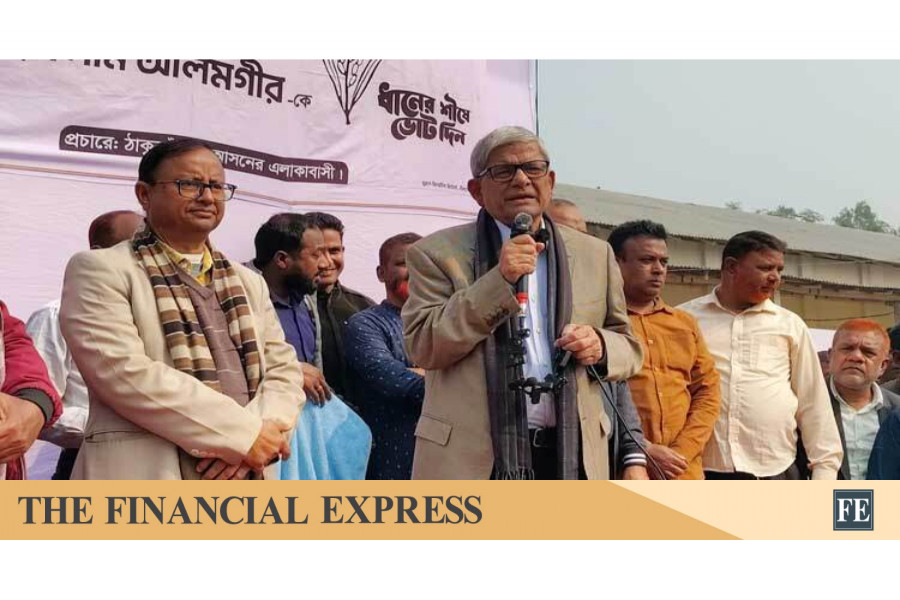
BNP Secretary General Mirza Fakhrul Islam Alamgir addresses an election rally in Nimbari, Thakurgaon Sadar Upazila on Saturday afternoon. Prothom Alo

Bangladesh Nationalist Party (BNP) secretary general Mirza Fakhrul Islam Alamgir said, “We had to go through immense struggles to secure the 12-February-election. We have been fighting tirelessly for the last 15 years for this. Twenty thousand people were killed and another 1,700 people who were subjected to enforced disappearance. Nearly two thousand students were killed during the July uprising of 2024. Only then did we get the election. That is why we consider this election extremely important. If the right government is not elected in this election, we will head in the opposite direction again.”

Mirza Fakhrul Islam Alamgir made these remarks on Saturday afternoon at election rallies in Debiganj Bazar and Nimbari in Thakurgaon Sadar upazila. Earlier, he attended a views-exchange meeting with the Thakurgaon Dairy Association at the training centre of the non-governmental organisation Manob Kalyan Parishad in the city.

The BNP secretary general, who is running for the polls from the Thakurgaon-1 constituency, further said, “We want to build a peaceful Bangladesh, where there is no division between Hindus and Muslims. Those who try to create division are harming the country. We must remember one thing: if we all move forward together, can anyone stop us? Can we progress if Hindus and Muslims are divided? We will develop Thakurgaon Sugar Mill. We will establish EPZs and set up industries so that people have jobs. We will build agro-based industries. A medical college will be established here. An airport will be opened and a university will be set up, Insha Allah.”

“This time the Awami League and the boat symbol are not in the race. This time a new contender is entering. Many of us do not know this contender. We do not know what will happen. The contender’s party has been involved in politics for a long time. In 1971, we fought the Liberation War. We had to leave our homes and flee to India. Many people were killed. The honour of mothers and sisters was violated. At that time, they did not want to recognise Bangladesh. How can we vote for people who did not trust my country! Not just Bangladesh, they did not even want Pakistan. When Pakistan was created in 1947, they opposed that too,” the BNP leader said.

Criticising Jamaat, Mirza Fakhrul said, “Maududi Saheb was the main leader of Jamaat. That is why everyone calls the party Maududi Jamaat. Maududi Saheb introduced a new interpretation of Islam, which we do not accept. Everyone says he acted outside Islam. We cannot accept that party, which acted outside religion, worked against my country, and collaborated in genocide.”

Earlier, at the exchange meeting, Mirza Fakhrul said, “This time we have an opportunity. If we apply it correctly, we will be able to choose the right person. I will not say, ‘Vote for me.’ If you feel that voting for me will put things in the right place, then vote accordingly.”​
 
Analyze

Analyze Post

Add your ideas here:
Highlight Cite Fact Check Respond

Tarique Rahman adopts different strategy to energise public rallies
Communication experts said that by calling a devout individual onto the stage and engaging in dialogue, Tarique Rahman created a connection with the large audience, increased interaction, and offered a response to the use of religion in election campaigning.

Selim ZahidDhaka
Published: 31 Jan 2026, 09: 21

1770081697222.webp


BNP Chairperson Tarique Rahman addresses a public rally at the Government Alia Madrasa ground in Sylhet on 22 January 2026. Anis Mahmud

At public rallies, the familiar tradition of the country’s politics is that leaders stand on the stage delivering speeches while party activists and supporters listen, applaud, and chant slogans. However, in this election campaign, Bangladesh Nationalist Party (BNP) chairman Tarique Rahman has added a different strategy to this familiar structure.

Tarique Rahman is not limiting himself only to speeches; at times he is calling ordinary people from the audience onto the stage, at other times speaking directly from the stage. He listens to local problems, asks questions, and gives immediate responses.

Campaigning for the 13th parliamentary election began on 22 January. On that day, Tarique Rahman launched his election campaign through a public rally in Sylhet city. It was there that he was first seen calling a person from the audience onto the stage and engaging in a conversation, which created considerable curiosity and excitement among those present.

In Sylhet, Tarique Rahman said that this time he wanted to ask a question to the people attending the rally. He then called for someone who had performed the holy Hajj or Umrah.

Many people raised their hands. From among them, Tarique Rahman called one person onto the stage. He asked the man where his home was. The answer came: Sunamganj. Tarique Rahman then asked the audience whether there were people from Sunamganj present. Hundreds of people raised their hands.

A conversation then began between Tarique Rahman and the person brought onto the stage. Both spoke through microphones, and the people at the rally listened. Tarique Rahman asked the man several religious questions. One of them was: Who owns heaven and hell? The man replied, “Allah.” Tarique Rahman then asked the audience whether anyone other than Allah has the authority to grant what belongs to Him. The crowd responded in unison, “No.”

Communication experts said that by calling a devout individual onto the stage and engaging in dialogue, Tarique Rahman created a connection with the large audience, increased interaction, and offered a response to the use of religion in election campaigning.

His conversations with these local individuals were striking. Some spoke about livelihood crises, others raised issues of law and order or rising prices. In immediate response, Tarique Rahman sometimes offered assurances, sometimes posed questions, and sometimes involved the entire rally in the discussion.

Not only in Sylhet, but in later rallies in other areas and in discussions with young people in different places, Tarique Rahman has used this strategy.

BNP insiders say this is a relatively new and striking strategy in Bangladesh’s electoral politics. Through this, public rallies are moving away from purely one-way speeches and becoming spaces for two-way interaction. This clearly conveys the message to voters that the party’s top leader is not only a speaker but also a listener.

According to analysts, a major target of this type of campaign is young and first-time voters, who are more accustomed to new digital platforms than traditional media. Monotonous speeches do not always attract people on digital platforms, whereas direct dialogue can.

BNP election steering committee member secretary and senior joint secretary general Ruhul Kabir Rizvi Ahmed told Prothom Alo, “I would say that this interaction, calling people from the crowd onto the stage and talking with them, represents a new kind of politics, through which a direct commitment between the leader and the people regarding problems and solutions is ensured. Moreover, people believe that only a leader who listens directly to problems or shows interest in listening can ensure solutions.”

Engaging the audience

Globally, many have been seen using such strategies. Most recently, in the New York City mayoral election in the United States, a large part of Democratic Party candidate Zohran Mamdani’s campaign was ‘interactive’, meaning Mamdani did not just speak one-way but also listened.

Former US President Barack Obama engaged directly with voters through ‘town hall meetings’ during his campaigns. French president Emmanuel Macron has also sparked discussions by participating in open dialogues with the public at various times.

Those involved say the aim of such campaign strategies is to reduce the distance between leaders and marginalised people. Outside politics, musicians or stage performers are often seen engaging directly with audiences at crowded gatherings. This is a popular global strategy for celebrities. Musicians or performers speak directly to audiences and take questions during concerts to make the atmosphere more lively and participatory. In communication terms, this is called ‘audience engagement’.

Tarique Rahman is not keeping people at rallies merely as listeners; he is turning them into speakers. At a rally in Bhashantek, Dhaka, on 23 January, Tarique Rahman spoke directly with five people—working-class individuals, small traders, women, and young people—standing in front of the stage.

Alongside differences in his speech style at rallies, another aspect of Tarique Rahman’s election campaign is also noticeable. That is, he is keeping his wife, Zubaida Rahman, by his side at election rallies. Such practices are commonly seen in the Western world. This strategy is known as presenting oneself as a ‘family man’.
His conversations with these local individuals were striking. Some spoke about livelihood crises, others raised issues of law and order or rising prices. In immediate response, Tarique Rahman sometimes offered assurances, sometimes posed questions, and sometimes involved the entire rally in the discussion.

Message of peace and tolerance

Since the day of his return to the country, Tarique Rahman has been trying to convey the message that restoring peace and order is his priority. He has also emphasised the importance of tolerance in politics.

Speaking at a reception event after returning to the country on 25 December, he said, “At any cost, we must remain calm in the face of provocation. We want peace in the country.”

In that speech, he said, “Regardless of our religion, class, or party affiliation, we must ensure that we maintain peace and order. We must ensure that people can live safely, that people of all classes and professions can remain safe.”

In his speeches at election rallies as well, Tarique Rahman has stressed peace and order. He has said that if BNP wins, law and order will be strictly controlled. At the same time, efforts to show tolerance are also visible. At a rally in Chattogram on 25 January, Tarique Rahman said that no matter who the rival parties are, many things can be said about them and many faults can be highlighted, but that will not benefit the people. Criticism for the sake of criticism will not fill people’s stomachs.

However, in this election, Tarique Rahman has criticised Jamaat-e-Islami’s role during the Liberation War and the use of religion in vote politics. At multiple programmes, he said, “These days, we hear some people or groups saying, ‘I saw this person, I saw that person, now look at this one.’ The people they talk about (Jamaat) were already seen by the people of this country in 1971. In 1971, how they killed hundreds of thousands of people to protect their own interests—just as the fallen autocrat killed thousands before fleeing to retain power.”

‘Family man’ image

Tarique Rahman, 60, joined BNP in 1988 by becoming a member of the Gabtali Upazila BNP unit in Bogura. He became a joint secretary general in 2002. After the death of his mother, former prime minister Khaleda Zia, last month, he became chairman, having previously served as acting chairman. Five days earlier, he returned to the country after 17 years of exile in the United Kingdom.

From 2003, Tarique Rahman became strongly involved in BNP’s organisational activities. That year, he held meetings with BNP’s union-level representatives across the country and later with Jatiyatabadi Chhatra Dal representatives. At these meetings, he would sometimes call local leaders onto the stage, ask questions, and respond. At times, he would step down from the stage with a microphone and go into the audience to ask questions directly.

Alongside differences in his speech style at rallies, another aspect of Tarique Rahman’s election campaign is also noticeable. That is, he is keeping his wife, Zubaida Rahman, by his side at election rallies. Such practices are commonly seen in the Western world. This strategy is known as presenting oneself as a ‘family man’.

The ‘family man’ image of politicians refers to presenting oneself to the public as a responsible husband, a caring father, and a person who believes in family values.

Communication experts say this is a very powerful and popular strategy in politics. Its main goal is to prove oneself as an ordinary and trustworthy person beyond a rigid or stern political identity.

How effective will it be?

Election campaigning will end on 10 February. By then, Tarique Rahman must reach 127.7 million voters. Informing voters about BNP’s election promises and what the party will do if it forms the government is essential, but not easy.

How effective Tarique Rahman’s strategy has been will be understood after the vote on 12 February. However, this campaign strategy and presentation at public rallies has already sparked discussion in political circles and is being seen as an attempt to give public rallies a new dimension.

Professor SM Shamim Reza of the Department of Mass Communication and Journalism at the University of Dhaka told Prothom Alo that such ‘interactive campaigns’ are not entirely new in the context of Bangladesh. Even in earlier times, the core of public relations was reaching out to people, listening to them, and even shaping local agendas in elections based on public opinion.

“It seems to me that Tarique Rahman wants to run a total campaign. I call it a total campaign because this is the era of digital media, where there are countless digital platforms. At the same time, there is a huge number of young and new voters who are not accustomed to very old media—radio, television, newspapers—but are used to new media and new platforms. My sense is that he is trying to address both aspects equally,” he added.​
 
Analyze

Analyze Post

Add your ideas here:
Highlight Cite Fact Check Respond

Posts you haven't read yet..

Members Online

Latest Posts

Back
 
G
O
 
H
O
M
E