Home Watch Videos Wars Movies Login

[🇧🇩] Monitoring the political activities of BNP

Latest Posts Countries Wars Q&A

[🇧🇩] Monitoring the political activities of BNP
413
11K
More threads by Saif

G Bangladesh Defense

Bangladesh Television to air Tarique’s address on Feb 9
Staff Correspondent 03 February, 2026, 20:56

1770169222851.webp

Tarique Rahman. —New Age photo

Bangladesh Nationalist Party chairman Tarique Rahman is set to deliver an electoral address to the nation on the Bangladesh Television on February 9, ahead of the upcoming referendum and national elections scheduled for February 12.

The Election Commission on Tuesday sent a letter to the BTV director general allocating the final slot on February 9 for broadcasting Tarique’s address as part of electioneering, the commission’s director for public relations Ruhul Amin Mollik told New Age.

Creating an environment conducive to polls is crucial for a free, fair and credible election, and providing equal access to electioneering opportunities on state-run media is an important part of fostering such an environment, the commission underlined in the letter.

All party leaders are entitled to request a broadcast slot through formal applications and so far, the BNP remains the only party to have applied, Ruhul Amin said.

In the letter, the commission issued a set of instructions on the allocation of slot for airing the electoral addresses of party chiefs.

According to the instructions, slots would be assigned on strictly in the order in which the parties submit the applications, in line with the National Parliament Election Code of Conduct 2025.

The instructiond said that BTV would determine both the slot allocation and the duration of each party leader’s broadcast, coordinating recording dates and times with the relevant parties.

Since no applications have been received from parties other than the BNP, the BNP chief’s address has been scheduled for the final slot on February 9, said the instructions.​
 
Analyze

Analyze Post

Add your ideas here:
Highlight Cite Respond

Undercover activists rise as new tyrants, says Tarique
Staff Correspondent 05 February, 2026, 00:16

1770281026151.webp

BNP chairman Tarique Rahman waves while addressing an election rally at Bells Park on Band Road in Barishal town on Wednesday. | New Age photo

Bangladesh Nationalist Party chairman Tarique Rahman on Wednesday said that leaders and activists of a political party in Bangladesh, who are known as ‘undercover’ members, had emerged as new tyrants.

In a veiled reference to the Bangladesh Jamaat-e-Islami, Tarique said that it was deeply painful to witness the emergence of a new oppressor and alleged that the leader of the group had publicly used a highly derogatory and stigmatising term against Bangladeshi women two days earlier.

He said that a conspiracy had begun against the people’s freedom, their rights to vote, and their rights to speak, and that the ‘undercover group’ was behind it.

The BNP chairman made the remarks in separate election rallies in Barishal and Faridpur.Bangladesh cultural tours

Tarique said that when a political party or its leader’s thinking or ideology developed such vile notions about the mothers and sisters of their own country, nothing good could be expected from them.

He said that that this had been evident during the Liberation War in 1971, when millions of women, mothers, and sisters in Bangladesh were dishonoured due to the controversial role of the ‘undercover’ group.

New Age correspondent from Barishal reported that Tarique, in his speech at Bell’s Park Maidan in the city, said that a person or a political party showing no respect for the mothers and sisters of their own country could never be expected to contribute to Bangladesh’s progress.

The BNP chairman said that recent media reports indicated the group had been producing fake seals and printing ballot papers for their own benefits, while also collecting national identity numbers and mobile payment numbers from vulnerable women.

He said that the group’s claims of establishing honest governance were contradicted by their pre-election unethical activities.

Tarique said that those who lied to cover their crimes could never offer honest rule.

He urged BNP supporters to remain vigilant, ensure voters in their communities stay alert, and prevent anyone from hijacking their rights on February 12.

‘The BNP believes that the people are the source of all power — and our goal is the people — our objective is the people — if we can change the fate of the people, then we have to take this country forward,’ he said.

Regarding the development of Barishal, Tarique said that the BNP would undertake various developmental initiatives, including Bhola-Barishal Bridge, industrialisation of Barishal by using natural gas, employment of manpower and preventing river erosion.

Speaking at a separate rally at the Rajendra College ground in Faridpur, the BNP chairman said that only a government accountable to citizens could solve regional problems and move the country forward.

Outlining the BNP’s plans, he identified river erosion as Faridpur’s most pressing challenge and said that his party would take measures to protect farmland.

He described the greater Faridpur region as agriculture-based, highlighting the potential of the jute sector to support farmers and earn foreign exchange through exports.

Tarique said that the BNP planned to introduce farmer cards to ensure timely access to seeds, fertilisers and inputs, expand industries based on regional strengths to create jobs for educated youth, and promote both agriculture and industry together.

He pledged family cards for households, expanded healthcare services through hospital upgradation and community health workers, and construction of a Padma barrage to address dry-season water shortages.

If the BNP is voted to power in the February 12 polls, it would consider declaring Faridpur a division and upgrading the town to a city corporation, provided these measures help address local problems, he added.​
 
Analyze

Analyze Post

Add your ideas here:
Highlight Cite Respond

BNP vision is equal rights for all faiths, not secularism: Fakhrul tells Al Jazeera

The term is ‘not congenial’ for Bangladesh’s politics, he says


1770341254747.webp

Screengrab

BNP Secretary General Mirza Fakhrul Islam Alamgir has said that secularism is not the party's objective, asserting that the term is not "congenial" for the politics of Bangladesh.

Speaking to Al Jazeera, Fakhrul defended Tarique Rahman’s leadership and outlined a vision focused on equal rights for all faiths rather than secularist ideology.

Addressing the 1977 removal of "secularism" from the constitution by BNP founder Ziaur Rahman, Fakhrul said, "Secularism is not our goal."

He explained that the decision reflected the "philosophy of the party at that time".

Highlighting the country’s demographics, he added that the word "is not at all very congenial for Bangladesh's politics".

Instead, Fakhrul argued that the BNP’s framework ensures religious freedom.

Regarding the party's chairman, Tarique Rahman, Fakhrul dismissed allegations of nepotism and corruption.

He described Tarique as the "most capable man" to lead the nation should the BNP win the upcoming elections.

He rejected the 80 plus cases previously filed against Tarique as "totally baseless" and "politically motivated," claiming the previous "fascist regime" failed to prove any allegations over 15 years.

Responding to a question on the upcoming election and exclusion of Awami League, Fakhrul said, "Now the question is when a political party or the leader of the political party has killed not less than 2,000 students and the agitators or the people who demonstrate against them... They involved themselves with and used the state apparatus including the police and others to kill those people. Naturally, there will be demand for those people that they should be tried, and so they were tried. It was Awami League in general that were involved in these things. All the ministers, all the members of the party were involved."

He, however, expressed his personal opposition to banning political parties, including the Awami League or Jamaat-e-Islami.

"I personally don't support this sort of banning a political party," he said, suggesting that individuals responsible for "genocide" should be tried rather than the entire organisation.

On international ties, Fakhrul said the BNP would "diplomatically try" to repatriate Sheikh Hasina from India to face execution of her convictions.

He expressed hope that relations with New Delhi would improve, describing a recent letter of condolence from Indian Prime Minister Narendra Modi following Khaleda Zia's death as a "very good gesture."​
 
Analyze

Analyze Post

Add your ideas here:
Highlight Cite Respond

Tarique pledges to give ‘utmost priority’ to curbing corruption

bdnews24.com
Published :
Feb 06, 2026 20:16
Updated :
Feb 06, 2026 20:16

1770423746766.webp


BNP Chairman Tarique Rahman has pledged to give the ‘utmost priority’ to curbing corruption and establishing the rule of law and accountability if his party wins the general election.

He warned that without taking stern measures in these three sectors, no national plans can be successfully implemented.

Tarique made this commitment on Friday during the unveiling of the BNP election manifesto, where he also defended his party's record against graft allegations dating back to the 2001–2006 term.

The manifesto, built on the promise of creating a "humane, inclusive, and accountable state”, focuses on nine priority areas.

The party chief described the document not merely as a set of election pledges, but as a declaration of a "new social and state contract”.

In the "Governance" section under the chapter on state reforms, the BNP addressed the issue of Bangladesh repeatedly topping Transparency International’s corruption index during the previous BNP-Jamaat coalition government.

While the Jamaat-e-Islami has recently used that period to attack the BNP during the current campaign, Tarique blamed the preceding Awami League administration (1996–2001) for the "corruption champion" label.

In the manifesto, Tarique said the BNP took over a country already leading in corruption from the Awami League in October 2001 and immediately launched an all-out effort to control it.

To strictly manage graft, the Khaleda Zia government transformed the then "Anti-Corruption Bureau" into a fully independent "Anti-Corruption Commission”, free from government interference, he added.

He noted that due to multiple government steps, Bangladesh's position on the corruption index began to improve from the very first year.

"As a result, the score in the TIB report rose from 0.4 in 2002 to 1.2. It reached 1.3 in 2003, 1.4 in 2004, 1.5 in 2005, and 2.0 in 2006. This means corruption was consistently declining in Bangladesh," the manifesto reads.

The BNP chairman also claimed that the "unbridled corruption of the fallen fascist government" caused the score to drop again from 2013.

He promised that if the BNP is given the chance to run the state by the people's mandate, fighting corruption and maintaining law and order will be the first priorities.

He vowed that the BNP would make no compromises on corruption, pledging to curb the graft that has spread like a “cancerous wound” through all levels of society by ensuring transparency, accountability, and legal and systemic reforms.

The party plans to reform the Anti-Corruption Commission and its laws, while noting that the interim government’s recent measures for the commission remain “insufficient”.

Concluding a speech lasting nearly two hours, Tarique returned to the themes of graft and governance.

He said if his party wins the election on the 12th and forms the government, their highest priority will be placed on three pillars: anti-corruption, the rule of law, and accountability.

The event began at 3:30pm at the ballroom of Pan Pacific Sonargaon Dhaka with a recitation from the Quran and the national anthem.​

Presided over by Secretary General Mirza Fakhrul Islam Alamgir, the programme was conducted by Ruhul Kabir Rizvi, the member secretary of the central election steering committee.
 
Analyze

Analyze Post

Add your ideas here:
Highlight Cite Respond

‘Bangladesh Before All’ at the core of BNP’s foreign policy

Party believes that beyond Bangladesh's borders, there are friends, not masters, says Tarique


1770425548183.webp

FILE VISUAL: STAR

BNP Chairman Tarique Rahman has reaffirmed the party's commitment to conducting foreign policy in a way that prioritises the country's and the people’s interests.

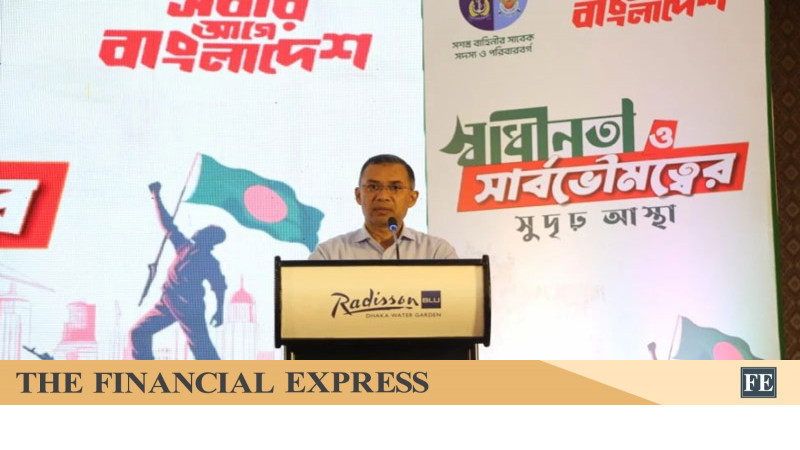
He reiterated BNP’s pledge while unveiling the party’s election manifesto at a press conference at the Pan Pacific Sonargaon Hotel in Dhaka today.

Tarique outlined the core principles that would guide BNP’s foreign policy, saying, "Our foreign policy will focus on protecting the interests of our country and its people. Through the cooperation and friendship of other nations, we can foster new businesses in Bangladesh, create employment opportunities, strengthen our economy, and ensure that our country's independence and sovereignty remain intact."

Tarique said BNP will emphasise establishing bilateral and multilateral relations with all states based on equality, fairness, pragmatism, and recognition of mutual interests.

The manifesto says, "The core philosophy of BNP's foreign policy is 'Bangladesh Before All'. BNP believes that beyond Bangladesh's borders, there are friends, not masters. In every aspect of foreign policy, Bangladesh's independence, sovereignty, national interests, national security and people's welfare will receive top priority."

The BNP chairman also addressed the ongoing Rohingya crisis, describing it as a major humanitarian challenge for Bangladesh.

"Currently, we host approximately 1.2 million Rohingyas. While Bangladesh has offered them shelter in the face of dire circumstances in their homeland, it remains imperative that we create a safe environment for their return. We want to ensure their safe repatriation to their own land,” Tarique said.

The BNP chief also highlighted the importance of resolving water-sharing disputes with neighbouring countries, specifically regarding the Padma, Teesta, and other rivers.

"We face challenges in water distribution across several rivers. BNP intends to sit down with the countries involved and work together to resolve these issues, ensuring our citizens receive their fair share of water."

Tarique also reiterated the party's commitment to improving the welfare of expatriate Bangladeshis, estimated at around 15 million.

The manifesto outlines BNP’s broader foreign policy goals, which include exploring new markets abroad, enhancing border security, forming strategic partnerships with Gulf nations, strengthening ties with the Muslim world, and increasing global trade and diplomatic cooperation.BNP also aims to bolster soft power, prioritise sports and cultural diplomacy, and improve the administrative capacity of the Ministry of Foreign Affairs, with a strong emphasis on economic diplomacy.​
 
Analyze

Analyze Post

Add your ideas here:
Highlight Cite Respond

ACCOUNTABILITY, RULE OF LAW, ANTI-CORRUPTION CORE GOVERNANCE ETHICS

BNP pledges economic, political democratisation if voted to power


FE REPORT
Published :
Feb 07, 2026 01:08
Updated :
Feb 07, 2026 01:08

1770510446856.webp


Economic and political democratisation free from oligarchs, higher foreign direct investment (FDI), financial-sector reforms, capital-market development and trade liberalisation are central to BNP vision for rebuilding a "fragile economy".

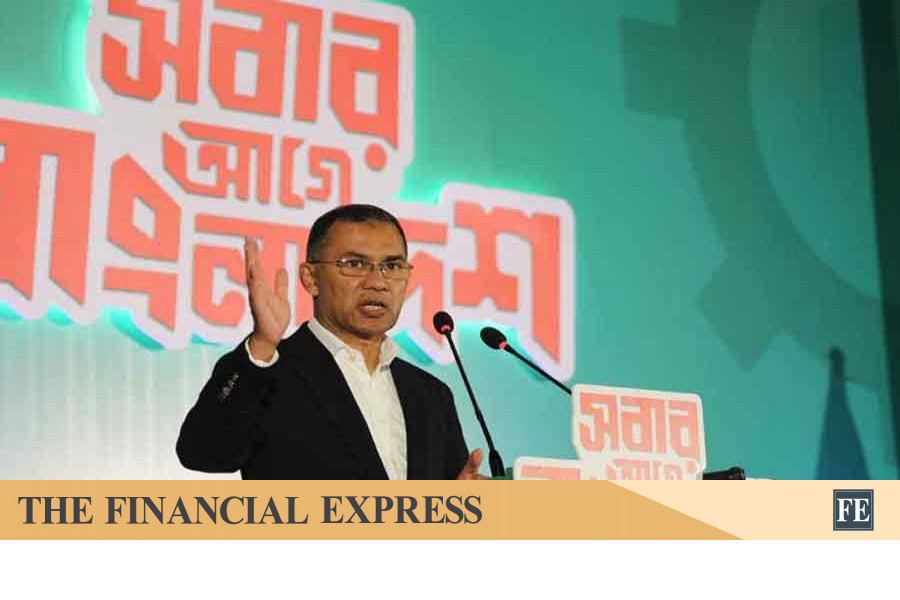
Chairman of the Bangladesh Nationalist Party (BNP) Tarique Rahman Friday expounded economic and political agenda set forth in his party's election manifesto, on the cusp of transition through the upcoming polls from the interregnum following the mass uprising.

"BNP's leadership will not be based on special privileges for any group but on the productive power of every citizen," Mr Rahman said while presenting the manifesto, based on their previously placed 31-point state-rebuilding programme and the post-uprising July Charter.

"At the centre of this vision is economic democratisation, through which the economy will be inclusive, participatory and open to all."

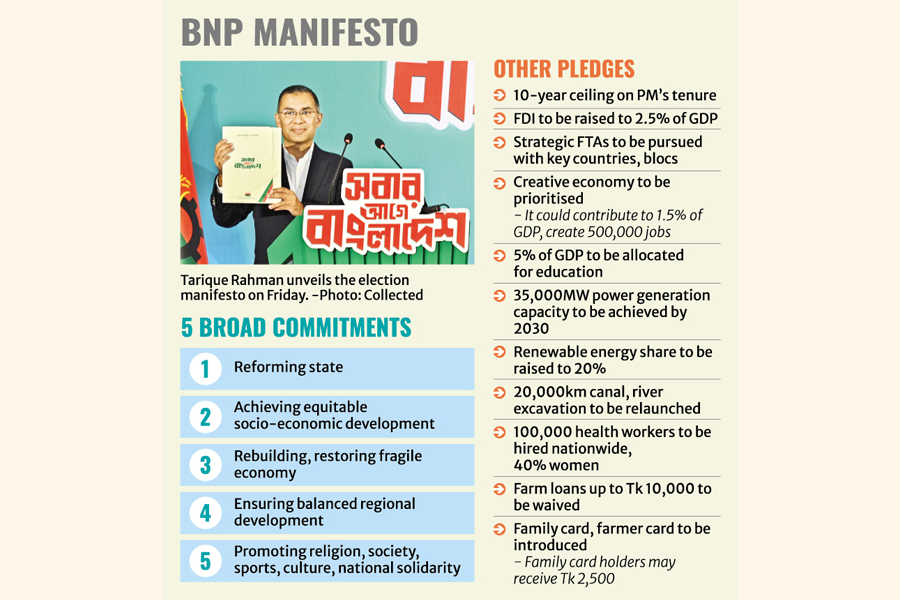
The BNP announced its manifesto for the 13th National Parliament election under five broad commitments: reforming the state, achieving equitable socioeconomic development and sustainable state capacity, rebuilding and restoring the fragile economy, ensuring balanced regional development, and promoting religion, society, sports, culture and national solidarity.

The manifesto presentation, moderated by BNP senior joint secretary- general Ruhul Kabir Rizvi and held at a city hotel, lasted more than two hours.

BNP secretary-general Mirza Fakhrul Islam Alamgir also spoke at the event, attended by political leaders, members of diplomatic corps and journalists.

Tarique Rahman said dismantling oligarchic structures, creating jobs and building a trillion-dollar economy by 2034 would be central priorities.

"Policy continuity and a comprehensive investment framework are essential to attract foreign investment," he said, setting a target of raising FDI to 2.5 per cent of GDP.

He proposed abolishing the banking division under the Ministry of Finance, arguing that it hampers the independence of the banking and financial sector.

"We will appoint competent and professional individuals to regulatory bodies to ensure efficiency and politics-free function," he said.

If elected to rule this time around, the former ruling party pledges a review of non-performing loans (NPLs), warning that those responsible for loan irregularities would be brought to justice.

As part of supporting agriculture, farm loans up to Tk10,000 along with interest will be waived.

Mr. Rahman said BNP would pursue strategic free-trade agreements with key countries and economic blocs across Asia, Europe, Africa and the Middle East.

The party would also prioritise the "creative economy", including film, music, theatre and digital content. Also short documentary films will be made on social values.

"If proper steps are taken, the creative economy could contribute 1.5 per cent of GDP and create 500,000 jobs," he said, citing South Korea's success in earning billions from content posts to social-media platforms.

He mentions that rapid development of the ICT sector and education reform could generate 200,000 jobs in cybersecurity, business-process outsourcing (BPO), artificial intelligence, data services, semiconductors and Industry 4.0 technologies.

The BNP chief, who had been nearly 17 years in exile in the UK, blames "corruption, opaque procurement and costly capacity charges" for high energy costs over the past decade.

He sets a target of raising power-generation capacity to 35,000 megawatts by 2030 and increasing renewable energy's share to 20 per cent of the energy mix.

He has stressed the need for independent rule of law, saying: "I know how I was victim of injustice."

To support inclusive growth, BNP plans to introduce 'Family Card' and 'Farmer Card' with a twin goal of helping families and strengthening local economies with their contributions.

Family cardholders may receive Tk2,500, while farmers, small traders, fishermen and livestock farmers would receive either cash support equivalent to input costs or direct farm inputs.

The party also pledges to strengthen local government, citing European models.

Tarique said the BNP will re-launch excavation around 20,000 kilometres of canals and rivers to improve water retention and support agriculture.

Expansion of Barind-type irrigation projects is also planned.

Mr. Rahman proposes allocating 5.0 per cent of GDP to education and introducing a "one tablet for one teacher" initiative.

Stressing the importance of healthcare, the party pledges stronger preventive care and the recruitment of 100,000 new health workers nationwide, 40 per cent of them women.

As planned, the women health workers will visit households and let them know how to prevent many diseases by changing lifestyles or eating habits.

He stresses that Bangladesh's future depends on a skilled, self-reliant and responsible youth population, with expanded employment and training opportunities.

The BNP manifesto provides for bicameral parliament and prime minister's tenures limited to total 10 years. As part of rebuilding state structure, an ombudsman will be appointed to ensure checks and balances.​
 
Analyze

Analyze Post

Add your ideas here:
Highlight Cite Respond

Tarique Rahman calls vigilance to protect voting rights

UNB
Published :
Feb 09, 2026 00:41
Updated :
Feb 09, 2026 00:41

1770596427599.webp


BNP Chairman Tarique Rahman on Sunday urged people across the country to remain alert so that no one can snatch away their voting rights or manipulate the results of the national election through conspiracies.

“You must remain alert so that no one can turn your vote into a dummy election and lock it inside ballot boxes. No one should be allowed to steal your voting rights or change the election results through conspiracy,” he said.

Tarique issued the warning while speaking at an election rally at the National Bangla High School ground in Mirpur in support of BNP candidate Sanjida Islam Tuli for the Dhaka-14 constituency

He said BNP does not want to make promises that are beyond people’s capacity or outside what Allah has enabled humans to do.

The BNP chief alleged that a certain party is trying to mislead people in the name of religion and is also engaging in conspiracies to influence the election.

“We have already seen that people from that party were caught while trying to make fake seals. They also went to innocent mothers and sisters to collect NID numbers and bKash numbers to mislead them,” he said.

In an oblique reference to Bangladesh Jamaat-e-Islami, Tarique said such party has a history of standing against people, including during the Liberation War and the mass movement of 1990.

“They have repeatedly abandoned the people and sided with anti-democratic forces,” he said.

Outlining BNP’s plans if it comes to power, Tarique said the party believes people need plans and programmes, not empty criticism.

“I could stand here and criticise our political opponents, but that would not benefit the people. What people need are plans and programmes that can truly change their fate. At this moment, BNP is the only political party that has such plans,” he said.

Criticising the past 16 years of governance by Awami League, the BNP chairman said so-called mega projects did not bring real benefits to ordinary people.

“Mega projects were carried out in the name of development, but people’s lives did not improve. Only a handful of people benefited, filling their pockets with huge amounts of money,” he said.

Calling on voters of Dhaka-14, Tarique urged them to support BNP candidate Sanjida Islam Tuli.

“Please look after Tuli until February 12. From February 13, she will be responsible for looking after all of you. We nominated her because she understands people’s pain and stands beside them,” he said.

Earlier, speaking at another rally at the Shyamoli Club ground in support of BNP-backed candidate Bobby Hajjaj for Dhaka-13, Tarique said restoring law and order will be a top priority if BNP forms the government.

“Ensuring public safety and freedom of movement is crucial for the success of any development initiative,” he said.

The BNP chief also said law and order would be ensured not only in Dhaka but across the country.

“Our mothers and sisters must be able to walk safely on the streets. People should be able to return home safely and sleep in peace,” he said.

Seeking votes for Bobby Hajjaj, Tarique said BNP is the only political force with a realistic plan for the people.

“We want to do what is possible for the people. We will not make promises that cannot be delivered,” he said.

The BNP chief assured voters that resolving Dhaka’s long-standing waterlogging problem would be a priority if BNP comes to power.

Referring to urban management, Tarique warned against the illegal occupation of canals, saying it worsens waterlogging and hampers people’s movement.

He said action will be taken against anyone who blocks canals and causes suffering to the people, regardless of how powerful they are.

Referring to political changeover through a mass uprising in 2024, Tarique said the sacrifices made during past uprisings must lead to the restoration of democratic rights.

“For the last 16 years, people could not vote in so-called elections. Now they will be able to vote. Freedom of speech has returned, and many people have sacrificed their lives for it,” he said.

Tarique urged voters to support BNP candidates to begin what he described as a new chapter of governance focused on safety, accountability and democratic rights.​
 
Analyze

Analyze Post

Add your ideas here:
Highlight Cite Respond

BNP manifesto targets 2.5pc FDI rise by 2034
Currently, Bangladesh's FDI is nearly 0.45 per cent of the GDP which is hovering at about US$1.5 billion annually


FHM Humayan Kabir
Published :
Feb 08, 2026 14:27
Updated :
Feb 08, 2026 14:27

1770597435047.webp


In a major move to reshape the nation's economic landscape, the Bangladesh Nationalist Party (BNP) vows to enhance the country's Foreign Direct Investment (FDI) to 2.5 per cent of the Gross Domestic Product (GDP) by 2034 from the current weak trajectory.

The party will appoint "FDI Captains" to act as liaisons for private sector internal and external investors and establish a 24/7 help desk to boost the investments.

Currently, Bangladesh's FDI is nearly 0.45 per cent of the GDP which is hovering at about US$1.5 billion annually.

In the national election 2026 manifesto, the BNP has described their plans and strategies for upgrading the country's investment scenario from the present bleak state.

The party announced its manifesto on Friday in Dhaka placing the massive surge in Foreign Direct Investment (FDI) at the heart of its "Bangladesh First" policy.

This FDI enhancement target is part of the BNP's broader "31-point" state reform outline aimed at transforming Bangladesh into a $1.0 trillion economy by 2034.

Criticizing the current economic structure as "fragile and oligarchic", BNP Chairman Tarique Rahman has proposed a transition from a consumption-based, debt-driven model to an investment-led growth strategy.

"Our goal is to democratize the economy," the manifesto states. "By dismantling barriers and ensuring transparency, we aim to make Bangladesh an irresistible destination for global capital."

To bridge the gap between 0.45 per cent and 2.5 per cent, the BNP has proposed 11 specific regulatory reforms designed to restore investor confidence.

Between 1972 and 2005, net FDI inflow in Bangladesh always remained less than 1.0 per cent of GDP, central bank data showed.

Between 2005 and 2015, Bangladesh saw a gradual but slight rise in the net FDI inflows with a peak of 1.74 per cent of GDP in 2013.

Nevertheless, ever since 2013, net FDI inflow as a share of GDP in Bangladesh has been on the decline. In 2021, FDI was only 0.41 per cent of the GDP of Bangladesh against 0.45 per cent of GDP last year.

The BNP manifesto said it would empower BIDA (Bangladesh Investment Development Authority) transforming the Authority into a highly effective, empowered body.

It wants to strengthen the "Single-Window" and facilitate the clearance implementing a fully digitized work flow to eliminate bureaucratic red tape and physical contact, reducing corruption.

It has pledged to build an automated profit repatriation system, investor protection laws, and modernized visa policies.

The manifesto identifies several high-potential sectors as primary targets for this new wave of investment including IT and hardware, renewable energy, blue economy, and pharmaceuticals & agro-processing sector.

Economists note that hitting the 2.5 per cent mark would require a radical overhaul of the country's ease-of-doing-business ranking.

While recent data from early 2026 showed a slight uptick in net FDI inflows, reaching the BNP's target would necessitate several billion dollars in additional annual investment compared to current levels.

The BNP also plans to establish an Economic Reform Commission and a National Trade Competitiveness Council to monitor these targets and ensure that fiscal and monetary policies remain stable and predictable for long-term investors.​
 
Analyze

Analyze Post

Add your ideas here:
Highlight Cite Respond

Members Online

No members online now.

Latest Posts

Back
 
G
O
 
H
O
M
E