Bangladesh Defense

Saif
Senior Member
- Joined
- Jan 24, 2024
- Messages
- 22,387
- Likes
- 9,875
- Nation

- Axis Group


100 Days of BNP govt: Bright start despite grim inheritance
When the BNP swept to power in February, expectations ran high. After years of misrule, voters were hungry for change.
100 Days of BNP govt: Bright start despite grim inheritance
Sajjad Hossain and Wasim Bin Habib
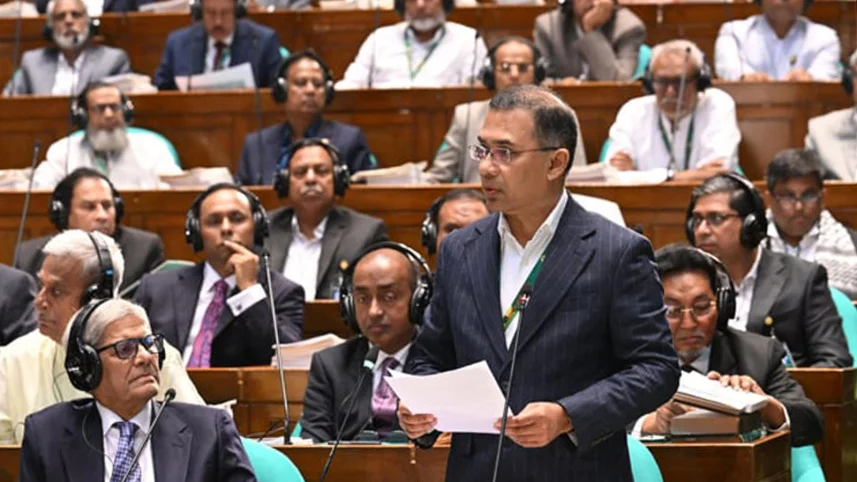
AFP file photo
When the BNP swept to power in February, expectations ran high. After years of misrule, voters were hungry for change. Three months on, Tarique Rahman’s government has made an encouraging start. As the administration is set to cross its first hundred days, the picture that emerges is one of earnest efforts.
The administration moved quickly on several fronts. It launched welfare programmes, signalled fiscal restraint and attempted to bring stability to key sectors. Family and farmers’ cards were distributed. Allowances were extended to religious leaders of various faiths. Canal excavation projects linked to rural development got under way. In a pointed gesture of austerity, BNP lawmakers gave up tax-free vehicles in a break from the past. The government is also taking steps to train people in technology, and has begun rolling out a 180-day programme tied to its electoral pledges -- the results of which, the home minister says, will be shared once the period concludes.
The first cabinet meeting set three clear priorities -- controlling commodity prices, improving law and order, and securing uninterrupted power and energy supplies. On all three, visible progress remains elusive.
The economic inheritance was grim. High public debt, a weakened banking sector and an investment drought greeted the new administration. Inflation, which had hovered between 8 percent and 9 percent for much of the past year, briefly eased in March, but it climbed back above 9 percent in April, prolonging hardship for the low-paid and those on fixed incomes.
Then came an external shock. The outbreak of the US-Israel war on Iran, within a fortnight of the government taking office, disrupted global energy supply chains, squeezed import budgets and forced hasty improvisation. The government introduced austerity measures -- cutting operating hours for offices, banks, shopping malls and markets to ease pressure on fuel, gas and electricity -- and scrambled to import LNG and fuel oil from multiple sources. Distribution, however, remained erratic. Complaints of shortages and irregularities surfaced in several districts, suggesting the government has struggled to enforce discipline and efficiency in the supply chain.
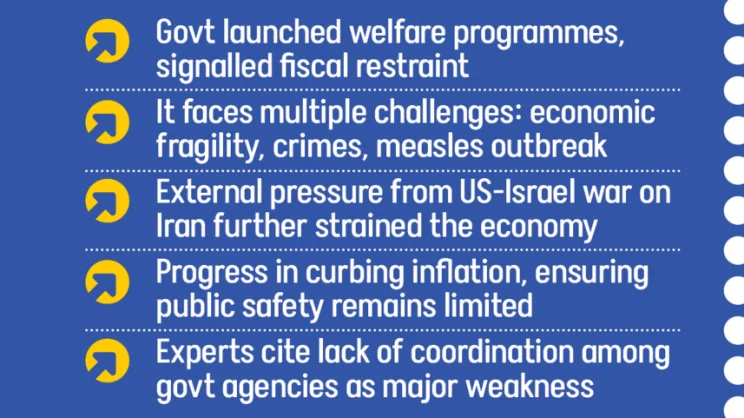
Beyond steep economic challenges, the government is confronting multiple problems -- worsening law and order and a deadly public health failure -- which it argues were largely inherited.
Political analysts said the government is entering a critical phase, as its long-term credibility now depends on turning its strong mandate into visible progress in the economy, public services and security.
Mohammad Mojibur Rahman, a professor at Dhaka University’s Institute of Education and Research, said the government’s biggest weakness has been poor coordination.
“The prime minister appears to want positive changes, but cabinet members are not properly translating his expectations into action. Some ministers are speaking beyond their responsibilities, while government activities often seem uncoordinated.”
Referring to the ongoing measles crisis, he said the failure may have roots in the previous government, but the current administration must develop long-term plans for health, education and labour sectors, while ensuring swift justice in rape and sexual violence cases.
Al Masud Hasanuzzaman, a former professor of government and politics at Jahangirnagar University, said the government has taken some people-friendly measures, including the introduction of family cards, but major challenges such as maintaining law and order remain.
“The government is working, but no major structural changes are visible as of now. Administrative and institutional systems continue to operate with the same old weaknesses,” he said, pointing out that parliament has not yet approved the key reforms discussed during the interim government’s tenure.
Al Masud noted that the government should shun partisanship in the appointments of government employees as this directly affects its public image. “It must make sure that neutral and qualified people get appointed.”
Several top BNP leaders and government officials said the vulnerabilities now being exposed are the result of years of economic mismanagement, rising public debt and weakened institutions during the tenure of the Awami League government.
Home Minister Salahuddin Ahmed, also a BNP Standing Committee member, said a 180-day programme has been rolled out to fulfil scores of the ruling party’s electoral pledges. Once it ends, the government will share the outcome.
Noting that there is no coordination problem within the government, he said the PM coordinates with ministers and gives necessary instructions at every cabinet meeting. Inter-ministerial meetings are also held whenever needed.
He further said the government has started implementing programmes promised in the election manifesto, including card-based schemes. It is also taking steps to train people in technology.
The implementation of plans has begun across all sectors, but three months are insufficient for a meaningful assessment, he added.
LAW AND ORDER STILL A CONCERN
Despite being identified as a top priority, law and order remains a major concern.
During the interim government’s tenure, the security situation was volatile, marked by mob violence and other crimes, with little sign of improvement so far.
There has been hardly any let-up in murders, extortion incidents, mob attacks, kidnappings and other crimes across the country, renewing public anxiety over safety.
Although the authorities carried out several anti-crime drives over the last three months, law enforcement agencies continue to struggle to contain criminal activities.
Professor Mojibur said the government should have prioritised public safety over other matters such as multiple welfare initiatives.
“Law and order should have come first. The situation remains fragile,” he said.
When asked, Salahuddin said law enforcement agencies are trying their best to maintain law and order. They are responding quickly to complaints and arresting offenders.
He also said the government is working on police reform and on measures to ensure discipline within the force.
“I think law and order is now at a level that is in line with public expectations,” he said.
Meanwhile, the measles outbreak among children has posed the biggest challenge to the administration.
More than 500 children are reported to have died from measles or measles-like symptoms across the country. UNICEF said that it had repeatedly warned the interim administration about looming vaccine shortages and the risk of a major outbreak. Those warnings, however, went largely unaddressed.
The current government responded with emergency vaccine procurement, immunisation drives and administrative reshuffles in parts of the health sector.
Both Mojibur and Al Masud said the coming months will determine whether the BNP government can transform its overwhelming electoral mandate into durable political credibility.
Sajjad Hossain and Wasim Bin Habib
AFP file photo
When the BNP swept to power in February, expectations ran high. After years of misrule, voters were hungry for change. Three months on, Tarique Rahman’s government has made an encouraging start. As the administration is set to cross its first hundred days, the picture that emerges is one of earnest efforts.
The administration moved quickly on several fronts. It launched welfare programmes, signalled fiscal restraint and attempted to bring stability to key sectors. Family and farmers’ cards were distributed. Allowances were extended to religious leaders of various faiths. Canal excavation projects linked to rural development got under way. In a pointed gesture of austerity, BNP lawmakers gave up tax-free vehicles in a break from the past. The government is also taking steps to train people in technology, and has begun rolling out a 180-day programme tied to its electoral pledges -- the results of which, the home minister says, will be shared once the period concludes.
The first cabinet meeting set three clear priorities -- controlling commodity prices, improving law and order, and securing uninterrupted power and energy supplies. On all three, visible progress remains elusive.
The economic inheritance was grim. High public debt, a weakened banking sector and an investment drought greeted the new administration. Inflation, which had hovered between 8 percent and 9 percent for much of the past year, briefly eased in March, but it climbed back above 9 percent in April, prolonging hardship for the low-paid and those on fixed incomes.
Then came an external shock. The outbreak of the US-Israel war on Iran, within a fortnight of the government taking office, disrupted global energy supply chains, squeezed import budgets and forced hasty improvisation. The government introduced austerity measures -- cutting operating hours for offices, banks, shopping malls and markets to ease pressure on fuel, gas and electricity -- and scrambled to import LNG and fuel oil from multiple sources. Distribution, however, remained erratic. Complaints of shortages and irregularities surfaced in several districts, suggesting the government has struggled to enforce discipline and efficiency in the supply chain.
Beyond steep economic challenges, the government is confronting multiple problems -- worsening law and order and a deadly public health failure -- which it argues were largely inherited.
Political analysts said the government is entering a critical phase, as its long-term credibility now depends on turning its strong mandate into visible progress in the economy, public services and security.
Mohammad Mojibur Rahman, a professor at Dhaka University’s Institute of Education and Research, said the government’s biggest weakness has been poor coordination.
“The prime minister appears to want positive changes, but cabinet members are not properly translating his expectations into action. Some ministers are speaking beyond their responsibilities, while government activities often seem uncoordinated.”
Referring to the ongoing measles crisis, he said the failure may have roots in the previous government, but the current administration must develop long-term plans for health, education and labour sectors, while ensuring swift justice in rape and sexual violence cases.
Al Masud Hasanuzzaman, a former professor of government and politics at Jahangirnagar University, said the government has taken some people-friendly measures, including the introduction of family cards, but major challenges such as maintaining law and order remain.
“The government is working, but no major structural changes are visible as of now. Administrative and institutional systems continue to operate with the same old weaknesses,” he said, pointing out that parliament has not yet approved the key reforms discussed during the interim government’s tenure.
Al Masud noted that the government should shun partisanship in the appointments of government employees as this directly affects its public image. “It must make sure that neutral and qualified people get appointed.”
Several top BNP leaders and government officials said the vulnerabilities now being exposed are the result of years of economic mismanagement, rising public debt and weakened institutions during the tenure of the Awami League government.
Home Minister Salahuddin Ahmed, also a BNP Standing Committee member, said a 180-day programme has been rolled out to fulfil scores of the ruling party’s electoral pledges. Once it ends, the government will share the outcome.
Noting that there is no coordination problem within the government, he said the PM coordinates with ministers and gives necessary instructions at every cabinet meeting. Inter-ministerial meetings are also held whenever needed.
He further said the government has started implementing programmes promised in the election manifesto, including card-based schemes. It is also taking steps to train people in technology.
The implementation of plans has begun across all sectors, but three months are insufficient for a meaningful assessment, he added.
LAW AND ORDER STILL A CONCERN
Despite being identified as a top priority, law and order remains a major concern.
During the interim government’s tenure, the security situation was volatile, marked by mob violence and other crimes, with little sign of improvement so far.
There has been hardly any let-up in murders, extortion incidents, mob attacks, kidnappings and other crimes across the country, renewing public anxiety over safety.
Although the authorities carried out several anti-crime drives over the last three months, law enforcement agencies continue to struggle to contain criminal activities.
Professor Mojibur said the government should have prioritised public safety over other matters such as multiple welfare initiatives.
“Law and order should have come first. The situation remains fragile,” he said.
When asked, Salahuddin said law enforcement agencies are trying their best to maintain law and order. They are responding quickly to complaints and arresting offenders.
He also said the government is working on police reform and on measures to ensure discipline within the force.
“I think law and order is now at a level that is in line with public expectations,” he said.
Meanwhile, the measles outbreak among children has posed the biggest challenge to the administration.
More than 500 children are reported to have died from measles or measles-like symptoms across the country. UNICEF said that it had repeatedly warned the interim administration about looming vaccine shortages and the risk of a major outbreak. Those warnings, however, went largely unaddressed.
The current government responded with emergency vaccine procurement, immunisation drives and administrative reshuffles in parts of the health sector.
Both Mojibur and Al Masud said the coming months will determine whether the BNP government can transform its overwhelming electoral mandate into durable political credibility.