[🇧🇩] Partnership Between Bangladesh And South Korea

Afghanistan Albania Algeria Andorra Angola Antigua Austria Azerbaijan Bahamas Bahrain Bangladesh Barbados Canada China Egypt Finland Germany India Iran Israel Japan Lebanon North Macedonia Pakistan Palestine Qatar Russia Syria Turkey Ukraine United Kingdom United States Yemen
[🇧🇩] Partnership Between Bangladesh And South Korea
36
2K
More threads by Saif

G Bangladesh Defense

Korean FM greets Khalilur Rahman; eyes enhanced ties with Dhaka

Published :
Feb 24, 2026 22:33
Updated :
Feb 24, 2026 22:33

1771979344885.webp


South Korean Foreign Minister Cho Hyun has said he looks forward to working closely with his newly appointed Bangladesh counterpart Dr Khalilur rahman to further enhance the bilateral relations in the years to come.

“I would like to extend my heartfelt congratulations on your appointment as Minister of Foreign Affairs of the People’s Republic of Bangladesh,” he said in a message to FM Dr Rahman, UNB reports.

Since the establishment of diplomatic ties in 1973, the Korean Foreign Minister said the Republic of Korea and the People’s Republic of Bangladesh have fostered strong ties of friendship and cooperation in a wide range of fields.

He conveyed best wishes for Dr Rahman’s continued good health and success, as well as the enduring prosperity of Bangladesh.​
 

Bangladesh, South Korea to strengthen trade, investment ties

BSS
Published :
Mar 30, 2026 12:08
Updated :
Mar 30, 2026 12:08

1774916197710.webp


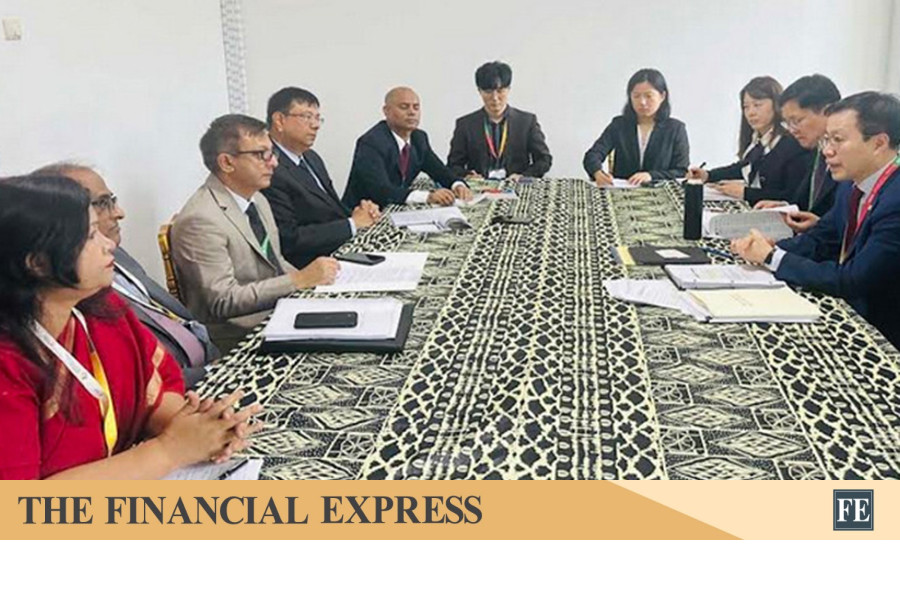
Bangladesh and South Korea held a bilateral meeting on Sunday on the sidelines of the 14th WTO Ministerial Conference (MC14) in Yaound‚, Cameroon to enhance trade cooperation and mutual investment.

The Bangladeshi delegation was led by Commerce Minister Khandaker Abdul Muktadir, accompanied by Commerce Secretary Mahbubur Rahman and other senior officials, said a press release here today.

The South Korean delegation was headed by Trade Minister Yeo Han-koo.

During the discussions, Muktadir highlighted that a new government led by Prime Minister Tarique Rahman was formed in February 2026 following a participatory election.

He emphasized the administration's visionary trade policies, market diversification strategies, and the ongoing pursuit of Free Trade Agreements (FTA) and Economic Partnership Agreements (EPA) as Bangladesh prepares for its LDC graduation.

The Commerce Minister informed his counterpart that Bangladesh has already concluded an EPA with Japan and is currently negotiating FTAs and Comprehensive Economic Partnership Agreements (CEPA) with several nations, including South Korea and Singapore.

He also expressed Bangladesh's interest in joining the Regional Comprehensive Economic Partnership (RCEP), noting that the country's strategic geographical location and large consumer market would be mutually beneficial.

Citing the success of South Korean investments in the readymade garments (RMG) sector, the Minister invited further investment, asserting that Bangladesh offers an attractive business environment for foreign investors.

South Korean Trade Minister Yeo Han-koo congratulated the newly formed Bangladesh government and characterised the country as a promising economy.

He expressed a keen interest in visiting Bangladesh soon and suggested that the Bangladesh-Japan EPA could serve as an effective model for ongoing bilateral trade negotiations.

Minister Yeo Han-koo noted that while current trade volumes are below their potential, there is significant room for growth in sectors such as shipbuilding, steel, manufacturing, and investment.

Both sides agreed to maintain regular communication at ministerial and expert levels to ensure tangible progress.

The meeting concluded with a reaffirmed commitment from both nations to strengthen bilateral relations and build a mutually beneficial trade and investment partnership.​
 

Boosting Exports, Trade
Bangladesh moves to sign FTA with S Korea

FE REPORT

Published :
May 10, 2026 08:42
Updated :
May 10, 2026 08:42

1778465799869.webp


Commerce Minister Khandakar Abdul Muktadir on Saturday said Bangladesh is moving forward with discussions to sign a Free Trade Agreement (FTA) with South Korea to boost exports and strengthen bilateral trade ties.

"The proposed FTA would open up new opportunities for Bangladesh's export sector and help local products become more competitive in global markets," he said while addressing a discussion after visiting the country's first beet sugar mill at Ramganj Bilashi Char in Debiganj upazila of Panchagarh.

Annual bilateral trade between Bangladesh and South Korea currently exceeds $3.0 billion. Bangladesh exports goods worth more than $600 million to South Korea, while imports from the East Asian country stand at over $2.4 billion.

Bangladesh mainly exports apparel items, including sweaters, T-shirts and non-knit men's suits, while importing refined petroleum products, pesticides and coated flat-rolled iron from South Korea.

More than 40,000 Bangladeshi students and skilled workers are currently residing in South Korea, he added.

"We are working to reduce cargo transportation and export costs so that Bangladeshi products can compete more effectively in global markets," the minister said.

He also stressed the need to fully digitise certification services of the Export Promotion Bureau (EPB) to ease complications faced by exporters.

"If necessary, branch offices may also be established in nearby areas for the convenience of entrepreneurs," he added.

The minister said the government remains committed to supporting innovative and export-oriented agro-industrial initiatives, including the country's first beet sugar project.​
 

32 Bangladeshi companies showcased at Korea expo
United News of Bangladesh . Dhaka 29 June, 2026, 23:41

1782793079406.webp

Bangladesh showcased its growing export potential and investment opportunities at the three-day Korea Import Expo 2026 in Seoul, with the participation of 32 companies representing a wide range of sectors. | PID photo

Bangladesh showcased its growing export potential and investment opportunities at the three-day Korea Import Expo 2026 in Seoul, with the participation of 32 companies representing a wide range of sectors.

The exhibition, organised by the Korea Importers Association, was held at COEX Hall B in Seoul from June 23 to 25.

Bangladesh’s participation was coordinated by the Korea-Bangladesh Chamber of Commerce and Industry (KBCCI) in close collaboration with the Bangladesh Embassy in Seoul.

The expo was jointly inaugurated by KOIMA chairman Young Mi Youn, Bangladesh Ambassador to South Korea Toufiq Islam Shatil and ambassadors from several other countries, said a PID handout.

Following the opening ceremony, the dignitaries visited the Bangladesh pavilion, which was jointly inaugurated by Ambassador Shatil and KBCCI president Shahab Uddin Khan.

Under the theme of ‘Invest in Bangladesh: Advancing Trade and Investment Through Strong Bilateral Relations,’ the Bangladesh pavilion drew significant attention from buyers and visitors throughout the exhibition, highlighting the country’s expanding manufacturing capacity and investment prospects.

The 32 participating Bangladeshi companies displayed products and services from sectors including ready-made garments, textiles, garment accessories, leather goods, footwear, jute and eco-friendly biodegradable products, handicrafts, agro and processed food, information technology, AI-driven software solutions and logistics services.

The Bangladesh Garments Accessories and Packaging Manufacturers and Exporters Association also had a strong presence at the fair.

Parallel to the main exhibition, the KBCCI delegation met with the KOIMA chairman for a dedicated bilateral meeting.

During the high-level discussions, both sides strongly reaffirmed their commitment and promised to work closely together to enhance mutual economic cooperation.

This milestone participation follows strategic foundational partnerships, including the landmark memorandum of understanding signed between KBCCI and KOIMA in September 2024 to enhance import-export mechanism frameworks between both friendly nations.

A powerful 41-member business delegation, led by KBCCI president Shahab Uddin Khan, traveled to Seoul to anchor Bangladesh’s participation. Proving to be a highly proactive mission, more than 15 B2B sideline meetings were successfully held during the three days of the expo, linking Bangladeshi entrepreneurs directly with Korean and foreign buyers.

During a reception in the Embassy on June 26, the Ambassador of Bangladesh committed all out cooperation from the Embassy to KBCCI and the delegation members in their pursuit to enhance trade & investment between Bangladesh and South Korea.

The reception was also attended by Ambassador Lee Yun Young, vice-president of KOICA and former Ambassador of South Korea to Bangladesh, Ambassador Park Young Sik, former Ambassador of South Korea to Bangladesh, and David Kim, honorary consul general of Bangladesh Embassy in Incheon, South Korea.

The main expo features approximately 200 booths showcasing a wide range of products including food and beverages, cosmetics, consumer goods, household products, health & wellness items, electronics, industrial materials and innovative technologies.​
 

Bangladesh secures preferential access for 97pc exports under Korea trade pact
Staff Correspondent 04 August, 2026, 15:31

1785887040342.webp

Commerce minister Khandakar Abdul Muktadir, South Korean trade minister Yeo Han-koo and others pose for a photo during CEPA signing ceremony at secretariat in Dhaka on Tuesday. Photo: Courtesy

Bangladesh and South Korea on Tuesday formally concluded negotiations on a Comprehensive Economic Partnership Agreement, paving the way for a bilateral trade deal aimed at expanding market access, investment and economic cooperation.

The CEPA would grant immediate duty-free access to 8,428 Bangladeshi product lines, including readymade garments which accounts about 84 per cent of the total export earnings, in the South Korean market once the agreement enters into force.

South Korea, in turn, would enjoy the same preferential treatment for 1,054 product lines in the Bangladeshi market, said the commerce ministry.

The conclusion of negotiations was announced through a joint declaration by commerce minister Khandaker Abdul Muktadir and South Korean trade minister Yeo Han-koo at the CEPA Negotiation Conclusion Ceremony held at the commerce ministry in Dhaka.

The agreement would take effect after both countries complete their respective legal and institutional approval processes.

About 97 per cent of Bangladesh’s goods and services would receive preferential market access to South Korea, while Bangladesh would extend similar preferences to 87 per cent of South Korean goods.

Under the agreement, Bangladesh would open 95 services subsectors to South Korea, while South Korea would open 111 subsectors to Bangladesh across all four modes of services trade under the World Trade Organisation framework.

Commerce minister Khandaker Abdul Muktadir said that the CEPA would enable Bangladeshi exports, including readymade garments, leather goods and jute products, to gain easier access to the South Korean market.

South Korean products, including selected agricultural goods, plastics and Completely Knocked Down items would gain access to Bangladesh, he added.

He also said the CEPA would support Bangladesh’s post-LDC trade transition and help attract greater foreign direct investment.

The minister said Bangladesh aimed to become a $1 trillion economy by 2034, requiring annual nominal GDP growth of around 8 per cent.

He said the agreement would accelerate economic growth, expand exports and attract foreign direct investment, noting that South Korea, with a GDP of around $2 trillion, was a model economy with strong technological capabilities.

The agreement would encourage Korean investment in high-value sectors, including semiconductors, information technology, shipbuilding, ship recycling and light engineering, said Muktadir.

South Korean trade minister Yeo Han-koo said bilateral economic relations had traditionally centred on the textile sector but were now expanding into broader industrial cooperation and investment.

He compared the agreement to ‘building a highway’ between Bangladesh and South Korea, saying it would provide the legal and institutional framework needed to facilitate trade and investment.

‘Governments cannot force companies to invest in particular sectors or commit to specific investment amounts. Instead, the agreement would make Korean businesses more confident about Bangladesh’s business environment,’ he said.

He added that Korean companies had been investing successfully in Bangladesh for decades and that the new framework would help deepen bilateral economic ties.

Muktadir said investors would increasingly view Bangladesh as a gateway to global markets, noting that the country had signed the agreement with South Korea and was negotiating similar deals with 10 to 12 other countries.

‘We plan to begin free trade agreement negotiations with the European Union and have applied to join the Regional Comprehensive Economic Partnership, one of the world’s largest trading blocs,’ he added.

According to the commerce ministry, preparatory work for the CEPA began with the finalisation of the terms of reference, followed by the formation of a committee and technical working groups.

Five formal rounds of negotiations were held over the past year — two in Bangladesh and three in South Korea. The first round took place in Seoul from August 22 to 27 past year.

The ministry said bilateral trade between Bangladesh and South Korea currently stood at about $1.39 billion, with Bangladesh exporting goods worth about $491.73 million and importing products worth approximately $902.90 million.

However, Export Promotion Bureau data showed Bangladesh exported goods worth $421 million to South Korea in the financial year 2025-26, while Bangladesh Bank data showed imports from South Korea amounted to $1.19 billion in FY25.

Bangladesh’s principal exports to South Korea include RMG, home textiles, leather and leather products, footwear, pharmaceuticals, jute and jute goods, frozen food and ceramic products.

Its imports from South Korea include industrial machinery, iron and steel, electrical equipment, plastics, chemicals and paper products.

Bangladesh Garment Manufacturers and Exporters Association president Mahmud Hasan Khan told New Age that, after concluding a similar agreement with Japan, Bangladesh had now reached another important deal with South Korea that could boost bilateral trade.​
 

Latest Posts

Back