[🇧🇩] Pharmaceutical and Chemical Industry in Bangladesh

Afghanistan Albania Algeria Andorra Angola Antigua Austria Azerbaijan Bahamas Bahrain Bangladesh Barbados Canada China Egypt Finland Germany India Iran Israel Japan Lebanon North Macedonia Pakistan Palestine Qatar Russia Syria Turkey Ukraine United Kingdom United States Yemen
[🇧🇩] Pharmaceutical and Chemical Industry in Bangladesh
66
4K
More threads by Saif

G Bangladesh Defense
The Indians think that they are the only self-sufficient nation in South Asia and all their neighbors are dependent on them. Look at the map. You will find that India is a large country surrounded by Bangladesh, Pakistan, Nepal and Bhutan. India needs its neighbors to connect to South East Asia, Middle East and Central Asia. It's a strategically insignificant country. Sorry for the off-topic discussion.
As far as Pharma goes, India has no internal indigenous strength and has not built up an API industry.

So they are completely dependent on China.

They possess no leverage international trade-wise and you are correct, no country (even medium powers) do not consider them trustworthy or significant trade partners. This is the opinion of experts within India itself.
 
As far as Pharma goes, India has no internal indigenous strength and has not built up an API industry.

So they are completely dependent on China.

They possess no leverage international trade-wise and you are correct, no country (even medium powers) do not consider them trustworthy or significant trade partners. This is the opinion of experts within India itself.
Bangladesh should seek China's help to build its own API industry. China is a great friend and I am sure they will extend their helping hand to build an API industry in Bangladesh.
 

Pharma pricing policy threatens innovation

Limited price adjustments have squeezed profitability, say manufacturers

Jagaran Chakma

1784074022056.webp


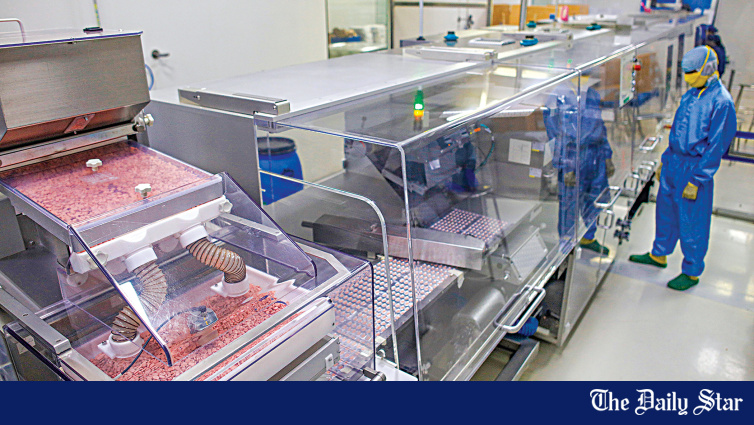
Bangladesh’s pharmaceutical industry is urging the government to review the country’s medicine pricing policy, saying years of limited price adjustments have squeezed profitability, discouraged investment in new medicines and put increasing pressure on smaller drug makers.

In a June 30 letter to Health and Family Welfare Minister Sardar Md Sakhawat Husain, the Bangladesh Association of Pharmaceutical Industries (Bapi) sought an urgent meeting to discuss the challenges facing the sector and propose policy support.

The association said rising production costs, persistent inflation, foreign currency shortages and constraints in the pricing regime have left many manufacturers struggling to survive.

Bangladesh has 258 pharmaceutical manufacturers, but the market has become highly concentrated, according to Bapi. Just 20 companies account for about 94 percent of total production, while the remaining 238 produce only 6 percent. Citing data from IQVIA, a leading global healthcare data company, it said 64 of the top 100 pharmaceutical companies recorded negative growth in 2025.

Bapi also rejected claims that medicines made in Bangladesh are expensive. It said 30 of 39 commonly used medicines are cheaper than equivalent products in India, despite local manufacturers relying heavily on imported raw materials.

Calling the pharmaceutical industry a strategic national asset, the association urged the government to introduce policies that would help restore the competitiveness of smaller manufacturers.

Industry leaders echoed Bapi’s concerns, saying the current pricing policy is discouraging investment in research and development and making it harder to introduce innovative medicines.

Abdul Muktadir, chairman and managing director of Incepta Pharmaceuticals, said Bangladesh’s pharmaceutical industry grew rapidly over the past three decades because of policy reforms that encouraged competition and investment.

He said the National Drug Policy introduced in the early 1980s shifted the industry’s focus towards essential medicines, while reforms in the early 1990s gave companies greater flexibility to set prices and expand their product range.

“The free-market approach encouraged competition,” he told The Daily Star. “As more companies entered the market, medicine prices fell while product quality improved.”

However, he said the industry’s momentum has slowed since 2016 as the drug regulator has become increasingly restrictive in approving prices for new medicines.

“If it costs Tk 10 to produce a technologically advanced medicine but the approved price is Tk 8, no company will continue investing in innovation,” he said.

According to Muktadir, companies are now less willing to introduce complex medicines that require significant investment in research and manufacturing technology. He also claimed that around 60 of the country’s roughly 100 pharmaceutical companies are struggling because of pricing constraints.

He called for a review of the current pricing framework, saying a commercially viable system is needed to sustain investment in research and development.

The industry also faces fresh challenges as Bangladesh prepares to graduate from least developed country (LDC) status.

Rabbur Reza, chief operating officer of Beximco Pharma, said Bangladesh has benefited from the World Trade Organization’s intellectual property waiver, which allows local manufacturers to produce certain patented medicines at affordable prices.

After the waiver expires, medicines introduced later will require licensing agreements with patent holders, involving royalty payments and higher costs.

While large companies may be able to negotiate such agreements, smaller manufacturers are likely to find it difficult because of limited financial capacity, he said. He urged companies to register as many eligible products as possible before the waiver expires.

Kaiser Kabir, managing director and CEO of Renata PLC, said many pharmaceutical companies are dropping low-margin medicines as rising costs and years of limited price adjustments squeeze profitability.

He said only 32 of the country’s top 100 pharmaceutical companies recorded revenue growth, while the rest posted lower sales.

“The industry has been going through a series of shocks since 2020,” he said, citing the Covid-19 pandemic, the depreciation of the taka, high inflation and disruptions to global supply chains.

Kaiser said the weaker taka has sharply increased the cost of imported raw materials, but manufacturers have not been able to fully pass on those costs because medicine prices have remained largely unchanged.

“If prices cannot reflect production costs, companies will stop making some medicines,” Kabir said.

He warned that patients could eventually have to rely on more expensive imported medicines, including products brought into the country illegally, as cheaper locally made alternatives disappear from the market.​
 

Latest Posts

Back