| Global Defense, OSINT & Geopolitics Wire

[🇧🇩] Save the Rivers/Forests/Hills-----Save the Environment

[🇧🇩] Save the Rivers/Forests/Hills-----Save the Environment
660
27K
More threads by Saif

G Bangladesh Defense

How long before the environmental pledges are honoured?
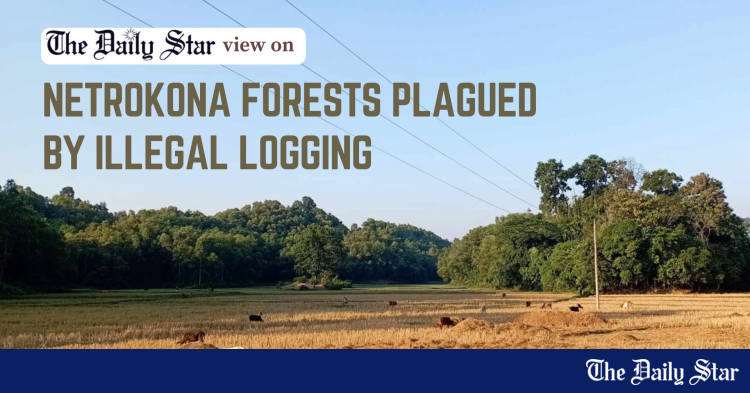
Save the forests at Netrakona's Durgapur and Kalmakanda

1737502632728.webp

VISUAL: STAR

Words alone cannot express our frustration over the relentless destruction of forests, rivers, and hills. Despite repeated appeals from environmentalists, the devastation continues unchecked, even when there is a so-called pro-environment government in place. Illegal logging and encroachment by powerful quarters have already erased or degraded many of our natural and reserve forests over the past decades. Among them are the forests of Durgapur and Kalmakanda upazilas in Netrakona—adjacent to the Garo Hills of Mymensingh—that have long been plundered right under the nose of local authorities.

A recent report by this daily paints a grim picture of these forests. It cites local residents who allege that the authorities have not only turned a blind eye to illegal logging and encroachment but, in some cases, forest officials have themselves colluded with those responsible. These once-thriving ecosystems—home to over 100 wild species, including elephants, tigers, leopards, deer, and hanuman langurs, and rich with indigenous trees like Segun, Gazari, Sal, Jarul, and Shirish—have now been reduced to mere shadows of their former selves. The introduction of harmful exotic species in the forests has worsened the problem. Human-elephant conflicts, driven by habitat destruction, have also intensified.

This pattern of deforestation is not new. Over the years, many forests have been cleared not just by unscrupulous individuals but also by government agencies—for housing projects, football training centres, roads, etc. Data from the Divisional Forest Office in Mymensingh reveals a dramatic decline in forest cover across the division, including parts of Jamalpur, Sherpur, and Netrakona. Once spanning over 71,000 acres, including 38,911 acres of reserved forest, Mymensingh alone has lost 24,895 acres to encroachment in the past three decades. This is deeply concerning.

If deforestation continues at this pace, we will soon have too little forestland left to sustain the ecological balance necessary for our survival. Moreover, we risk failing to meet our commitment to halt deforestation by 2030 under the Glasgow Leaders' Declaration on Forests and Land Use. The fast-worsening climate crisis will only magnify the consequences of this neglect.

We, therefore, urge the interim government to take decisive steps to stop illegal logging and encroachment and to restore our forest ecosystems. Since taking office, Environment, Forest, and Climate Change Adviser Syeda Rizwana Hasan has made numerous pledges about environmental protection. It's time to turn those promises into action.​
 

Politics has ‘weaponised’ science
Says UN climate chief after Trump orders US withdrawal from Paris Agreement

The UN's climate chief yesterday said that the science of global warming had been "weaponised" by politics, a day after Donald Trump withdrew the United States from the Paris Agreement.

Simon Stiell said that shifting geopolitical events could not change the hard facts that underpin climate change and the disastrous consequences linked to a warming planet.

Last year was the hottest on record. Stiell said that support for climate science was "far, far more significant than those few voices that challenge" it.

"The science has actually been weaponised, and again that is reflective of the politics," he told an audience at the World Economic Forum in Davos.​
 

Billionaire Bloomberg to fund UN climate body after US withdrawal

1737613311943.webp

File photo

Billionaire Michael Bloomberg announced Thursday that his foundation will step in to fund the UN climate change body after President Donald Trump declared the United States would withdraw from the Paris Agreement for the second time.

Bloomberg's intervention aims to ensure the United Nations Framework Convention on Climate Change (UNFCCC) remains fully funded despite the United States halting its contributions.

The United States typically provides 22 percent of the UNFCCC secretariat's budget, with the body's operating costs for 2024-2025 projected at 88.4 million euros ($96.5 million).

"From 2017 to 2020, during a period of federal inaction, cities, states, businesses, and the public rose to the challenge to uphold our nation's commitments -- and now, we are ready to do it again," Bloomberg, who serves as the UN Special Envoy on Climate Ambition and Solutions, said in a statement.

This marks the second time Bloomberg has stepped in to fill the gap left by US federal disengagement.

In 2017, following the Trump administration's first withdrawal from the Paris accord, Bloomberg pledged up to $15 million to support the UNFCCC.

He also launched "America's Pledge," an initiative to track and report US non-federal climate commitments, ensuring the world could monitor US progress as if it were still a fully committed party to the Paris Agreement.

Bloomberg reiterated his commitment to upholding US reporting obligations this time as well.

"Contributions like this are vital in enabling the UN Climate Change secretariat to support countries in fulfilling their commitments under the Paris Agreement and advancing a low-emission, resilient, and safer future for all," said UN climate chief Simon Stiell.​
 

Bangladesh must switch to hollow blocks to reduce pollution
Says Concord Group Managing Director Shahriar Kamal

1737614268868.webp


Clay bricks cost Tk 12 per piece. A hollow block, which is four times larger than a clay brick, is priced at Tk 50.

This price difference suggests a competitive edge for clay bricks in the construction market.

But the true cost of traditional bricks extends far beyond their purchase price.

Overlooked factors include Dhaka's frequent ranking as one of the world's most polluted cities. This severe air pollution, largely caused by brick kilns, is responsible for a tragically shortened lifespan for many people.

"This cannot continue," said Shahriar Kamal, managing director of the construction conglomerate Concord Group, in an interview with The Daily Star. "To reduce pollution, we need to switch to green alternatives as soon as possible."

Kamal's firm has been producing concrete and hollow blocks since 1998.

They built the 17-acre Lake City Concord township in Dhaka entirely without using a single clay brick. This township comprises 14 buildings, each rising to 16 storeys.

Given the longstanding reliance on clay bricks in the local construction sector, questions naturally arise regarding the feasibility, cost-effectiveness, and urgency of transitioning to hollow blocks.

Traditional brick kilns extract clay by stripping topsoil from fertile lands, resulting in an annual loss of around 1 percent of the country's arable land.

This practice not only devastates agricultural productivity but also involves the burning of vast amounts of coal and wood, releasing harmful particulates and greenhouse gases into the atmosphere.

"The process is unsustainable," said Kamal. "As construction demand increases each year, the environmental toll intensifies."

In contrast, hollow blocks are manufactured using a more sustainable approach. They are produced with materials such as fly ash, cement, and other industrial by-products. This process does not require burning, as the blocks are simply dried.

According to Kamal, hollow blocks are lighter but have superior strength. Therefore, they are suitable for construction in earthquake-prone regions like Bangladesh.

"Buildings constructed with hollow blocks are much lighter than those built with traditional bricks," he explained. "This reduced weight offers an advantage during earthquakes, minimising the risk of collapse and subsequent casualties."

According to the Managing Director of Concord Group, although hollow blocks offer many advantages, the adoption rate of eco-friendly bricks remains low. Only 5-8 percent of bricks currently in use are eco-friendly.

For the slow shift, he said a lack of awareness among builders, insufficient training for construction workers in the use of these blocks, and a strong entrenched preference for traditional bricks are responsible.

"Many workers are not familiar with how to work with these blocks," said Kamal. "For example, traditional bricks require soaking before use, whereas hollow blocks are installed dry."

"We arranged training for the workers several times," he said, "but this effort needs to be scaled up with government support to ensure nationwide adoption."

Kamal acknowledged that cost is another barrier to the widespread adoption of eco-friendly bricks.

"While eco-friendly bricks may have a slightly higher initial cost compared to traditional bricks, they offer long-term savings," he commented. "Proper planning and mindful design can reduce overall construction costs by about 15 percent."

In 2020, the government announced a policy to replace traditional bricks with eco-friendly blocks in all public projects. This policy aimed to achieve a 10 percent adoption rate in fiscal year (FY) 2019-20, with a gradual phasing out of clay bricks by FY25.

However, slack monitoring and enforcement have hindered progress towards these ambitious goals.

"Implementation is key," Kamal stressed. "We need strong inter-ministerial coordination, led by the Ministry of Environment, to oversee the implementation of these policies. Regulatory bodies like Rajdhani Unnayan Kartripakkha (Rajuk) must also play a crucial role by enforcing these targets in private-sector construction projects."

He pointed to successful examples from countries like China and India, where the adoption of eco-friendly bricks has been accelerated through a combination of financial incentives, strict enforcement of environmental regulations, and comprehensive public awareness campaigns.

Kamal said their facilities have the capacity to manufacture 200,000 eco-friendly bricks, blocks, and tiles every eight hours. But, without enough demand, they cannot operate at full capacity.

He called for a range of policy measures to stimulate demand, including financial incentives for manufacturers of eco-friendly building materials and penalties on polluting industries to ensure accountability.

"The polluters must pay," he commented.

"This isn't just about bricks," he said. "It's about rethinking how we build our cities and protect our people. Change is difficult, but it is necessary — and it begins with each of us."

Currently, the size of the traditional brick industry is around Tk 9,000 crore, while the concrete block market is only at Tk 200 crore.

Bangladesh produces an estimated 2,300 crore bricks annually. Concrete blocks currently account for a relatively small share of this market, constituting roughly 6-7 percent of the total.

There are 164 registered factories producing concrete blocks, with an annual production capacity of 214 crore blocks. However, considering the unregistered factories, the total number is more than 250.

Kamal said the concrete block market is projected to capture up to 50 percent of the market share by 2030, due mainly to government policies and a steadily increasing demand for sustainable building materials.

He said large-scale factories have heavily invested in automated production units, often imported from China, with typical investments ranging from Tk 30-Tk 50 crore. Mid-sized factories have also invested in modernising their production lines, with typical investments ranging from Tk 5-Tk 6 crore.

Major industry players, including Concord, Mir Group, BTI, and Meghna, currently collectively control nearly 20 percent of the hollow block market.​
 

Thousands of trees 'felled' from Moheshkhali forest
Trees felled under the pretext of an auction citing Cyclone Hamoon damage

1737674164817.webp

Photo: Star

Thousands of trees have allegedly been felled from the hilly forests of Dineshpur in Maheshkhali, Cox's Bazar, under the pretext of an auction following Cyclone Hamoon, that struck the upazila in October 2023.

Local groups, reportedly in collaboration with members of the Coastal Afforestation Department, are accused of clearing the forest beyond the authorised scope of the auction.

Environmental activists claim this auction provided an opportunity for widespread deforestation.

The Coastal Forest Department had auctioned 920 cyclone-damaged trees around four months ago.

Rakib Hasan, an environmental activist and student representative from Shaplapur, said, "Dineshpur forest was once a natural forest rich in biodiversity. The forest department destroyed that biodiversity by planting acacia trees. Now, under the guise of auctioning cyclone-damaged trees, they have allowed the plundering of thousands of trees."

He alleged that forest department staff were complicit in the irregularities and demanded punishment for those involved.

Activists also reported that the group responsible for the tree felling constructed an unpaved road, approximately 2.5 to 3km long, by cutting through hills to transport the felled trees.

"They could have left the forest to recover naturally, but instead, they created a way to loot the forest," Rakib said.

Journalist and environmental activist Faruq Azam claimed that tree felling has been ongoing for over a month. "We saw many unmarked tree roots where tree leaves were dumped to conceal the scale of the felling," he said, adding that the construction of the road further deformed the hills.

Assistant Conservator of Forests Sheikh Abul Kalam Azad said the department had auctioned 920 marked acacia trees to prevent locals from stealing fallen trees for firewood.

"We have sent a team to investigate the allegations. If the beat officer and auction owners are found guilty, action will be taken," he said.

Shefayet Ullah, one of the four tender owners, denied any wrongdoing, saying that they only felled marked trees and levelled the water stream for transport rather than building a new road.​