Bangladesh Defense

Saif
Senior Member
- Joined
- Jan 24, 2024
- Messages
- 22,344
- Likes
- 9,875
- Nation

- Axis Group


Will foreign firms run all four Chattogram port terminals?
With three of Chattogram port’s container terminals already handed over to foreign operators, the government is now in the process of handing the Chittagong Container Terminal to another one, potentially the Saudi-based Red Sea Gateway Terminal International.
Will foreign firms run all four Chattogram port terminals?
Government weighs giving the last locally run container terminal to a Saudi firm, as critics warn of losing control over the premier port
Dwaipayan Barua
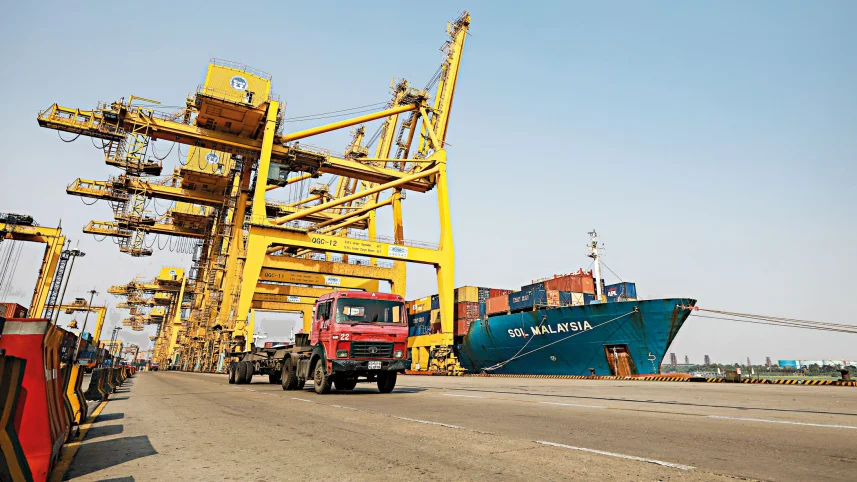
With three of Chattogram port’s container terminals already handed over to foreign operators, the government is now in the process of handing the Chittagong Container Terminal to another one, potentially the Saudi-based Red Sea Gateway Terminal International.
If the deal goes ahead, foreign companies will run all four container terminals of the port, which handles about 92 percent of Bangladesh’s $115 billion trade. It would be a major shift, ending domestic firms running the terminals.
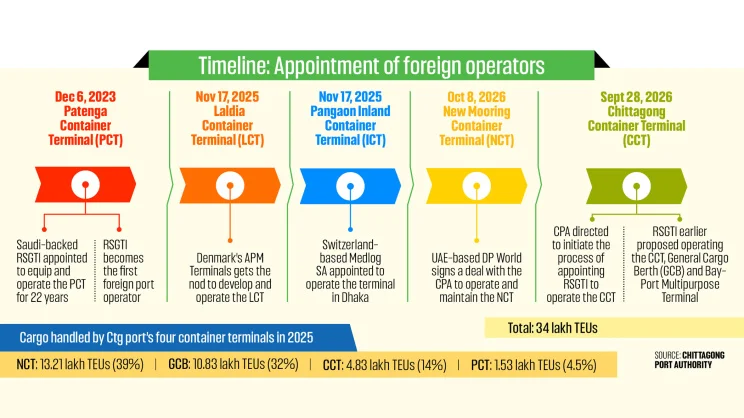
The four container terminals are Patenga Container Terminal (PCT), the greenfield Laldia Container Terminal (LCT), New Mooring Container Terminal (NCT) and Chittagong Container Terminal (CCT).
As the terminals have passed one by one to foreign firms, labour leaders, workers and political activists say that the shift could weaken state control over the country’s premier port, cut revenue, cost workers their jobs and raise security concerns at a strategic gateway.
Some economists and business leaders, however, have welcomed the move as a way to make the port more efficient, while urging the authorities to ensure transparency and fairness.
Of the four container terminals of the port, Red Sea Gateway became operator of Patenga in 2023. Denmark’s APM Terminals won the contract to develop and run Laldia in 2025.
This month, UAE-based DP World secured the management of the New Mooring Terminal, the port’s largest container terminal. The deal was signed after months of protests by port workers and activists, who said it would undermine the country’s security and national interests.
The authorities in 2025 handed the Pangaon Inland Container Terminal in Keraniganj, on Dhaka’s outskirts, to Swiss operator Medlog SA. This terminal is also managed by the Chittagong Port Authority.
SHIPPING MINISTRY PUSHES SAUDI FIRM FOR CCT
The issue about foreign operator appointment came to light after the shipping ministry asked Invest Bangladesh to begin appointing Red Sea Gateway as Chittagong Container Terminal’s operator.
In a letter on September 28, the ministry directed the agency, formerly the Bangladesh Investment Development Authority, to start the process.
However, Shipping Secretary Md Zakaria told The Daily Star on Sunday that no decision had yet been taken.
He said Invest Bangladesh informed the ministry about Red Sea Gateway’s proposal to operate the terminal. The ministry then passed it to the Chittagong Port Authority, which is responsible for signing the deal, for review and comment.
“We are yet to get any reply from the port authority,” he said, adding that the ministry would ask the Public Private Partnership Authority (PPPA) to start the process once the port authority responded positively.
Officials familiar with the matter said the ministry has also directed the port authority on the issue.
Chattogram port has four operational terminal facilities for both containerised and non-containerised cargoes. The oldest, General Cargo Berth (GCB), has 12 jetties, six of which handle bulk cargo vessels and the other six handle container ships.
The port’s first two dedicated container jetties under Chittagong Container Terminal (CCT) were built in 1986. But it took more than two decades before the terminal got essential equipment such as quayside gantry cranes.
In 2005, four such cranes were installed. Since 2006, local firm Saif Powertec Limited has been running the terminal. The port’s contract with the company will expire next month.
In March last year, Bangladeshi multinational MGH Group submitted a proposal to upgrade and operate the terminal, with a planned investment of $300m.
Besides, at the fourth joint PPP platform meeting of the Bangladesh-Dubai government-to-government platform in Dubai in April this year, DP World expressed interest in modernising and operating the Chittagong Container Terminal.
MIXED REACTIONS TO THE MOVE
The prospect of foreign firms running more terminals has drawn criticism from different corners, while some port users have called for a more gradual approach.
Sheikh Nurullah Bahar, a former leader of Chattogram Port CBA and general secretary of the Jatiyatabadi Sramik Dal’s Chattogram divisional unit, said Chittagong Container Terminal and New Mooring Container Terminal have been built and equipped with the port’s own funds.
“Both of them delivered productivity beyond expectations under local operators,” said Nurullah, also a senior coordinator of the Chattogram Bandar Rokkha Committee, a labour and political alliance opposed to the privatisation and foreign leasing of key terminals.
He said the alliance has no objection to foreign investment in greenfield projects such as Bay Terminal, but sees little scope for major investment in the two older terminals.
Calling the port the heart of the country’s economy, he said giving foreign firms operational control of all its container terminals would be risky.
Md Nasir Uddin Chowdhury, a former Bangladesh Garment Manufacturers and Exporters Association (BGMEA) leader, also urged caution rather than handing over every terminal at once.
Nasir, also a director of the Chittagong chamber, said the government should watch the two global operators at Patenga and New Mooring for a couple of years before deciding. Red Sea Gateway has been at Patenga for only two years, he noted, and the New Mooring deal has only just been finalised.
Md Zafar Alam, a former CPA board member, said he sees no problem with foreign operators at all the terminals.
“Many countries are increasingly using foreign operators to improve the performance of major port terminals, and state-owned authorities often no longer run operations but keep ownership of the land,” he said.
He did, however, question the direct appointment of foreign operators through government-to-government deals.
Open tendering should be preferred because it encourages competition, he said. “Under open tendering, other interested global firms could compete, allowing the government to choose the operator offering the best returns and so earn more revenue.”
ECONOMISTS SPLIT ON THE WAY FORWARD
Economist Anu Muhammad said a responsible country should keep its premier port under state control for reasons of national security, calling Chattogram the heart of the economy.
“Whoever controls Chattogram port will have control over the entire economy of Bangladesh.”
Criticising the handover of terminals to foreign operators one after another, he said it seems control of the economy is being passed to an invisible power.
He said the current elected government should have reviewed the deal with Red Sea Gateway, struck under the Awami League, and the Laldia and Pangaon agreements signed under the interim government.
“Instead, ignoring public and expert opinion, the BNP government signed the New Mooring deal with DP World, a company chosen by the Hasina government, whose deal the Yunus-led interim government rushed to finalise.”
He asked why three consecutive governments were so keen to sign deals with a particular company without competitive tenders, and which power was behind it.
“We still don’t know about the signed deals while the government is not letting people know about the terms and conditions of these deals.”
“The port’s location on the Bay of Bengal gave it military and geopolitical importance,” Anu said. “It is dangerous that people have no clear idea who was taking control of it, or on what terms.”
M Masrur Reaz, chairman and CEO of Policy Exchange of Bangladesh, said foreign port operators are needed, but they are not the whole solution.
The port and logistics specialist said Chattogram’s limited draft and dependence on tides leave the river-based port at full capacity, and operators alone cannot change that.
But modern management, technology and global expertise can help it perform as well as possible within those limits, he said, which is why he welcomed the government’s move.
The economist urged the government to protect the national interest in the deals and to involve local logistics firms wherever possible, to build national capacity.
The terminal operator is only one part of the puzzle, he said, and success also requires better hinterland connectivity, transport, storage, inland container depots and customs clearance.
He also called for faster progress on the proposed Bay Terminal to handle rising cargo volumes.
Government weighs giving the last locally run container terminal to a Saudi firm, as critics warn of losing control over the premier port
Dwaipayan Barua
With three of Chattogram port’s container terminals already handed over to foreign operators, the government is now in the process of handing the Chittagong Container Terminal to another one, potentially the Saudi-based Red Sea Gateway Terminal International.
If the deal goes ahead, foreign companies will run all four container terminals of the port, which handles about 92 percent of Bangladesh’s $115 billion trade. It would be a major shift, ending domestic firms running the terminals.
The four container terminals are Patenga Container Terminal (PCT), the greenfield Laldia Container Terminal (LCT), New Mooring Container Terminal (NCT) and Chittagong Container Terminal (CCT).
As the terminals have passed one by one to foreign firms, labour leaders, workers and political activists say that the shift could weaken state control over the country’s premier port, cut revenue, cost workers their jobs and raise security concerns at a strategic gateway.
Some economists and business leaders, however, have welcomed the move as a way to make the port more efficient, while urging the authorities to ensure transparency and fairness.
Of the four container terminals of the port, Red Sea Gateway became operator of Patenga in 2023. Denmark’s APM Terminals won the contract to develop and run Laldia in 2025.
This month, UAE-based DP World secured the management of the New Mooring Terminal, the port’s largest container terminal. The deal was signed after months of protests by port workers and activists, who said it would undermine the country’s security and national interests.
The authorities in 2025 handed the Pangaon Inland Container Terminal in Keraniganj, on Dhaka’s outskirts, to Swiss operator Medlog SA. This terminal is also managed by the Chittagong Port Authority.
SHIPPING MINISTRY PUSHES SAUDI FIRM FOR CCT
The issue about foreign operator appointment came to light after the shipping ministry asked Invest Bangladesh to begin appointing Red Sea Gateway as Chittagong Container Terminal’s operator.
In a letter on September 28, the ministry directed the agency, formerly the Bangladesh Investment Development Authority, to start the process.
However, Shipping Secretary Md Zakaria told The Daily Star on Sunday that no decision had yet been taken.
He said Invest Bangladesh informed the ministry about Red Sea Gateway’s proposal to operate the terminal. The ministry then passed it to the Chittagong Port Authority, which is responsible for signing the deal, for review and comment.
“We are yet to get any reply from the port authority,” he said, adding that the ministry would ask the Public Private Partnership Authority (PPPA) to start the process once the port authority responded positively.
Officials familiar with the matter said the ministry has also directed the port authority on the issue.
Chattogram port has four operational terminal facilities for both containerised and non-containerised cargoes. The oldest, General Cargo Berth (GCB), has 12 jetties, six of which handle bulk cargo vessels and the other six handle container ships.
The port’s first two dedicated container jetties under Chittagong Container Terminal (CCT) were built in 1986. But it took more than two decades before the terminal got essential equipment such as quayside gantry cranes.
In 2005, four such cranes were installed. Since 2006, local firm Saif Powertec Limited has been running the terminal. The port’s contract with the company will expire next month.
In March last year, Bangladeshi multinational MGH Group submitted a proposal to upgrade and operate the terminal, with a planned investment of $300m.
Besides, at the fourth joint PPP platform meeting of the Bangladesh-Dubai government-to-government platform in Dubai in April this year, DP World expressed interest in modernising and operating the Chittagong Container Terminal.
MIXED REACTIONS TO THE MOVE
The prospect of foreign firms running more terminals has drawn criticism from different corners, while some port users have called for a more gradual approach.
Sheikh Nurullah Bahar, a former leader of Chattogram Port CBA and general secretary of the Jatiyatabadi Sramik Dal’s Chattogram divisional unit, said Chittagong Container Terminal and New Mooring Container Terminal have been built and equipped with the port’s own funds.
“Both of them delivered productivity beyond expectations under local operators,” said Nurullah, also a senior coordinator of the Chattogram Bandar Rokkha Committee, a labour and political alliance opposed to the privatisation and foreign leasing of key terminals.
He said the alliance has no objection to foreign investment in greenfield projects such as Bay Terminal, but sees little scope for major investment in the two older terminals.
Calling the port the heart of the country’s economy, he said giving foreign firms operational control of all its container terminals would be risky.
Md Nasir Uddin Chowdhury, a former Bangladesh Garment Manufacturers and Exporters Association (BGMEA) leader, also urged caution rather than handing over every terminal at once.
Nasir, also a director of the Chittagong chamber, said the government should watch the two global operators at Patenga and New Mooring for a couple of years before deciding. Red Sea Gateway has been at Patenga for only two years, he noted, and the New Mooring deal has only just been finalised.
Md Zafar Alam, a former CPA board member, said he sees no problem with foreign operators at all the terminals.
“Many countries are increasingly using foreign operators to improve the performance of major port terminals, and state-owned authorities often no longer run operations but keep ownership of the land,” he said.
He did, however, question the direct appointment of foreign operators through government-to-government deals.
Open tendering should be preferred because it encourages competition, he said. “Under open tendering, other interested global firms could compete, allowing the government to choose the operator offering the best returns and so earn more revenue.”
ECONOMISTS SPLIT ON THE WAY FORWARD
Economist Anu Muhammad said a responsible country should keep its premier port under state control for reasons of national security, calling Chattogram the heart of the economy.
“Whoever controls Chattogram port will have control over the entire economy of Bangladesh.”
Criticising the handover of terminals to foreign operators one after another, he said it seems control of the economy is being passed to an invisible power.
He said the current elected government should have reviewed the deal with Red Sea Gateway, struck under the Awami League, and the Laldia and Pangaon agreements signed under the interim government.
“Instead, ignoring public and expert opinion, the BNP government signed the New Mooring deal with DP World, a company chosen by the Hasina government, whose deal the Yunus-led interim government rushed to finalise.”
He asked why three consecutive governments were so keen to sign deals with a particular company without competitive tenders, and which power was behind it.
“We still don’t know about the signed deals while the government is not letting people know about the terms and conditions of these deals.”
“The port’s location on the Bay of Bengal gave it military and geopolitical importance,” Anu said. “It is dangerous that people have no clear idea who was taking control of it, or on what terms.”
M Masrur Reaz, chairman and CEO of Policy Exchange of Bangladesh, said foreign port operators are needed, but they are not the whole solution.
The port and logistics specialist said Chattogram’s limited draft and dependence on tides leave the river-based port at full capacity, and operators alone cannot change that.
But modern management, technology and global expertise can help it perform as well as possible within those limits, he said, which is why he welcomed the government’s move.
The economist urged the government to protect the national interest in the deals and to involve local logistics firms wherever possible, to build national capacity.
The terminal operator is only one part of the puzzle, he said, and success also requires better hinterland connectivity, transport, storage, inland container depots and customs clearance.
He also called for faster progress on the proposed Bay Terminal to handle rising cargo volumes.