โ˜• Support Us โ˜•
[๐Ÿ‡ง๐Ÿ‡ฉ] - Strategic Aspect of Bangla-Japan Relation | Page 2 | PKDefense

[๐Ÿ‡ง๐Ÿ‡ฉ] Strategic Aspect of Bangla-Japan Relation

Reply (Scroll)
Press space to scroll through posts
G Bangladesh Defense
[๐Ÿ‡ง๐Ÿ‡ฉ] Strategic Aspect of Bangla-Japan Relation
63
3K
More threads by Saif


Japan keen to invest more in Bangladesh's manufacturing sector
Published :
Jun 10, 2024 00:03
Updated :
Jun 10, 2024 00:03

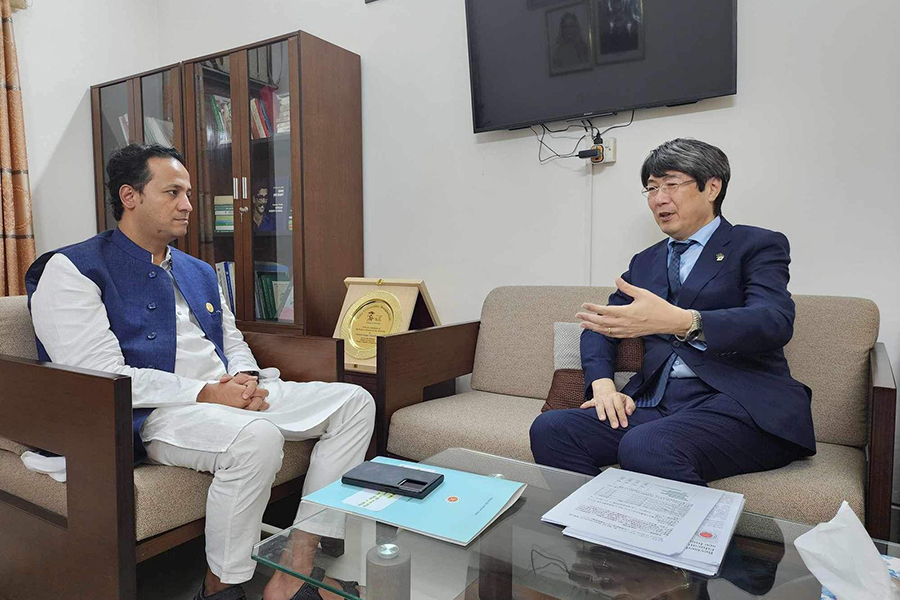
1717979235147.png


Japanese Ambassador to Bangladesh Iwama Kiminori on Saturday expressed his country's willingness to invest more in the manufacturing sector in Bangladesh.

The envoy expressed this interest in a bilateral meeting with Education Minister Mohibul Hasan Chowdhury in the National Parliament on Sunday.

The Japanese government is also willing to increase the connection and collaboration of Bangladeshi universities with Japanese universities, UNB reports.

He has expressed interest in retraining Bangladeshi students to employ them in Japanese industrial factories in the fields of robotics and manufacturing in Japan.

Education Minister Mohibul assured to support any initiative of the Japanese government in all fields of education starting from the university level to increase the skills of Bangladeshi students through information technology and technical and vocational training.

He expressed his interest in teaching the Japanese language in universities and introducing a teacher exchange program aimed at improving the skills of secondary-level teachers in Bangladesh through Japanese-trained teachers.
 

Japan leads development funding to Bangladesh
FHM HUMAYAN KABIR

1718841234471.png


Japan leads development funding to Bangladesh by releasing the highest US$1.66 billion worth of assistance among the foreign financiers in recent tough times facing the country amid forex crunch.

The amount of foreign-aid disbursement by Japan was the highest during the first 10 months from July to April of the outgoing financial year (FY) 2023-24, in keeping with its top position since last fiscal, official data showed.

In the FY2023 also, Bangladesh received the highest $1.94 billion in loans and grants from the historically highest bilateral donor, Japan, according to the Economic Relations Division (ERD) data.

During this past July-April period, the total amount of the assistance was nearly $600 million higher than Bangladesh's historically largest development partners-the World Bank-and nearly $200 million higher than the second-biggest financier- the Asian Development Bank.

The Manila-based Asian bank disbursed $1.499 billion worth of assistance and the Washington-based WB $1.05 billion during the period in question.

In the past fiscal, Japan disbursed $1.94 billion worth of loans and grants in FY2023. But the ADB released $1.787 billion and the WB $1.898 billion.

"Japan has emerged as the biggest development partner of Bangladesh in recent years, as its fund disbursement is rising year on year," says a senior ERD official in appreciation of the gesture at a time when the country faces the toughest challenge on the financial front from foreign-exchange inadequacies.

"The amount of foreign assistance from Japan is higher than that of two other larger development partners -the WB and the ADB," he adds.

According to another ERD official, Japan is currently bankrolling some mega-and larger projects in Bangladesh which need lots of fund investment every year.

The developed Asian country is financing MRT-01, MRT-05 and MRT-06, the rail bridge over the Jamuna, and the third terminal at the Hazrat Shahjalal International Airport in Dhaka.

For the Uttara-Motijheel MRT-06, Japan International Cooperation Agency (JICA) has made a commitment of $2.1 billion.

In June 2022, JICA confirmed $979.8 million (JPY 133,399 million) in credit for building MRT-05 from Hemayetpur to Vatara in Dhaka.

For the Airport-Kamalapur MRT-01, Dhaka will receive $1.10-billion loan from Tokyo as they signed an agreement in 2021 for construction of Dhaka's first underground metro rail.

For the third-terminal project, Japan has recently signed an agreement for providing some $517.27 million (JPY 76.635 billion).

Earlier in August 2020, JICA confirmed nearly $750 million (JPY 80 billion) worth of aid in the first installment for the same project.

Meanwhile, the agency provided a record $2.314 billion worth of aid in FY2022, some $1.945 billion in FY2021 and $1.69 billion in FY2020, the ERD data showed.

JICA's support has been on the rise since FY2018 when it disbursed $1.54 billion in foreign assistance, up by $899 million from FY2017.

Japan disbursed $1.195 billion in FY2019 and $1.544 billion in FY2018.

Meanwhile, the country's biggest multilateral financier, the World Bank, disbursed $1.42 billion in FY2018, $2.03 billion in FY2019, $1.51 billion in FY2020, $1.64 billion in FY2021, $1.739 billion in FY2022 and $1.93 billion in FY2023.

The ADB released $938 million in FY2018, $1.25 billion in FY2019, $1.70 billion in FY2020, $1.30 billion in FY2021, $2.628 billion in FY2022 and $1.56 billion in FY2023.

Historically, Japan also remains the third-largest donor among its peers operating in Bangladesh. In 2012, it became the largest bilateral donor to Bangladesh.

To read the rest of the news, please click on the link above.
 

Japan reviewing plan to support BD's LDC graduation, 9th FYP
General Economic Division is currently formulating the Ninth Five-Year Plan
FE REPORT
Published :
Jul 11, 2024 09:47
Updated :
Jul 11, 2024 09:47
1720919135715.png


Japan is reviewing the Country Assistance Plan for Bangladesh, taking into account the nation's upcoming graduation from Least Developed Country status and its Ninth Five-Year Plan, Japanese Ambassador to Bangladesh Iwama Kiminori said.

"We are considering Bangladesh's needs against its development plan and Japan's assistance policy," he said after a meeting with Planning Minister Major General (Retired) Abdus Salam at his office on Wednesday.

The General Economic Division (GED) is currently formulating the Ninth Five-Year Plan (FYP), titled 'Sustainable and Equitable Growth for Higher Middle Income'.

This plan, involving secretaries from over 15 ministries, aims to transform Bangladesh into a developed nation by 2041. The Eighth FYP, covering 2020-2025, was the first in a series of four designed to implement the government's Vision 2041.

After the meeting, the ambassador told journalists that various topics, including Bangladesh's future development plans, were discussed.

"Bangladesh is working on its Ninth Five-Year Plan. In this ambitious plan, Japan will provide financing in line with Japan's policies and Bangladesh's needs," he added.

Japan is revising its Country Assistance Plan, with specific areas of support to be determined through further discussions with Bangladesh. Japan's assistance will prioritise areas aligned with the Bangladeshi government's priorities, he added.

Planning Minister Abdus Salam called for Japanese collaboration to support the second phase of the Public Investment Management System to improve the efficiency of government spending.

Mr Salam told journalists that the ambassador visited to congratulate him and that Bangladesh has requested Japan's continued cooperation in capacity building.

"Specifically, support is sought for the second stage of the Public Investment Management System, with 40 projects already implemented with Japanese funding," said the minister.

Discussions also focused on enhancing Bangladesh's skills capacity, with Japan committed to supporting the implementation of both the current five-year plan and future development plans, he said.

While responding to a media query, Minister Salam said, "Japan is always with us. They have promised to stand by Bangladesh in various developments in the future".​
 

Japan to continue supporting Bangladesh
Salehuddin says

1724110853694.png

Salehuddin Ahmed

Japan has expressed happiness over Bangladesh reaching political stability recently and assured of continuing its support for the development of the country, said Finance and Commerce Adviser Salehuddin Ahmed yesterday.

"We discussed various bilateral issues, including trade, investment and employment. Japan is very happy over the political stability and interim government's leadership," he said.

The adviser made the remarks while talking to journalists after meeting with Japanese Ambassador to Bangladesh Iwama Kiminori at the Ministry of Finance in Dhaka.

"There are no more questions about the work. Rather, they want to extend their cooperation with more projects for the future, including metro rail projects," he said.

Ahmed said during the meeting, they sought budgetary support and more investment in the private sector to boost the foreign exchange reserves.

"We have urged them to expand their cooperation in the health and education sectors," he said.

Ahmed said Japan wanted Bangladesh to ensure a business-friendly environment and smooth access and processes in banks and customs.

"About their concerns regarding reforms, I have assured them of bringing about reforms in the banking sector and customs of the National Board of Revenue. We are already on it," he said.

"About the near future, we have told them that their existing cooperation is good and we urged them to intensify it," he said.

The government wants to relieve people's sufferings and Japan will stand by Bangladesh, he added.

"In the meeting, we have also discussed free trade agreement (FTA) and graduation from LDC (least developed country) status. Japan also assured us about their cooperation," he added.​
 

Japan assures of cooperation for Bangladesh's economic rebuilding
BSS
Published: 21 Aug 2024, 23: 04

1724288242611.png


Japanese ambassador in Dhaka assured Chief Adviser Professor Muhammad Yunus of Tokyoโ€™s cooperation in rebuilding Bangladesh economy as he called on him at his Jamuna office on Wednesday.

Briefing the newsmen after the meeting chief adviserโ€™s press secretary Shafiqul Alam said Prof Yunus sought enhanced Japanโ€™s assistance for rebuilding Bangladesh economic when Ambassador Iwama Kiminori assured him that his country would stay beside his interim government.

The envoy acknowledged the challenges of his interim government and compared the Bangladesh situation with post-World War 2 period in Japan.

โ€œThe envoy said Japan is interested to work closely with the interim government of Bangladesh . . . He congratulated Prof Yunus on his assumption as the chief adviser to the interim government,โ€ Alam told the briefing at the Foreign Service Academy.

Kiminori, the press secretary said, focused on economic cooperation, peace and people-to-people bonding.

The chief adviser told the envoy he considered none as foe in Bangladesh saying โ€œwe are all brothers and sisters. No one is enemyโ€.

The press secretary said the Rohigya crisis also came up during the meeting when the chief adviser said the repatriation of the forcibly displaced people was the only solution to the crisis.

โ€œHe sought more Japanese humanitarian assistance for Rohingyas,โ€ Alam said.​
 

Japan to start work to recover World War 2 soldiers' remains in Bangladesh
There are graves of 43 Japanese soldiers in Cumilla, says the country's public broadcaster

1726016410531.png

Photo: Mohiuddin Ahmed Sagor/File

Japan has taken an initiative to recover the remains of Japanese soldiers taken as prisoners of war to Bangladesh during World War Two.

The work is set to begin in November, NHK, the public broadcaster of Japan, reported yesterday.

Japan's welfare ministry said the soldiers were captured by British forces during the Battle of Imphal, in which the Imperial Japanese military sought to conquer British-controlled northeastern India.

The Japanese soldiers were taken to Bangladesh, where they died. The Japanese government learned through a field survey that there are 43 soldiers' graves in Cumilla.

In July this year, the Bangladesh government approved the recovery of the remains, NHK reports.

Japan plans to first send a team to Cumilla's Mainamati War Cemetery, where the remains of 24 soldiers are said to be buried, NHK reported.

The Japan Association for Recovery and Repatriation of War Casualties, entrusted by the welfare ministry to conduct surveys of wartime remains, says the recovery work has been delayed due to worsening security in Bangladesh and the coronavirus pandemic.

It said it hopes to finally return the remains to their families, nearly 80 years after the end of World War Two.​
 

Post-flood economic recovery
BD seeks $1.0b aid from Japan

FHM Humayan Kabir
Published :
Sep 22, 2024 00:02
Updated :
Sep 22, 2024 00:02

1726965900517.png


Bangladesh has recently sought $1.0-billion budgetary support from Japan to facilitate the country's post-flood recovery in the eastern region and also to weather the economic storm, officials said on Saturday.

"We sent a request letter to our friendly country Japan early this month seeking its support. Bangladesh needs sizeable funds to recover the economy, damaged by some wrong macro-economic policies of the Sheikh Hasina government and sudden floods in late August," said a senior official of the Economic Relations Division (ERD).

"We also wrote to Japan seeking its budget support in last regimeโ€ฆ"

The government has also requested the World Bank, the Asian Development Bank, the International Monetary Fund (IMF), the Asian Infrastructure Investment Bank (AIIB), the New Development Bank (NDB), the French lender AFD and others for the same.

Recent floods deluged 11 districts in eastern and north-eastern parts of Bangladesh claiming at least 59 lives and impacting over 5.3-million people.

Millions of dollars have been lost in agriculture, industry and service sectors as dozens of roads and bridges got destroyed, croplands submerged, and fisheries and livestock damaged.

"Japan usually provides us loans to execute different projects. After the Covid pandemic in 2020, it started to give us some budgetary support too. As Bangladesh's economy has been affected by recent floods, we need budgetary support for economic recovery," said another ERD official.

Last June, Japan provided JPY30 billion (equivalent to $225 million) as budgetary support to Bangladesh.

Earlier, it also provided two rounds of budget aid amounting to total 685 million yen ($4.7 million) in 2020 and 2021.

Japan is Bangladesh's largest bilateral development partner, which helped it build three metro rails, third terminal at the Hazrat Shahjalal International Airport and Jamuna Railway Bridge.

"Japanese loan is very concessional. It will be good for Bangladesh if the budget support from Japan is confirmed," according to the ERD official.

For the $225-million budget support in June, the loan came with an annual interest rate of 1.6 per cent with a 30-year repayment period, which includes a 10-year grace period.

"We are eagerly waiting for Japan's response to our latest budget support request," the official added.

Meanwhile, the WB, ADB, AIIB and IMF have already assured the interim government of providing necessary support for the recovery of economic shocks and post-flood impacts.​
 

Bilateral ties with Japan and potentials within socio-economic matrix
Muhammad Zamir
Published :
Oct 27, 2024 21:54
Updated :
Oct 27, 2024 21:54

1730078113742.png


On September 25, 2024, retired Bangladesh Ambassadors of AOFA organised an interactive session with Ambassador Iwama Kiminori of Japan to Bangladesh. The dialogue had several significant dimensions and recalled not only the longstanding friendship between Bangladesh and Japan since 1972 but also Japan's pivotal role in Bangladesh's infrastructure and connectivity, highlighting the multifaceted partnership across various sectors.

The discussion recalled the leading role of Japan in sectors such as IT and automated manufacturing. It was also stressed that there needs to be continued cooperation between the two countries in new areas such as regional security, maritime affairs, sustainable development and climate change.

In his in-depth presentation, Ambassador Kiminori briefly highlighted elements of Japan's foreign policy including their commitment to the Free and Open Indo-Pacific (FOIP), focusing on inclusiveness, diversity, and openness. He also outlined the four pillars of cooperation under FOIP, emphasising peace, prosperity, and regional security.

Reflecting on over 50 years of Japan-Bangladesh relations, the Japanese Ambassador highlighted key milestones in the relationship, including Japan's recognition of Bangladesh in 1972, announcing the Comprehensive Partnership in 2014 and elevating it to Strategic Partnership in 2023, which deepened cooperation. He also noted the increased presence of Japanese companies in Bangladesh and Japan's ODA commitment to Public-Private Joint Economic Dialogue (PPED) and people-to-people exchange between the two countries. He also mentioned new initiatives and trends such as the rising interest in learning Japanese. He concluded by stressing the importance of strengthening ties for the future and expressed commitment of Japan to respect the policy decisions of Bangladesh.

Following the in-depth presentation of the Japanese Ambassador, Mr. Yuji Andu, Country Representative of JETRO Bangladesh and President, JBCCI offered his insights about the investment opportunities, bureaucratic limitations and other structural issues related to Bangladesh. He explained how Japan had reduced the number of ministries to attain greater efficiency and reduce bureaucratic red tape. He lso suggested reduction of corruption and advancement of a business-friendly environment for promotion of business between the two countries.

To a question about the possibility of inviting Hon'ble Chief Adviser to Japan and Japan's views on enhancing people-to-people exchanges and defence cooperation, Ambassador Kiminori responded that Japan was keen to engage with the current government in Bangladesh and would extend invitation to Hon'ble Chief Advisor at an appropriate time. He also stressed Japan's willingness to enhance cooperation in all sectors, including people- to-people cooperation and defence. He further emphasised Japan's commitment to strengthening ties with Bangladesh, in the light of the priorities of the new government and continuing the Economic Partnership Agreement (EPA). He also clarified that Japanese companies were not withdrawing from Bangladesh and stressed the importance of improving the investment environment to attract more foreign businesses, particularly from Japan.

On a query regarding the Japan Foundation, he clarified that the Foundation's primary focus was on cultural exchange. He emphasised for promoting cooperation across various sectors, including defence and academia, and hoped for a swift recovery of the domestic situation in Bangladesh.

On a request for his perspective on the Matarbari power plant-- with reference to recent remarks that the project was a luxury project-- Ambassador Kiminori mentioned the sensitivity of the issue and refrained from providing a specific response. He mentioned Japan's past consultations with the former government, emphasising the project's utility for Bangladesh.

To another query on Japan's role on the Rohingya issue-- given its humanitarian support-- Ambassador Kiminori highlighted Japan's commitment for a dignified repatriation and a resolution of the issue despite the complexity of the existing situation.

Ambassador Kiminori also acknowledged strong economic ties between Bangladesh and Japan but emphasised for reassessing infrastructure projects according to the new government's priorities. He stressed the need for a better investment climate to attract foreign businesses and also indicated that the issue of possible agricultural cooperation between Japan and Bangladesh was also on the cards.

Regarding a query on Japan's position on QUAD and containment of China, he noted the complexities surrounding the Quad, mentioning that it encompassed security discussions as well as health and pandemic responses. He reaffirmed Japan's commitment to fostering a positive relationship with China, emphasising cooperation based on common interests.

Regarding the Economic Partnership Agreement (EPA) and its role in Bangladesh's graduation from LDC status, Ambassador Kiminori noted that Japan offered duty-free access to LDCs, with the EPA providing a framework not only for transparent investment procedures and improved business environment but also for attracting Japanese investment. With the current duty-free access ending, the EPA would establish a new framework.

In response to queries about academic and scientific cooperation, Ambassador Kiminorii acknowledged the positive developments in academic exchanges between Japan and Bangladesh. He pointed out the existing frameworks, such as those of JICA, that promoted research collaboration. He stressed the importance of enhancing these initiatives, fostering cooperation in various fields, especially in medical and technological research, to strengthen bilateral relations further.

Responding to a question regarding Bangladesh strategic location and how it could leverage benefits from projects like the Big B initiative, which aims to enhance connectivity in industry, trade, and energy, the Japanise Ambassador reiterated Japan's commitment to support initiatives that align with the current government's vision. He stressed the importance of responding to Bangladesh's priorities and exploring avenues for cooperation based on mutual interests.

In response to a question about Japan's diplomatic relations with different countries, Ambassador Kiminori acknowledged diplomatic challenges, especially with China, both the Koreas and Russia, and underlined that efforts are underway to overcome the challenges and thereby improve ties.

However, at this point, the focus of Japan's involvement needs to be also on food security and lifting the quality of life of the poorest of the poor in many of our rural areas, and create a greater balance by removing growing income inequality.

Those involved in politics in Bangladesh also need to understand that this is a country where politicisation of efforts can only create obstacles towards the current efforts that are being taken to reduce poverty. We also must not forget that removal of poverty will also enhance our chances of gender equality and better movement forward for our youth population.

The World Bank, the Asian Development Bank and the International Monetary Fund have all been carefully monitoring the economic activities of Bangladesh and have also been suggesting how to overcome existing challenges in the financial sector. Very correctly they are reiterating that Bangladesh has to be careful and bring forth accountability for reduction of poverty. It has been stressed that this will then enable Bangladesh to reach the goal of becoming a middle-income country and also be free of extreme poverty by 2030. It has also been underlined that Bangladesh, to sustain its economic growth needs to focus on developing energy and transport infrastructure, improve the quality of healthcare, education and governance and also strengthen anti-corruption measures.

In this context, attention may also be drawn to the fact that Bangladesh is not only vulnerable to natural disasters but is also faced with the challenges of climate variability through adaptation and mitigation.

Muhammad Zamir, a former Ambassador, is an analyst specialised in foreign affairs, right to information and good governance.​
 

Bangladesh, Japan agree to ink EPA to deepen trade ties
BSS
Published :
Nov 15, 2024 17:03
Updated :
Nov 15, 2024 17:45

1731720627160.png


Bangladesh and Japan have agreed to sign the Economic Partnership Agreement (EPA) by the end of 2025 or early 2026 to deepen and expand bilateral trade and investment relations between the two nations.

This was revealed on Wednesday at a ceremony to launch the โ€˜EPA Study Reportโ€™ at the Embassy of Japan in the city, said a press release.

Japan-Bangladesh Chamber of Commerce and Industry (JBCCI) officially launched the EPA Study Report.

For signing the EPA, JBCCI has formed a standing committee and assigned a consulting firm named โ€˜Policy Exchange of Bangladesh Limitedโ€™. The consulting firm prepared the โ€œEPA Study Reportโ€.

As the chief guest, Iwama Kiminori, Ambassador of Japan to Bangladesh, appreciated JBCCI for organizing the launching ceremony and expressed the hope that the inputs and findings of the โ€˜EPA Study Reportโ€™ will accelerate the process of EPA signing.

Md Emran, executive director of JBCCI, said that EPA is a very important vehicle to secure duty-free market access for Bangladesh after its graduation from LDC in 2026.

Manabu Sugawara, president of JBCCI, laid emphasis on EPA for increasing the trade and investment relations between Bangladesh and Japan.

M Masrur Reaz, chairman of Policy Exchange of Bangladesh, presented a keynote paper outlining the benefits and challenges of the EPA, along with insights into how countries could benefit from it.​
 

Japanese envoy urges better business climate for EPA benefits
FE Online Report
Published :
Nov 17, 2024 20:11
Updated :
Nov 17, 2024 20:11

1731892735174.png


Outgoing Japanese Ambassador Iwama Kiminori on Sunday called for improving the business environment in all aspects as a fundamental requirement for a new chapter of relations between Japan and Bangladesh to reap the benefits of the economic partnership agreement (EPA).

The successful conclusion of the second round of negotiations on EPA last week has shown the strong determination to take the country forward and improve the business environment, he added.

The Ambassador was addressing the annual general meeting of the Japan Bangladesh Chamber of Commerce and Industry (JBCCI) as chief guest at a Dhaka city hotel.

He said the last weekโ€™s successful negotiations signal the nurturing of a positive environment.

Ambassador Iwama also said the foundation that has been established during all the years continues to offer opportunities for both Japan and Bangladesh.

He lauded the role of JBCCI in this regard as a valuable platform and said the increase in the chamber's membership shows the success and opportunities ahead. The Ambassador also lauded the Chamber's role in EPA negotiation.

The Ambassador recalled respect and support received by all during his two years of tenure in the country and hoped for the government's more support in improving investment and the business environment.

JBCCI secretary general Anwar Shahid said Bangladesh has amazing potentials to rebuild and go forward using the experiences of Japan.

Abdul Haque of Haq Bay said more Japanese investment is expected in Bangladesh's manufacturing, technology and renewable energy sectors, apart from big infrastructure projects.

He added that reforms need to address the right agendas and to improve not only the business environment but also the social environment in the country.

Among others, founder of JBCCI and honorary member AKM Moazzem Hussain, past President Sugawara Manabu and newly elected President Tareq Rafi Bhuiyan spoke on the occasion.​
 

Members Online

Latest Posts

Latest Posts