Home Watch Videos Wars Movies Login

[🇧🇩] Strategic Aspect of Bangla-Japan Relation

Latest Posts Countries Wars Q&A

[🇧🇩] Strategic Aspect of Bangla-Japan Relation
71
3K
More threads by Saif

G Bangladesh Defense

Tokyo seeks early EPA with Dhaka to boost trade
United News of Bangladesh . Dhaka 02 February, 2025, 23:23

Japanese parliamentary vice-minister Ikuina Akiko has underscored the need for early conclusion of the economic partnership agreement or EPA between Bangladesh and Japan in order to boost trade and investment between the two countries.

The issues were discussed when Japanese parliamentary vice-minister Akiko met foreign adviser Md Touhid Hossain at the Ministry of Foreign Affairs on Sunday.

Appreciating Bangladesh’s positive investment climate, Akiko mentioned that the Japanese investment and businesses were continuing their operations in Bangladesh despite recent political changes.

The Japanese parliamentary vice-minister is on a two-day visit to Bangladesh, said the Ministry of Foreign Affairs.

Lauding Japan’s humanitarian assistance for the Rohingyas including their relocation to Bhashan Char, the foreign adviser sought Japanese support to draw a roadmap for early repatriation of the Rohingyas.

He also sought Japanese support for hosting a high-level conference on the Rohingya issue in Doha in collaboration with the United Nations.

During the meeting, the Japanese vice-minister reiterated Japan’s support for the interim government and its ongoing reform and nation-building initiatives.

The foreign adviser thanked Japan for its immense contribution to Bangladesh’s socio-economic development initiatives since independence.

The Japanese vice-minister conveyed Japan’s continued support for Bangladesh during the post-LDC graduation period.

She noted that more than 310 Japanese companies were currently doing business in Bangladesh and the number would go higher.

Reiterating Bangladesh’s commitment to improve the investment environment, the foreign adviser mentioned that BIDA was very proactive to ensure effective functioning of one-stop service (OSS) to facilitate services for foreign investors.

Vice-minister Akiko highlighted the importance of a free and open Indo-Pacific region for regional peace and stability.

In response, the foreign adviser mentioned that as an advocate for regional peace and stability, Bangladesh had been supportive of a free and open Indo-Pacific region with freedom of navigation for all parties.​
 
Analyze

Analyze Post

Add your ideas here:
Highlight Cite Respond
  • Like (+1)
Reactions: Bilal9

Japan reaffirms support for Bangladesh interim govt
BSS
Dhaka
Updated: 02 Feb 2025, 22: 11

1738540292474.webp

Ikuina Akiko, the Parliamentary Vice-Minister for Foreign Affairs of Japan, called on Chief Adviser Professor Muhammad Yunus at the State Guest House Jamuna in Dhaka on 2 February 2025 PID

Japan Sunday reaffirmed its support for Bangladesh’s interim government and sought to increase bilateral engagement for a boost in businesses and development cooperation.

Ikuina Akiko, the Parliamentary Vice-Minister for Foreign Affairs of Japan, conveyed the message to Chief Adviser Professor Muhammad Yunus as she called on him at the State Guest House Jamuna here.

“Japan values its relationship with Bangladesh and has consistently supported it. My visit is to convey our commitment towards supporting Bangladesh and further enhancing our bilateral relationship,” Akiko told the Chief Adviser.

Chief Adviser Muhammad Yunus termed Japan as a very close ally and helpful friend and said the two countries need strong cooperation at this historic period.

“This is a new Bangladesh and a very opportune time in view of our relationship,” he said.

Japan is the single largest bilateral development partner of Bangladesh, which offered sustained and generous support over the years to Bangladesh’s socio-economic advancement.

The bilateral trade between the two countries now stands at around US$ 4 billion, with Japan being one of Bangladesh’s top five export destinations.

More than 350 Japanese companies are currently operating in Bangladesh.

The Japanese vice minister enquired about the interim government’s ongoing reform initiatives and plans for the next general elections.

Ikuina Akiko invited the Chief Adviser to visit Japan for the Nikkei 30th Future of Asia event to be held on 29-30 May 2025 in Tokyo.

She also invited Professor Yunus, a recipient of the Nikkei Asia Prize in 2004, for Osaka Expo 2025, a separate event, in May.

The organiser of the Expo will observe 11 May as Bangladesh Day, the Japanese vice-minister said, adding that the Bangladesh Chief Adviser’s presence there could be encouraging for all.​
 
Analyze

Analyze Post

Add your ideas here:
Highlight Cite Respond
  • Love (+3)
Reactions: Bilal9

Bashir urges top Japanese groups to invest more
Bangladesh Sangbad Sangstha . Dhaka 17 February, 2025, 22:47

1739836258748.webp

Commerce adviser Sk Bashir Uddin and Bangladesh ambassador to Japan Md Daud Ali, among others, are present at a bilateral meeting in Tokyo on Monday. | PID/Focus Bangla photo

Commerce adviser Sk Bashir Uddin on Monday called upon the top Japanese investors to invest more in Bangladesh.

He made this call in a bilateral meeting with representatives of Japan’s one of the largest trade groups NEXI (Nippon), Mitsui, Marubeni, HSBC, Mitsubishi Heavy Industry and JT in Tokyo.

The commerce adviser said that currently the bilateral trade volume between Bangladesh and Japan was about $4 billion while Japan is Bangladesh’s one of top five export destinations, said a commerce ministry press release.

‘Currently, more than 350 Japanese companies are operating in Bangladesh. We expect more investment from Japan,’ Bashir added.

The commerce adviser also urged the Japanese side to import more products as well as manpower from Bangladesh.

In the meeting, the top Japanese business representatives assured to continue their business and thus increase their investment in Bangladesh.

Bangladesh ambassador to Japan Md Daud Ali, JETRO representative Iuji Ando and JICA representative Yasuyuki Murahashi, commercial counselor to Japan Morarji Desai Burman and representatives of Bangladesh Investment Development Authority (BIDA) and National Board of Revenue (NBR) were present in the meeting.

Later, the commerce adviser had a meeting with Watami Group head Miki Watanabe.​
 
Analyze

Analyze Post

Add your ideas here:
Highlight Cite Respond
  • Love (+3)
Reactions: Bilal9

Bashir assures Japanese investors of support
Bangladesh Sangbad Sangstha . Dhaka 18 February, 2025, 22:30

1739924873452.webp

Sk Bashir Uddin. | BSS file photo

Commerce adviser Sk Bashir Uddin has assured of extending all necessary cooperation to Japanese entrepreneurs and businesspeople who were interested to invest in Bangladesh.

He gave the assurance while speaking as chief guest at a seminar on ‘Investment Promotion’ at a hotel in Tokyo on Tuesday morning during which he urged Japanese entrepreneurs and businesspeople to invest more in Bangladesh.

He said that Japan was a very trusted friend of Bangladesh and also the largest development partner of Bangladesh as a single country.

He thanked the Japanese government for its continued support and cooperation towards the development of Bangladesh, said a ministry press release.

At the seminar, Bangladesh Investment Development Authority executive chairman Chowdhury Ashik Mahmud Bin Harun made a power-point presentation on investment opportunities in Bangladesh.

Nahian Rahman Rochi, head of business development of BIDA, and Yuji Ando, representative of JETRO in Bangladesh, participated in the panel discussion titled ‘Investment Potentials in Post-Reform Bangladesh’.

Bangladesh ambassador to Japan Md Daud Ali, senior vice-president of JICA Sachiko Imoto and senior vice-president of JETRO Kazuya Nakajo spoke at the seminar.

Economic minister of the Bangladesh embassy in Japan, representatives from the Bangladesh Bank and National Board of Revenue and commercial counsellor Tokyo were present at the event.

The seminar was jointly organised by the BIDA, Japan International Cooperation Agency and Japan External Trade Organization. More than a hundred entrepreneurs and businesspeople from Japan participated in the seminar.

Meanwhile, commerce adviser Sk Bashir Uddin met with Ogushi Masaki, state minister of economy, trade and industry of Japan on Tuesday and discussed in details bilateral trade, investment and economic partnership agreement and the Public-Private Economic Dialogue.

In the meeting, the commerce adviser requested the Japanese state minister to take measures so that more Japanese companies invest in Bangladesh.

Bashir said that currently there was a favourable investment situation in Bangladesh as Bangladesh Single Window had been launched in the country to provide services to the investors in a speedy manner.

He requested the Japanese investors to avail of this service.

The Japanese state minister also urged the commerce adviser to expedite process for economic partnership agreement.

In the meeting, both the adviser and the state minister expressed their keen intention to work together to strengthen the bilateral trade.​
 
Analyze

Analyze Post

Add your ideas here:
Highlight Cite Respond
  • Love (+3)
Reactions: Bilal9

Japan lending Bangladesh $581 million
FHM Humayan Kabir
Published :
Mar 11, 2025 00:40
Updated :
Mar 11, 2025 00:40

1741658292443.webp


Japan is going to lend Bangladesh US$581 million for improving power generation and ensuring food safety, officials said Monday, in aid to the interim government.

The Economic Relations Division (ERD) under the Ministry of Finance (MoF) and Japan are likely to sign two loan deals on March 25 to this effect MoF officials said.

Japan International Cooperation Agency (JICA) under the 45th Overseas Development Assistance (ODA) package would provide $386.72 million (8th tranche) loan for completing the Matarbari Ultra Super Critical Coal-fired Power Project.

Another $194.30 million would be confirmed for upgrading capacity of the Bangladesh Food Safety Authority (BFSA) in ensuring the food quality and its safety for the people.

"We are going to sign loan deals on March 25. The loans will be provided under the ongoing 45th ODA package. The funds will be utilized for completing Matarbari coal-fired power-plant project and ensuring food safety in Bangladesh," said a senior MoF official.

The proposed $386.72-million loan will be the last tranche for the Matarbari coal-fired power project, which is already supplying 1200 megawatts (MW) of power into the national grid, he added.

Earlier in September 2023, JICA confirmed the 7th tranche of the loan for the Matarbari power project, and this will be the 8th and last instalment.

Under the 44th Japanese ODA Loan Package (2nd batch), Japan extended financial support of 217,556 million Japanese Yens (JPY), approximately $1,500 million, for the seaside power project.

The Japanese aid agency has been a crucial partner in different phases of this project, having already disbursed 437,754 million JPYs in six tranches. The 7th tranche, under the ODA Loan for this project, involves an additional 217,556 million JPYs.

Meanwhile, the government has recently approved a project of the BFSA where JICA will provide the proposed $194.30 million worth of funds and work for improving the food safety and security across the country, the MoF official said.

The ECNEC early February approved a Tk 24.09 billion 'Food Safety Testing Capacity Development Project' run by the Bangladesh Food Safety Authority under the Ministry of Food.

The project will be implemented by December 2034.

The first phase of the 45th Japanese ODA package brought approximately $257 million in November last year. Under the loans, $11.07 million was provided for Chittagong WASA and $249.34 million for the Jamuna Rail Bridge Construction Project (III).

Japan usually charges 1.70-percent interest rate for construction work and 0.40 per cent for consultancy services. Additionally, there is a one-time front-end fee of 0.2 per cent.

The repayment period is spread over 30 years, including a 10-year grace period.​
 
Analyze

Analyze Post

Add your ideas here:
Highlight Cite Respond
  • Love (+3)
Reactions: Bilal9

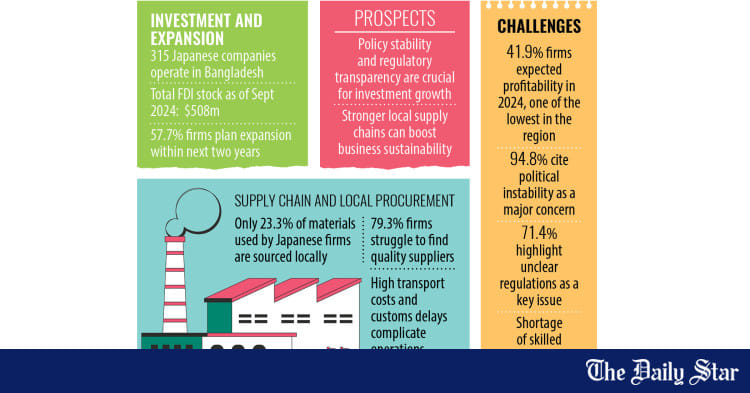
Half of Japanese firms optimistic about profit growth in 2025: survey

1742689089307.webp


After a challenging year, Japanese companies in Bangladesh are eyeing 2025 with cautious optimism, as 50 percent anticipate a rise in operating profits despite persistent hurdles.

However, political instability, unclear regulatory policies, and difficulties in local procurement continue to hinder smooth business operations, according to findings of the latest Japan External Trade Organisation (Jetro) survey 2024, which will be released today.

The report also highlighted both optimism and concerns among Japanese firms navigating these obstacles.

As of 2024, nearly 315 Japanese companies are operating in Bangladesh, with cumulative investments exceeding $508 million.

Despite the interest from Japanese businesses, the percentage of companies expecting profitability in Bangladesh in 2024 remains among the lowest in Asia and Oceania, standing at just 37.4 percent, according to the Jetro survey.

However, looking ahead to 2025, 50 percent of these companies anticipate a rise in operating profits, indicating cautious optimism.

Bangladesh has consistently ranked as one of the top investment destinations in South Asia for Japanese firms, with 57.7 percent of surveyed companies planning to expand their business activities in the next one to two years.

"The local market demand is a significant factor driving this expansion," said Yuji Ando, country representative of the Jetro in Dhaka.

"However, a combination of structural inefficiencies and policy uncertainties pose serious challenges," he said.

Among the major concerns highlighted in the survey are political and social instability, unpredictable regulatory policies, and insufficient infrastructure.

Notably, 94.8 percent of Japanese firms cited political uncertainty as a key risk while 75.3 percent pointed to unclear government policy management.

Moreover, Bangladesh's legal and administrative processes, including delays in obtaining permits and tax-related complexities, were identified as significant hurdles to smooth business operations.

Further challenges are posed by a shortage of skilled labour, which impacts productivity and efficiency.

Japanese companies have noted that while Bangladesh has a growing workforce, gaps in technical training and professional expertise create barriers to scaling up operations.

Investing in workforce development, Ando suggested, would significantly improve the investment climate and increase the competitiveness of the local industry.

A key area where Bangladesh struggles is in local procurement, which remains significantly lower than in other regional economies.

Only 23.3 percent of materials and parts used by Japanese companies are sourced locally, compared to higher rates in Vietnam, Indonesia, and India.

"The lack of reliable suppliers meeting international quality and technical standards remains a major obstacle," Ando noted.

The survey found that 79.3 percent of Japanese companies in Bangladesh faced difficulties in finding suppliers who met their quality requirements while 55.2 percent reported challenges in securing necessary raw materials.

To mitigate this, Japanese businesses are calling for more investment in the backward linkage industries and increased government support to strengthen local supply chains.

"Improving the local supplier ecosystem is critical to reducing dependency on imports and ensuring cost efficiency in production," Ando emphasised.

Additionally, logistical inefficiencies, such as delays at ports and high transportation costs, further complicate supply chain operations.

Japanese firms have called for streamlined customs procedures and improved transport infrastructure to ensure a more seamless movement of goods, which would reduce costs and enhance profitability.

Despite these obstacles, Japanese firms see long-term potential in Bangladesh, given its growing consumer base and strategic location.

The Jetro report suggests that expansion of business activities in Bangladesh remains a priority, particularly in sectors such as high-value manufacturing, consumer goods, and technology.

Ando emphasised that while Bangladesh presents numerous investment opportunities, addressing regulatory transparency and policy consistency would be essential in sustaining investor confidence.

"A stable and predictable business environment is crucial for attracting more Japanese investments," he noted.

One promising development is an increase in economic cooperation between Japan and Bangladesh.

Large-scale infrastructure projects supported by Japanese investment, such as the ongoing construction of the Matarbari deep-sea port and various road and energy projects, demonstrate Japan's commitment to enhancing Bangladesh's business environment.

These improvements could alleviate some of the logistical constraints currently affecting foreign businesses.

With Japan being one of Bangladesh's largest development partners, continued collaboration between the two nations could help overcome these challenges and pave the way for stronger economic ties.

Experts believe that a combination of government policy reforms, infrastructure advancements, and skilled workforce development will be key to ensuring long-term success for Japanese investors in Bangladesh.

While risks persist, the overall sentiment remains one of cautious optimism as Bangladesh works towards becoming a more favourable investment destination.

If the country can successfully address its regulatory and infrastructure shortcomings, it has the potential to emerge as a premier hub for Japanese investment in South Asia.​
 
Analyze

Analyze Post

Add your ideas here:
Highlight Cite Respond
  • Love (+3)
Reactions: Bilal9

Political stability key to higher Japanese investment: experts

Bangladesh must ensure long-term political stability, maintain policy consistency, and improve regulatory processes to create an environment conducive to attracting more Japanese investment, according to speakers at a discussion yesterday.

The findings of the Japan External Trade Organization (Jetro) 2024 survey have underscored the country's resilience and investment potential, particularly in attracting Japanese businesses, they said.

The discussion on the "2024 Jetro Survey on Business Conditions of Japanese Companies in Asia and Oceania" was organised by Jetro at The Westin Dhaka.

"Political stability and policy consistency remain vital to investor confidence," said Ashik Chowdhury, executive chairman of Bida

"Bangladesh's investment potential and key areas for improvement have been reflected in the Jetro 2024 survey," said Ashik Chowdhury, executive chairman of the Bangladesh Investment Development Authority (Bida).

Speaking on the country's commitment to fostering a business-friendly environment, he reaffirmed Bida's dedication to addressing investor concerns, particularly those of Japanese businesses.

"The structured flow of human capital is crucial," he said, noting that Japanese investors emphasise skilled labour export and knowledge exchange.

Bida is actively working to streamline labour management systems to ensure a stronger economic partnership with Japan, he said.

Chowdhury also stressed the need to integrate Bangladesh into the broader regional trade network.

He acknowledged that investment decision-making varies globally and that Japanese investors typically adopt a long-term approach.

"Political stability and policy consistency remain vital to investor confidence," he said.

Chowdhury also emphasised the need for structural reforms to ensure transparency and predictability.

"Developing quantifiable indicators will help track progress and build a more stable investment environment," he said.

An upcoming investment summit has drawn significant global interest, said Chowdhury, expressing optimism about Bangladesh's potential to become a leading investment destination.

Saida Shinichi, Japan's ambassador to Bangladesh, said the findings of the Jetro survey reaffirm what has long been recognised—that Bangladesh holds immense potential as a destination for Japanese investment.

He said the country's business environment was improving and that despite global uncertainties, the Bangladeshi economy remained resilient.

"While some investors may be waiting for the outcome of upcoming national elections, it is reassuring to see a growing sense of stability and optimism in the market," he said.

"My recent visit to Japan, along with high-level exchanges between our two countries, highlights the deepening economic relationship we share," he pointed out.

"However, to fully unlock this potential, we must continue working together to enhance business conditions, address investor concerns, and ensure long-term policy continuity," the ambassador emphasised.

He also said Japanese companies were eager to explore opportunities in Bangladesh, particularly in manufacturing, infrastructure, and human capital development.

"To attract more investment, it is crucial to streamline regulatory processes, improve logistics, and create a more predictable business environment," he said.

"These efforts will not only benefit Japanese investors but also contribute to Bangladesh's long-term economic growth," Shinichi added.

He said stability, continuity, and cooperation would be essential in shaping a future where Japanese and Bangladeshi businesses thrive together.

"I… remain confident that, through collaboration, we can further strengthen our economic partnership," he said.

"Japan remains committed to supporting Bangladesh's development journey, and I believe our cooperation will only grow stronger in the years ahead," Shinichi said.

"The Jetro 2024 survey highlights Bangladesh's strong business momentum despite political changes, reflecting its resilience and investment potential," said Tareq Rafi Bhuiyan, president of the Japan-Bangladesh Chamber of Commerce and Industry.

He said Japanese companies were increasingly exploring both export and domestic market opportunities, showcasing confidence in Bangladesh's economic landscape.

However, for sustainable growth, key factors must be addressed—ensuring political stability, maintaining policy consistency, and developing backward linkage industries to enhance local procurement, he added.

"BIDA's proactive approach and the Japanese ambassador's continuous support are crucial in this regard. Strengthening these areas will further solidify Bangladesh's position as a key investment destination for Japanese businesses," he said.

Yuji Wagata, vice president of the Japanese Commerce and Industry Association in Dhaka, said they were committed to creating a stable and conducive environment for business growth through collaboration and effective regulation.

"By working together, we can enhance Bangladesh's business climate and contribute to its economic development," he said.

Yuji Ando, country representative of Jetro in Dhaka, highlighted that business momentum in Bangladesh remains strong despite political changes.

He said Japanese companies were increasingly exploring both export-oriented and domestic market opportunities in the country.

He emphasised that political stability, policy consistency, increasing local procurement to reduce costs, and the development of backward linkage industries were crucial for business expansion.

Ando stressed that the success of Japanese companies in Bangladesh directly contributes to the country's foreign direct investment promotion, underscoring the importance of continuous efforts and dialogue in business development.​
 
Analyze

Analyze Post

Add your ideas here:
Highlight Cite Respond

Over 60pc Japanese cos keen to expand business in Bangladesh
Bangladesh Sangbad Sangstha . Dhaka 23 April, 2025, 22:41

1745454947332.webp

Participants pose for photo during The 6th Bangladesh-Japan public-private joint economic dialogue held on Wednesday at the Ministry of Economy, Trade and Industry at Tokyo in Japan. | BSS photo

Japanese vice-minister for economy, trade and industry Matsuo Takehiko while referring to a survey said that more than 60 per cent of the Japanese companies were considering expanding their business in Bangladesh.

He said that his government is ready to facilitate enhancing Japanese investment in Bangladesh through public private partnership.

The vice-minister was speaking at the 6th Bangladesh-Japan Public-Private Joint Economic Dialogue held today at the Japanese Economy, Trade and Industry ministry in Tokyo, according to a message received here today.

The Bangladesh delegation, comprising senior government officials and private sector representatives, was led by principal secretary to the chief advisor M Siraz Uddin Miah.

Bangladesh Ambassador to Japan Md Daud Ali and Japanese Ambassador to Bangladesh Saida Shinichi also attended the event.

The dialogue provided a platform for continued open and constructive engagement between stakeholders from both countries.

The discussions focused on strengthening trade and investment cooperation, with particular attention to connectivity, the Bay of Bengal Industrial Growth Belt (BIG-B), logistics, energy transition, agriculture, and the simplification of tax and customs procedures.

At the dialogue, Bangladesh highlighted its investment potential and ongoing reform initiatives aimed at fostering a more business-friendly environment.

The Japanese side was updated on the progress made in response to earlier feedback from Japanese investors.

The Japanese delegation conveyed their private sector’s strong satisfaction with Bangladesh’s improving business climate, noting that the number of Japanese companies in the country has tripled over the past decade.

This reflects increased investor confidence and strong interest in business expansion.

Both sides reaffirmed their commitment to deepening bilateral economic ties and expressed the hope for concluding the Economic Partnership Agreement (EPA) by the end of this year.

Bangladesh reiterated its full support to facilitate Japanese investment and emphasized its willingness to work closely with Japanese stakeholders.

The Japanese side welcomed the ongoing reforms and expressed optimism that the current momentum would continue.

Principal Secretary Miah assured that the Bangladesh government will continue working to address the key challenges, as raised in the discussion.

He highlighted reform and automation efforts to ensure a more investor-friendly environment and underscored the importance of concluding the EPA before Bangladesh’s graduation from Least Developed Country (LDC) status.

The dialogue, held in a hybrid format, was attended by senior officials from both governments and prominent business leaders.

From Bangladesh, participants included representatives from the chief advisor’s Office, National Board of Revenue, Ministry of Commerce, Bangladesh Investment Development Authority (BIDA), Bangladesh Bank and FBCCI.

From the Japanese side, participants included among others the Chairman of the Japan-Bangladesh Committee for Commercial and Economic Co-operation of the Japan Chamber of Commerce and Industry (JCCI), Japanese foreign ministry and other ministries officials as well as heads of the JICA and JETRO offices in Bangladesh and representatives from the Japanese private sector.​
 
Analyze

Analyze Post

Add your ideas here:
Highlight Cite Respond

Members Online

Back
 
G
O
 
H
O
M
E