Bangladesh Defense

Saif
Senior Member
- Joined
- Jan 24, 2024
- Messages
- 22,387
- Likes
- 9,875
- Nation

- Axis Group

Bangladesh RMG unit prices trail global average in US, EU
Exporters cite concentration on basic products, rising raw material prices
Saddam Hossain . Dhaka 21 September, 2026, 00:00
Bangladesh has been earning significantly less per unit of garment exported to the European Union and the United States for years, with no sign of a reversal in 2026.
Recent trade data showed that Bangladesh’s average export price on the US market stood at $3.05 per square metre equivalent against a global average of $3.17 per SME — a 3.8 per cent discount in January-July of the current year.
The gap was much wider in the European Union, Bangladesh’s largest export destination, where the global average unit price for imported apparel reached 19.84 euros a kilogram, while Bangladeshi shipments fetched only 13.80 euros a kilogram during the period, a steep 30.4 per cent discount, according to the data.
By comparison, Vietnam commanded more than 30 euros a kilogram on the European market, more than double Bangladesh’s realisation, the data showed.
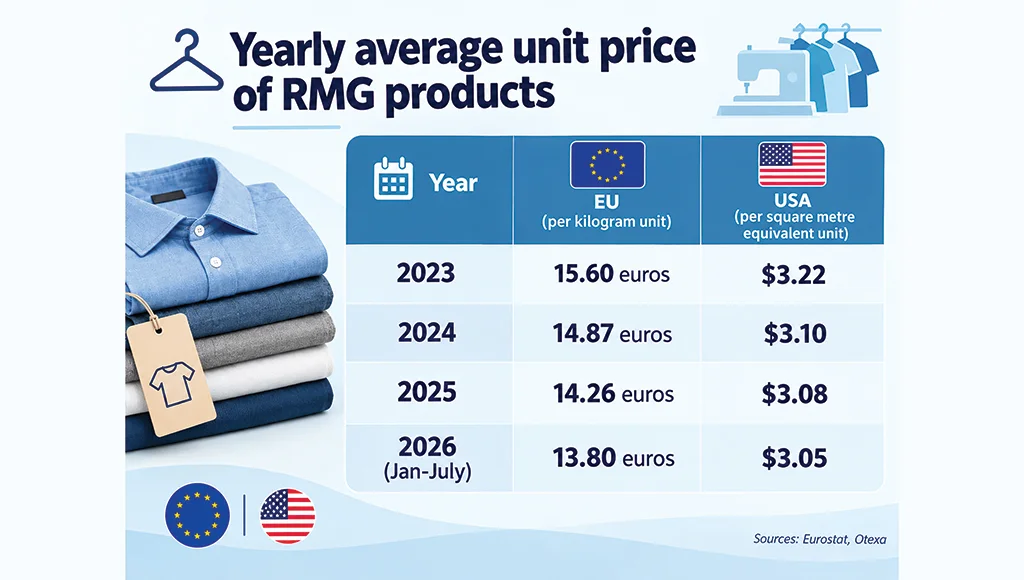
The shortfall is not a one-off, as Bangladesh’s average EU unit price has fallen every year since 2023 — from 15.60 euros a kilogram that year to 14.87 euros in 2024, 14.26 euros in 2025 and 13.80 euros in January-July 2026.
The US market has followed a similar path, with the average unit price slipping from $3.22 per SME in 2023 to $3.10 in 2024, $3.08 in 2025 and $3.05 in the first seven months of 2026, according to data compiled by Bangladesh Apparel Voice from Eurostat and OTEXA.
The decline has also become more volatile. EU prices fluctuated from a peak of 16.17 euros a kilogram in March 2025 to 12.89 euros in November of the same year — a 3.28-euros gap within a single year — before narrowing to a 1.17-euros range so far in 2026.
RMG exporters have said rising raw material prices and Bangladesh’s concentration on basic products has created a structural mismatch between its export basket and global demand patterns.
According to Export Promotion Bureau data, basic items, including T-shirts and polos, trousers, sweaters and pullovers, and other basic knitwear products, accounted for about 80 per cent of Bangladesh’s total RMG export basket.
In the financial year 2025-26, Bangladesh earned $38.7 billion from RMG exports to global destinations.
EPB and International Trade Centre data showed that 58.4 per cent of global apparel demand in 2025 was for non-cotton products, including synthetic yarns and performance blends.
Bangladesh’s export basket, by contrast, was concentrated 72.7 per cent in cotton items, mainly basic knitwear, T-shirts, trousers, sweaters and undergarments.
Bangladesh Garment Manufacturers and Exporters Association president Mahmud Hasan Khan told New Age that the unit price was on a declining trend because of the product basket and global raw material prices.
‘Due to these, we cannot bargain for aggressive prices,’ he said, adding that adequate policy support might help the country diversify its product basket.
Bangladesh Knitwear Manufacturers and Exporters Association executive president Fazlee Shamim Ehsan has said Bangladesh’s focus on basic apparel items and rising raw material prices are preventing garment exporters from increasing actual unit prices.
Unfair competition among local manufacturers to secure orders was another issue, he said, adding that many factories were accepting orders at very low prices, even at break-even levels, to remain in operation.
‘Buyers also had a responsibility. Manufacturers had invested in LEED-certified factories, sustainability and safe working environments but had not been able to increase prices accordingly,’ he added.
He also said that the government needed to provide policy support and tax incentives, particularly to facilitate a smooth transition towards man-made fibres, synthetic products, innovation and diversification.
Manufacturers also said that rising gas prices, costlier raw materials and higher bank financing costs had squeezed margins, while buyers refused to raise free-on-board prices.
Industry stakeholders have said the issue carries added urgency as Bangladesh prepares to graduate from least developed country status, a transition expected to phase out duty-free, quota-free access under the European Union’s Everything But Arms scheme and similar preferential arrangements elsewhere.
Once those preferences lapse, Bangladeshi exports could face tariffs of 8 to 12 per cent in major markets — a burden manufacturers may struggle to absorb if unit prices and product sophistication do not improve, they said.
Former BGMEA director Mohiuddin Rubel said that Bangladesh had become highly concentrated in basic apparel items, while its share of the cotton-based market was already large and offered limited scope for further expansion.
‘It is time to keep pace with global trends. Instead of focusing on further domination in markets where we already have a strong presence, we need to focus on potential markets,’ he said.
Rubel, also CEO of Bangladesh Apparel Voice, said that Bangladesh should put greater emphasis on technical textiles, medical textiles and activewear, while also exploring diversified cotton-based products beyond basic items.
Bangladesh should follow Vietnam’s example and focus on ports, energy, infrastructure and ease of doing business, he added.
He also called for the establishment of in-house design and innovation centres so that manufacturers could propose original concepts rather than depend entirely on buyer-supplied designs, thereby moving the industry towards full-package manufacturing.
Centre for Policy Dialogue distinguished fellow professor Mustafizur Rahman said in his recent write up that the strength of competing countries lied in their diversified product portfolios, covering a wide range of products including high- and mid-value garments.
Bangladesh, by contrast, remained heavily dependent on a limited number of products, with a large share of total exports concentrated in about five products, limiting flexibility, he said.
Domestic and foreign investment is now crucial to move from low-value basic cotton garments to higher-value products such as synthetic, technical and sportswear, he said.
He also said that weak backward linkages, particularly in man-made fibres and specialised textiles, meant Bangladesh remained heavily dependent on imported fabrics.
Investment could help develop integrated textile and recycling systems and reduce this dependence, he added.
Exporters cite concentration on basic products, rising raw material prices
Saddam Hossain . Dhaka 21 September, 2026, 00:00
Bangladesh has been earning significantly less per unit of garment exported to the European Union and the United States for years, with no sign of a reversal in 2026.
Recent trade data showed that Bangladesh’s average export price on the US market stood at $3.05 per square metre equivalent against a global average of $3.17 per SME — a 3.8 per cent discount in January-July of the current year.
The gap was much wider in the European Union, Bangladesh’s largest export destination, where the global average unit price for imported apparel reached 19.84 euros a kilogram, while Bangladeshi shipments fetched only 13.80 euros a kilogram during the period, a steep 30.4 per cent discount, according to the data.
By comparison, Vietnam commanded more than 30 euros a kilogram on the European market, more than double Bangladesh’s realisation, the data showed.
The shortfall is not a one-off, as Bangladesh’s average EU unit price has fallen every year since 2023 — from 15.60 euros a kilogram that year to 14.87 euros in 2024, 14.26 euros in 2025 and 13.80 euros in January-July 2026.
The US market has followed a similar path, with the average unit price slipping from $3.22 per SME in 2023 to $3.10 in 2024, $3.08 in 2025 and $3.05 in the first seven months of 2026, according to data compiled by Bangladesh Apparel Voice from Eurostat and OTEXA.
The decline has also become more volatile. EU prices fluctuated from a peak of 16.17 euros a kilogram in March 2025 to 12.89 euros in November of the same year — a 3.28-euros gap within a single year — before narrowing to a 1.17-euros range so far in 2026.
RMG exporters have said rising raw material prices and Bangladesh’s concentration on basic products has created a structural mismatch between its export basket and global demand patterns.
According to Export Promotion Bureau data, basic items, including T-shirts and polos, trousers, sweaters and pullovers, and other basic knitwear products, accounted for about 80 per cent of Bangladesh’s total RMG export basket.
In the financial year 2025-26, Bangladesh earned $38.7 billion from RMG exports to global destinations.
EPB and International Trade Centre data showed that 58.4 per cent of global apparel demand in 2025 was for non-cotton products, including synthetic yarns and performance blends.
Bangladesh’s export basket, by contrast, was concentrated 72.7 per cent in cotton items, mainly basic knitwear, T-shirts, trousers, sweaters and undergarments.
Bangladesh Garment Manufacturers and Exporters Association president Mahmud Hasan Khan told New Age that the unit price was on a declining trend because of the product basket and global raw material prices.
‘Due to these, we cannot bargain for aggressive prices,’ he said, adding that adequate policy support might help the country diversify its product basket.
Bangladesh Knitwear Manufacturers and Exporters Association executive president Fazlee Shamim Ehsan has said Bangladesh’s focus on basic apparel items and rising raw material prices are preventing garment exporters from increasing actual unit prices.
Unfair competition among local manufacturers to secure orders was another issue, he said, adding that many factories were accepting orders at very low prices, even at break-even levels, to remain in operation.
‘Buyers also had a responsibility. Manufacturers had invested in LEED-certified factories, sustainability and safe working environments but had not been able to increase prices accordingly,’ he added.
He also said that the government needed to provide policy support and tax incentives, particularly to facilitate a smooth transition towards man-made fibres, synthetic products, innovation and diversification.
Manufacturers also said that rising gas prices, costlier raw materials and higher bank financing costs had squeezed margins, while buyers refused to raise free-on-board prices.
Industry stakeholders have said the issue carries added urgency as Bangladesh prepares to graduate from least developed country status, a transition expected to phase out duty-free, quota-free access under the European Union’s Everything But Arms scheme and similar preferential arrangements elsewhere.
Once those preferences lapse, Bangladeshi exports could face tariffs of 8 to 12 per cent in major markets — a burden manufacturers may struggle to absorb if unit prices and product sophistication do not improve, they said.
Former BGMEA director Mohiuddin Rubel said that Bangladesh had become highly concentrated in basic apparel items, while its share of the cotton-based market was already large and offered limited scope for further expansion.
‘It is time to keep pace with global trends. Instead of focusing on further domination in markets where we already have a strong presence, we need to focus on potential markets,’ he said.
Rubel, also CEO of Bangladesh Apparel Voice, said that Bangladesh should put greater emphasis on technical textiles, medical textiles and activewear, while also exploring diversified cotton-based products beyond basic items.
Bangladesh should follow Vietnam’s example and focus on ports, energy, infrastructure and ease of doing business, he added.
He also called for the establishment of in-house design and innovation centres so that manufacturers could propose original concepts rather than depend entirely on buyer-supplied designs, thereby moving the industry towards full-package manufacturing.
Centre for Policy Dialogue distinguished fellow professor Mustafizur Rahman said in his recent write up that the strength of competing countries lied in their diversified product portfolios, covering a wide range of products including high- and mid-value garments.
Bangladesh, by contrast, remained heavily dependent on a limited number of products, with a large share of total exports concentrated in about five products, limiting flexibility, he said.
Domestic and foreign investment is now crucial to move from low-value basic cotton garments to higher-value products such as synthetic, technical and sportswear, he said.
He also said that weak backward linkages, particularly in man-made fibres and specialised textiles, meant Bangladesh remained heavily dependent on imported fabrics.
Investment could help develop integrated textile and recycling systems and reduce this dependence, he added.