Home Watch Videos Wars Movies Login

[🇧🇩] Textile & RMG Industry of Bangladesh

[🇧🇩] Textile & RMG Industry of Bangladesh
549
26K
More threads by Saif

G Bangladesh Defense

Costs to cool Bangladesh garment factories can be recovered within four years, study shows

Reuters
1789964490808.webp

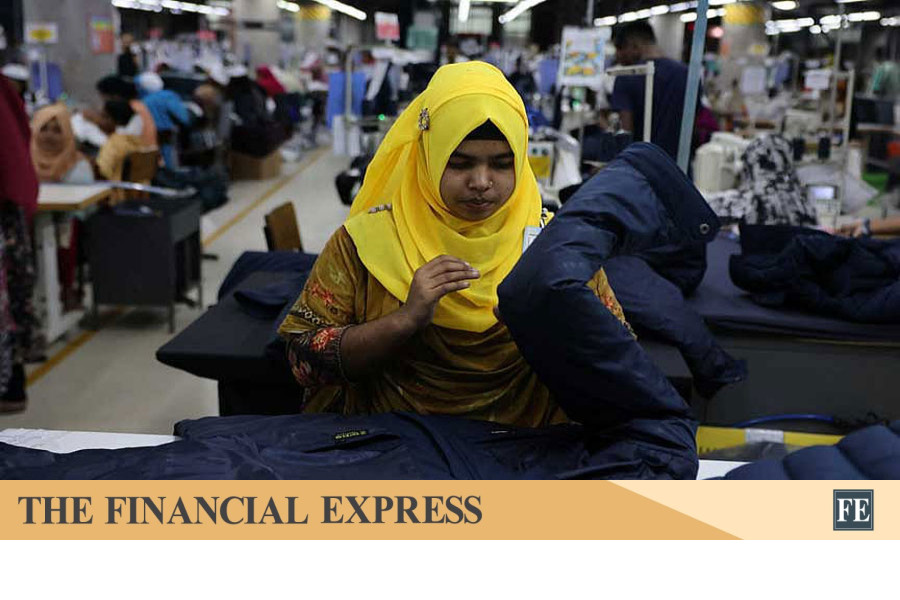
Bangladeshi garment workers make clothing in the sewing section of a factory in Gazipur, Bangladesh, April 9, 2025. REUTERS

Investing in cooling systems to reduce heat stress for garment factory workers makes financial sense for manufacturers and the brands they supply, a report showed on Sunday, as climate change poses growing risks to apparel production hubs.

Cooling investments at factories in Bangladesh, from reflective paint and roof insulation to airflow ventilation, are commercially viable and pay back within four years, researchers at Cornell University's Global Labor Institute found. The report urged brands to share the cost burden by easing prices for suppliers that invest to cool workers.

Temperatures inside factories often exceed those outdoors, with workers most exposed to extreme heat in ironing and finishing sections of the facilities, the authors found, citing temperature readings over a six-month period at eight factories in Dhaka. High heat stress erased 4.1% of these factories' annual revenue on average, posing financial risks for manufacturers and global brands.

The report "gives both buyers and suppliers a context for the scale of the intervention required," Jason Judd, executive director of the Global Labor Institute, told Reuters. "If you're contemplating cooling investments but you don't know how much is going out the door, it's very difficult."

In conversations with researchers over the past year, apparel brands have expressed interest in the payback period for heat adaptation spending at factories, Judd said. Brands have been "back and forth with their manufacturers over mitigation costs, hitting GHG (greenhouse gas) targets, identifying alternative energy sources," he added.

The latest findings follow research three years ago that showed heat and flooding could erase $65 billion in apparel export earnings from Bangladesh, Cambodia, Pakistan and Vietnam by 2030.

The apparel industry is increasingly recognizing the risks posed by climate change throughout supply chains. But the extent to which global brands funnel resources into adaptation remains an open question.

The American Apparel and Footwear Association (AAFA) last week released a toolkit aimed at protecting workers from extreme temperatures. The trade group proposed that brands share the costs of resilience measures in cases where the investments may not generate sufficient returns for a manufacturer to justify funding them alone.

"As extreme heat becomes an increasingly common reality worldwide, our industry must act to protect the workers who are at the heart of our supply chains," AAFA Executive Vice President Nate Herman said in a statement.​
 
Analyze

Analyze Post

Add your ideas here:
Highlight Cite Respond

Bangladesh RMG unit prices trail global average in US, EU
Exporters cite concentration on basic products, rising raw material prices

Saddam Hossain . Dhaka 21 September, 2026, 00:00

1789965950428.webp


Bangladesh has been earning significantly less per unit of garment exported to the European Union and the United States for years, with no sign of a reversal in 2026.

Recent trade data showed that Bangladesh’s average export price on the US market stood at $3.05 per square metre equivalent against a global average of $3.17 per SME — a 3.8 per cent discount in January-July of the current year.

The gap was much wider in the European Union, Bangladesh’s largest export destination, where the global average unit price for imported apparel reached 19.84 euros a kilogram, while Bangladeshi shipments fetched only 13.80 euros a kilogram during the period, a steep 30.4 per cent discount, according to the data.

By comparison, Vietnam commanded more than 30 euros a kilogram on the European market, more than double Bangladesh’s realisation, the data showed.

The shortfall is not a one-off, as Bangladesh’s average EU unit price has fallen every year since 2023 — from 15.60 euros a kilogram that year to 14.87 euros in 2024, 14.26 euros in 2025 and 13.80 euros in January-July 2026.

The US market has followed a similar path, with the average unit price slipping from $3.22 per SME in 2023 to $3.10 in 2024, $3.08 in 2025 and $3.05 in the first seven months of 2026, according to data compiled by Bangladesh Apparel Voice from Eurostat and OTEXA.

The decline has also become more volatile. EU prices fluctuated from a peak of 16.17 euros a kilogram in March 2025 to 12.89 euros in November of the same year — a 3.28-euros gap within a single year — before narrowing to a 1.17-euros range so far in 2026.

RMG exporters have said rising raw material prices and Bangladesh’s concentration on basic products has created a structural mismatch between its export basket and global demand patterns.

According to Export Promotion Bureau data, basic items, including T-shirts and polos, trousers, sweaters and pullovers, and other basic knitwear products, accounted for about 80 per cent of Bangladesh’s total RMG export basket.

In the financial year 2025-26, Bangladesh earned $38.7 billion from RMG exports to global destinations.

EPB and International Trade Centre data showed that 58.4 per cent of global apparel demand in 2025 was for non-cotton products, including synthetic yarns and performance blends.

Bangladesh’s export basket, by contrast, was concentrated 72.7 per cent in cotton items, mainly basic knitwear, T-shirts, trousers, sweaters and undergarments.

Bangladesh Garment Manufacturers and Exporters Association president Mahmud Hasan Khan told New Age that the unit price was on a declining trend because of the product basket and global raw material prices.

‘Due to these, we cannot bargain for aggressive prices,’ he said, adding that adequate policy support might help the country diversify its product basket.

Bangladesh Knitwear Manufacturers and Exporters Association executive president Fazlee Shamim Ehsan has said Bangladesh’s focus on basic apparel items and rising raw material prices are preventing garment exporters from increasing actual unit prices.

Unfair competition among local manufacturers to secure orders was another issue, he said, adding that many factories were accepting orders at very low prices, even at break-even levels, to remain in operation.

‘Buyers also had a responsibility. Manufacturers had invested in LEED-certified factories, sustainability and safe working environments but had not been able to increase prices accordingly,’ he added.

He also said that the government needed to provide policy support and tax incentives, particularly to facilitate a smooth transition towards man-made fibres, synthetic products, innovation and diversification.

Manufacturers also said that rising gas prices, costlier raw materials and higher bank financing costs had squeezed margins, while buyers refused to raise free-on-board prices.

Industry stakeholders have said the issue carries added urgency as Bangladesh prepares to graduate from least developed country status, a transition expected to phase out duty-free, quota-free access under the European Union’s Everything But Arms scheme and similar preferential arrangements elsewhere.

Once those preferences lapse, Bangladeshi exports could face tariffs of 8 to 12 per cent in major markets — a burden manufacturers may struggle to absorb if unit prices and product sophistication do not improve, they said.

Former BGMEA director Mohiuddin Rubel said that Bangladesh had become highly concentrated in basic apparel items, while its share of the cotton-based market was already large and offered limited scope for further expansion.

‘It is time to keep pace with global trends. Instead of focusing on further domination in markets where we already have a strong presence, we need to focus on potential markets,’ he said.

Rubel, also CEO of Bangladesh Apparel Voice, said that Bangladesh should put greater emphasis on technical textiles, medical textiles and activewear, while also exploring diversified cotton-based products beyond basic items.

Bangladesh should follow Vietnam’s example and focus on ports, energy, infrastructure and ease of doing business, he added.

He also called for the establishment of in-house design and innovation centres so that manufacturers could propose original concepts rather than depend entirely on buyer-supplied designs, thereby moving the industry towards full-package manufacturing.

Centre for Policy Dialogue distinguished fellow professor Mustafizur Rahman said in his recent write up that the strength of competing countries lied in their diversified product portfolios, covering a wide range of products including high- and mid-value garments.

Bangladesh, by contrast, remained heavily dependent on a limited number of products, with a large share of total exports concentrated in about five products, limiting flexibility, he said.

Domestic and foreign investment is now crucial to move from low-value basic cotton garments to higher-value products such as synthetic, technical and sportswear, he said.

He also said that weak backward linkages, particularly in man-made fibres and specialised textiles, meant Bangladesh remained heavily dependent on imported fabrics.

Investment could help develop integrated textile and recycling systems and reduce this dependence, he added.​
 
Analyze

Analyze Post

Add your ideas here:
Highlight Cite Respond

Import rules eased for specialised fabrics

Jagaran Chakma

1790057895254.webp


Apparel exporters will now be able to import specialised fabrics and materials used to produce niche products such as seamless sportswear, underwear and functional garments more easily, as the government has relaxed several provisions of the country’s import policy.

The commerce ministry amended the Import Policy Order 2026-2029 through a notification issued on Sunday, with the changes taking immediate effect.

Under the amended provisions, specialised fabrics and materials required for producing certain types of garments can be imported on the recommendation of either the Bangladesh Garment Manufacturers and Exporters Association (BGMEA) or the Bangladesh Knitwear Manufacturers and Exporters Association (BKMEA).

The move is expected to ease sourcing of inputs for manufacturers producing specialised apparel, which often require fabrics and materials that are not commonly used in mainstream garment production.

The latest amendment also removes some procedural requirements that had created additional complications for exporters, according to Mohammad Hatem, president of BKMEA.

Speaking to The Daily Star, Hatem said the changes were largely aimed at correcting inconsistencies and unnecessary restrictions in the Import Policy Order 2026-2029.

One of the major changes concerns the import of fabrics and yarn.

Under the previous provision, importers in certain cases were required to obtain approval from the Ministry of Commerce to import knit fabrics and yarn.

“That requirement did not make much sense when imports were already being made under the utilisation declaration (UD) system and within the framework of the import policy,” Hatem said.

He said the requirement could have forced businesses to approach the ministry for approval for individual letters of credit, adding another layer of paperwork to the import process.

The amended policy has removed the requirement, he said.

The government has also scrapped a provision concerning the import of spare parts for industrial machinery.

Previously, the value of spare parts that could be imported was capped at 2 percent of the value of machinery in the first year and 5 percent in subsequent years.

Hatem said the amendment also addressed several other inconsistencies, including contradictory and unclear wording in the previous policy.

“These corrections will make import procedures easier for businesses and reduce disruptions caused by inconsistencies in the policy,” he said.

The notification, however, does not provide any specific duty concession or quantitative limit for the import of the specialised fabrics and materials. Rather, it sets out the conditions under which such inputs can be imported.​
 
Analyze

Analyze Post

Add your ideas here:
Highlight Cite Respond

RMG factory cooling can deliver returns within 4 years: study

Reuters

1790058166208.webp

Workers sewing clothes at a factory in Gazipur. Photo: Reuters/file

Investing in cooling systems to reduce ‌heat stress for garment factory workers makes financial sense for manufacturers and the brands they supply, a report showed on Sunday, as climate change poses growing risks to apparel production hubs.

Cooling investments at factories in Bangladesh, from reflective paint and roof insulation to airflow ventilation, are commercially viable and pay back within four years, researchers at Cornell University’s Global Labor Institute found. The report urged brands to share the cost burden by easing prices for suppliers that invest to cool workers.

Temperatures inside factories often exceed those outdoors, with workers most exposed to extreme heat in ironing and finishing sections of the facilities, the authors found, citing temperature readings over a six-month period at eight factories in Dhaka. High heat stress erased 4.1 percent of these factories’ annual revenue on average, posing financial risks for manufacturers and global brands.

The report “gives both buyers and suppliers a context for the scale of the intervention required,” Jason Judd, executive director of the Global Labor Institute, told Reuters. “If you’re contemplating cooling investments but you don’t know how much is going out the door, it’s very ‌difficult.”

In conversations with researchers over the past year, apparel brands have expressed interest in the payback period for heat adaptation spending at factories, Judd said. Brands have been “back and forth with their manufacturers over mitigation costs, hitting GHG (greenhouse gas) targets, identifying alternative energy sources,” he added.

The latest findings follow research three years ago that showed heat and flooding could erase $65 billion in apparel export earnings from Bangladesh, Cambodia, Pakistan and Vietnam by 2030.

The apparel industry is increasingly recognising the risks posed by climate change throughout supply chains. But the extent to which global brands funnel resources into adaptation remains an open question.

The American Apparel and Footwear Association (AAFA) last week released a toolkit aimed at protecting workers from extreme temperatures. The trade group proposed that brands share the costs of resilience measures in cases where the investments may not generate sufficient returns for a manufacturer to justify funding them alone.

“As extreme heat becomes an increasingly common reality worldwide, our industry must act to protect the workers who are at the heart of our supply chains,” AAFA Executive Vice President Nate Herman said in a statement.​
 
Analyze

Analyze Post

Add your ideas here:
Highlight Cite Respond

$239m investment can curb RMG heat stress, boost productivity: Cornell


1790132709002.webp


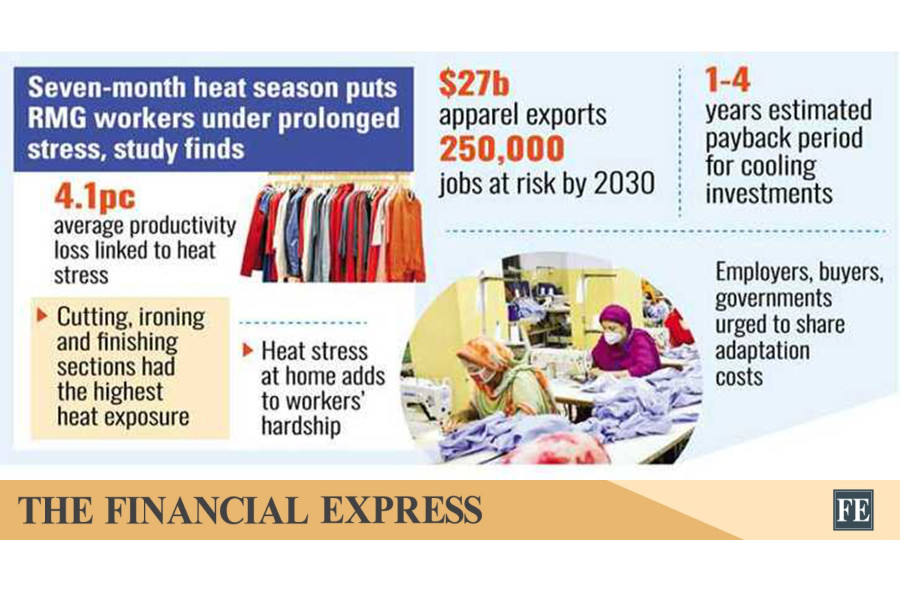
Workers in the ironing and finishing segments of Bangladesh's readymade garment (RMG) sector endure extreme environmental hazards inside factories, spending over three-quarters of their working days under high or severe heat stress during an expanding seven-month heat season, a new study has found.

The report, released Monday by Cornell University's Global Labor Institute, revealed that while the physical burden on these workers threatens human health and factory output, an industry-wide investment of US$239 million -- equivalent to just 0.2 per cent of Bangladesh's 2025 export revenues -- could help reduce factory heat stress.

The investments could also generate financial returns for manufacturers by improving productivity, with the study finding that cooling measures could pay for themselves within one to four years.

Titled 'Six Seasons, Four Summers: How to solve fashion's high heat problem', the report is the first to quantify both the costs of extreme heat and the financial returns from reducing it in the fashion industry, according to the authors. It examines how heat-adaptation measures can protect workers while improving productivity and employer earnings.

The findings show that Dhaka experienced a seven-month heat-stress season in 2025, which the authors describe as "the new norm". Heat stress inside factories was consistently higher than outdoor levels, the report said.

Researchers from Cornell partnered with BRAC University, YGEN Engineering and the Bangladesh Centre for Worker Solidarity to conduct a year-long analysis of heat stress in garment factories and workers' homes.

The study used electronic temperature and humidity sensors in eight factories and 37 workers' homes, alongside engineering assessments, to measure heat exposure and estimate the costs and potential returns of reducing it.

The greatest exposure was recorded in cutting and ironing/finishing sections, where workers spent a substantial share of their working time in the hottest months in "caution", "high" and "severe" heat-stress zones, according to the report.

Workers also frequently continued working despite dangerous heat conditions, the researchers found.

Across the eight factories studied, heat stress was associated with an average 4.1 per cent loss in working-time productivity.

Engineering assessments found that targeted measures, including roof insulation, improved ventilation and mechanical cooling systems, could substantially reduce heat exposure, delivering a return on investment by improving productivity and protecting workers' health.

Under a more pessimistic "headwinds" scenario, the average payback period across the eight factories was 2.9 years, while under the worst-case scenario it was just over four years, according to the report.

The authors said the business case remained positive even under more conservative assumptions involving higher capital and energy costs and lower productivity gains.

The findings build on Cornell's landmark 'Higher Ground?' study published in 2023 with Schroders, which found that extreme heat and flooding could put $65 billion in apparel exports at risk across Bangladesh, Cambodia, Pakistan and Vietnam by 2030 -- equivalent to a 22 per cent loss in export earnings -- while reducing potential job creation by nearly one million due to slower industry growth.

For Bangladesh, that study estimated that $27 billion in apparel exports and 250,000 potential jobs could be at risk by 2030.

But the impacts do not stop at the factory gate. The research found that workers are also experiencing rising heat stress at home, where increasingly hot nights limit recovery from long shifts spent working in high temperatures.

Hotter homes are also driving up electricity, medicine and other household costs, with surveys finding that workers reported borrowing money, pawning belongings or cutting spending to afford fans, electricity and healthcare during the hottest months.

The authors called for greater coordination among brands, manufacturers, governments and international institutions to address extreme heat in apparel workplaces and share the costs of adaptation.

"The problem is urgent and we already know what can be done to reduce heat stress," said Jason Judd, executive director of Cornell University's Global Labor Institute.

He said practical solutions were available to manufacturers and that addressing heat stress made sense from both business and worker health and safety perspectives.

"The challenge now is deciding how to share the costs fairly and scaling these solutions across the industry," he said.

"This means acting together -- employers, buyers, workers, government -- through mandatory programmes such as the International Accord, which provide a framework for putting solutions into practice and spell out how responsibility is shared," he added.

The paper noted that there was no single solution to heat stress and that measures would need to reflect the conditions and requirements of individual factories.

"There is no one-size-fits-all solution to heat stress. Every factory is different, so measures need to reflect the factory's design and production processes," said Tareq Ahmed Robin, managing director of YGEN Engineering.

"The important thing is to start now, with practical steps -- insulation, improved airflow, active cooling for the hottest areas -- and to build on these measures as heat stress rates go higher," he said.

Kalpona Akter, executive director at Bangladesh Centre for Worker Solidarity, called for workload adjustment for workers when heat increases.​
 
Analyze

Analyze Post

Add your ideas here:
Highlight Cite Respond

How a Bangladeshi garment-maker fights West Asia energy crunch


1790133697572.webp

A worker inspects a jacket at the Yarn Dyeing Limited factory, amid the energy crisis, in Savar, on the outskirts of Dhaka, Bangladesh, Sept 17, 2026.
Source: REUTERS

A gas and power crisis has hit production at most Bangladeshi garment makers, but at 4A Yarn Dyeing, a supplier to Walmart, Gap and Next, workers stitch hoodies and attach brand logos uninterrupted, at least for now.

Since 2019, 4A has generated its own power, including through solar panels, making it an exception in Bangladesh's garment industry, the world's second-biggest exporter after China. The West Asia crisis has worsened energy shortages in the country, where much of the electricity is generated using natural gas, furnace oil and diesel.

A recent survey of 134 knitwear factories found that 55 per cent had seen buyers cancel or cut orders because of gas and power shortages since late August, and 78 per cent had partially halted production. The factories also reported shipment delays and discounted orders to buyers.

But that's not yet the case at 4A, whose factory on Dhaka's outskirts employs nearly 7,500 workers and meets around 40 per cent of its electricity needs through solar, the rest mainly through its own gas and diesel generation.

"We never stayed at a single-source energy dependency. We had backups for everything," said company co-owner Abdullah Hil Nakib. "We need some sort of certainty. But the cost of doing business has increased. First there was a shortage of oil, then a shortage of gas."

Costlier diesel has pushed 4A's production costs up by 2 per cent to 3 per cent, adding up to Tk 5 million ($40,950) to its monthly fuel bill, he said.

Chairman of 4A Yarn Dyeing Limited Abdullah Hil Nakib gestures during an interview with Reuters at his office, in Dhaka, Bangladesh, Sept 17, 2026. REUTERS

The pressure on factories intensified on Monday after Bangladesh raised fuel prices by up to 17.4 per cent, a move the government said was necessary because of soaring global prices and higher shipping costs due to the West Asia conflict triggered by US-Israeli attacks on Iran in February.

To reduce future disruptions, 4A plans to install an industrial-scale battery system that would allow operations to continue for several hours if power sources fail.

"We've been able to absorb the extra costs, but not every factory can afford to do that," said Nakib, whose factory roofs are nearly covered in solar panels.

Steep Fuel Price Hike To Pile More Pressure

Soaring gas import costs are slowing the country's industrial growth, causing electricity outages and hurting spending on development projects due to higher gas subsidies, Bangladesh's power minister said last week.

Bangladesh's ready-made garment sector accounts for more than 80 per cent of export earnings, employs about 4 million workers and contributes around 10 per cent to gross domestic product.

Some manufacturers have incurred additional costs by shipping goods by air or offering discounts to meet delivery deadlines after energy-related disruptions.

"Our margins are already very thin, and the fuel price hike will squeeze them further," said garment exporter Shahidullah Azim. "It is becoming increasingly difficult for us to absorb higher production and transportation costs while remaining competitive."

Azim said a Canadian buyer that had been expected to order 25,000 pieces ultimately placed an order for only 8,000, which he attributed to declining buyer confidence amid Bangladesh's economic and energy challenges.

Companies may be able to pay higher fuel costs, but gas shortages and power cuts are more worrying for some, given that those problems are not as intense in competitors like Vietnam and India, said Mohiuddin Rubel, additional managing director of Denim Expert Ltd, which supplies to brands including H&M.

"Whether we hold our position against other sourcing countries or lose ground to them depends on how well we manage it," he said.​
 
Analyze

Analyze Post

Add your ideas here:
Highlight Cite Respond

Latest Posts

Back
 
G
O
 
H
O
M
E