Bangladesh Defense
Saif
Senior Member
- Jan 24, 2024
- 21,580
- 9,778
- Nation

- Residence
- Axis Group

July Warriors: Patients who refuse to be just patients
Our hospitals exist to heal bodies, not feed egos
July Warriors: Patients who refuse to be just patients

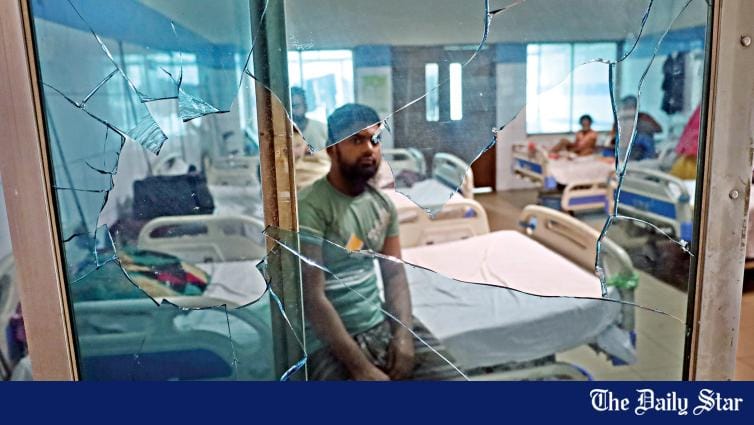
Signs of a clash visible inside a ward at the National Institute of Ophthalmology and Hospital in Dhaka. Picture taken on May 29, 2025. Photo: Star
Che Guevara once said, "The true revolutionary is guided by great feelings of love for the people. It is impossible to think of a genuine revolutionary lacking this quality."
But what happens when that love curdles into entitlement, when ideals decay into demands, and when revolutionaries become the very oppressors they once resisted?
That is the unfortunate irony now unfolding at three major public hospitals in Dhaka: the National Institute of Ophthalmology and Hospital (NIOH), Bangladesh Medical University (BMU), and the National Institute of Traumatology and Orthopaedic Rehabilitation (NITOR). These institutions are meant to serve the most vulnerable, but now held hostage by patients who have already been declared fit for discharge.
Most of them are injured July protesters. While some may have legitimate grievances about past medical negligence, many are now accused of occupying beds unnecessarily, intimidating staff members, disrupting services, and depriving ordinary citizens of critical care.
According to multiple reports in The Daily Star, the crisis began with violent clashes at NIOH in late May. On May 28, hospital staff, protesters, and other patients were embroiled in a confrontation that led to injuries on all sides. Services were suspended for nearly a week.
To address the situation, the health ministry formed a four-member medical board comprising senior ophthalmologists. On June 4, the board reviewed 31 patients and recommended discharge for the majority. Hospital authorities issued discharge letters, but instead of complying, some protesters allegedly confined NIOH Acting Director Zane Alam to his office and tore up the documents.
The Daily Star's investigations revealed troubling accusations: hospital staff allege that some protesters were brokering admission to the hospital, offering bribes to fast-track surgeries, and demanding preferential treatment. Protesters, meanwhile, insist they face neglect and demand the removal of certain doctors. Even if their complaints are valid, their methods, holding hospitals hostage, undermine their cause.
The hypocrisy is glaring. Those who once marched against injustice now risk becoming what they despised, weaponizing victimhood to cling to privilege. Their refusal to vacate beds, their demands for special treatment, and their coercion of hospital staff are not acts of resistance, they are symptoms of entitlement. A movement born for justice now teeters on self-parody.
Director Zane Alam stated, "The fear among doctors and nurses has not completely disappeared, but we are trying to restore their confidence."
Yet how long can professionals work under duress while hospital corridors remain a battleground?
Md Abul Kenan, director of NITOR said: "Most of these patients no longer need hospital admission. They can continue treatment at home."
And yet, they remain, blocking critical care for others. A Prothom Alo report on June 2 described a patient from Demra who arrived for surgery only to find the hospital shut. "When will I get another date? I don't know," he said. His story is not unique but represents many.
If some protesters require advanced care beyond what these hospitals can offer , the government should transfer them to specialized facilities, or arrange treatment abroad if absolutely necessary. But permitting indefinite occupation of public hospitals is unconscionable.
Here lies the deeper crisis; state paralysis. Despite having medical assessments, administrative authority, and public mandate, the government has failed to act. Is this fear? Appeasement? Sheer incompetence? Whatever the reason, the result is the same: a betrayal of public trust.
This is not mere mismanagement. It is a moral collapse. By allowing healthcare to be monopolized by a vocal few, the state surrenders the soul of public service to the loudest, not the neediest.
Our hospitals exist to heal bodies, not feed egos. Our government must serve the public, not coddle political pawns. And those who once wore the mantle of heroes must now answer: Will they uphold the ideals they fought for, or cling to beds they no longer need?
Arafat Rahaman is a journalist at The Daily Star.
Signs of a clash visible inside a ward at the National Institute of Ophthalmology and Hospital in Dhaka. Picture taken on May 29, 2025. Photo: Star
Che Guevara once said, "The true revolutionary is guided by great feelings of love for the people. It is impossible to think of a genuine revolutionary lacking this quality."
But what happens when that love curdles into entitlement, when ideals decay into demands, and when revolutionaries become the very oppressors they once resisted?
That is the unfortunate irony now unfolding at three major public hospitals in Dhaka: the National Institute of Ophthalmology and Hospital (NIOH), Bangladesh Medical University (BMU), and the National Institute of Traumatology and Orthopaedic Rehabilitation (NITOR). These institutions are meant to serve the most vulnerable, but now held hostage by patients who have already been declared fit for discharge.
Most of them are injured July protesters. While some may have legitimate grievances about past medical negligence, many are now accused of occupying beds unnecessarily, intimidating staff members, disrupting services, and depriving ordinary citizens of critical care.
According to multiple reports in The Daily Star, the crisis began with violent clashes at NIOH in late May. On May 28, hospital staff, protesters, and other patients were embroiled in a confrontation that led to injuries on all sides. Services were suspended for nearly a week.
To address the situation, the health ministry formed a four-member medical board comprising senior ophthalmologists. On June 4, the board reviewed 31 patients and recommended discharge for the majority. Hospital authorities issued discharge letters, but instead of complying, some protesters allegedly confined NIOH Acting Director Zane Alam to his office and tore up the documents.
The Daily Star's investigations revealed troubling accusations: hospital staff allege that some protesters were brokering admission to the hospital, offering bribes to fast-track surgeries, and demanding preferential treatment. Protesters, meanwhile, insist they face neglect and demand the removal of certain doctors. Even if their complaints are valid, their methods, holding hospitals hostage, undermine their cause.
The hypocrisy is glaring. Those who once marched against injustice now risk becoming what they despised, weaponizing victimhood to cling to privilege. Their refusal to vacate beds, their demands for special treatment, and their coercion of hospital staff are not acts of resistance, they are symptoms of entitlement. A movement born for justice now teeters on self-parody.
Director Zane Alam stated, "The fear among doctors and nurses has not completely disappeared, but we are trying to restore their confidence."
Yet how long can professionals work under duress while hospital corridors remain a battleground?
Md Abul Kenan, director of NITOR said: "Most of these patients no longer need hospital admission. They can continue treatment at home."
And yet, they remain, blocking critical care for others. A Prothom Alo report on June 2 described a patient from Demra who arrived for surgery only to find the hospital shut. "When will I get another date? I don't know," he said. His story is not unique but represents many.
If some protesters require advanced care beyond what these hospitals can offer , the government should transfer them to specialized facilities, or arrange treatment abroad if absolutely necessary. But permitting indefinite occupation of public hospitals is unconscionable.
Here lies the deeper crisis; state paralysis. Despite having medical assessments, administrative authority, and public mandate, the government has failed to act. Is this fear? Appeasement? Sheer incompetence? Whatever the reason, the result is the same: a betrayal of public trust.
This is not mere mismanagement. It is a moral collapse. By allowing healthcare to be monopolized by a vocal few, the state surrenders the soul of public service to the loudest, not the neediest.
Our hospitals exist to heal bodies, not feed egos. Our government must serve the public, not coddle political pawns. And those who once wore the mantle of heroes must now answer: Will they uphold the ideals they fought for, or cling to beds they no longer need?
Arafat Rahaman is a journalist at The Daily Star.