[🇺🇸] Trump vs Xi vs Putin

Quick Reply ✓ Posted!
[🇺🇸] Trump vs Xi vs Putin
1
22
More threads by Saif

G   American Defense

Saif

Senior Member
Joined
Jan 24, 2024
Messages
22,296
Likes
9,869
Nation

Axis Group

Trump, Xi, Putin to hold historic meeting in China: White House

AFP
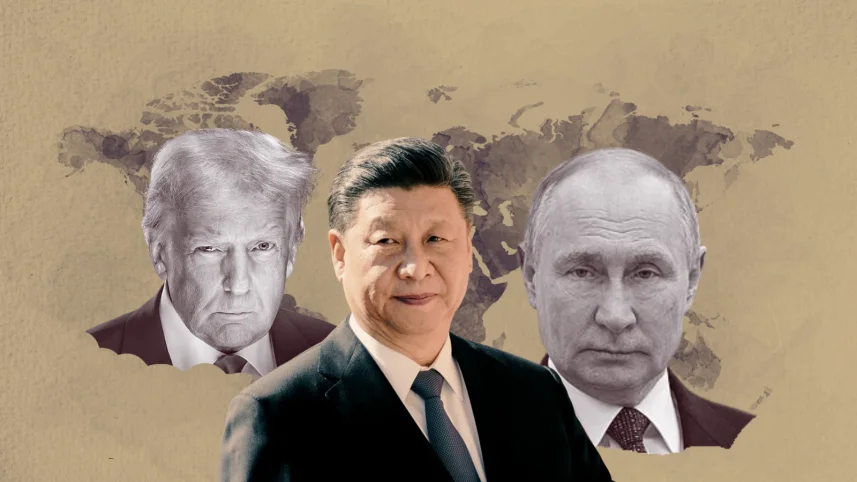
1794618596250.webp


Donald Trump, Vladimir Putin and Xi Jinping will hold the first ever three-way meeting between the leaders of the United States, Russia and China at a summit in Shenzhen next week, the White House said Friday.

Trump wants to talk about reducing nuclear arsenals at the trilateral talks on Thursday and is also set to bring up his war in Iran -- but he is not expected to discuss Russia's war in Ukraine, US officials said.

The three leaders will meet on the sidelines of the Asia-Pacific Economic Cooperation summit in the southern Chinese city, White House spokeswoman Olivia Wales told reporters.

"The president has made it clear that, among other topics, he will discuss the reduction of nuclear weapons in the world. This proliferation, President Trump believes, is very dangerous," Wales said.

One of the major conflicts dominating Trump's second term as president will feature, but the other will not, the US officials said.

"I think the president does intend to talk about Iran in the trilateral meeting with Xi Jinping and Vladimir Putin," a senior US official, speaking on condition of anonymity, told reporters on a call.

Washington has a "whole other track" of negotiations with Kyiv and Moscow aimed at ending the war in Ukraine, the official added, referring to talks that US envoys have had in recent days with Putin and Ukrainian President Volodymyr Zelensky.

"China is not really a part of that track, so it doesn't seem appropriate to have the Ukraine discussion there," the official added.

Tesla and Space X boss Elon Musk will accompany Trump on his trip to China but won't be involved in the meeting with Xi and Putin, the officials said.

Trump will also hold a bilateral working lunch and meeting with the Chinese president on Thursday -- their fourth meeting since the US president's return to power last year.

But Trump is not scheduled to have a separate one-on-one with Putin.

Among other topics, Nvidia chief executive Jensen Huang's resignation over an affair with an alleged Chinese spy is not expected to come up in Trump's meetings with Xi, the officials said.

"The situation with Nvidia should not really have any bearing on the trip," a second US senior official said.

The United States also did not plan to discuss export controls on sensitive chip technology, which were at the heart of the Nvidia scandal.

"We do not negotiate American export controls. These are national security matters that we develop in the administration... and we don't expect it to figure at all in any of our conversations with the Chinese while we're there," the second official said.

Trump will leave Washington on Monday and arrive in the Philippines on Tuesday for a summit of the Association of Southeast Asian Nations (ASEAN) summit before heading to Shenzhen.​
 

World looks at Trump-Putin-Xi meeting
1794869822119.webp

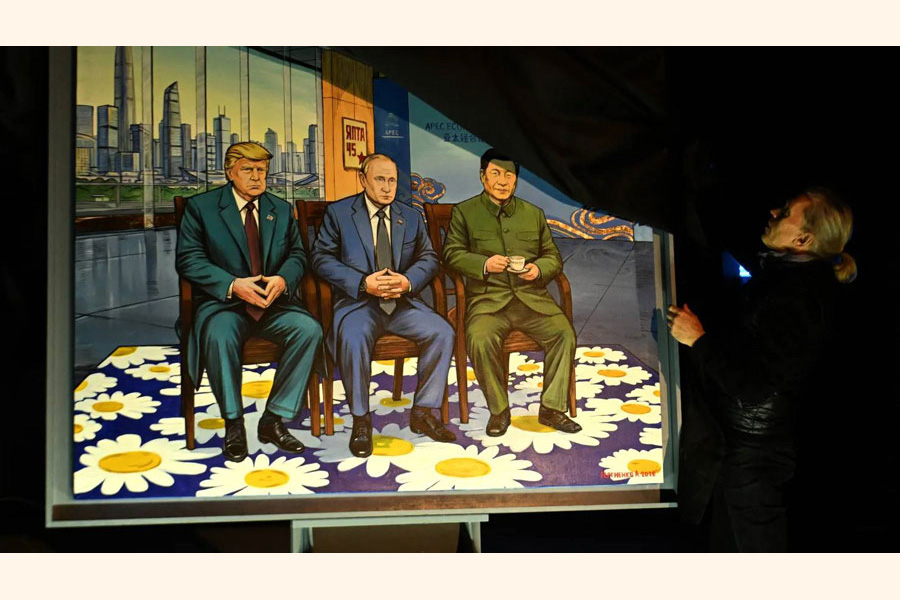
Russian artist Alexey Sergienko unveils his new pop art painting dubbed "Shenzhen, 26" in Saint Petersburg on November 12, 2026 —Photo: AFP

At a time when the international order appears increasingly fragile, the planned meeting of Donald Trump, Vladimir Putin and Xi Jinping in Shenzhen has assumed an importance far beyond an ordinary diplomatic gathering. The leaders of the world's three most powerful countries are expected to come together this week, raising hopes that their combined political influence could help address some of the most dangerous conflicts confronting humanity.

For a world exhausted by the war in Ukraine and the US-Iran confrontation, the prospect of these three leaders sitting around the same table offers a rare moment of hope. Both conflicts have inflicted enormous human suffering and generated economic consequences that reach far beyond their immediate theatres. Energy prices, international trade, food security and the livelihoods of millions have been affected. Their consequences are being felt even in countries thousands of miles away from the battlefields.

The question, therefore, is whether Shenzhen can become more than a summit of powerful men exchanging diplomatic courtesies. Can it produce a breakthrough towards ending the wars, or will it merely expose the widening differences among the three powers?

The gathering has inevitably invited comparisons with the 1945 Yalta Conference, when Joseph Stalin, Winston Churchill and Franklin D Roosevelt met to discuss the future of a world emerging from the devastation of the second world war. That meeting helped shape the postwar international order and determined much of Europe's political future. It also laid the foundations for the divisions that subsequently developed into the cold war.

The historical parallel is striking, although the circumstances are considerably different. In 1945, the Allied powers were negotiating the arrangements for a world emerging from a devastating global conflict. Today, Trump, Putin and Xi are meeting amid several competing geopolitical crises, with no common understanding of how the international order should evolve. Their countries are not united by a shared war objective. Instead, they are divided by strategic competition, conflicting security interests and deep mutual suspicion.

Nevertheless, the importance of the meeting should not be underestimated. The United States and Russia possess the world's largest nuclear arsenals, while China is rapidly expanding its military and strategic capabilities. Together, the three countries have extraordinary influence over international security. Their willingness to communicate and cooperate could make a substantial difference to the prospects of global stability.

Ukraine will remain one of the most difficult issues. Putin wants recognition of Russia's strategic and security interests, while Kyiv insists that its sovereignty and territorial integrity cannot be sacrificed through negotiations among major powers. Any settlement reached without Ukraine's meaningful participation would risk producing an agreement without legitimacy. A ceasefire imposed from outside might temporarily stop the fighting, but it would not necessarily resolve the underlying conflict.

The Middle East presents an equally complicated challenge. The US-Iran confrontation has heightened instability across an already volatile region, threatening energy supplies and vital shipping routes. The economic implications extend well beyond the Middle East, particularly for developing countries dependent on imported fuel. Washington, Moscow and Beijing have different relationships with Tehran and different calculations about regional security. Yet all three have reasons to prevent a wider conflict.

A diplomatic understanding among them could help create conditions for de-escalation. Even if a comprehensive settlement remains beyond reach, an agreement to restrain military escalation and encourage negotiations would be an important beginning.

Each leader, however, will approach the meeting with a different agenda.

Trump will want to demonstrate that his preference for direct, leader-to-leader diplomacy can deliver results. An agreement that reduces international tensions would reinforce his claim that personal negotiations can achieve what conventional diplomacy has failed to accomplish.

Putin will seek to ensure that Russia is treated as an indispensable global power and that its interests in European security receive international recognition. A meeting with the American and Chinese presidents also offers Moscow an opportunity to demonstrate that it remains influential despite its confrontation with Western countries.

For Xi, the calculations are more complex. China has strengthened its strategic relationship with Russia but has substantial economic interests in maintaining stable relations with the United States and Europe. Beijing is also conscious that its growing global influence depends partly on economic stability. A prolonged international crisis could undermine trade, investment and China's development priorities.

The three leaders may therefore find common ground in preventing a wider confrontation, even if they remain divided over how existing wars should end.

There is another reason why the Shenzhen summit matters. The postwar international system, built around the United Nations and the principles of sovereignty and international law, is facing a serious credibility crisis. Military interventions, economic coercion and great-power rivalries have increasingly challenged the institutions designed to prevent conflict.

The danger is that international diplomacy could become a matter of powerful countries negotiating arrangements over the heads of smaller nations. The experience of Yalta offers a warning in this regard. The future of Ukraine cannot be decided without Ukraine, just as the security of the Middle East cannot be determined without the participation of the countries and peoples directly affected.

For Bangladesh and other developing economies, the outcome of these geopolitical confrontations has immediate economic implications. Higher fuel prices, disrupted supply chains, shipping insecurity and inflation place additional pressure on countries already struggling with economic challenges. Peace is therefore not merely a distant diplomatic aspiration; it is an economic necessity.

The Shenzhen meeting should also look beyond the immediate wars. Nuclear arms control, the prevention of military miscalculation and the restoration of diplomatic communication deserve serious attention. With strategic competition intensifying, the absence of effective dialogue among nuclear powers is itself a growing danger.

No one should expect three leaders to resolve decades of geopolitical rivalry in a single meeting. Nor should the world confuse a carefully choreographed summit with a genuine commitment to peace. The differences among Washington, Moscow and Beijing are substantial, and each leader will be reluctant to compromise on issues considered central to national interests.

But diplomacy often begins with much smaller steps. A commitment to keep communication channels open, prevent further escalation and support negotiations could provide the foundation for more substantial agreements.

The world does not need another Yalta, where the fate of nations is determined by a handful of powerful leaders. It needs a new commitment to international cooperation in which great powers recognise that their security cannot be built at the expense of everyone else's.

The people of Ukraine and the Middle East are not looking for grand diplomatic photographs. They want an end to the violence, the return of displaced families and the opportunity to rebuild their lives. Millions elsewhere are hoping for relief from the economic uncertainty generated by these conflicts.

That is the responsibility confronting Trump, Putin and Xi in Shenzhen. Their meeting may not produce an immediate peace agreement, but it should at least demonstrate that the world's most powerful leaders understand the consequences of continued confrontation.

History will not judge the summit by the grandeur of its setting or the warmth of its handshakes. It will judge it by whether the three leaders take even a meaningful step towards making the world safer.

For a war-weary world, that is not too much to ask.​
 

PKDefense Forums: Country-by-Country Military Discussions

Log In Register Forums
Latest
Back