
[🇧🇩] Tyre Manufacturing Industry of Bangladesh

Afghanistan Albania Algeria Andorra Angola Antigua Austria Azerbaijan Bahamas Bahrain Bangladesh Barbados Canada China Egypt Finland Germany India Iran Israel Japan Lebanon North Macedonia Pakistan Palestine Qatar Russia Syria Turkey Ukraine United Kingdom United States Yemen
[🇧🇩] Tyre Manufacturing Industry of Bangladesh
3
7
More threads by Saif

G Bangladesh Defense

Saif

Senior Member
Joined
Jan 24, 2024
Messages
20,358
Likes
9,555
Nation

Residence

Axis Group

Heavy tyre sector expands amid rising demand, export ambitions
Muhammad Ayub Ali 20 July, 2026, 23:47
1784594332950.webp


Bangladesh’s tyre market is gradually expanding, driven by rising vehicle sales, economic growth, infrastructure development and increasing demand for replacement tyres.

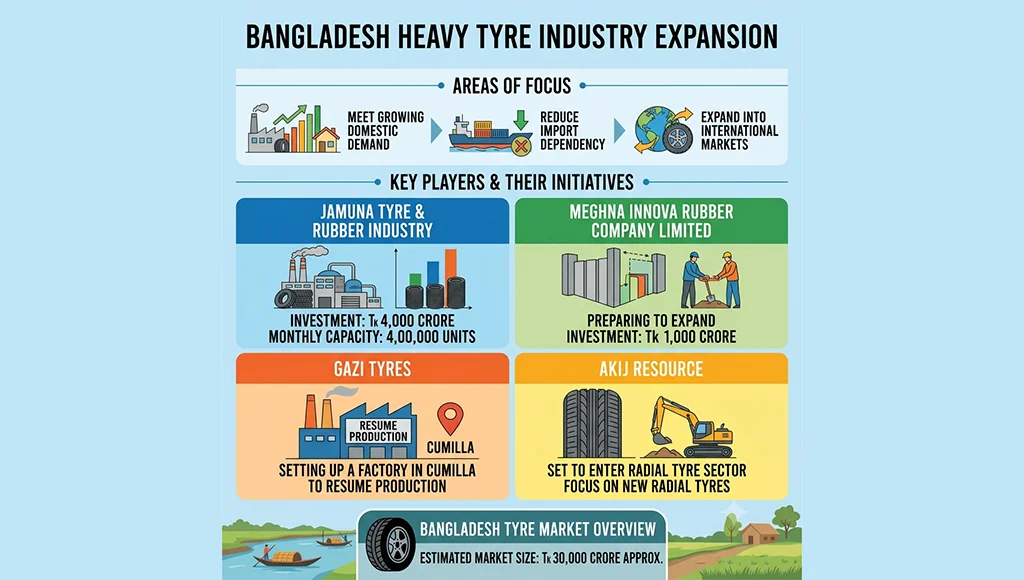
The country’s leading local business conglomerates are turning their focus toward heavy tyre manufacturing industry, with a strong focus on radial tyre technology to address the growing domestic demand reducing import dependency and expand into international markets.

Major business players entering this sector include Jamuna Tyre and Rubber Industry of Jamuna Group, Meghna Innova Rubber Company Limited, a concern of Meghna Group, Gazi Tyre and AKIJ Resource.

At present, Jamuna Tyre and Rubber Industry is the only major local manufacturer producing radial heavy tyres, while the market remains largely dominated by imported brands.

Industry insiders say a shortage of skilled workers and advanced technology has limited local manufacturers, as developing such capabilities requires substantial investment.

Bangladesh’s tyre market, including both radial and bias tyres, is worth roughly Tk 25,000-30,000 crore and is expanding at an annual rate of 6-8 per cent, according to the Bangladesh Tyre-Tube Manufacturers and Exporters Association.

Despite having installed production capacity more than twice the country’s demand, Bangladesh still relies heavily on imported motorcycle tyres, said Luthful Bari, vice-president of the BTMEA.

Jamuna Tyre and Rubber Industry made radial tyre from March 2025, by investing Tk, 4,000 crore and competing various foreign brand radial tyres on the local market.

Tarun Chandra Rajbongshi, director (marketing and sales), told to the New Age, ‘Our plans to export around 80 per cent of our tyre to North and Latin America countries, along with south Asian countries positioning Bangladesh as a potential hub for high-quality tyre manufacturing.’

‘We are currently producing radial tyres for trucks, buses, light trucks and passenger cars, with a monthly production capacity of 4,00,000 units,’ said Ahtesam Roman, marketing manager, Jamuna Tyre and Rubber Industry.

AKIJ Resource is set to enter Bangladesh’s radial tyre manufacturing sector, aiming to meet the rising demand for commercial and passenger vehicle tyres.

‘We are currently strengthening our market presence through imported tyres and expect to commence local production soon,’ said Ehtesamul Haq, business head — tyre at AKIJ Resource.

Meghna Innova Rubber Industry is preparing to expand into the radial tyre segment with a new investment plan of around Tk 1,000 crore, said chief business officer Luthful Bari.

Currently, Meghna holds a dominant position in the bias tyre segment, controlling more than 40 per cent.

Gazi Tyres is setting up a new factory in Cumilla to resume production and regain market share, following the devastating fire and vandalism at its Rupganj plant during the August 2024 mass uprising,

Before the disruption, Gazi Tyres met more than 60 per cent of the country’s demand for tyres used in rickshaws, three-wheelers and small commercial vehicles. It also held over 20 per cent of the bus and truck tyre market and around 65 per cent of the minibus segment.

‘We are setting up a tyre manufacturing plant in Cumilla and expect to begin production in the final quarter of this year,’ said Muhammad Fakhrul Islam, executive director (accounts and finance).

‘Initially, we will produce tyres for rickshaws, three-wheelers and small commercial vehicles, and gradually expand our capacity and upgrade our technology,’ he added.

In the national budget for the financial year 2026-27, the government imposed 20 per cent supplementary duty on selected imported tyre categories.

Customs data show the sharpest increase applies to tyres for light commercial trucks and buses, raising the total tax incidence from 64.25 per cent to 96.10 per cent, the higher tariff is expected to protect domestic manufacturers and encourage investment in the local tyre industry, said Muhammad Fakhrul Islam.

General manger (operation) of the Apex Husain Tyre, Md Tuhin, said, ‘After the Gazi Tyre plant fire, our sales nearly doubled and have been increasing every year since.’

Kamruzzaman Kamal, director of marketing at PRAN-RFL Group told to the New Age, ‘Currently we hold around a 10 per cent share of the market share with 15 per cent growth per year in the bias tyre segment.’

‘We are taking land plan to invest more in the tyre sector,’ he added.

‘We increasing our investment every year, this year we invested 20 crore in the bias tyre segment’ said, Md Miraj Rahman, director of Rupsha Tyres and Chemicals Limited.​
 
Bangladesh’s tyre manufacturing industry is a rapidly expanding sector transitioning from basic light automotive and two-wheeler production to heavy radial and agricultural tyre manufacturing. Historically reliant on imports for ~ 60% to 70% of national demand, major local conglomerates are scaling up domestic capacity to reduce import dependency and serve the ~ $220 million market.

Key Market Dynamics & Industry Scope

The Bangladesh tyre market is largely driven by the aftermarket replacement sector, which accounts for approximately 74% to 79% of total demand due to rough road conditions and frequent maintenance cycles. Two-wheelers and three-wheelers (CNG-run and electric) dominate sales volume, while demand for 15-20 inch passenger car and heavy truck radial tyres continues to rise.

Major Local Manufacturers

To meet this growing domestic need and tap into regional export markets, several major business conglomerates have established large-scale local production facilities:​
    • Meghna Innova Rubber Company Ltd: Investing BDT 1,300 crore (over USD 106 million) into a heavy-duty tyre plant in Mirzapur. They produce a full range of agricultural and off-the-road (OTR) tyres (including large 28-inch tractor tyres) and operate advanced testing laboratories with consultants from Germany, China, and India.​
    • Jamuna Tyre and Rubber Industry Ltd (Double Horse Tyre): Upgraded their lines and commenced production of heavy-duty radial tyres (such as 11.00 R20 truck tyres) to cover a sizable share of heavy-vehicle demand.​
    • Other Domestic Players: Established brands like Gazi Tyres, RFL Tyres, Rupsha Tyres, Apex Husain, and Zess Tyre operate extensively in the lighter vehicle, motorcycle, and three-wheeler segments.​

Industry Challenges & Government Protection

Despite growth, the sector faces challenges such as a shortage of skilled workers, reliance on imported raw rubber/materials, and stiff competition from established international brands (like Bridgestone, CEAT, and Apollo) imported from China, India, Japan, and Indonesia.

To level the playing field, the Bangladesh Tyre-Tube Manufacturers and Exporters Association (BTMEA) continuously lobbies for protective tariff structures. Recent budget proposals have featured supplementary duties (such as a proposed 20% supplementary duty on imported light truck tyres) to protect domestic manufacturing, safeguard local jobs, and prevent foreign currency outflows.​
 

Tyre market gearing towards full steam

Suman Saha

Bangladesh's tyre market is projected to grow at around 9 percent annually until 2020, riding on higher vehicle sales and rising investments by foreign players, a Dublin-based research firm said yesterday.

The government is expected to reduce duties on raw materials for the tyre industry, which, ultimately, will boost sales, said Research and Markets, a noted research company, in a study.

The country's annual tyre sales are close to Tk 1,500 crore and two-wheeler and light automotive tyres account for majority of the sales, according to industry insiders.

The monthly demand for motorcycle tyres has increased to 50,000 pieces and that of CNG-run three-wheelers to 60,000 pieces, they said.

The tyre market is dominated by two-wheelers, whose fleet exceeds all others by a significant margin, according to the study.

The firm said Dhaka remains the major market witnessing higher tyre sales across Bangladesh.

Despite rising automobile sales, the replacement segment continues to dominate the market, it said.

Over the past few years, Bangladesh has been emerging as another developing country in Southeast Asia offering considerable growth opportunities across diverse industry segments including automotive.

Currently, the tyre industry in Bangladesh is largely dependent on imports from countries like India, China, Japan and Indonesia due to a scarcity of raw materials (natural rubber), a lack of indigenous tyre production units as well as skilled labour, the study said.

Bangladesh spends around Tk 1,000 crore to import more than 15 lakh pieces of tyres a year mainly from India, Japan and China, according to importers, distributors and sellers.

Bangladesh also imports tyres from Vietnam, Thailand and Indonesia.

However, the scenario is expected to witness a paradigm shift in the coming years as several global leading tyre companies are gearing to set up manufacturing units in the country.

India's tyre giant CEAT, for example, is setting up a plant in Bangladesh in partnership with local AK Khan & Company.

CEAT also aims to export back at least 30 percent of the products manufactured at the plant in Mymensingh, taking advantage of the duty benefits the neighbouring country has extended to Bangladesh.

In November 2012, India extended duty-free benefits to all Bangladeshi products except for 25 alcoholic and beverage items.

Several foreign investors are even eyeing Bangladesh as the next important destination over the coming years.

Besides tyre companies, many automotive players have also voiced their desire to commence manufacturing operations in Bangladesh, which, in turn, would drive investments in the tyre market as well.

Last year, 73,051 motorised vehicles were registered in Dhaka alone, up 34 percent year-on-year, according to Bangladesh Road Transport Authority. Countrywide, 160,639 vehicles were registered last year.

Currently, Apex Husain, Gazi Group, Meghna Group and Rupsha Tyre are the leading players in the light truck, minibus, microbus, motorcycle, autorickshaw and easy bike tyre markets.

Besides, leading global companies like MRF, Dunlop, CEAT and Goodyear have been selling their tyres in the country through their exclusive distributors.​
 

Bangladesh Tire Market Key Takeaways
  • The Bangladesh Tire Market was valued at USD 0.20 billion in 2025 and is projected to grow from USD 0.23 billion in 2026 to USD 0.31 billion by 2032, registering a CAGR of 5.10% during the forecast period (2026–2032).​
  • By vehicle type, the passenger car segment accounted for a significant market share of approximately 30%.​
  • By demand category, the aftermarket segment held a dominant share of nearly 74% in 2026.​
  • The industry remains moderately fragmented; however, the top five players collectively accounted for nearly 50% of the market share.​

Bangladesh Tire Market Size and Outlook
The Bangladesh Tire Market is expected to grow at a CAGR of around 5.10% during the forecast period (2026–2032). Market growth is being supported by rising vehicle ownership, expanding road infrastructure, and increasing transportation activity across urban and regional areas. The growing reliance on road-based mobility for passenger and commercial movement is driving consistent tire demand across multiple vehicle categories. Additionally, higher vehicle utilization, frequent tire replacement cycles, growth in logistics and e-commerce transportation, and increasing two-wheeler penetration are further contributing to market expansion.

A major growth driver is the continuous rise in vehicle parc, supported by improving income levels and urban expansion. Increasing use of road transport for daily commuting and freight movement is reinforcing long-term tire demand across OEM and aftermarket channels. This structural shift is strengthening vehicle parc growth, replacement tire demand, and overall market stability in Bangladesh.

Government-led infrastructure investment is further supporting market expansion. Under the Revised Annual Development Programme, transport and communication projects received significant budget allocation to enhance national connectivity and improve road networks. These developments are expected to increase vehicle movement and strengthen long-term tire consumption across freight and passenger transport systems.

In addition, a shift toward radial tire adoption is being observed, driven by better durability, fuel efficiency, and long-distance performance. Fleet operators are increasingly investing in higher-quality tires to support operational efficiency, driving radial tire adoption, fleet modernization, and demand for advanced commercial vehicle solutions. Improved logistics connectivity is further accelerating this transition across transport networks.

From a segmentation perspective, passenger vehicles account for nearly 30% of the market, driven by rising urban mobility and expanding vehicle ownership. However, the aftermarket segment dominates with around 79% share, supported by frequent tire replacement cycles and strong utilization across commercial and passenger vehicles, reinforcing aftermarket growth as a key market pillar.

Overall, the Bangladesh Tire Market is projected to grow from USD 0.23 billion in 2026 to USD 0.31 billion by 2032, supported by infrastructure expansion, rising transportation demand, and gradual technological advancements in tire technologies. Strong replacement demand, increasing vehicle parc, and the growing preference for efficient and durable tire solutions are expected to continue supporting the long-term development of the market.

Bangladesh Tire Market Key Indicators
  • In 2025, the government allocated nearly USD 17.7 billion under the Revised Annual Development Programme (RADP), with a strong focus on transport and communication infrastructure. This large-scale investment is expected to enhance road connectivity, increase vehicle movement efficiency, and indirectly support higher consumption of automotive tires across passenger and commercial segments in the coming years.​
  • The Bangladesh Road Transport Authority (BRTA) reported a motorcycle base of around 4.3 million units as of January 2024, with 289,830 new registrations added in 2025, reflecting steady growth momentum. Given that each motorcycle requires periodic front and rear tire replacement, this expanding fleet significantly amplifies replacement tire demand and supports long-term market volume growth in the tire industry.​
  • Bangladesh continues to depend on imported tires for nearly 90% of its annual requirement, equivalent to around 2.5 million units. While local manufacturers focus primarily on bias tires for commercial and two-wheeler segments, passenger car radial tires are almost entirely import-driven. This imbalance underscores strong import dependency and indicates a significant opportunity for domestic production expansion.​

Bangladesh Tire Market Growth Drivers
Rising Vehicle Ownership

Rising vehicle ownership is emerging as a major growth driver for the Bangladesh tire industry as increasing dependence on personal mobility continues to strengthen demand for replacement and OEM tires. According to the Bangladesh Road Transport Authority (BRTA), Bangladesh had nearly 6.26 million registered vehicles by 2024, including approximately 4.58 million motorcycles, highlighting the dominant role of two-wheelers in the country’s transportation ecosystem. The rapid expansion of motorcycles is significantly boosting demand for motorcycle tires and supporting long-term aftermarket growth across urban and semi-urban regions. The growing popularity of motorcycles as an affordable mobility solution is further reflected in sales trends. Motorcycle sales in Bangladesh rebounded strongly in 2025, increasing by 19.6% year-on-year to nearly 476,000 units. Earlier industry data also showed that motorcycle sales during the first half of 2025 surged by 42.7% to around 273,840 units, indicating recovering consumer demand and rising transportation adoption nationwide.

In parallel, government investments in transport infrastructure and highway connectivity projects beyond 2025 are expected to further support vehicle parc growth and strengthen road mobility across Bangladesh. Improving connectivity between urban and regional areas is likely to encourage higher vehicle registrations and sustained tire consumption in the coming years.

As vehicle ownership continues expanding, demand for replacement tires is projected to rise steadily across motorcycles and passenger vehicles. The increasing transportation footprint and expanding mobility network will continue supporting long-term growth of the Bangladesh tire industry.

Recent Trends
Shift Toward Radial Tires Across Commercial Fleets

Bangladesh is witnessing a gradual shift toward radial tires across commercial vehicle fleets as transport operators increasingly prioritize durability, fuel efficiency, and long-distance performance. Compared to conventional bias tires, radial tires provide better road grip, lower rolling resistance, improved heat dissipation, and longer operational life, making them more suitable for freight transportation and highway logistics operations. Rising cargo movement, expanding highway connectivity, and increasing intercity transportation activities are accelerating demand for advanced commercial vehicle tires and supporting broader fleet modernization trends in the country.

The transition toward radial technology is also becoming visible through domestic product innovation. In 2025, Jamuna Tire & Rubber Industries Ltd. introduced Bangladesh’s first locally manufactured 12.00R20 radial tire designed for heavy-duty commercial vehicles. The product was developed to deliver improved load-bearing capacity, durability, and road safety performance for truck and bus operators. The launch reflects growing industry preference for technologically advanced and reliable tires over conventional low-cost alternatives, while also strengthening local manufacturing capabilities for radial tire adoption in Bangladesh.

Additionally, increasing awareness among fleet operators regarding fuel savings and lower maintenance requirements is encouraging wider acceptance of radial tires across buses and freight carriers. As Bangladesh continues improving transport infrastructure and logistics connectivity, demand for high-performance radial tires is expected to rise steadily across the commercial fleet segment in the coming years.

Bangladesh Tire Industry Opportunities and Challenges

High Import Dependency Driving Domestic Manufacturing Expansion and Supply Chain Localization


Bangladesh’s tire industry remains heavily dependent on imported tires and rubber-based raw materials, particularly for passenger cars, commercial vehicles, and specialty tire categories. This growing imported tire reliance exposes the market to fluctuating freight costs, foreign exchange pressure, and disruptions in global supply chains, affecting pricing stability and product availability. In addition, dependence on overseas suppliers for essential compounds and synthetic rubber has highlighted the country’s limited domestic manufacturing ecosystem and increasing trade dependency within the automotive supply chain.

At the same time, this challenge is creating strong opportunities for localized manufacturing and industrial expansion across Bangladesh. Rising vehicle ownership and expanding transportation activity are encouraging domestic companies to strengthen local tire production capabilities in order to reduce import dependence and improve long-term cost competitiveness. Reflecting this shift, Meghna Innova Rubber Company announced an investment of approximately USD 118 million equivalent in 2024 to expand its tire manufacturing facility in Tangail, with a focus on increasing production capacity for truck and bus tires. The expansion aligns with Bangladesh’s broader industrial development goals and supports future growth in domestic tire availability.

The rising emphasis on domestic production is expected to strengthen supply chain resilience and support industrial self-sufficiency over the coming years. As manufacturing investments continue increasing, Bangladesh’s tire market is likely to witness improved product accessibility, reduced import exposure, and stronger long-term industrial competitiveness.​
 

Latest Posts

Back
