| Global Defense, OSINT & Geopolitics Wire

[🇧🇩] Ziaur Rahman in the eyes of the masses

[🇧🇩] Ziaur Rahman in the eyes of the masses
14
680
More threads by Saif

G Bangladesh Defense

PM Tarique is reviving Ziaur Rahman’s revolutionary programmes: BNP’s Fakhrul

bdnews24.com

Published :
May 30, 2026 15:50
Updated :
May 30, 2026 15:50

1780183940570.webp


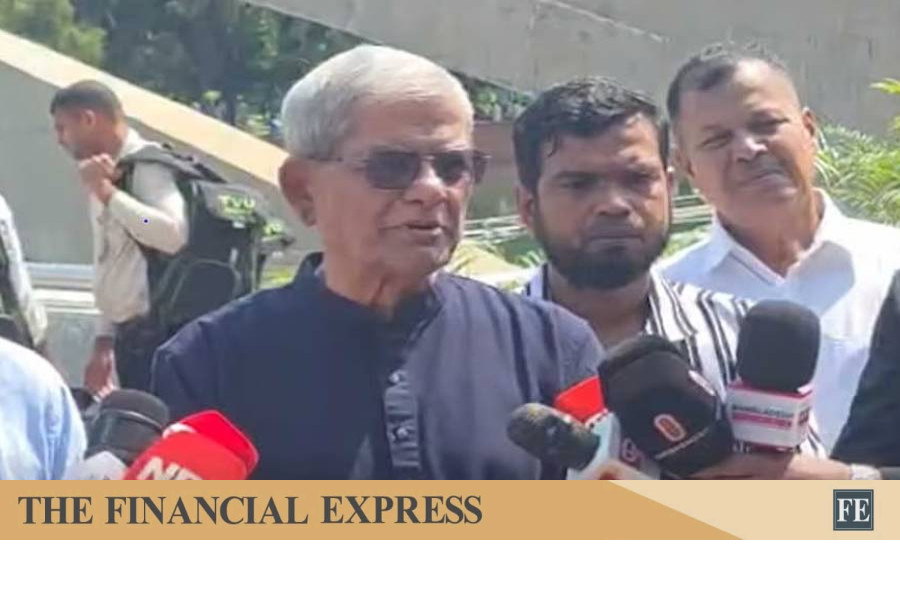
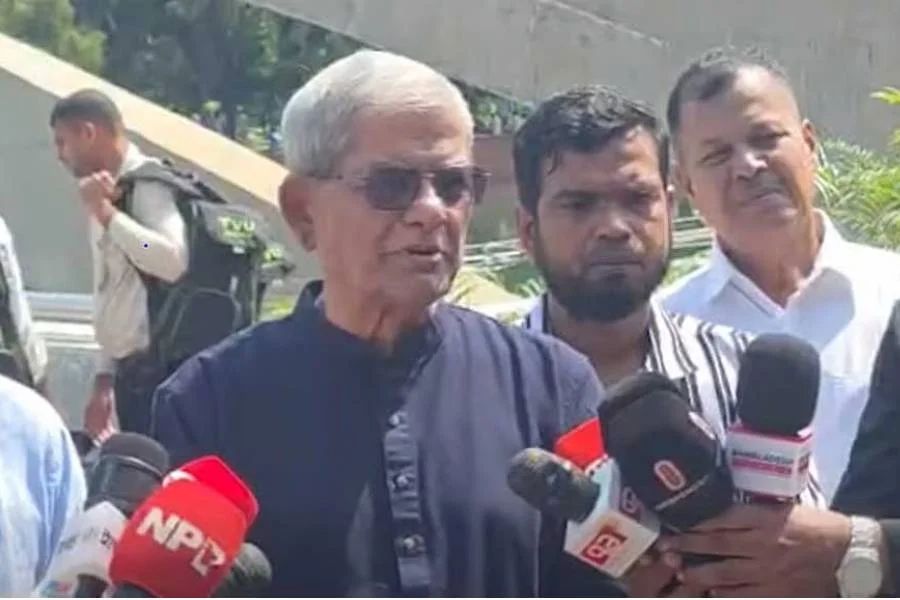
Mirza Fakhrul Islam Alamgir says the revolutionary programmes of former president Ziaur Rahman have resumed under the leadership of Prime Minister Tarique Rahman.

He made the remark to reporters before paying tribute to Ziaur Rahman at his grave in Sher-e-Bangla Nagar on Saturday morning to mark his 45th death anniversary.

He said, “President Ziaur Rahman brought unprecedented changes to the country in one and a half years. Today, under his worthy successor, Tarique Rahman - our prime minister - we have revived those revolutionary programmes once again, we are working on reforms… Our Family Card, Farmer Card, and canal digging programme have already created a stir in Bangladesh.”

“Bangladesh, which was once called a bottomless basket, has become a country of prosperity. Today’s day is so important that we want to remember this day again and again. We want to remember it with great solemnity, love and great significance so that this day shows us the way forward.”

Mirza Fakhrul said, “Today is the death anniversary of martyred president Ziaur Rahman, the advocate of multi-party democracy in Bangladesh and the architect of modern Bangladesh. For almost 17 years during the long fascist regime, we could never celebrate this day properly. I still remember one day when we came here and many police leaders were injured.”

“From those circumstances, today we are going to celebrate this day in a free environment. We attach the utmost importance to this leader who declared the independence of Bangladesh. Later, when the people of Bangladesh and members of the Army gave him the responsibility of running the state, and when he was given the people’s mandate to take on the helm of the state, in just three and a half to four years, he brought about changes in Bangladesh… On the one hand, he made political reforms, such as the introduction of multi-party democracy… bringing the country from a single-party regime to a multi-party regime. On the other hand, he introduced a free market economy in the country… I think these were the first steps in the change of our Bangladesh. He brought about an unprecedented change in those three and a half years.”

Following the remarks, members of the BNP National Standing Committee led by party Chairman Tarique Rahman, paid tribute to Ziaur Rahman by placing wreaths at his grave.​
 

Shaheed President General Zia: As I saw him

Shaheed President Ziaur Rahman remains an inspiration for many of us of that generation. For military officers of that era and those who later served alongside him during the Liberation War, General Zia and President Zia will forever remain an inspirational and ideological leader

M Sakhawat Hossain

1780185707761.webp

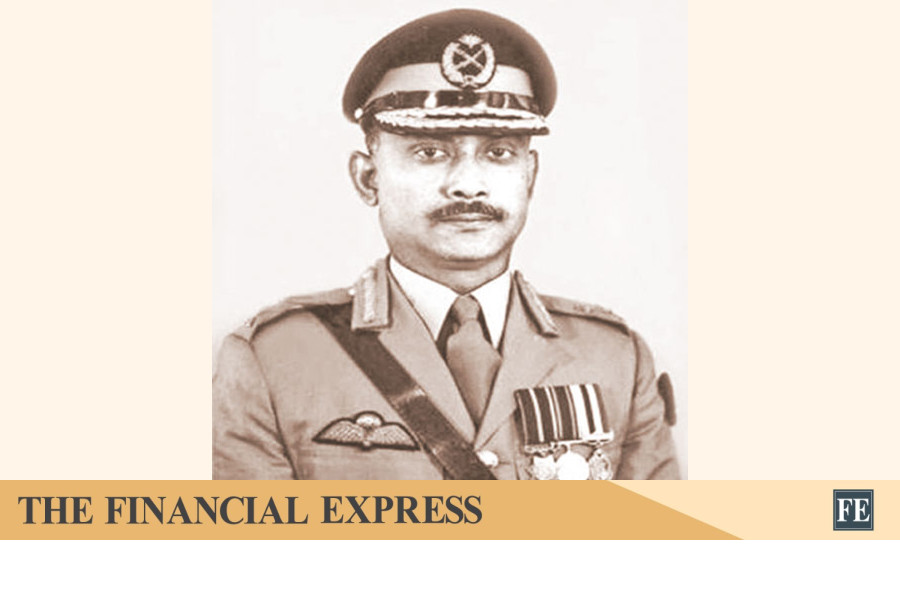
Ziaur Rahman

Forty-five years ago today, a heartbreaking event took place in Bangladesh's political and military history. At around 5:30 am, or shortly thereafter, the then Director of Army Operations, late Major General (then Brigadier) Abdul Wahed, telephoned me and instructed me to report immediately to the Army Headquarters Operations Directorate. At the time, I was serving as a Lieutenant Colonel in the Operations Section of that directorate.

In those days, being called to the office at short notice was not unusual. Sometimes, we even had to go in the middle of the night because of the arrival of President General Ziaur Rahman. During that period, he frequently discussed ways to enhance the effectiveness of the reorganised armed forces and develop military strategies suited to Bangladesh''s needs, while also providing guidance and directives. The primary responsibility for implementing those directives rested with this directorate.

Whenever we met him in the corridor, he would greet us with a gentle smile and ask, “How are you?” I would respectfully reply, “Sir, by your grace.” He would then give everyone a slight smile before proceeding to the briefing room.

We first came to know this man of few words in early 1966 at the second company of the Pakistan Military Academy, Kakul, where we Bengali cadets were undergoing training. At that time, there were two Bengali platoon commanders serving in different platoons. One was then-Captain Ziaur Rahman (who would later become Bangladesh''s Army Chief and President), and the other was the late Captain (later Major General) Abdul Mannaf.

I had already heard Ziaur Rahman's name during the Indo-Pakistani War of 1965. At the time, he was serving with the 1st East Bengal Regiment on the Lahore front. The regiment's record of bravery remains prominently remembered in Pakistan's military history. According to the account, it was this Bengali battalion that helped defend the city of Lahore from Indian forces during the war. After the conflict, for as long as the East Bengal Regiment remained stationed in Lahore, the people of the city reportedly treated its members with great respect and admiration.

Anyhow, it was the morning of 31 May 1981. Somehow, I managed to reach Army Headquarters that morning. As I was climbing the stairs to the office on the third floor, I encountered then-Brigadier (later General) Wahed coming down with several files in his hands. While descending, he told me to try to establish contact with Chattogram as quickly as possible and obtain details of what had happened.

He also informed me that the Circuit House had been attacked with the intention of assassinating the President.

I stood there on the stairs for a few moments in shock. As far as I can recall, the President normally did not spend the night outside Dhaka. So how had this happened? The subsequent events are well known, so I will not go into them here. See my books Roktakto Oddhay (A Bloody Chapter) and Roktakto Dingulo (The Bloody Days).

I tried to gather information about what had occurred in Chattogram. It was learned that the President had been unable to return to Dhaka because of unfavorable weather conditions and had remained there to resolve certain internal party matters.

Gradually, more details emerged: a military rebellion had broken out in Chattogram, and in the attack on the Circuit House, the President, along with two other officers, had been killed.

His integrity, sense of justice, and patriotism were exceptional and will remain an example for present and future generations of Bangladeshis.

It later became known that the rebellion did not primarily involve enlisted soldiers; rather, it was carried out by officers of the Chattogram Division, nearly all of whom were personally known to Ziaur Rahman. It was even reported that the President's then Principal Staff Officer (PSO) had been involved in the conspiracy. Many details of the plot and the assassination have since been described in books by various authors.

Those of us who had known Ziaur Rahman since 1966 and later saw him serve as Deputy Chief of Army Staff, Army Chief, and President never imagined that he would meet such an end. For that reason, I was deeply shaken by his assassination.

On 7 November 1975, General Zia was freed from detention through what is often referred to as the Sipahi-Janata (Soldier-People) Uprising. According to the author, at that critical moment he helped save the country from a path of certain destruction. That day, I was among 20 to 25 officers who stood beside him in the Dhaka Cantonment.

During that period, many officers had been killed by members of Colonel Abu Taher's so-called "Revolutionary Soldiers Organisation". Resistance emerged not only in Dhaka but also from soldiers stationed outside the capital, and the coup led by Brigadier Khaled Mosharraf ultimately failed. The author argues that one reason for its failure was the decision to carry out the coup while keeping then-Army Chief General Zia imprisoned.

According to this account, Khaled Mosharraf, and perhaps even Abu Taher, may have underestimated the extent of Ziaur Rahman's popularity among soldiers and young military officers, which was considerably greater than their own. (See Roktakto Dingulo (The Bloody Days) for further discussion.)

Ziaur Rahman's popularity was built on his declaration of independence, his role as sector commander, and his reputation as being honest, capable and fearless. His integrity, sense of justice, and patriotism were exceptional and will remain an example for present and future generations of Bangladeshis. Even when many people opposed him, he harbored no personal animosity toward them and gave due recognition to those he considered deserving.

Another reason the Chattogram rebellion collapsed after Ziaur Rahman''s assassination was the lack of support from ordinary soldiers. Many rank-and-file soldiers in Chattogram were unwilling to accept the killing of such a popular President. Following the uprising and Zia's assassination, the coup plotters reportedly received little cooperation from the general body of soldiers.

One month after Zia's assassination, in July 1981, I joined the Command and Staff College in the United States. There were more than 120 international students from 90 countries, many of them officers from Afro-Asian nations. I recall that officers from nearly every country in the Middle East asked him the same question: "Who killed such a distinguished leader of the Muslim world, and why?" I had no answer to give them.

As President, Ziaur Rahman was extremely popular not only in the Middle East and Muslim countries, but across Afro-Asian nations as well. It may be recalled that in September 1980, a bloody war broke out between two Muslim countries, Iraq and Iran. At that time, a three-member mediation committee was formed involving the late President of Pakistan, Zia-ul-Haq, and two other heads of state.

Alongside the President of Guinea, Ahmed Sékou Touré, I was also a member of this committee as the President of Bangladesh, Ziaur Rahman. The committee worked repeatedly to mediate and establish peace between the two countries. President Zia’s diplomatic efforts elevated Bangladesh to the ranks of global leadership and gave the country a distinct identity among Afro-Asian nations. It was during this period that Bangladesh’s military diplomacy began to take shape.

Ziaur Rahman opened new avenues in Bangladesh’s foreign policy. He visited China for the first time in 1977, and from that time onward, relations with China were elevated to the military level. From then on, significant changes took place in Bangladesh’s foreign policy. Not only in China, but the respect he received in the United States was also rare. His foreign policy strengthened Bangladesh’s defense and security posture. One of his notable achievements was introducing and establishing the idea of SAARC for regional cooperation in South Asia.

Ziaur Rahman’s thinking on Bangladesh’s defence policy was far-sighted. I recall December–January of 1975–76. During military exercises, Zia formed the Village Defence Party (VDP) for rural security in villages and countryside areas. This reflected the long-term vision of martyred Zia.

In conclusion, it must be said that Shaheed President Ziaur Rahman remains an inspiration for many of us of that generation. For military officers of that era and those who later served alongside him during the Liberation War, General Zia and President Zia will forever remain an inspirational and ideological leader.

* M Sakhawat Hossain is a former adviser to the interim government, former Election Commissioner, and retired military officer.​
 

45 years since Zia's assassination: The blood-stained dawn at Circuit House and an unfinished history

1780185950908.webp
 

The first reports of a political assassination: Revisiting newspaper coverage of Zia's killing

Rahat Minhaz

The Complete Reporter is an essential book for journalism students worldwide. Written by Julian Harris, Stanley Johnson and Kelly Leiter, the book includes Philip L. Graham's definition of news: 'News is the first rough draft of history.' The preliminary draft of history is contained in the pages of newspapers. It may not be authentic history, but it is certainly an important element of history. Few events in Bangladesh's political history have generated as much interest as the assassination of President Ziaur Rahman. Newspapers offer a valuable record of those turbulent days. Let us revisit the events through newspaper reports published immediately after his assassination in Chittagong.

Banner headlines and press notes on President Zia's assassination

1780361637412.webp


May 31, 1981. Daily Ittefaq.

President Ziaur Rahman was assassinated at the Chittagong Circuit House in the early hours of May 30, 1981. The news of the assassination was first published in newspapers on Sunday, May 31. On that day, almost all of Bangladesh's daily newspapers carried eight-column banner headlines about the assassination of President Zia. For example, The Daily Ittefaq's main headline read: প্রেসিডেন্ট জিয়া নিহত (President Zia killed). At the same time, the news of Vice President Justice Sattar taking charge as interim President was also given prominence. In addition, news of the declaration of a nationwide state of emergency was published in the newspapers.

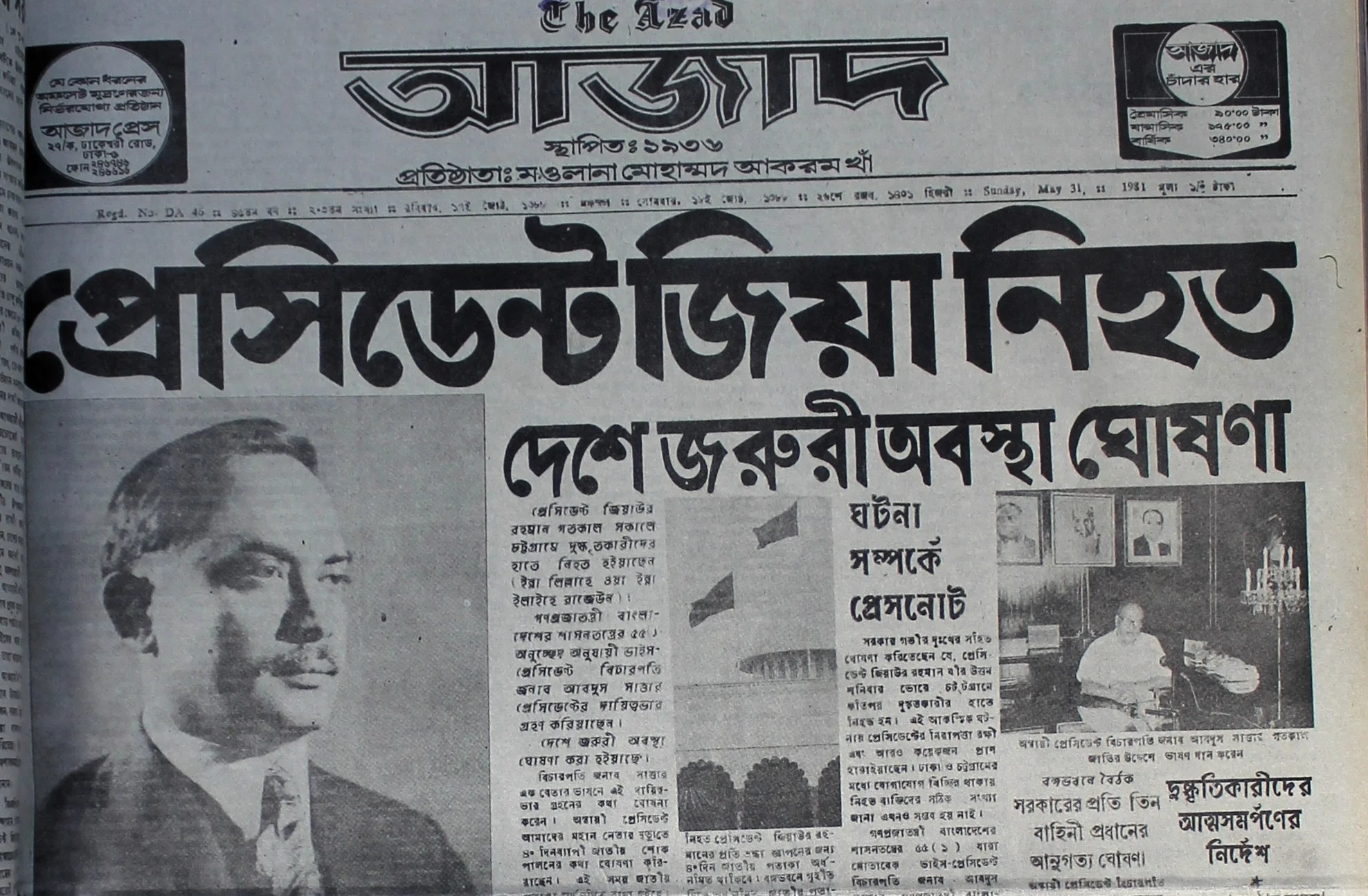
In 1981, Azad was one of the leading daily newspapers in the country. The newspaper also published the news of the assassination of President Ziaur Rahman with notable prominence. The main headline in Azad's eight-column banner was প্রেসিডেন্ট জিয়া নিহত (President Zia killed). The main news report in Azad stated: 'President Ziaur Rahman was killed by miscreants in Chittagong yesterday morning (Inna Lillahi wa Inna Ilayhi Raji'un). In accordance with Article 55(1) of the Constitution of the People's Republic of Bangladesh, Vice President Justice Abdus Sattar has assumed the responsibilities of the President. A state of emergency has been declared in the country. Justice Sattar announced his assumption of this responsibility in a radio address. The interim President has declared a 40-day national mourning period on the death of our great leader. During this time, the national flag will be flown at half-mast. The interim President said in his radio address that all regional and international agreements between the Government of Bangladesh and other countries will remain in force. The interim President appealed to the countrymen to maintain peace and order, inspired by patriotism. He said that all the ministers of the Council of Ministers were continuing their duties as usual' (The Azad, May 31, 1981).
1780361670506.webp

May 31, 1981. The Azad

Another news item published in the newspaper on May 31, 1981, was noteworthy. At that time, it was the Government's custom to publish press notes on major incidents. Especially in cases of major political killings, and even when someone was killed in police firing during movements, a press note would be published on behalf of the Government. On May 31, 1981, such a press-note-based news report was published about the assassination of President Ziaur Rahman. It said: 'The Government announces with deep sorrow that President Ziaur Rahman Bir Uttam was killed by some miscreants in Chittagong early on Saturday morning. The President's security guards and several others lost their lives in this sudden incident. Since communication between Dhaka and Chittagong was cut off, it is not yet possible to know the exact number of those killed.

In accordance with Article 55(1) of the Constitution of the People's Republic of Bangladesh, Vice President Justice Abdus Sattar has assumed the duties of the President of the People's Republic of Bangladesh. An emergency meeting of the Council of Ministers was held immediately afterwards, and after reviewing the situation, the Acting President issued a nationwide declaration of a state of emergency. The Acting President and his Cabinet members monitored the situation throughout the day. The chiefs of the armed forces, Bangladesh Rifles, and the police reiterated their full allegiance to the country's constitutional Government. The Acting President and the Army Chief ordered the miscreants in Chittagong, who called themselves the Revolutionary Council, to surrender to the Government immediately. The Acting President informed the leaders of all national political parties about the situation yesterday evening. The assembled leaders condemned the assassination of President Ziaur Rahman in Chittagong and the politics of terror. The leaders expressed deep sorrow at the demise of President Ziaur Rahman and conveyed their condolences to the bereaved family. They prayed for the forgiveness of the soul of the President' (The Azad, May 31, 1981).
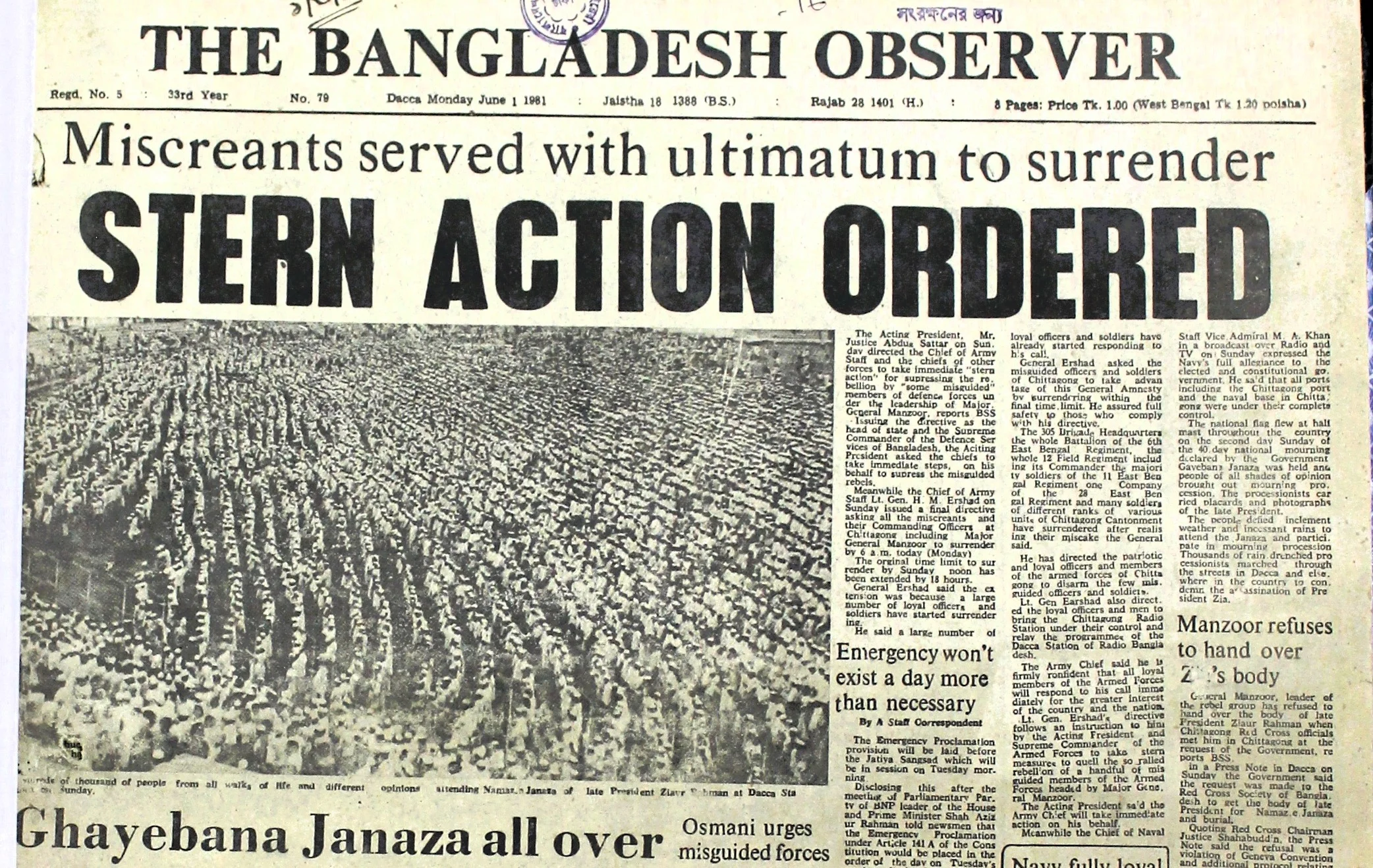
1780361706435.webp

June 1, 1981. The Bangladesh Observer


The newspaper of June 1, 1981, carried news of the assassination of President Ziaur Rahman, as it had on the previous day. On that day, the newspapers published photographs and reports of the President's funeral prayers in absentia. At the same time, there was a stern warning to GOC Major General M A Manzoor and his loyal officers to end the rebellion. Several news reports quoted Acting President Justice Abdus Sattar, Army Chief Hussain Muhammad Ershad, and General Muhammad Ataul Gani Osmani, commander-in-chief of the Bangladesh Armed Forces and of the Liberation Forces during the Liberation War. Their main theme was the need to end the rebellion. At the same time, there was a warning of stern action if the rebels did not surrender quickly.

On that day, the main headline of The Bangladesh Observer was 'Stern Action Ordered'. The report stated: The Acting President Justice Abdus Sattar on Sunday directed the Chief of Army Staff and the chiefs of other forces to take immediate "stern action" for suppressing the rebellion by "some misguided" members of the defence forces under the leadership of Major General Manzoor, reports BSS. Issuing the directive as the Head of State and the Supreme Commander of the defence services of Bangladesh, the Acting President asked the chiefs to take immediate steps, on his behalf, to suppress the misguided rebels. Meanwhile, the Chief of Army Staff, Lt Gen H M Ershad, on Sunday issued a final directive, asking all miscreants and their commanding officers in Chittagong, including Major General Manzoor, to surrender by 6 am today (Monday).

The original deadline for surrender by Sunday noon had been extended by 18 hours. General Ershad said the extension was due to a large number of loyal officers and soldiers beginning to surrender' (The Bangladesh Observer, June 1, 1981).

The Bangladesh Observer's description of the state's highest alert to suppress the rebellion in Chittagong was loud and clear. The coverage of this news was extensive and prominent, and a statement by the Chief of the Navy was later added. In it, the Chief of the Navy, Vice Admiral M A Khan, said in a radio and television address that the navy was completely loyal to the elected Government. At the same time, he announced that Chittagong Port and the naval base were under his complete control.

On that day, The Bangladesh Observer also published an important report about Manzoor's refusal to hand over the body of President Ziaur Rahman. The headline was: 'Manzoor refuses to hand over Zia's body'. The report stated: General Manzoor, leader of the rebel group, has refused to hand over the body of late President Ziaur Rahman when Chittagong Red Cross officials met him in Chittagong at the request of the Government, reports BSS. In a press note issued in Dacca on Sunday, the Government said it had requested the Bangladesh Red Cross Society to arrange for the late President's body to be brought for Namaz-e-Janaza and burial.

Quoting Red Cross Chairman Justice Shahabuddin, the press note said that the refusal violated the Geneva Convention and the Additional Protocol relating to non-international armed conflicts.

1780361778101.webp

A Bangladesh Observer report published on June 1, 1981, reproduced a government press note stating that Major General M A Manzoor had refused to hand over the body of President Ziaur Rahman to Red Cross officials for Janaza and burial.

The press note stated: The Bangladesh Government requested the Bangladesh Red Cross Society to recover the body of the late President Ziaur Rahman for Janaza and burial. The Chairman of the Bangladesh Red Cross Society informed the Government that, when Red Cross officials in Chittagong approached General Manzoor, he refused to comply with the request. According to Justice Shahabuddin, Chairman of the Bangladesh Red Cross Society, the refusal was a violation of the Geneva Convention and the Additional Protocol relating to Non-International Armed Conflicts (The Bangladesh Observer, June 1, 1981).

This report deserves particular attention. Following the assassination of President Ziaur Rahman, GOC Major General M A Manzoor and his fellow officers refused to hand over the President's body. This remains one of the starkest facts surrounding the events of May 1981. The body of Ziaur Rahman, along with those of two security officials killed in the attack, was buried near Chittagong in a manner that reflected a profound disregard for the dead. After the rebellion was suppressed, the bodies of President Ziaur Rahman and the two security officials were recovered from a shallow ditch in Rangunia.

The end of the rebellion and media coverage

Following the killing, Major General MA Manzoor assumed responsibility for the incident. However, some former army officers have argued that Manzoor may not have been involved in planning the assassination. In his memoir Amar Sainik Jiban: Pakistan Theke Bangladesh, retired army officer Manzur Rashid Khan quotes another officer who had spoken directly with Manzoor. When asked about the killing of President Zia, Manzoor reportedly replied: 'It was beyond my control, they have done it, but I owned it. I'm responsible for everything' (p. 143). That, however, is a separate chapter of the story.

1780361819500.webp

June 2, 1981. The Azad

During the failed rebellion, Chittagong was cut off from Dhaka. As a result, people across the country were eager to know what had actually happened there. Once the rebellion ended, newspapers began reporting the circumstances surrounding this tragic killing.

We can refer to a report published in The Azad on June 2, 1981. The report, titled সেই ভয়াল রাতের ঘটনা (The incident of that terrible night) and supplied by the government news agency Bangladesh Sangbad Sangstha (BSS), stated: The great leader of Bangladesh, President Ziaur Rahman, was killed by a group of errant army commandos at the Circuit House in Chittagong at around 4 am on May 30. The commandos first fired several rockets at the Circuit House. They shot and killed several police guards before entering the protected area. The miscreants surrounded the Circuit House from all sides and first killed a police officer named Dulal.

1780361850110.webp

June 2, 1981. The Azad

They immediately went upstairs in the Circuit House under the cover of heavy gunfire. BNP Secretary-General Professor Badruddoza Chowdhury said that the night had been completely normal and that he had sensed nothing unusual until the tragic incident occurred. He said that at around 4 am, he woke from his sleep to the sound of a sudden rocket attack and tried to understand what was happening outside. But within a few minutes, the entire Circuit House area started shaking from the explosions, and nothing could be seen except smoke. Professor Badruddoza Chowdhury, along with former State Minister for Social Welfare Syed Mohibul Hasan, was staying in the room opposite the President's on the second floor of the Chittagong Circuit House.

1780361875461.webp

Begum Khaleda Zia mourns beside the coffin of President Ziaur Rahman, while their eldest son, Tarique Rahman, weeps nearby. The photograph was published in The Daily Ittefaq on June 2, 1981.

Mr Hasan said that the miscreants were firing so rapidly that nothing could be heard except the terrible sound of gunfire. Within a few minutes, the miscreants reached the second floor. He said that they were waiting for death amid the rain of bullets. Within moments, the miscreants killed the sentry guarding the door of the President's room. Professor Badruddoza Chowdhury said that hundreds of bullets were entering their room and striking their beds and windows. They were simply waiting for the final moment of their lives. He further said that, after this, the late President's personal secretary, Colonel Mahfuz, was the first to realise that the miscreants had left the Circuit House.

Former Women's Affairs Minister Mrs Amena Rahman was at the Circuit House that night. She said that the miscreants killed the President within a few minutes and left. At the time of the incident, hundreds of bullets entered her room through the door, and she went to the bathroom to perform ablution before offering prayers.

BNP Sramik Dal leader Mizanur Rahman was also at the Chittagong Circuit House that night. He said that, after the miscreants had killed the President and others and left, he came out of his room and met Colonel Mahfuz. Later, they saw the President's bloodied body lying on the floor.

1780361920453.webp

June 3, 1981. The Azad

Professor Badruddoza Chowdhury said that at around 4:30 in the morning, he and Mohibul Hasan came out of their room and saw the bloodied body of the President. The body was lying a step away from the door of the President's room.

He said that the President had probably come out of the room after hearing the sound of gunfire and was immediately shot dead by the miscreants. He was wearing white pyjamas and a Punjabi (Azad, June 2, 1981).

1780361964956.webp

A report in The Daily Ittefaq on August 13, 1981, covering the government's white paper on the assassination of President Ziaur Rahman.

Following the assassination of Ziaur Rahman, a three-member civilian commission was formed to investigate the incident. After its report was published in August 1981, newspapers across the country carried more detailed accounts of the President's assassination.

More than four decades later, these newspaper reports remain valuable historical sources for understanding one of the most consequential episodes in Bangladesh's political history. Yet much work remains to be done. A deeper examination of contemporary newspaper accounts, official documents, personal memoirs, and archival records may help future researchers develop a more complete understanding of the events surrounding the assassination of President Ziaur Rahman and its wider implications for Bangladesh's political trajectory.

Rahat Minhaz is an Assistant Professor of Mass Communication and Journalism at Jagannath University.​
 

Unforgettable traits of Shaheed Zia

Ziaur Rahman (January 19, 1936 -May 30, 1981)


1794005389558.webp


Shaheed President Ziaur Rahman had some traits that distinguished him from other great leaders of Bangladesh. These traits can be best encapsulated if we consider his four distinct roles. These were: soldier Zia; Zia as a person; Zia as president; and Zia as a politician. The foremost dream of a soldier is to free his motherland from the clutches of occupiers. Zia did this by declaring Bangladesh's Independence and by participating in the War of Liberation as a sector cum force commander. His dream ultimately materialised through the liberation of Bangladesh, and his name became immortal in the country's history as one of the greatest soldiers of this land.

The examples of honesty and simplicity in the personal life of Zia have also inspired the country's youths in the past and continue to inspire them at the present juncture as well. He used to eat ordinary food like roti, broth and pulses, wore old attires, and utilised old suitcases during tours. He used to donate a part of his salary to the state-exchequer, led a corruption-free life, and did not own any land or residential building in capital Dhaka. Besides, he used to work non-stop from early morning to midnight. These examples were extraordinary for a statesman belonging to the developing third world.

Zia spent the last five years of his life as the leading statesman and subsequently the first elected president of the country. He proved how an accomplished statesman could become intertwined with the country's advancement through integrity, honesty, selflessness, and incessant tireless work. He became a successful statesman by ceaselessly working for 18 hours per day. His outlook was crystal-clear, and his views were geared towards the country's future. He sought to eliminate poverty, illiteracy, and economic subjugation from his motherland and aspired to lift the country to the status of a developed one. He believed in swift decision-making and quick implementation of plans and programs, which were reflected in all his undertakings as the head of government of Bangladesh.

However, it was in politics that Shaheed Zia's exceptional qualities found holistic expression, which benefitted the country immensely. As he had spearheaded the country's liberation war, politics should have been his natural destiny. But he did not join politics out of his own accord. When the country was thrown into a turmoil due to coups and counter-coups in the first week of November 1975, a revolution of the soldiers and people thrust him into the middle in order to rescue Bangladesh from a calamitous situation. Zia was then forced to assume the leadership and steer the country towards safety.

The efforts made by Zia to fill up the vacuum in polity ultimately resulted in socio-economic resurgence of the country. His pragmatic political philosophy is summarised below. The first and foremost ideology espoused by Zia was Bangladeshi Nationalism. It acknowledged that Bangladeshi citizens were Muslims, Hindus, Buddhists, and Christians based on their religious identities. A majority of them also had the 'Bangali' identity owing to their language and culture. However, our history, geography, economy, demography, the language movement and the liberation war had given rise to a unique national identity, which could be best expressed by the holistic term 'Bangladeshi'. 'Bangladeshi Nationalism' had no conflict with 'Bangali Nationalism', but the latter had a limited connotation compared to the former. Therefore, 'Bangladeshi Nationalism' was more appropriate.

The principal objective of Ziaur Rahman's politics was to build an exploitation-free society that espoused equal opportunities for all. It implied that everybody would have equal rights before law alongside similar responsibilities. His 19-point programme had specific objectives for improving the lot of all classes of people. These encompassed the right to food, attire, health, education, and housing. It also sought to eliminate discriminations, social vices and socio-economic disparities, and carry forward an independent foreign policy that upheld the country's interests.

President Zia also initiated some revolutionary programs for the country's uplift. These included: launching of an agriculture revolution by aiming to double food output within five years; enhancing literacy through a country wide mass literacy programme that lifted millions of people from the darkness of illiteracy; disseminating the message of family planning across rural Bangladesh; and launching industrial revolution whereby manufactured output rose to a record level.

President Zia established village governments in 68 thousand villages of the country in order to make the rural people partners in the development endeavour. It was aimed at maintaining law and order in villages, suppressing anti-social activities and containing smuggling. Ordinary offences were resolved through the village courts. All these led to a mass awakening in rural Bangladesh after many centuries. Rural physicians were groomed through imparting one-year training that helped in preventing and treating diseases at the grassroots level. Village Defence Parties were also raised, who provided training on operating arms as well as healthcare. The objective was to enable them to maintain law and order and put an end to anti-social activities, especially in places where the police force was absent. All these efforts led to an elimination of a famine-like situation of the past, strengthening of the economy, and rise in exports that included readymade garments for the first time.

Reestablishment of multi-party democracy was another big achievement of President Zia. The country was freed from the shackles of one-party rule, and thousands of political prisoners were set free. The news media was also free once again, and numerous periodicals came out following the captivity of BAKSAL era - when only four newspapers were published at the national level. Political rallies were once again held in open spaces without restriction, and the people could make their voices heard. Above all, Zia could reunite the people, independence and sovereignty of the country was restored, and the nation could stand on its own feet once again.

Initiatives were also taken by Zia to resolve the outstanding disputes with neighbouring India. The first document for water-sharing of the river Ganges after the operationalisation of Farakka Barrage by India was signed during his tenure. He also acted as the spokesperson of the Muslim world in various international forums, and even led efforts for reconciliation among Islamic nations. It was during Zia's period that Bangladesh could become a member of the UN Security Council for the first time in history.

Therefore, the history of Ziaur Rahman was a tale of a captive Bangladesh becoming free and united once again. It was a history of reawakening, the tale of a resolute Bangladesh rising up from the ashes, with the whole world uttering in amazement: 'Bravo Bangladesh'.

History would deliberate on why Zia had to embrace martyrdom. Only those who wanted to see Bangladesh in a dishevelled, subjugated, and miserly state were afraid of Ziaur Rahman and his politics; they hated and abhorred him. History will undoubtedly expose these people fully in course of time.

But as long as a country called Bangladesh remains, the great hero of our Independence War, the tireless worker for people's welfare, the driving force of a socioeconomic revolution in Bangladesh named Shaheed Ziaur Rahman would continue to inspire the nation in moments of crisis and jubilation and motivate the younger generation to illuminate the country with the flame of his people-centric ideals and vision.

Dr Helal Uddin Ahmed is a retired Additional Secretary and former Editor of Bangladesh Quarterly.​