Home Watch Videos Wars Movies Login

Wars 2023 10/08 Monitoring the Israel and Lebanon War

Wars 2023 10/08 Monitoring the Israel and Lebanon War
191
8K
More threads by Saif

G War Archive

A city silenced by war

1729467645247.webp

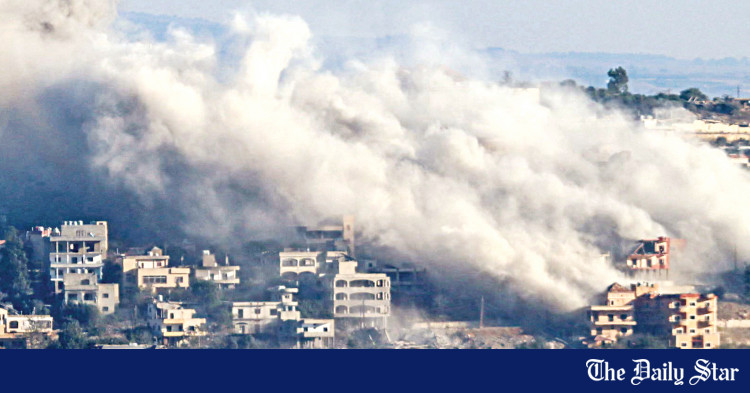
Smoke rises from the site of an Israeli airstrike that targeted the southern Lebanese border village of Khiam, where the Lebanese official media reported 14 strikes within minutes yesterday. Photo: AFP

Just a month ago, south Beirut's bustling streets were packed with traffic, families strolling about and youths in cafes, but now silence dominates the abandoned Hezbollah bastion, interrupted only by the sound of Israeli bombs.

Escalating Israeli attacks since late September, after nearly a year of low-intensity cross-border exchanges, have reduced much of the Lebanese capital's once densely-packed southern suburbs to rubble and sent many of its residents fleeing.

Braving the smell of rotting flesh that reeks from razed buildings, a few young men stood guard, dressed in black civilian clothes and occasionally driving around the ruins on their motorbikes.

They observed the odd car and the handful of displaced residents who come on foot, hastily checking on their apartment or collecting some belongings before heading back to safety.

"The young people told me not to stay too long because drones were constantly flying over and could strike at any time," said 32-year-old Mohammed, on a brief visit home to get more clothes.

Giving his first name only for security concerns, he said he first left on September 27, days into Israel's intense air campaign on Lebanon.

That day, massive Israeli strikes killed Hezbollah's elusive leader Hassan Nasrallah in the heart of the Iran-backed group's south Beirut stronghold, toppling several apartment buildings and spreading fear of even greater violence.

"We left in a hurry and thought we would never see our house again," said Mohammed, adding that his neighbours had also fled.

The building was still standing, but many others have been damaged or destroyed.

ATTACKS ON INFRASTRUCTURE

Cracks snaked down nearby buildings as torn-off asphalt and burst pipes leaked sewage and tap water.

Generators that long made up for daily power cuts after five years of economic crisis had also been blown to bits.

"About 320 buildings were destroyed in Beirut and its suburbs" in less than a month of war, Mona Fawaz of the Beirut Urban Lab told AFP.

The devastation has surpassed the damage caused by Israel's last war with Hezbollah in 2006, said Fawaz, who records cases of "urbicide", the destruction of cities in conflict, focusing now on Lebanon and the Gaza Strip.

She accused Israel of "deliberate targeting of what allows life to continue," including vital infrastructure unrelated to Hezbollah.

Hezbollah had completely rebuilt Beirut's south based on the existing urban plans from before the 2006 war, which had displaced about 100,000 people from the area.

During that 33-day war, "surveys list 1,332 severely damaged multi-storey apartment buildings, of which 281 were completely razed to the ground" in an area of about 20 square kilometres (eight square miles), said Fawaz.

The Burj al-Barajneh neighbourhood, unscathed in 2006, has been heavily damaged in the bombardment this time around.

CHILDHOOD MEMORIES

Once again, families from south Beirut are forced to seek refuge elsewhere in the country or abroad.

Many live in rented apartments or with relatives, while others are crammed in schools-turned-shelters.

Hassan, 37, grew up in the Mraijeh district of Beirut's south, where Israeli jets targeted Hashem Safieddine, widely seen as Nasrallah's most likely successor.

Despite the bloodshed, he said Mraijeh will always remind him of his "friends, the games we used to play as children, the smell of freshly-baked bread in the morning, neighbours chatting and Ramadan festivities".

The supermarket he used to shop at is in ruins, with nearby shops, schools and buildings also reduced to rubble.

Hassan, who also asked to be identified by first name only, was told his favourite record store was no more.

As the war shows no signs of abating, greater losses are all but certain.

"We are afraid to return after the war only to discover how many of our friends have died, like in 2006," said Hassan with a sigh.​
 
Analyze

Analyze Post

Add your ideas here:
Highlight Cite Respond

US, Iran in ‘tug of war’ over Lebanon, analysts say
Agence France-Presse . Beirut, Lebanon 20 October, 2024, 18:22

1729468966457.webp

A fire rages on a hill after rockets were fired from southern Lebanon, on the outskirts of Rosh Pinna in the Upper Galilee on October 20, 2024, amid the ongoing war between Israel and Hezbollah. | AFP photo

With Iran-backed Hezbollah on the defensive after a series of heavy Israeli blows, the United States and Iran are locked in a showdown over Lebanon’s future, analysts said.

Hezbollah, the most powerful regional force backed by Iran, which arms and finances it, has long held sway in Lebanon.

But the group’s influence is now in question after Israel’s assassination of its leader, Hassan Nasrallah, in a significant setback.

Hezbollah’s losses have left Lebanon in a ‘tug of war between Iran and the United States’, said Michael Young of the Carnegie Middle East Center think tank.

‘The Israelis with the Americans... are trying to use military force to try to transform the balance of power in Lebanon to their advantage,’ he told AFP.

‘There are no signs that the Iranians are going to accept this without a fight.’

Hezbollah is considered better armed than Lebanon’s national military and remains the only group that did not put down its weapons after the 1975-90 civil war.

Last year, it opened a new front with Israel over the conflict in Gaza, in support of its ally Hamas.

It carefully calibrated attacks to avoid a full-blown conflict, which eventually came on September 23 when Israel stepped up bombing of Hezbollah strongholds, including south Beirut.

The United States has pushed for ceasefire, but has also expressed support for Israeli attempts to ‘degrade Hezbollah’s infrastructure’.

US Secretary of State Antony Blinken said this month that ‘it’s clear that the people of Lebanon have an interest -- a strong interest -- in the state asserting itself and taking responsibility for the country and its future.’

Kim Ghattas, the author of ‘Black Wave’, a book on the Saudi-Iran rivalry, said: ‘Lebanon is caught between Iran and Hezbollah on the one hand, and Israel and the US on the other.’

But ‘Washington’s vision doesn’t necessarily align with Israel’s in terms of war goals and tactics’, she said.

‘The US would certainly like to see a weakening of Hezbollah, maybe even the disarming of the group, but it is wary of Israel going too far with the military campaign.’


Israeli Prime Minister Benjamin Netanyahu warned Lebanon it could face destruction ‘like Gaza’ as Israel vowed to keep fighting Hezbollah until it secures its northern border.

‘I say to you, the people of Lebanon: Free your country from Hezbollah so that this war can end,’ Netanyahu said on October 8.

Iran, for its part, ‘wants to preserve what’s left of its assets in Lebanon and ensure the survival of the regime’, Ghattas said, referring to the Islamic republic.

‘It needs to walk a fine line between continuing to support Hezbollah... while signalling it is ready for diplomacy.’

Iran’s meddling drew a rare rebuke from Lebanon last week, as Prime Minister Najib Mikati accused it of ‘blatant interference’ over remarks attributed to a Tehran official regarding ceasefire terms.

Mikati charged that Iran had attempted ‘to establish an unacceptable guardianship over Lebanon’, after Iran’s parliament speaker Mohammad Bagher Ghalibaf reportedly told France’s Le Figaro newspaper that his government was ready to negotiate on the implementation of a 2006 UN resolution that calls for only the Lebanese army and UN peacekeepers to be deployed in southern Lebanon.

As the Israel-Hezbollah war nears its one-month mark, calls have mounted for Lebanon to elect a president after a two-year void due to political deadlock.

The last president, Michel Aoun, was a Hezbollah ally, making the vote a test for the country’s political trends.

In an interview with AFP, Mikati said serious efforts were underway to elect a president, in line with calls from the United States and other Western allies.

Political leaders in Lebanon too have made careful appeals for a new president, trying to avoid impressions they were leveraging Hezbollah’s setbacks for political gain.

‘The Lebanese parties hostile to Hezbollah understand that the situation is very delicate,’ said Young.

‘They don’t want to provoke the Shiite community, which already feels humiliated and angry and isolated and let’s remember, is armed,’ he added.

While suspicion between sects has grown since the Israeli-Hezbollah war forced displaced Shiite communities into Christian-majority areas, many are wary of a repeat of the country’s 15-year war.

The Israeli invasion of Lebanon in 1982 also recalls bitter memories for Lebanese and ultimately led to the creation of Hezbollah, one of Israel’s most formidable foes.

‘It seems that politicians in Lebanon have learned lessons of the past, but the longer this current limbo and war lasts, the harder it will be to keep tensions under control,’ said Ghattas.​
 
Analyze

Analyze Post

Add your ideas here:
Highlight Cite Respond

Israeli strikes on Beirut after evacuation warning: state media
AFP
Published: 20 Oct 2024, 13: 24

1729470457137.webp

A cloud of smoke erupts following an Israeli airstrike on Beirut's southern suburbs on October 19, 2024. Israel expanded operations in Lebanon nearly a year after Hezbollah began exchanging fire in support of its ally, Hamas, following the Palestinian group's deadly attack on Israel on October 7, 2023 AFP

Two Israeli air strikes targeted south Beirut on Sunday after the Israeli army warned civilians to evacuate the stronghold of Lebanon’s Hezbollah movement, state media said.

The reported strikes came after Israeli Prime Minister Benjamin Netanyahu accused the Iran-backed Hezbollah movement of trying to assassinate him by attacking his residence.

“Enemy (Israeli) airplanes carried out two strikes this morning on Beirut’s southern suburbs, one of them hitting a residential building in Haret Hreik” near a mosque and a hospital, the National News Agency reported.

The Israeli military had earlier issued an “urgent warning” for civilians living near buildings it said were affiliated with Hezbollah in the neighbourhood to immediately evacuate.

“You are located near facilities and interests affiliated with Hezbollah, which the IDF (Israeli army) will work against in the near future,” the military’s Arabic spokesman Avichay Adraee said on Telegram.

Netanyahu’s office on Saturday said a drone was launched towards his residence in the central town of Caesarea but he and his wife were not home and there were no injuries.

“The attempt by Iran’s proxy Hezbollah to assassinate me and my wife today was a grave mistake,” Netanyahu said in a statement.

“Anyone who tries to harm Israel’s citizens will pay a heavy price,” he said in comments directed at Tehran and “its proxies”, which include Lebanon’s Hezbollah, a group Israel has been at war with since late September.

Iran said Hezbollah, which it arms and finances, was behind the attack on Netanyahu’s residence.

“This action was taken by the Lebanese Hezbollah,” Iran’s mission to the United Nations said in response to a question about its role in the attack, according to Iran’s official IRNA news agency.

Hezbollah has not claimed the attack.

Israel has vowed to retaliate against Iran, its regional arch-foe, for an 1 October missile barrage. Iran has warned it will hit back.​
 
Analyze

Analyze Post

Add your ideas here:
Highlight Cite Respond

Nasrallah killing sets a dangerous precedent
Syed Badrul Ahsan
Published :
Oct 02, 2024 21:35
Updated :
Oct 02, 2024 21:35

View attachment 9165

The killing of Hezbollah leader Sayyed Hassan Nasrallah, along with many of his close associates, in an Israeli raid in Lebanon certainly does not end the crisis in the Middle East. Much as Benjamin Netanyahu would like the world to know, the activities of the Israeli military in this past year have only exacerbated conditions in the region. And now, with Nasrallah's death, a greater danger is what the wider world confronts.

There are the reasons why the world should be concerned about what has been going wrong in the Middle East. Israel's pounding of Gaza and the West Bank in the past twelve months, the consequence being the death of nearly 42,000 Palestinians and survivors forced into internal exile of the worst sort, has gone on unchecked. The international community has been unable to either restrain Netanyahu or to censure him, that last bit owing to the strong levels of support he yet enjoys in such capitals as Washington.

The consequences of inaction against Netanyahu and his extremist government are now out there for all to see. Israeli intelligence has tracked senior military commanders of Hamas and Hezbollah --- and add to that number the high-level Iranians who have been victims of targeted killings --- and put an end to their lives. But such action has only emboldened Israel's enemies into deepening their operations against Tel Aviv. Netanyahu's consistent claim that he would destroy Hamas has been followed by renewed assaults, through missile attacks on Israeli towns, by Hamas.

Israel has clearly been unable to subdue Hamas. It should have been for Israel's embattled leadership to opt for a diplomatic solution to the crisis. A refusal to take that path has only widened the theatre of conflict, with the Israelis now embroiled in fresh crises in southern Lebanon and Yemen. Israel's bizarre ability to create new enemies has now made it hard for it to set a course toward a rolling back of the situation. It was a blunder taking out Nasrallah and his team in Beirut. It does not help that Joe Biden, rather than taking Netanyahu to task over the action, chose to describe the killing operation in Beirut as a measure of justice for the Hezbollah leader.

All of this has pushed geopolitics into a condition where niceties and respect for territorial integrity have been pushed to an extreme by Israel's leaders. With Israel freely and without any demonstration of respect for international law having its air force rain down missiles on Beirut in search of Hezbollah, worries assume a horrendous dimension. And that is largely the creation of a precedent that in future will allow states to send in their forces into countries they might feel will be necessary to bomb, kill or flush out their enemies. Lebanon is no stranger to such external violence. In the 1980s, Israeli troops and Palestinian guerrillas fought it out in the country, ruining the very fabric of Lebanon's political system. Now the assault on Beirut and on southern Lebanon throws up the very real possibility of the Middle East crisis not only broadening out but also of states not involved in the crisis bearing the brunt of external assault.

Benjamin Netanyahu has warned Iran's leadership that Israel has the ability to reach deep into Iran, a statement grounded on the understanding that the Hezbollah has long enjoyed Tehran's support in its operations against Tel Aviv. Now 200 Iranian missiles hitting Tel Aviv have given Netanyahu a taste of his own medicine. Netanyahu's bellicosity should raise alarm bells around the world, for it is patently dismissive of international law. A rules-based world is clearly under threat, for other nations might now begin to feel the need to assert their authority over nations they consider enemies by simply bombing them into submission or having their soldiers march into them as a way of achieving their questionable purposes. It is a precedent which someday might have Pakistani soldiers go into Afghanistan to subdue the Taliban forces responsible for trouble at the frontier between the two countries.

Israel's violation of Lebanese sovereignty, together with its refusal to draw an end to the massacre of Palestinians in Gaza, is stark warning for the world of the terror that might threaten the future of nations. Iran will, in light of Netanyahu's bombast, be under threat of an Israeli assault. And one can be sure that no leaders in the West will condemn such a move if it comes to pass. The irony is that while large sections of the western leadership were quick to condemn Russia's invasion of Ukraine, one does not seriously expect them to do a similar act if Iran falls under Israeli aggression. They will be happy to see regime change in Tehran through Israeli military action. And out of that situation will emerge a new crisis, with Turkey's Recep Tayyep Erdogan not willing to remain quiet when his own borders come under threat as a result of Israeli action against Iran.

Nations around the globe have a right to be concerned about the impunity with which Israel's leadership has been vitiating the scene over the past year. Its bombing of Beirut has pushed Lebanon to a fresh spate of instability, given that it already suffers from issues of governance. If Israel's leadership remain unleashed in their violence, other leaders around the world, their own motives at work, might be inspired into taking a leaf out of the Israeli playbook. Rwanda could decide to march into Congo in force to subdue elements it considers a threat to its security. With the Chinese laying claims to chunks of Indian territory, the leadership in Delhi will be properly and justifiably worried about the threat. The 1962 border clashes have not been forgotten by Indians. A new Trump administration could be tempted to send American troops into Mexico to force an end to the influx of refugees into the United States. With belligerence permeating policy-making in the new Nato member states along its border, a resurgent Russia might someday decide to teach them a lesson by direct military means. Hungary 1956 and Czechoslovakia 1968 remain unforgotten.

The danger is therefore hard to ignore. The state of Israel is a threat to global stability in these times. More pertinently, Netanyahu symbolises this danger. As long as he clings to power, people around the world will not sleep well at night. War criminals on the loose are a risk to lives everywhere.​

When you kill 1200 innocent civilian including women and Children in peace time and pared girls naked, scope of good precedent, bad precedent, negation, talks etc. ends. You cannot complaint anything after such genocide, rapes and oppression. Now face whatever comes in retaliation, whether in your favor and against, whether good or bad.
 
Last edited:
Analyze

Analyze Post

Add your ideas here:
Highlight Cite Respond

US wants end to conflict ‘for good’

The United States said yesterday that it was working on a formula to end the conflict between Israel and Lebanese armed group Hezbollah "for good", and that merely committing to a previous UN resolution would not be enough.

US envoy Amos Hochstein held talks in Lebanon's capital with parliament speaker Nabih Berri, a Hezbollah ally, in a push for an end to a nearly month-long war that has killed more than 1,470 people in Lebanon.

UN resolution 1701, which ended the last round of conflict between Israel and the Lebanese militant group Hezbollah in 2006, calls for southern Lebanon to be free of any troops or weapons other than those of the Lebanese state.

The Iranian-backed Shi'ite movement did not end its presence, however.

Committing to a previous UN resolution would not be enough: US envoy

Continued cross-border tensions culminated in Hezbollah missile attacks on northern Israel in support of the Palestinian militant group Hamas after it staged a bloody killing spree in Israel from Gaza just over a year ago. Israel began a large-scale onslaught on Hezbollah last month.

Hochstein, visiting Lebanon for the second time in two months, was holding talks with Lebanese officials in a new US mediation push to bring peace to the Middle East after Israel killed Hamas leader Yahya Sinwar last week.

"Both sides simply committing to (UN resolution) 1701 is not enough," Hochstein told a press conference.

While the resolution remained as a basis for ending the conflict, additional measures were needed to ensure it was implemented "fairly, accurately and transparently".

"We are working with government of Lebanon, the state of Lebanon, as well as the government of Israel to get to a formula that brings an end to this conflict once and for all," he said.

Israel's assault on Hezbollah has raised fears of a wider regional conflict between Israel and Hezbollah's patron, Iran.

After what he called a "very constructive" meeting with Parliament Speaker Nabih Berri, a close ally of Hezbollah who has been engaging in diplomatic efforts to end the conflict, Hochstein said: "The United States wants to end this conflict absolutely as soon as possible. That is what President Biden wants, that is what we all are working towards."​
 
Analyze

Analyze Post

Add your ideas here:
Highlight Cite Respond

Mideast on a tripwire
SYED FATTAHUL ALIM
Published :
Oct 21, 2024 21:47
Updated :
Oct 21, 2024 21:47

1729558869188.webp


After assassinating Lebanese Shiite militia leader Hassan Nasrallah on September 27 and the killing of Yahya Sinwar, the leader of the Palestinian militia group Hamas on October 17, Israel is now in a state of what in military jargon is called 'escalation dominance'. This is what Israel and its western allies believe. Escalation dominance refers to a state when a nation can demonstrate its ability to control and dictate the pace and intensity of conflict with its adversaries. In the earlier months, too, senior Hezbollah and Hamas leaders were assassinated by Israel. Senior Hezbollah commander Fuad Shukr was murdered by Israel in the south suburbs of Beirut, the Lebanese capital on July 30. The very next day, Ismail Haniyeh, chairman of the Hamas Political Bureau, was assassinated in Tehran, capital of Iran. Clearly, it was a violation of Iran's national sovereignty and a strong enough provocation for Iran to retaliate. And to save face, if not to take the promised revenge against the killing of Hassan Nasrallah and Ismael Haniyeh, Iran was bound to retaliate and it did so on October 1, though in a rather restrained manner by firing some 180 ballistic missiles that targeted military installations without causing any intended civilian death, though Israel never reciprocates with such restraint.

Obviously, Israel is now in the driving seat, escalating and expanding the war in the Middle East (ME) at will. So, will it now carry out its promised tit for tat retaliatory strike against Iran, which Israel thinks its existential threat? Israeli Prime Minister Benjamin Netanyahu's repeated threats that it will, have kept the rest of the world and Iran guessing when and how that is going to happen. Perhaps, this is also part of Israel's policy of escalation dominance. But despite the US President Joe Biden's so-called 'ironclad' support for Israel, can this small country with a population of around 9.4 million afford a protracted and expanded war in the ME?

Some experts on war and military issues are of the view that tired of yearlong campaign against the Hamas militants in Gaza, the members of IDF (Israeli Defence Force) are not in a proper mood to engage in a protracted war against Hezbollah militias in Lebanon. Now that Hezbollah leadership is decapitated, it has breathed new life into war-weary members of IDF to launch the long-awaited ground invasion in Lebanon. But so far, the much-touted land offensive, which started on October 1, could not produce anything substantial. Rather the 'decapitated' Hezbollah militia have been able to demonstrate remarkable resilience in the face of Israeli carpet-bombing of Lebanon and failed attempts by the IDF to cross into southern Lebanon. Not only have the Hezbollah fighters been able to repulse IDF incursions into southern Lebanon, they have increased their attacks on military installations deep into Israel with the help of rockets, missiles and drones. Similarly, after assassination of their top leaders, Palestinian militia, too, do not seem to have been demoralised.

To all appearances, the assassination and bombing missions that Israeli military excels in, thanks to the unlimited military, financial and moral support extended by the US and its European allies, have not been able to effectively silence the resistance fighters in Lebanon and Gaza in Palestine. True, Israel has succeeded in killing hundreds of thousands of civilians, mostly women and children in Gaza, and thousands of civilians in Lebanon. But history has ample proof that by just launching bombing campaigns and sending killing missions to deprive guerrilla fighters who are defending their homeland of their leadership cannot extinguish the spirit of resistance. American experiences in Vietnam, Iraq and Afghanistan support this view.

So, by expanding the war in Palestine, Lebanon and Syria in the northeast or, perhaps, farther east into Iran, can Israel sustain a long-drawn and unpredictable war?

Only time will tell if it can.​
 
Analyze

Analyze Post

Add your ideas here:
Highlight Cite Respond
When you kill 1200 innocent civilian including women and Children in peace time and pared girls naked, scope of good precedent, bad precedent, negation, talks etc. ends. You cannot complaint anything after such genocide, rapes and oppression. Now face whatever comes in retaliation, whether in your favor and against, whether good or bad.
Krishna, you have to remember that Israel was created by carrying out genocide against Palestinians. Palestinians have been evicted from their own country to form Israel.
 
Analyze

Analyze Post

Add your ideas here:
Highlight Cite Respond
Krishna, you have to remember that Israel was created by carrying out genocide against Palestinians. Palestinians have been evicted from their own country to form Israel.
This is the Problem with Indian Muslims as well. They tell Hindus that they Destroy Babari Mosque to build Ram Temple. At this time, they conveniently keep mum on the fact that Mosque itself was built by destroying Temple which is now reclaimed. Israelis reclaimed their land. As per your logic, now Parasis from India should go to Iran and ask them to vacate the land as it originally belongs to Parasis.
 
Analyze

Analyze Post

Add your ideas here:
Highlight Cite Respond

Members Online

No members online now.

Latest Posts

Back
 
G
O
 
H
O
M
E