[🇧🇩] Bangladesh Railway

[🇧🇩] Bangladesh Railway
81
4K
More threads by Saif

G Bangladesh Defense
Bangladesh also sought EU support for manufacturing European-standard locomotives, coaches and wagons.

Officials said the government requested assistance to upgrade railway workshops in Saidpur, Ishwardi and Chattogram, including the supply of machinery and training to strengthen local capacity.

Banglkadesh has to decide first whether it will model its locomotives on European-standard or US standard locomotives, coaches and wagons. They are very different in practice and usage.

US standard locomotives, coaches and wagons are simpler and far more robust in comparison. Although standard gauge is used in the USA, unlike broad gauge in Bangladesh and India, carriages and freight infra are not very different.

Both India and China have long licensed and used US-made GE and EMD locomotives, though Indian high speed carriages have been modeled after European (German) LHB technologies. LHB joint venture passenger carriage products made in India were initially built at Kapurthala Coach factory in Punjab (who supplied them to Bangladesh), but nowadays these LHB designed coaches were built at other Indian coach factories like the Integral Coach Factory in Chennai and the Modern Coach Factory at Raebareli.

If Bangladesh decides to build passenger coaches locally according to LHB or other EU designs, that will be a good step.

However - Locomotives should be license built from American/Canadian designs, which most experts say, are suited to conditions in the subcontinent and are more or less indestructible. Even China license built GE and EMD designs for locos. For the limited number needed in Bangladesh, we can try assembly from parts first.

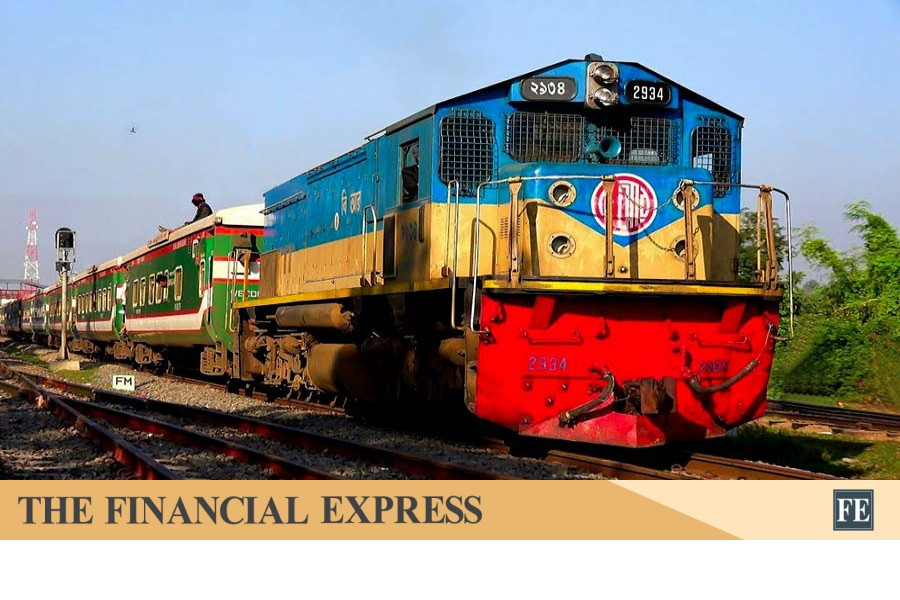
Here is an 80 year old Canadian Meter gauge GMD-Ontario-Made loco (EMD B-12) deployed in East Pakistan in 1953 or so - and still working pulling container and tanker trains between Dhaka and Chittagong port to this day. This was oldest diesel electric loco deployed in the subcontinent (yes, ahead of India as well when most of their locos were vintage steam locos).

The EMD B12 (classified by Bangladesh Railway as the Class 2000) holds a legendary status as the first diesel-electric locomotive series to operate in the region. Manufactured by General Motors Diesel (GMD) in Canada (Canadian division of EMD USA) between 1953 and 1956, a total of 40 units were delivered to the then Eastern Bengal Railway (later named East Pakistan Railway or EPR). Affectionately nicknamed "Dadu Vai" (Grandpa) by local rail enthusiasts due to their age, these meter-gauge locomotives are powered by a 12-cylinder EMD 567C engine producing approximately 1,125 hp.

1777683716350.webp

.
 

Bangladesh Railway eastern zone
Rail revenue up Tk 1.5b; questions over service quality remain

Sujan Ghose
Chattogram
Published: 05 May 2026, 08: 13

1777947646699.webp


Bangladesh Railway File photo.


In the first nine months of the current fiscal year, Bangladesh Railway’s Eastern Zone has earned Tk 1.50 billion more than the previous year. Most of this income has come from passenger transport. However, revenue from freight transport has declined again this year.

Until March of the current fiscal year, the Eastern Zone earned about Tk 9.10 billion, which is higher than the target. In the same period last fiscal year, earnings were over Tk 7.59 billion.

The railway earns revenue from a total of eight sectors, but the main sources are passenger and freight transport. This time, 86.5 per cent of total revenue came from passenger transport. Income from freight and parcel transport stood at Tk 717.7 million, which is only 7.9 per cent of total earnings.

Although passenger transport revenue has increased due to various charges and withdrawal of previous benefits, there have been no effective measures to improve passenger service quality. Issues such as trains not running on schedule, failing to reach destinations on time, engine failures en route, derailments, suffering despite having tickets but not getting seats, and stone-throwing incidents on popular routes continue.

Freight transport has failed to meet targets this year, and revenue has declined compared to last year. Due to an engine shortage, the organisation is struggling to run freight trains. In contrast, neighbouring India and many other countries emphasise freight transport.

The Eastern Zone of the railway includes Dhaka, Chattogram, Sylhet, and Mymensingh divisions. While there is a large gap between passenger and freight revenue in this zone, the situation in South Asian countries like India and Pakistan is different.

In the last fiscal year (2024–25), Indian Railways earned over 2.65 trillion rupees. Of this, over 1.71 trillion rupees came from freight transport, while passenger revenue was 753.67 billion rupees—meaning freight earnings were 2.3 times higher than passenger earnings.

Once, the railway offered distance-based concessions to attract passengers. According to railway data, passengers received a 20 per cent discount for travel between 101–250 km, 25 per cent for 251–400 km, and 30 per cent for distances over 401 km. However, these were withdrawn in April 2024.

In the same fiscal year, Pakistan Railways earned 83 billion rupees, including 42 billion from passenger services and 29 billion from freight, with the rest coming from other sectors.

Passenger revenue rises due to added charges

Analysis of railway data shows that passenger transport is now the main source of income. Revenue from passenger transport reached Tk 7.87 billion, compared to over Tk 6.23 billion in the previous year. That means an increase of about Tk 1.64 billon, or 26 per cent, within one year.

In the first nine months of the current fiscal year (July to March), about 37 million people travelled by train in Dhaka and Chattogram divisions. The target was about 28 million passengers. That means nine million more passengers travelled than the target.

Railway officials say the increase in passenger numbers is due to traffic congestion on roads, risk of accidents, higher fares, time savings, and avoidance of various hassles. New routes, including Cox’s Bazar, have been introduced. Interest in train travel has increased significantly as people seek safer and more comfortable journeys.

However, as interest in trains has grown, the railway has imposed various charges and withdrawn earlier benefits. Previously, there was no VAT on first-class non-AC coaches, but a 15 per cent VAT was imposed in 2022.

Once, the railway offered distance-based concessions to attract passengers. According to railway data, passengers received a 20 per cent discount for travel between 101–250 km, 25 per cent for 251–400 km, and 30 per cent for distances over 401 km. However, these were withdrawn in April 2024.

To increase passenger revenue, additional coaches have been added to intercity trains, and upon application, reserved AC tickets carry an extra 30 per cent charge and non-AC tickets 20 per cent above normal fare.

Most recently, in December last year, the railway introduced a pontage charge for bridges longer than 100 meters, increasing fares by Tk 5 to Tk 226 depending on train and seat.

In the first eight months of the 2024–25 fiscal year, some 1,838 freight trains operated. In the same period of the current fiscal year, only 985 trains ran—nearly half. The target was to transport 199,715 wagons, but only 49,476 wagons were carried, about one-fourth of the target.

According to the railway, a pontage charge is an additional fee applied when a bridge or similar infrastructure is included in the route. In such cases, a 100-meter bridge is counted as 2.5 kilometers in distance, effectively increasing the calculated travel distance.

Mahbubur Rahman, Chief Commercial Manager of the Eastern Zone, told Prothom Alo that various measures have been taken to increase revenue. For example, long-distance seats on intercity trains often remained empty, while mid-distance passengers were discouraged by higher fares. The quota system for tickets was revised to allocate more seats to stations with higher demand, increasing both passenger numbers and revenue.

Freight revenue declining; investment not yielding results

Despite overall revenue growth, the situation in freight transport remains disappointing. The railway has failed to take effective measures in this sector, and revenue has not increased. For 11 fiscal years, income in this sector has been declining. Although there was a slight increase in between, it could not be sustained. In the 2015–16 fiscal year, freight revenue was Tk 731 million. From 2021–22 to 2023–24, it crossed Tk 1 billion annually. However, in the last fiscal year, it dropped to Tk 775 million.

This year, revenue from this sector is lower than last year. While it was Tk 723 million last year, it has fallen to Tk 651 million this year, against a target of Tk 2.27 billion. Additionally, parcel sector income was Tk 57 million, against a target of Tk 188 million.

During the 15 years of the Awami League government, which was ousted following the mass uprising of students and the public, more than Tk 1 trillion was invested in railway development. However, most of the spending went into building new rail lines, without corresponding investment in new engines. As a result, while rail lines increased, the number of operating trains declined—especially freight trains.

In the first eight months of the 2024–25 fiscal year, some 1,838 freight trains operated. In the same period of the current fiscal year, only 985 trains ran—nearly half. The target was to transport 199,715 wagons, but only 49,476 wagons were carried, about one-fourth of the target.

The main reason is a shortage of engines. While 13 engines are needed daily to maintain normal freight operations, only three to four are available, and sometimes even fewer. Due to disrupted train operations, businesses are losing interest in using rail for freight transport.

Experts and railway officials say that despite massive investment, the railway has effectively ‘derailed’ due to poor planning, corruption, inefficiency, and waste. A major example is the purchase of luggage vans. In 2023, as many as 125 luggage vans were bought for Tk 3.58 billion with the aim of making rail profitable through freight transport. However, instead of generating profit, they have become a burden.

Railway documents show that 125 new luggage vans were added in September 2023. Previously, there were 50 old vans, of which only 18 were operational.

Before adding the new vans, revenue from parcel transport in the first three months (July–September) of the 2023–24 fiscal year was Tk 22 million. Even after adding the vans, revenue did not increase significantly. In the first nine months of the current fiscal year, parcel revenue was only Tk 67 million. Although the vans were expected to transport 882 quintals of goods, they carried only 286 quintals.

Professor Md Shamsul Hoque, a transport expert at Bangladesh University of Engineering and Technology (BUET), told Prothom Alo that despite heavy investment, neither service quality nor passenger capacity has improved significantly. This indicates that investments were not well planned.

According to him, many purchases were made in ways that benefited suppliers, with luggage vans being a prime example. These were bought without proper assessment of utility and ultimately failed to deliver results.​
 

Latest Posts

Back
Top Bottom