Lets say its one Rafale or ten Rafales shot down.......
The problem for some of us who are Pakistanis here is that Indias totally crossed the Rubicon here no?
What this means is dat despite us having 'nukes'......India can attack our country wily nily based upon any excuse.
You understand the gravity of this situation no?
Our deterrent is gone bro!.......We've been exposed along with our China supplied weaponry, none of which could prevent nor thwart an Indian attack on us.
This is all slipping away from our grip folks......
We gotta talk to Iran ASAP and get hypersonics right now. Regular Scud type ballistic missiles are junk today!
As per Indian media we launched about 50 SSM's at Indian positions along with a similar no of drones, but 99% of them were intercepted, (unconfirmed Indian media accounts)
This is all slipping away from our grip folks......
We gotta talk to Iran ASAP and get hypersonics right now. Regular Scud type ballistic missiles are junk today!
As per Indian media we launched about 50 SSM's at Indian positions along with a similar no of drones, but 99% of them were intercepted, (unconfirmed Indian media accounts)
I believe those hypersonic missiles are ballistic. They will not help much. They can be easily be shot down. In response, India will get the chance to use its huge arsenal of weapons which it has not been used yet. Prahar, Pralay, Brahmos, Agni 1, Agni Prime, Rudram family, K family, Shaurya etc. They are amongst most deadly missiles anywhere. We haven't yet used Pinaka. In response to any ballistic missile strike, India has much wider spectrum of weapons and option to retaliate with. Any sensible guy in decision making will take all this into account.
They are saying this for a long long time. This is the best chance for them to use it. They should prove that they can do it which they are talking for a long time. One effort and one rogue nation erased from the map of world for ever.
A top Chinese-made Pakistani fighter shot down at least two Indian military aircraft on Wednesday, two US officials told Reuters, marking a major milestone for Beijing's advanced fighter jet. One US official, speaking on condition of anonymity, said there was high confidence that Pakistan had used
thefinancialexpress.com.bd
Pakistan's Chinese-made jet brought down two Indian fighter aircraft, US officials say
REUTERS
Published :
May 08, 2025 22:01
Updated :
May 08, 2025 22:01
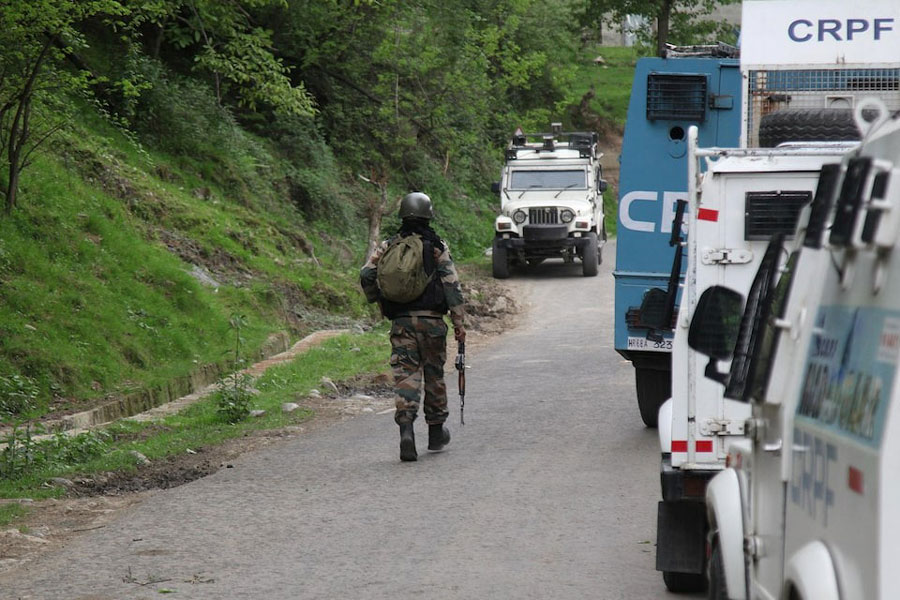
An Indian security force trooper moves past parked vehicles during a cordon and search operation, following an attack on tourists near Pahalgam, in Gudder village of south Kashmir's Kulgam district April 26, 2025. Photo : REUTERS/Stringer/Files
A top Chinese-made Pakistani fighter shot down at least two Indian military aircraft on Wednesday, two US officials told Reuters, marking a major milestone for Beijing's advanced fighter jet.
One US official, speaking on condition of anonymity, said there was high confidence that Pakistan had used the Chinese-made J-10 aircraft to launch air-to-air missiles against Indian fighter jets - bringing down at least two.
Another official said at least one Indian jet that was shot down was a French-made Rafale fighter aircraft.
Delhi has not acknowledged the loss of any of its planes and instead said it carried out successful strikes against what it said was "terrorist" infrastructure inside Pakistan.
In France, Rafale manufacturer Dassault Aviation (AM.PA) and the MBDA (AIR.PA), (BAES.L), (LDOF.MI), consortium, which makes the Meteor air-to-air missile, could not immediately be reached for comment on a public holiday.
This is great. Unnamed US officials are praising Chinese J10s. When Pakistani minister was asked about Pakistan shooting down Indian jets and proof same, he replied some twits of Indian person. Pakistani defense minister came to know about Pakistani planes shooting Indian jets through the twit on twitter.
They are saying this for a long long time. This is the best chance for them to use it. They should prove that they can do it which they are talking for a long time. One effort and one rogue nation erased from the map of world for ever.


 Pakistan Affairs