[🇧🇩] Semiconductor Industry in Bangladesh

Afghanistan Albania Algeria Andorra Angola Antigua Austria Azerbaijan Bahamas Bahrain Bangladesh Barbados Canada China Egypt Finland Germany India Iran Israel Japan Lebanon North Macedonia Pakistan Palestine Qatar Russia Syria Turkey Ukraine United Kingdom United States Yemen
[🇧🇩] Semiconductor Industry in Bangladesh
40
4K
More threads by Saif

G Bangladesh Defense
The value addition possibilities in the Semiconductor sector can be divided into 3 sections,

1. Design

2. Fabrication

3. Testing/Packaging/Assembly/QC

Design (#1) is being already done in Bangladesh - and you need all sorts of CAD training and people, which Bangladesh possesses. Ultimately this is where labor value addition for Bangladesh for educated workforce will bear fruit.

Fab (#2) is incredibly expensive. requiring humongous capital outlay (in the order of hundreds of Billions) and existing status quo players like Taiwan/Korea/US are unwilling to share that tech. So that is out for Bangladesh. But....

Packaging/QC/Testing (#3) is also a remote possibility for Bangladesh, though that is certainly less labor intensive than #1. Maybe not right now, but five/six years down the line, will be very appropriate option.

So for now - Design is the number one prerogative for Bangladesh in Semiconductor sector, and the one we should focus on.
Very informative post:)
 
Last edited by a moderator:

National Semiconductor Symposium 2025 kicks off

1752800212654.webp

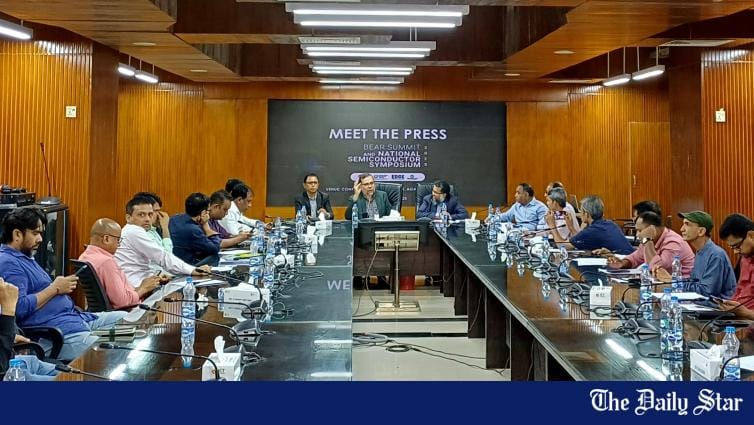
Press conference ahead of BEAR Summit and Bangladesh National Semiconductor Symposium 2025 on July 15. Image: Md. Zahidur Rabbi.

The inaugural session of the country's first Biotic Electronics AI and Robotics (BEAR) Summit and Bangladesh National Semiconductor Symposium 2025 was held at Dhaka on July 16.

The two-day event, taking place on July 16 and 17 at the National Science and Technology Complex in Agargaon, is jointly organised by the Information and Communication Technology (ICT) Division, the EDGE Project, and the Bangladesh Computer Council.

Earlier, at a press conference on July 15, ICT Division Secretary Shish Haider Chowdhury described the event as a landmark collaboration between the government, the semiconductor industry, academic institutions, and members of the Bangladeshi diaspora. He noted that the government is prepared to provide full policy support to foster growth in this sector, adding that a draft of the National Semiconductor Policy has already been prepared and will soon be finalised.

Shish Haider Chowdhury also stated that proposals have been submitted to policymakers to offer cash incentives of five to ten percent for the export of semiconductor-based products and services. He projected that with a workforce of 20,000 skilled professionals, Bangladesh could generate USD 150 billion in semiconductor exports over the next decade.​
 

ACI to enter property, semiconductor businesses

16 January 2026, 13:06 PM
UPDATED 16 January 2026, 13:06 PM

1768612103329.webp


ACI Ltd, one of the leading diversified conglomerates in Bangladesh, plans to enter the property and semiconductor businesses.


The group will form two new subsidiaries—ACI Properties Ltd and ACI Semiconductor Ltd—according to decisions by the ACI board, taken on Thursday.

The group has 17 subsidiaries and five joint ventures.

ACI, in disclosures made through advertisements, said it would form ACI Properties Ltd with an authorised capital of Tk 100 crore and a paid-up capital of Tk 10 crore.

ACI will hold 85 percent of the shares, subject to the approval of the concerned authority.

The group operates under five strategic business units, spanning health, consumer care, agribusiness, and motors, and said its semiconductor subsidiary will also have an authorised capital of Tk 100 crore and a paid-up capital of Tk 10 crore.

In this case, ACI will hold 85 percent of the shares.

The conglomerate said the formation of the subsidiaries is subject to the approval of the concerned authority.

The group suffered losses for the third consecutive year in the financial year 2024–25.

ACI, however, posted a profit in the first quarter of the fiscal year 2025–26.​
 

BSIA, SICIP team up to build semiconductor workforce

FE REPORT
Published :
Feb 18, 2026 12:45
Updated :
Feb 18, 2026 12:45

1771461660556.webp


The Bangladesh Semiconductor Industry Association (BSIA) on Tuesday signed a contract with the Skills for Industry Competitiveness and Innovation Programme (SICIP) to implement a large-scale, industry-oriented semiconductor workforce development programme.

Mohammed Walid Hossain, executive project director of SICIP, and M A Jabbar, president of BSIA, signed the contract on behalf of their respective organisations at the SICIP office in Dhaka.

Under the agreement, BSIA will train 3,500 graduates from EEE, ECE, CSE, applied physics and other relevant disciplines through six specialised courses, says a press statement.

The courses are IC Design & Layout Engineering; Advanced Physical Design Program: RTL to GDSII; DFT and Verification Engineering Program for ASIC Designers; Applied Semiconductor Systems: Power Devices and Industrial Integration; Smart Systems Engineering: Embedded Design and Semiconductor Application Interfaces; and Packaging and Testing. Each course will run for three months (240 hours).

The total cost of the programme is Tk 351.4 million, and the implementation period will run from February 2026 to December 2028.

Speaking on the occasion, SICIP Executive Project Director Mohammed Walid Hossain emphasised the importance of ensuring high-quality training delivery, strong monitoring throughout implementation, and achieving at least 65 per cent job placement of certified trainees in line with the programme's objectives.​
 

Govt eyes chip industry growth with extended tax concessions until 2031

1781233845144.webp


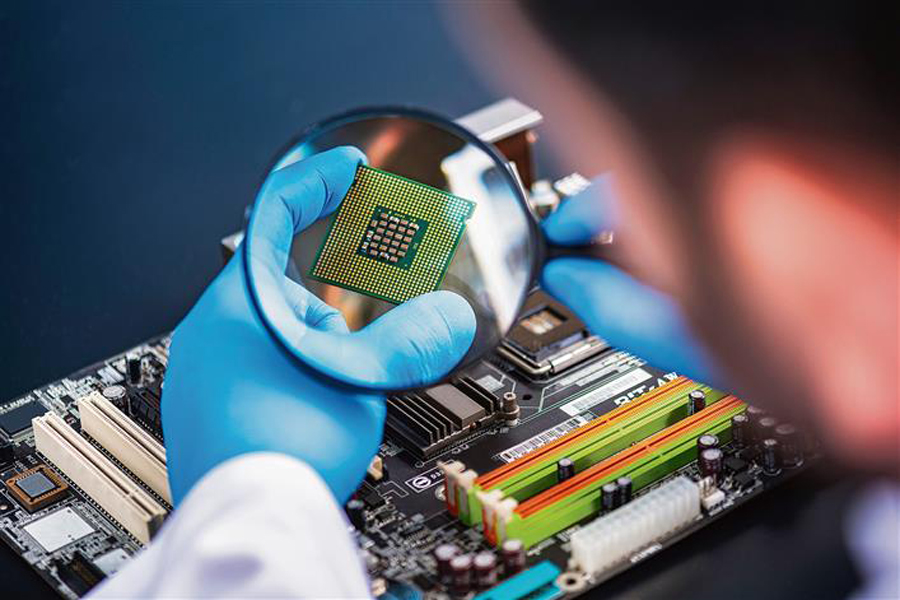
Image: He Junhui/Unsplash

The Bangladesh government has proposed sweeping tax concessions for the semiconductor industry, including reducing import duties on key raw materials to 1 percent until mid-2031, as part of its fiscal year 2026-27 budget.

Semiconductors are a critical component in modern electronics, powering products ranging from smartphones and computers to industrial equipment and vehicles.

Under the proposal, raw materials used in semiconductor and chip design, testing and packaging would be exempt from regulatory duty, supplementary duty, value-added tax and advance tax. A 1 percent import duty would remain in place. The concessions would apply until 30 June 2031.

Presenting the budget, finance and planning minister Amir Khosru Mahmud Chowdhury said, “Every year, our universities produce many qualified engineers, and many more are contributing globally as part of the Bangladeshi diaspora.”

The proposed incentives are aimed at leveraging that talent pool, creating skilled jobs and supporting export-oriented growth, according to the minister.​
 

Govt offers tax breaks to develop semiconductor sector

Jagaran Chakma

1781481272587.webp


The government has announced a series of tax incentives for semiconductor and chip-related activities in a bid to develop a domestic ecosystem for the high-tech industry and create skilled jobs.

In his budget speech for FY2026-27 on Thursday, Finance Minister Amir Khosru Mahmud Chowdhury proposed exempting regulatory duty, supplementary duty, value added tax (VAT) and advance tax on raw materials used in semiconductor or chip design, testing and packaging until June 30, 2031. A 1 percent import duty will still apply on such imports.

The proposal is a part of a broader effort to strengthen the country’s capacity in advanced technologies and diversify its export base.

The finance minister said Bangladesh produces a large number of engineering graduates each year, and that many Bangladeshi professionals already work in the global semiconductor industry.

He said the government has proposed the incentives for the sector “to harness their talent, create high-skilled employment and promote export-oriented growth”.

The budget also set out plans to establish specialist laboratories for artificial intelligence (AI), semiconductors, robotics, machine learning and big data analytics.

It also outlined initiatives to strengthen national capacity in space research, semiconductor technology, and earthquake and seismographic research.

The government pledged continued support for researchers through the Science and Technology Fellowship Trust, saying investment in research and innovation would be critical to developing new technologies and preparing young people for the demands of the Fourth Industrial Revolution.

Industry stakeholders welcomed the move, saying the incentives could help attract investment in chip design, testing and packaging services, areas where Bangladesh already has a modest presence.

MA Jabbar, president of the Bangladesh Semiconductor Industry Association (BSIA), welcomed the proposed incentives, saying the industry had long engaged with policymakers to secure support.

“We have 21 member companies already invested in the local semiconductor sector,” he said. “We met officials from the National Board of Revenue and later the finance minister to explain the need for policy support.”

According to Jabbar, the country has strong potential to develop a skilled semiconductor workforce, particularly in chip design and related services.

“So far, we have trained around 1,200 semiconductor engineers and expect to develop another 3,000 within the next two years,” he said.

While the country has yet to enter semiconductor manufacturing, local firms have established a foothold in chip design, a key segment of the global semiconductor value chain.

“Our current focus is design. We are also working to establish testing laboratories to gradually move towards manufacturing,” Jabbar said.

He noted that the expanding global semiconductor market presents opportunities for countries able to supply skilled talent and specialised services.

“If we are to capture a share of this market, policy support must continue. The incentives announced in the budget are a positive step,” he said.

Jabbar added that sustained support could generate high-skilled jobs, boost exports and attract foreign investment. “There is considerable potential for foreign direct investment in this industry. But first, we must build the ecosystem and strengthen the sector domestically.”

In a statement, BSIA welcomed the fiscal and policy support for the semiconductor sector, saying it formally recognises activities such as IC design, electronic design automation (EDA), outsourced semiconductor assembly and testing (OSAT), packaging and fabrication within customs, tariff and VAT frameworks.

The association said exemptions from customs duty, regulatory duty, supplementary duty, VAT and advance tax on eligible inputs would lower costs, help attract investment, create skilled jobs and strengthen the country’s position in the global semiconductor and deep tech industries.

Syed Almas Kabir, president of the Bangladesh Association of Software and Information Services (BASIS), described the incentives as a strategic step towards high-value technology manufacturing.

“The incentives are timely and aligned with global industry trends. However, their success will depend not only on tax benefits but also on the ability to develop skilled talent, strengthen infrastructure and foster industry-academia collaboration,” he said.

According to Kabir, the tax relief for chip design, testing and packaging aligns policy support with the growing engineering talent base. “The real impact will come when these measures are backed by investment in advanced laboratories, stronger university-industry partnerships and a dedicated VLSI talent pipeline,” he added.

He said countries such as Vietnam and Malaysia built successful semiconductor industries by developing complete ecosystems rather than relying solely on incentives.

Kabir also highlighted the potential role of the Bangladeshi diaspora, many of whom work at leading global companies including TSMC, Intel, Qualcomm, NVIDIA, AMD and Synopsys. A structured programme to engage these professionals, he said, could significantly accelerate the country’s semiconductor capabilities.​
 

Semiconductor export potential remains untapped
Sojib Miah 12 July, 2026, 23:58

1783902910670.webp


As Bangladesh seeks to reduce its heavy dependence on readymade garment sector, industry experts are urging the government to make semiconductors a national priority, saying that the country had a rare opportunity to establish itself in one of the world’s fastest-growing high-tech industries. Bangladeshnews updates

Although Bangladesh currently has no significant domestic semiconductor market, experts believe that the country could build a globally competitive industry by focusing on semiconductor design, testing and packaging, backed by targeted government incentives, skilled manpower and industry-friendly policies.

The global semiconductor industry is witnessing rapid growth, driven by soaring demand for artificial intelligence and advanced computing.

World Semiconductor Trade Statistics has forecasted that the market would exceed $1.5 trillion in 2026, while the Semiconductor Industry Association said that global chip sales reached $120.6 billion as of May 2026, more than doubling from a year earlier.

For 2027, WSTS forecasted that the global semiconductor market would grow a further 27 per cent, reaching approximately $1.9 trillion, with memory and logic chips leading growth.

According to the Bangladesh Semiconductor Industry Association, 19 companies are currently operating under its umbrella, with several more set to join. BSIA members generate an estimated $12 million in annual exports, a figure expected to grow by at least 40 per cent each year, with a target of reaching $1 billion by 2030.

The industry currently employs about 1,200 skilled professionals. The BSIA aims to create 10,000 jobs for graduates by 2030 and, through an agreement with the Skills for Industry Competitiveness and Innovation Programme, plans to train 3,500 graduates by 2028.

At least 65 per cent are expected to secure jobs at home or abroad, including 2,300 trainees under the Synopsys Global Certification Programme.

Semiconductors — tiny silicon chips containing billions of microscopic transistors — power almost every modern technology, from smartphones and computers to electric vehicles, medical devices and military systems.

As global demand surges, countries are racing to secure positions in semiconductor supply chains, recognising chips as both an economic and strategic asset.

Developing domestic semiconductor capability is also vital for national security, because countries increasingly require secure chips for defence, cybersecurity and critical infrastructure.

ABM Harun-Ur-Rashid, an advisory board member of the BSIA, said that Bangladesh must seize this opportunity to diversify exports and transition towards a knowledge-based economy.

‘The RMG sector has long been the backbone of our economy, but it has reached a level of maturity. To sustain export growth, Bangladesh needs new high-value industries and semiconductors offer perhaps the strongest opportunity,’ he said in an interview with New Age.

Rashid, also electrical and electronic engineering department professor of the Bangladesh University of Engineering and Technology, said that Bangladesh should not attempt to enter semiconductor fabrication, the most capital-intensive stage of production, but instead concentrate on chip design, testing and packaging, where investment requirements were comparatively lower and global outsourcing demand was growing rapidly. Youthculture articles

‘Chip design itself is a $300 billion global industry. Companies like Intel, AMD and NVIDIA outsource significant portions of their design work. India captured these opportunities decades ago and today it hosts major semiconductor design centres,’ he said.

Bangladesh currently has about 13 semiconductor design companies with combined annual revenues of roughly $15 million to $20 million.

With supportive policies, fiscal incentives and stronger engagement with non-resident Bangladeshi community, Rashid believed that the industry could expand into a $1 billion export sector and potentially reach $2-3 billion if multinational companies established local operations.

However, he stressed that attracting global firms depended primarily on developing a large pool of skilled engineers.

‘Multinational companies invest where they can immediately recruit qualified talent,’ he said.

To achieve that goal, Rashid proposed establishing regional centres of excellence equipped with costly Electronic Design Automation software and linked with international semiconductor foundries for affordable chip prototyping through Multi-Project Wafer programmes. Bangladeshnews updates

He also welcomed the government’s recent reduction of customs duties on semiconductor equipment to 1 per cent, calling it a positive step, but said that additional reforms were needed to streamline bonded warehouse facilities and logistics for testing and packaging operations.

In semiconductor packaging, expensive silicon wafers must be imported, processed and exported within a very short time, he said, adding, ‘Even a day’s delay can result in huge financial losses and damage customer confidence.’

Malaysia, he noted, built a globally competitive semiconductor packaging industry by ensuring efficient logistics and seamless customs procedures.

Rashid identified the shortage of specialised engineers as Bangladesh’s biggest challenge.

‘We have thousands of engineering graduates looking for jobs while the global semiconductor industry faces an acute talent shortage. With proper training, this can become one of Bangladesh’s greatest competitive advantages,’ he said.

He revealed that AMD recently explored establishing operations in Bangladesh and expressed interest in recruiting about 500 engineers.

‘We couldn’t even provide 50 qualified engineers,’ he said.

Power reliability remains another critical concern, he added.

‘Semiconductors are extremely sensitive to power fluctuations. Stable electricity is non-negotiable,’ he said, calling for greater investment in renewable energy, battery storage and grid resilience.

To address the skills gap, Rashid called for government and private sector co-investment in specialised training programmes and suggested creating a national semiconductor development fund financed through a 1-per cent contribution from mobile telecom operators, similar to Pakistan’s Inspire programme.

He also urged stronger collaboration between universities and industry, curriculum reform and mandatory internships, warning that many talented engineering graduates continued to leave the private technology sector in favour of government jobs because of better job security and salaries.

Rashid envisioned Bangladesh establishing 30 semiconductor design houses and two or three packaging plants, employing 20,000 to 30,000 engineers within five years.

Echoing these concerns, Mohammed Enayetur Rahman, founder, chief executive officer and president of ULKASEMI, said that Bangladesh’s immediate opportunity lied in exporting semiconductor design services rather than manufacturing chips.

‘The world is facing a massive shortage of semiconductor engineers. Bangladesh should focus on developing skilled talent and integrating into the global supply chain,’ he said.

The global semiconductor market is expected to reach between $1 trillion and $2 trillion by the early 2030s, driven by artificial intelligence, cloud computing and advanced electronics.

Enayetur said that Bangladesh should seize the opportunity by creating high-value knowledge-based jobs instead of waiting to build chip manufacturing capacity.

He argued that workforce development should take priority over expensive research projects, criticising earlier policy initiatives that focused on advanced laboratories while neglecting practical training and job creation.

‘We recommended building a centre of excellence and launching a ‘Made in Bangladesh’ chip initiative years ago, but those proposals never materialised,’ he said.

Although the latest national budget acknowledged the semiconductor sector, Enayetur said that stronger policy support was needed, including tax holidays, lower import duties on specialised equipment and cash incentives of 20-25 per cent for export-oriented semiconductor companies.

He also proposed introducing dedicated customs codes and simplifying import procedures.

Lengthy customs procedures, rigid banking rules, unreliable electricity and inconsistent internet connectivity continue to discourage technology companies that must import high-end equipment and meet strict project deadlines, he said.

He urged the government to establish dedicated semiconductor parks with guaranteed utilities and business support services to attract multinational technology firms.

‘If multinational companies establish design centres in Bangladesh, they can create hundreds of thousands of high-paying jobs,’ he said. Bangladeshnews updates

Enayetur also stressed the need for education reform, saying that universities still produced graduates whose skills often failed to match industry requirements.

When ULKASEMI began operations in Bangladesh in 2007 with only four engineers, few universities offered courses on Very Large Scale Integration, the foundation of semiconductor design.

The company later collaborated with universities to update curricula and introduced boot camps, online learning resources, campus ambassador programmes and hackathons.

Despite progress, he said that Bangladesh still faced a severe shortage of qualified VLSI faculty and experienced engineers.

ULKASEMI now employs about 500 engineers in Bangladesh and has transferred dozens to Silicon Valley to work on projects for global technology companies, including Apple.

‘Our engineers are entirely Bangladeshi. Their performance proves our talent can compete globally,’ he said.

Enayetur called for a comprehensive National Semiconductor Policy centred on talent development, specialised infrastructure and the promotion of international investment, implemented through a dedicated government body reporting directly to the prime minister.

He said that Bangladesh could follow India’s phased approach by strengthening semiconductor design before moving into packaging, testing and eventually manufacturing.

Developing domestic semiconductor capability is also vital for national security, he added, as countries increasingly require secure chips for defence, cybersecurity and critical infrastructure.

‘Semiconductors are no longer just an economic issue — they are a strategic technology for every nation,’ he said.​
 

Govt eyes chip industry growth with extended tax concessions until 2031

View attachment 27586

Image: He Junhui/Unsplash

The Bangladesh government has proposed sweeping tax concessions for the semiconductor industry, including reducing import duties on key raw materials to 1 percent until mid-2031, as part of its fiscal year 2026-27 budget.

Semiconductors are a critical component in modern electronics, powering products ranging from smartphones and computers to industrial equipment and vehicles.

Under the proposal, raw materials used in semiconductor and chip design, testing and packaging would be exempt from regulatory duty, supplementary duty, value-added tax and advance tax. A 1 percent import duty would remain in place. The concessions would apply until 30 June 2031.

Presenting the budget, finance and planning minister Amir Khosru Mahmud Chowdhury said, “Every year, our universities produce many qualified engineers, and many more are contributing globally as part of the Bangladeshi diaspora.”

The proposed incentives are aimed at leveraging that talent pool, creating skilled jobs and supporting export-oriented growth, according to the minister.​

Here - we are not talking about chip foundries - which is outside the realm of reality for a nation like Bangladesh.

However chip design is very much a profitable activity and is being pursued very actively by local firms like ULKA SEMI.
 

Latest Posts

Back