New Tweets

[🇮🇷] Iran news/views

G   Iranian Defense
[🇮🇷] Iran news/views
66
2K
More threads by Saif

Saif

Senior Member
Messages
17,643
Likes
8,479
Nation

Residence

Axis Group

Jailed Iranian Nobel winner denied medical care: UN
Agence France-Presse . Geneva 21 August, 2024, 22:27

1724285610897.webp

Narges Mohammadi

UN experts on Tuesday accused Iran of denying jailed Nobel Peace Prize winner Narges Mohammadi proper healthcare, saying she reportedly suffered physical violence earlier this month.

Human rights activist Mohammadi, who won the 2023 Nobel for her campaigning, was hurt along with other female inmates in clashes that erupted at Tehran’s Evin prison, her family said earlier in August.

Mohammadi ‘was reportedly subjected to physical violence’ in Evin on August 6, during which she ‘allegedly lost consciousness, and sustained injuries to her ribcage and other parts of her body’, the experts said.

Iranian authorities acknowledged a confrontation took place but blamed Mohammadi for ‘provocation’ and denied any prisoners had been beaten.

Mohammadi, 52, has been jailed since November 2021 and has spent much of the past decade in and out of prison.

‘Our deep concerns about the physical and mental integrity of Narges Mohammadi have been communicated to the Iranian government,’ the UN experts said in a joint statement.

‘Once again we call on Iranian authorities to release her immediately and ensure her access to full medical care without delay, along with other detainees.’

They said that over the past eight months, Mohammadi had been suffering from acute back and knee pain, including a herniated spinal disc, according to medical specialists and scan examinations.

‘The denial of medical care appears to be used to punish and silence Mohammadi inside prison. These reports raise serious concerns regarding her right to health and physical well-being,’ the experts said.

The special rapporteurs are independent experts mandated by the UN Human Rights Council who do not speak on behalf of the United Nations.

They said there was a pattern of ill-treatment of detainees in Iran.

‘Such deprivations may amount to torture and inhuman treatment,’ they said.

The panel reiterated its ‘calls for the immediate release of human rights defenders and all other individuals in Iranian detention facilities who are currently being held arbitrarily’.

Mohammadi has kept campaigning behind bars and strongly supported the protests that erupted across Iran following the September 2022 death in custody of Mahsa Amini.

The 22-year-old Iranian Kurd had been arrested for an alleged breach of Iran’s strict dress rules for women.​
 
Analyze

Analyze Post

Add your ideas here:
Highlight Cite Respond

Helicopter of Iran's late president Raisi crashed due to bad weather, final report says
REUTERS
Published :
Sep 01, 2024 23:08
Updated :
Sep 01, 2024 23:08

1725236447422.webp

Rescue team works following a crash of a helicopter carrying Iran's President Ebrahim Raisi, in Varzaqan, East Azerbaijan Province, Iran, May 20, 2024 — Stringer/WANA (West Asia News Agency) via REUTERS/Files

The helicopter crash in which Iran's late President Ebrahim Raisi was killed was primarily caused by weather conditions that included thick fog, Iran's state TV said on Sunday, citing the final investigation report on the incident.

Iranian President Ebrahim Raisi, a hardliner who was seen as a potential successor to Supreme Leader Ayatollah Ali Khamenei, died when his helicopter crashed in May in a mountainous region near the Azerbaijan border.

"The main reason of the helicopter crash was complicated weather conditions in the region," the final report concluded, according to Iran's state TV.

A thick mass of fog caused the helicopter that was carrying Raisi and his companions to crash into the mountain, the report issued by a high committee charged by Iran's military with investigating the incident said.

A preliminary report by Iran's military had said in May that no evidence of foul play or an attack had been found during the investigation.​
 
Analyze

Analyze Post

Add your ideas here:
Highlight Cite Respond
The new guy Pezeshkian went on the air and has said that we are under severe sanctions and we need to find a way out of this and we need a min $100 billion in foreign investments. 80 million people are counting on it (including the 25 million illegals who have trickled into Iran over the years as illegal migrants).

Iran has become a joke because of its inability to stop illegal migration. Just like da US.

Illegals from Afghanistan, Iraq, Lebanon, Pakistan, Tajikistan, Uzbekistan, Azher Bhaija and India have turned Iran into another busted ass United States of junkies.
 
Last edited:
Analyze

Analyze Post

Add your ideas here:
Highlight Cite Respond

Iran president vows to ensure morality police don’t ‘bother’ women
Agence France-Presse . Tehran, Iran 16 September, 2024, 23:11

1726534353890.webp

A handout picture provided by the Iranian presidency shows President Masoud Pezeshkian delivering a speech as part of a community ceremony during his visit to the Iraqi city of Basra on September 13, 2024. | AFP photo.

Iranian President Masoud Pezeshkian vowed Monday to ensure the morality police will no longer ‘bother’ women, in remarks to the media on the second anniversary of Mahsa Amini’s death in custody.

Amini, a 22-year-old Iranian Kurd, died in police custody on September 16, 2022, days after the morality police arrested her in Tehran for an alleged breach of the Islamic republic’s strict dress code for women.

Her death triggered months-long protests nationwide, with hundreds of people, including dozens of security personnel, killed. Thousands of demonstrators were arrested.

‘The morality police were not supposed to confront (women). I will follow up so they don’t bother’ them, Pezeshkian said during his first press conference since he took office in July.

Pezeshkian replaced the ultraconservative Ebrahim Raisi, who died in a helicopter crash in May.

During election campaigning, he had vowed to ‘fully’ oppose police patrols enforcing the mandatory hijab headscarf, as well as easing long-standing internet restrictions.

Iran has over the years tightly controlled internet use, restricting popular social media platforms such as Facebook and X.

Harsher curbs were enforced following 2019 protests against fuel price hikes and during the demonstrations triggered by Amini’s death.

On Monday, Pezeshkian said his government was working to ease restrictions online, especially on social media.

At his press conference, Pezeshkian briefly touched on other topics including Iran’s fraught relations with the United States and the 2015 nuclear deal.

‘We do not want to fight with America if it respects our rights,’ he said.

‘It is not us who are hostile (to the Americans). We have not built military bases around their country.’

Iran and the United States have had no diplomatic relations since 1980, the year after the Islamic Revolution that toppled its Western-backed Shah Mohammed Reza Pahlavi.

A landmark 2015 deal between Tehran and world powers granted Iran sanctions relief in return for curbs on its nuclear programme.

But the deal quickly collapsed and tensions reignited after the United States unilaterally withdrew from the accord in 2018 and reimposed sanctions on Iran the following year.

Iran has since suspended its compliance with caps on nuclear activities.

‘We are not seeking nuclear weapons; we have respected the framework of the nuclear agreement,’ Pezeshkian said.

‘They (the United States) broke the agreement and forced us to do something.’

Pezeshkian also spoke about newly imposed sanctions.

Last week Britain, France and Germany announced punitive measures targeting Iranian air transport, accusing it of delivering ballistic missiles to Russia for use in the Ukraine war.

Iran has repeatedly denied sending weapons to Russia for use in the war, and vowed to respond to the latest in a long string of Western sanctions.

Pezeshkian said Iran ‘has not given’ Russia any weapons.

‘It is possible that Iran and Russia had military cooperation in the past... because there was no ban at the time,’ he said.

‘What I can say with certainty is that since our arrival, we have not given them anything so that (the West) boycotts us.’

He also insisted on Iran’s right to maintain its missile programme, which has drawn Western criticism, as a deterrent against its arch-foe Israel.

‘They (the West) want us not to have missiles, that is fine, but you need to disarm Israel first,’ he said, adding that otherwise ‘they can drop bombs on us whenever they want, like in Gaza’.

Israel launched a relentless campaign against the Palestinian militant group Hamas which controls the Gaza Strip, after its October 7 attack on Israel that killed 1,205 people, mostly civilians, according to an AFP tally based on official Israeli figures.

Militants also seized 251 hostages, 97 of whom are still held in Gaza, including 33 the Israeli military says are dead.

Israel’s offensive has so far killed at least 41,226 people in Gaza, according to Gaza’s health ministry, which does not provide a breakdown of civilian and militant deaths.

Tehran hailed Hamas’s October 7 attack on Israel but denied any involvement.

Iran does not recognise Israel, and has made support for the Palestinian cause a centrepiece of its foreign policy since the Islamic revolution in 1979.​
 
Analyze

Analyze Post

Add your ideas here:
Highlight Cite Respond
  • Like (+1)
Reactions: Lulldapull

Iran says its allies 'will not back down' in war with Israel

1728110733704.webp

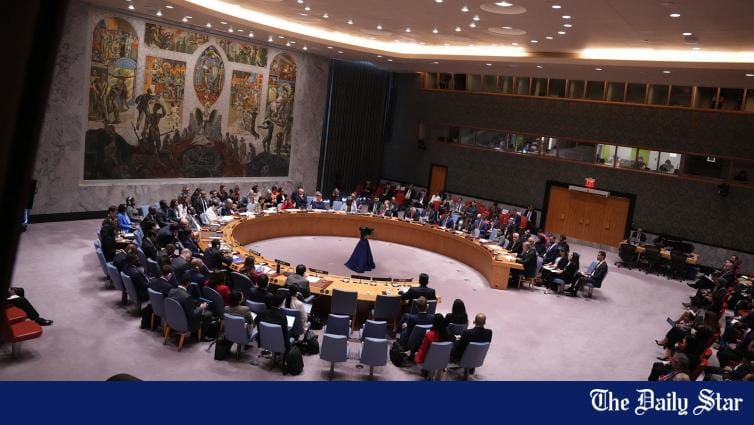
Lebanon Ambassador to the Untied Nations Hadi Hachem speaks at the Security Council meeting on the situation in the Middle East at the United Nations headquarters on October 2, 2024 in New York. UN Secretary-General Antonio Guterres called Monday for an end to the "sickening cycle of escalation" in the Middle East, where conflict rages between Israel, Iran and its allies, Hezbollah and Hamas. Photo: AFP

Iran's supreme leader vowed in a rare address on Friday that his allies around the region would keep fighting Israel, as he defended his country's missile strike on its foe.

Ayatollah Ali Khamenei's address in Tehran followed Iran's second-ever direct attack on Israel. It was also the first since exchanges of fire between Tehran-backed Hezbollah fighters and Israeli troops escalated into full-blown war in Lebanon.

Speaking ahead of the first anniversary of Hamas's October 7 attack on Israel that triggered the ongoing war in the Gaza Strip, Khamenei defended the Palestinian group's "logical and legal" actions and hailed its "fierce defence" against Israeli forces.

The unprecedented Hamas attack resulted in the deaths of 1,205 people, triggering global condemnation but also supporting fire from Iran-backed groups around the Middle East, mainly Lebanon's Hezbollah and Yemen's Huthi rebels.

Hezbollah said early Saturday it was engaged in ongoing clashes with Israeli troops in the Lebanon border area after earlier saying it forced Israeli soldiers to retreat there.

AFP correspondents heard a series of explosions in Beirut early Saturday over the city's southern suburbs after Israeli army Arabic-language spokesperson Avichay Adraee warned residents in part of the area's Burj al-Barajneh neighbourhood to evacuate.

In Jordan and Bahrain, which both have ties with Israel, crowds gathered after Friday prayers in a show of support for Hamas and Hezbollah.

In Amman, demonstrators carried posters hailing the "glory and dignity" of the October 7 attack.

Nearly a year into the Gaza war, Israel has shifted its focus north, aiming to allow tens of thousands of Israelis displaced by cross-border Hezbollah rocket attacks to return home.

Israel's military launched an intensified wave of strikes on Hezbollah strongholds around Lebanon, killing more than 1,110 people since September 23, and forcing hundreds of thousands to flee their homes in a country already mired in economic crisis.

The attacks have killed an Iranian general, a host of Hezbollah commanders and, in the biggest blow to the group in decades, its leader, Hassan Nasrallah.

Strikes in Yemen

"The resistance in the region will not back down with these martyrdoms, and will win," Khamenei said in Arabic.

He charged that Israel was a "malicious regime" that would "not last long".

There was no immediate response from Israeli leaders as much of the country celebrated the Jewish new year.

Khamenei's address came as Israel weighs retaliation for Iran's missile attack on Tuesday, which Tehran called revenge for the killing of Nasrallah and other top figures.

One person was reported killed in the Iranian barrage.

Satellite pictures of Nevatim air base in southern Israel showed apparent damage to a structure on Wednesday, compared with a photo taken on August 3.

United States President Joe Biden, whose country is Israel's biggest military supplier, on Friday urged Israel against striking Iran's oil facilities, a day after he said Washington was "discussing" the possibility of such strikes.

But Republican White House hopeful Donald Trump said the same day he believed Israel should "hit" Iran's nuclear sites.

Iran's Foreign Minister Abbas Araghchi visited Beirut and said his government backs "the efforts for a ceasefire" that would be acceptable to Hezbollah and come "simultaneously with a ceasefire in Gaza".

Biden said the US was working to "rally the rest of the world and our allies" to prevent the fighting from spreading even further.

The US military on Friday said it struck 15 targets in areas of Yemen controlled by Huthi rebels, who have fired missiles at Israel and repeatedly attacked global shipping in the Red Sea.

US, Qatari and Egyptian mediators tried unsuccessfully for months to reach a Gaza truce and secure the release of hostages still held by Hamas.

Border crossing closed

In Beirut, 35-year-old displaced nurse Fatima Salah said people were "scared for our children, and this war is going to be long".

Sina Toossi, a senior fellow at the Center for International Policy in Washington, told AFP: "Everything right now hinges on Israel's response, whether it escalates into a regional war."

In Lebanon, Israeli bombardment has put at least four hospitals out of service, and on Friday, the first delivery of medical aid organised by the United Nations reached Beirut airport.

Lebanon said an Israeli strike on Friday cut off the main international road to Syria, with Israel saying it aimed to prevent the flow of weapons.

Lebanon's disaster management unit said more than 374,000 people -- most of them refugees from Syria's war -- crossed back into the relative safety of their home country in the final week of September.

In Hezbollah's bastion in Beirut's southern suburbs, US and Israeli media reports said that intense bombardment had targeted the militant group's potential successor, Hashem Safieddine, a week after Nasrallah's killing.

The Israeli military has not commented on that strike.

'Scandalous'

Israel announced this week that its troops had started ground raids into parts of southern Lebanon, a Hezbollah stronghold.

On the Israel-Lebanon border, the Israeli military said its forces had killed 250 Hezbollah fighters this week and hit "over 2,000 military targets".

Hezbollah on Friday said its fighters again clashed with Israeli soldiers during "infiltration" attempts.

The group also said it kept up its rocket fire, and Israel's military reported about 200 projectiles fired into Israel on Friday.

The Islamic Health Committee, a Hezbollah-affiliated emergency service, reported that 11 of its personnel were killed Friday by Israeli strikes in southern Lebanon.

The Israeli military said nine soldiers have been killed in combat in Lebanon.

Separately, a drone launched "from the east" killed two Israeli troops, the army said Friday. An Israeli public broadcaster said the strike originated in Iraq.

In the Israeli-occupied West Bank, which has endured intense military raids throughout the Gaza war, the Palestinian health ministry said an air strike killed 18 people in the Tulkarem refugee camp.

Germany described the number of civilian casualties as "shocking", and the United Nations rights office called the strike "unlawful". Israel said it had targeted a local Hamas leader.

In Gaza, Israel's retaliatory offensive has killed at least 41,802 people, the majority of them civilians, according to figures provided by the Hamas-run territory's health ministry. The United Nations has described the figures as reliable.

An official with Medical charity Doctors Without Borders (MSF) told AFP life was becoming "impossible" in Gaza, urging greater humanitarian efforts.

In a separate statement, MSF denounced the "scandalous inaction and duplicity" of the international community.​
 
Analyze

Analyze Post

Add your ideas here:
Highlight Cite Respond

UK sanctions Iranian military chiefs
Agence France-Presse . London 14 October, 2024, 21:56

1728952018481.webp

Iran’s parliament speaker Mohammad Bagher Ghalibaf (C) waves as he returns to his car after visiting the site of an Israeli airstrike that targeted Beirut’s Basta neighbourhood, on October 12, 2024. | AFP file photo

Britain on Monday ordered sanctions against top Iranian military figures after the Islamic republic’s October 1 ballistic missile attack on Israel.

Foreign secretary David Lammy said Iran had ignored repeated warnings that its ‘dangerous actions’ — and those of its proxies — were fuelling conflict in the Middle East.

Among the individuals subject to a travel ban and assets freeze are the commander-in-chief of the Iranian army, Abdolrahim Mousavi, and the head of the air force Hamid Vahedi.

Iran said it launched the missile attack in response to Israel’s killing of Hezbollah leader Hassan Nasrallah in Lebanon, and the death of Hamas leader Ismail Haniyeh in a Tehran bombing widely blamed on Israel.

It was Iran’s second direct attack on Israel after a missile and drone attack in April in response to an air strike on the Iranian consulate in Damascus that it blamed on Israel.

Lammy, in Luxembourg at a meeting with EU foreign ministers, said in a statement that the sanctions were a way to hold Iran to account and expose those behind the attacks.

‘Alongside allies and partners, we will continue to take necessary measures to challenge Iran’s unacceptable threats and press for de-escalation across the region,’ he added.

The British list also features the Islamic Revolutionary Guard Corps intelligence chief Mohammad Kazemi. Two companies, including Iran’s space agency, whose technology can be used in cruise and ballistic missile were hit with an assets freeze.

Last week, the US government imposed restrictions on dozens of companies in Iran’s oil and petrochemicals sectors, to cut off funding of what it said was the country’s ‘destabilising activity’.​
 
Analyze

Analyze Post

Add your ideas here:
Highlight Cite Respond

Iran releases Nobel Peace laureate Mohammadi on medical leave
Agence France-Presse . Tehran 04 December, 2024, 22:12


1733360630582.webp

laureate Mohammadi

Iran has released Nobel Peace laureate Narges Mohammadi, jailed since November 2021, for three weeks on medical grounds, her lawyer posted on social media.

Over the past quarter century, Mohammadi, 52, has been repeatedly tried and jailed for her vocal campaigning against Iran’s widespread use of capital punishment and its mandatory dress code for women.

‘Based on the advice of the examining doctor, the public prosecutor suspended the jail sentence against Narges Mohammadi for three weeks and she was released from prison,’ Mostafa Nili said on X.

‘The grounds for her release are her physical condition after the removal of a tumour and a bone graft three weeks ago.

‘The tumour was benign but she needs check-ups every three months.’

Mohammadi’s family and supporters swiftly put out a statement protesting that the three weeks’ medical leave was not enough.

‘A 21-day suspension of Narges Mohammadi’s sentence is inadequate. We demand Narges Mohammadi’s immediate and unconditional release or at least an extension of her leave to three months,’ they said in a statement.

‘The denial of proper medical care and sufficient recovery time post-surgery has led to the rapid development of bedsores and intensified pain in her back and legs.’

Mohammadi has spent much of the past decade behind bars and has not seen her twin children, who live in Paris, since 2015.

She is serving her sentence in the women’s section of the capital’s notorious Evin prison with around 50 other inmates, according to her husband Taghi Rahmani.

In June, she was sentenced to an additional year behind bars for ‘propaganda against the state’.

She refused to appear in court for the trial after her request for it to be held in public was rejected.

Even behind bars, the Nobel laureate has not given up campaigning, staging protests in the prison yard and going on hunger strikes.

In a letter from prison in September, she condemned the ‘devastating oppression’ of women in Iran.

The letter was published by her foundation to mark the second anniversary of the nationwide protests that followed the death in custody of Mahsa Amini, an Iranian Kurdish woman detained for an alleged breach of the dress code.

Mohammadi won the Nobel Peace Prize in 2023, primarily for her campaigning against the death penalty in Iran. Her children collected the award on her behalf as she was in prison at the time.

Human rights groups, including Amnesty International, say Iran carries out more executions each year than any other country apart from China, for which no reliable figures are available.

Born in the northwestern city of Zanjan in 1972, Mohammadi studied physics and pursued a career in engineering alongside work as a journalist for several reformist media outlets.

In the 2000s, she joined the Defenders of Human Rights Center set up by 2003 Nobel Peace Prize winner Shirin Ebadi, an organisation of which Mohammadi remains vice president.

She was jailed from May 2015 to October 2020 for ‘forming and leading an illegal group’, campaigning for the abolition of the death penalty in Iran.​
 
Analyze

Analyze Post

Add your ideas here:
Highlight Cite Respond

Iran president vows to ensure morality police don’t ‘bother’ women
Agence France-Presse . Tehran, Iran 16 September, 2024, 23:11

View attachment 8511
A handout picture provided by the Iranian presidency shows President Masoud Pezeshkian delivering a speech as part of a community ceremony during his visit to the Iraqi city of Basra on September 13, 2024. | AFP photo.

Iranian President Masoud Pezeshkian vowed Monday to ensure the morality police will no longer ‘bother’ women, in remarks to the media on the second anniversary of Mahsa Amini’s death in custody.

Amini, a 22-year-old Iranian Kurd, died in police custody on September 16, 2022, days after the morality police arrested her in Tehran for an alleged breach of the Islamic republic’s strict dress code for women.

Her death triggered months-long protests nationwide, with hundreds of people, including dozens of security personnel, killed. Thousands of demonstrators were arrested.

‘The morality police were not supposed to confront (women). I will follow up so they don’t bother’ them, Pezeshkian said during his first press conference since he took office in July.

Pezeshkian replaced the ultraconservative Ebrahim Raisi, who died in a helicopter crash in May.

During election campaigning, he had vowed to ‘fully’ oppose police patrols enforcing the mandatory hijab headscarf, as well as easing long-standing internet restrictions.

Iran has over the years tightly controlled internet use, restricting popular social media platforms such as Facebook and X.

Harsher curbs were enforced following 2019 protests against fuel price hikes and during the demonstrations triggered by Amini’s death.

On Monday, Pezeshkian said his government was working to ease restrictions online, especially on social media.

At his press conference, Pezeshkian briefly touched on other topics including Iran’s fraught relations with the United States and the 2015 nuclear deal.

‘We do not want to fight with America if it respects our rights,’ he said.

‘It is not us who are hostile (to the Americans). We have not built military bases around their country.’

Iran and the United States have had no diplomatic relations since 1980, the year after the Islamic Revolution that toppled its Western-backed Shah Mohammed Reza Pahlavi.

A landmark 2015 deal between Tehran and world powers granted Iran sanctions relief in return for curbs on its nuclear programme.

But the deal quickly collapsed and tensions reignited after the United States unilaterally withdrew from the accord in 2018 and reimposed sanctions on Iran the following year.

Iran has since suspended its compliance with caps on nuclear activities.

‘We are not seeking nuclear weapons; we have respected the framework of the nuclear agreement,’ Pezeshkian said.

‘They (the United States) broke the agreement and forced us to do something.’

Pezeshkian also spoke about newly imposed sanctions.

Last week Britain, France and Germany announced punitive measures targeting Iranian air transport, accusing it of delivering ballistic missiles to Russia for use in the Ukraine war.

Iran has repeatedly denied sending weapons to Russia for use in the war, and vowed to respond to the latest in a long string of Western sanctions.

Pezeshkian said Iran ‘has not given’ Russia any weapons.

‘It is possible that Iran and Russia had military cooperation in the past... because there was no ban at the time,’ he said.

‘What I can say with certainty is that since our arrival, we have not given them anything so that (the West) boycotts us.’

He also insisted on Iran’s right to maintain its missile programme, which has drawn Western criticism, as a deterrent against its arch-foe Israel.

‘They (the West) want us not to have missiles, that is fine, but you need to disarm Israel first,’ he said, adding that otherwise ‘they can drop bombs on us whenever they want, like in Gaza’.

Israel launched a relentless campaign against the Palestinian militant group Hamas which controls the Gaza Strip, after its October 7 attack on Israel that killed 1,205 people, mostly civilians, according to an AFP tally based on official Israeli figures.

Militants also seized 251 hostages, 97 of whom are still held in Gaza, including 33 the Israeli military says are dead.

Israel’s offensive has so far killed at least 41,226 people in Gaza, according to Gaza’s health ministry, which does not provide a breakdown of civilian and militant deaths.

Tehran hailed Hamas’s October 7 attack on Israel but denied any involvement.

Iran does not recognise Israel, and has made support for the Palestinian cause a centrepiece of its foreign policy since the Islamic revolution in 1979.​
Absolutely true. Iran's turning moderate and listening to its citizens demands or there will be riots again and now nobody enforces the hijab laws. It's all over the vidz on youtube. All the younger generation not adhering to any morality laws anymore. Half the women publicly don't observe hijab laws today.
 
Analyze

Analyze Post

Add your ideas here:
Highlight Cite Respond
  • Like (+1)
Reactions: Saif

Latest Posts

Back
PKDefense - Recommended Toggle