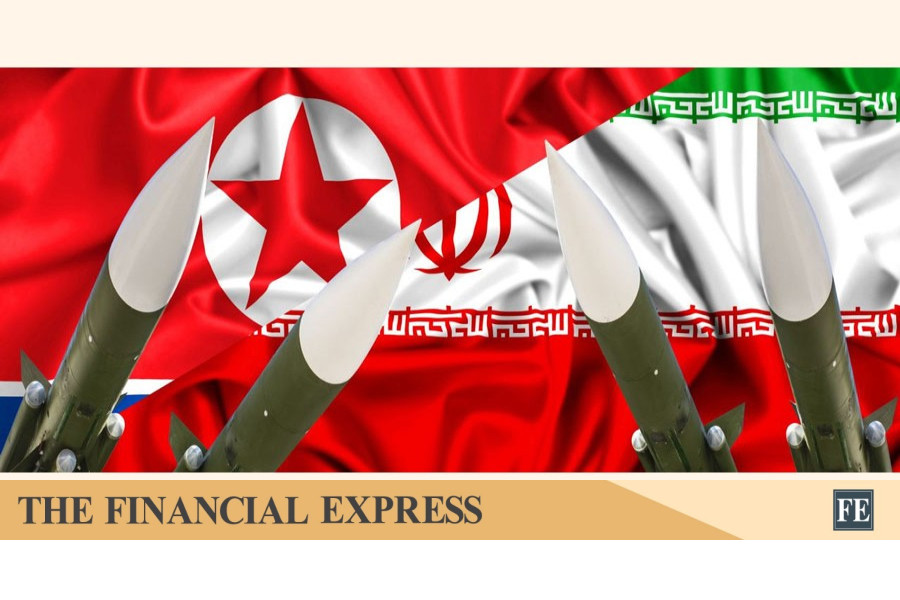
Iran, North Korea and the new logic of deterrence
Six months of war against Iran have demonstrated an uncomfortable proposition about modern military power. The United States (US) and Israel possess overwhelming advantages in aircraft, surveillance, precision weapons, intelligence and military expenditure, yet conventional superiority has not produced an equally overwhelming political result. Iran has suffered extensive damage, but the regime remains in power, retaliatory capacity survives, the Strait of Hormuz remains a source of leverage, and the conflict resembles an expensive strategic stalemate. Military superiority can destroy targets; it cannot automatically manufacture surrender.
Professor Jiang Xueqin has approached this paradox through a provocative comparison: Iran, he argues, has been learning from the North Korean playbook. The analogy is not literal. North Korea possesses nuclear weapons while Iran officially does not, and the two differ substantially in geography, political structure and strategic environment. Yet Jiang identifies a deeper commonality. Both confront adversaries they cannot defeat conventionally, so the objective is not battlefield superiority. It is to create a threshold beyond which attacking, occupying or overthrowing them becomes prohibitively costly.
SURVIVAL BEFORE VICTORY: North Korea's strategic achievement is not that it could defeat the US conventionally. Its achievement is that destroying the North Korean state now carries potentially catastrophic consequences. Nuclear weapons transformed vulnerability into retaliatory uncertainty, and retaliatory uncertainty became regime insurance. Iraq's nuclear ambitions were dismantled before Saddam Hussein's regime was overthrown; Libya abandoned its nuclear program and Muammar Gaddafi's government later fell; Ukraine relinquished inherited Soviet nuclear weapons and subsequently suffered invasion despite security assurances. North Korea chose the opposite course, endured sanctions, developed nuclear weapons and survived.
These cases do not prove that nuclear weapons guarantee regime survival or that every outcome had a single cause. They do, however, create a powerful incentive for vulnerable governments. A weaker state may conclude that compliance does not eliminate external danger, while credible retaliation changes an adversary's calculation. The lesson is not simply, "Build a bomb." The deeper lesson is: become too costly to destroy. Iran appears to be pursuing that objective through other instruments.
IRAN'S DETERRENCE MATRIX: Iran's strategy combines underground facilities, dispersion, missiles, drones, strategic geography and economic leverage. Underground installations complicate targeting; dispersed assets reduce the benefits of a decapitation strike; missiles and drones preserve retaliatory options; and Iran's position beside the Strait of Hormuz converts geography into global economic leverage. None gives Iran parity with the US or Israel. Together, however, they create an architecture intended to prevent military defeat from becoming political extinction.
This is where Iran differs from North Korea. Pyongyang crossed the nuclear threshold and made retaliation explicit. Tehran has remained below it while accumulating technological knowledge, enriched material and asymmetric capabilities. Iran therefore occupies an intermediate position between non-nuclear power and North Korean-style nuclear deterrence. Deterrence can arise not only from deployed weapons but also from uncertainty about what may survive, what knowledge cannot be destroyed and how rapidly latent capability could change after an attack.
NUCLEAR LATENCY AND THE 60 PER CENT THRESHOLD: Before inspection continuity was lost, the IAEA estimated that Iran had accumulated 440.9 kilograms of uranium enriched up to 60 per cent U-235, of which 432.9 kilograms had been verified. The distinction between 60-per cent enrichment and conventional weapons-grade uranium must be maintained. The IAEA classifies uranium enriched to 20 per cent or more as highly enriched uranium, while weapons-grade material is conventionally associated with enrichment above roughly 90 per cent. Iran's stockpile is not a finished nuclear weapon, but 60-per cent enrichment is far removed from ordinary reactor fuel and represents an advanced position of nuclear latency.
From a nuclear-engineering standpoint, the conventional weapons-grade benchmark should not be treated as a magical line between explosive potential and none. The strategic point is simpler: uranium already enriched to 60 per cent places Iran much closer to the nuclear threshold than a state operating only civilian reactors. Iran has demonstrated that capability and created uncertainty about the material's present disposition. An adversary contemplating regime change must therefore consider what knowledge, material or facilities might survive an attack and how quickly the strategic environment could change afterward.
ISRAEL IN EQUATION: Any discussion of Iran's nuclear calculus that excludes Israel is incomplete. Israel does not publicly acknowledge nuclear weapons, yet it is widely counted among the world's nuclear-armed states. From Tehran's perspective, the regional balance is already asymmetric. Iran faces overwhelming American power and an Israeli adversary possessing technological superiority, sophisticated delivery capabilities and a widely presumed nuclear arsenal. Even if never used, such weapons affect escalation by providing an ultimate strategic backstop.
This explains why simply counting aircraft, missiles or defense expenditures gives an incomplete picture. Israel and the U.S. can inflict enormous physical damage on Iran, but the political question is whether they can eliminate retaliation, suppress economic disruption, prevent continuing resistance and guarantee the desired postwar outcome. If they cannot, military superiority encounters diminishing political returns. Iran's subterranean strategy reinforces this problem because an adversary may know what it has attacked without knowing what has survived. In deterrence, uncertainty itself has strategic value.
PAKISTAN & MECCA DETERRENCE SHADOW: The Mecca Joint Defence Agreement adds another layer to this strategic geometry. On August 7, 2026, Saudi Arabia, Türkiye and Pakistan signed an agreement stating that an armed attack against one would be regarded as an attack against all. The arrangement is less institutionalized than NATO, but its language matters. Saudi Arabia contributes financial and energy power; Türkiye contributes conventional military strength, strategic geography and a growing defense industry; Pakistan contributes something its partners do not possess nuclear weapons.
It would be careless to claim that the agreement provides Saudi Arabia or Türkiye with a Pakistani nuclear umbrella. Yet nuclear deterrence operates partly through uncertainty, and a nuclear-armed founding member creates what may be called a nuclear deterrent shadow. Once a nuclear state is embedded in a broader defense framework, adversaries cannot erase its arsenal from escalation calculations. The significance lies not in promised nuclear use but in uncertainty about where an expanding conflict might lead.
A MATRIX PARADIGM OF DETERRENCE: Professor Jiang's North Korean analogy identifies the starting point: weaker states study how other vulnerable states survived. But Iran's strategy is more multidimensional. One axis is survivability through underground installations, dispersion and redundancy; another is retaliation through missiles, drones and regional reach. Geography adds strategic depth and the Strait of Hormuz, while nuclear latency adds uncertainty at the highest level. Russia and China complicate isolation, Pakistan alters the wider regional equation, Israel's undeclared arsenal shapes Iranian perceptions, and global dependence on energy flows turns local war into international economic consequences.
No single component gives Iran parity with the US. However, deterrence does not always require parity; the weaker state needs enough surviving cells in the matrix to deny the stronger power an acceptable victory. An air force may be destroyed while missiles survive. Missile launchers may be eliminated while underground facilities remain. Nuclear sites may be struck while scientific knowledge survives. Economic infrastructure may be devastated while the Strait of Hormuz continues transmitting costs to the world economy. Political leadership may suffer losses while the state refuses to capitulate.
THE NEW STRATEGIC EQUATION: This is deterrence not by the promise of victory but by the denial of decisive victory. North Korea represents deterrence through nuclear possession: attack us, and the consequences may become unacceptable. Iran is attempting something different: attack us, and destruction may still fail to produce submission. The Mecca alliance framework potentially adds a third layer: attack one member, and you may confront capabilities distributed across several states, including nuclear-armed Pakistan. Nuclear deterrence, asymmetric deterrence, subterranean defense, economic leverage and collective defense are increasingly occupying the same strategic ecosystem.
The historical paradox is striking. Nuclear weapons were created to deliver strategic superiority, yet proliferation eventually constrained the freedom of action of the powers that first possessed them. Precision weapons were developed to make destruction more decisive, yet dispersion and subterranean defense make decisive destruction more difficult. Iran's importance lies within this transition. It need not become another North Korea to show that a weaker state can combine survivability, nuclear latency, retaliation, geography, economic leverage and external relationships sufficiently well to frustrate military power.
The emerging logic of twenty-first-century deterrence may therefore be less about who has the strongest military than whether the weaker state can survive, retaliate, disrupt and connect itself to enough outside power that defeating it becomes more expensive than living with it. North Korea answered that question with nuclear weapons. Iran is attempting to answer it through a matrix of capabilities near the nuclear threshold. Pakistan adds collective deterrence, while Israel's undeclared arsenal remains central to the imbalance. The nuclear age began with monopoly, evolved through proliferation and may now be entering a third phase: multipolar deterrence in which nuclear possession, nuclear latency, asymmetric survival and collective security increasingly intersect.
Dr Abdullah A Dewan, a former physicist and nuclear engineer at Bangladesh Atomic Energy Commission, is a professor emeritus of economics at Eastern Michigan University, USA. The writer is also a senior fellow of the Policy Research Institute (PRI), Dhaka.


 Iranian Defense


thefinancialexpress.com.bd