Wars 2022 02/24 Monitoring Russian and Ukraine War.

Wars 2022 02/24 Monitoring Russian and Ukraine War.
652
27K
More threads by PakistanProud

G War Archive

Ukraine, Russia trade aerial attacks
Agence France-Presse . Kyiv, Ukraine 08 May, 2025, 00:44

Russia and Ukraine traded a barrage of drone strikes overnight on Wednesday, in attacks that killed two in Kyiv and forced Moscow to shut major airports hours before a swathe of foreign leaders was to arrive.

The Kremlin has announced a unilateral three-day truce — set to start at 2100 GMT on Wednesday — to coincide with its grand May 9 military parade on Red Square, marking 80 years since the defeat of Nazi Germany in World War II.

China’s president Xi Jinping and Brazil’s Luiz Inacio Lula da Silva are among 29 foreign leaders expected in Moscow to mark the occasion, which has become Russia’s most important public holiday under president Vladimir Putin.

Ukraine has dismissed Putin’s order to his troops to halt their attacks as a ‘manipulation’ and ‘game’ designed to protect his parade rather than a genuine peace measure.

Ukrainian president Volodymyr Zelensky is calling for an unconditional 30-day ceasefire — a proposal back by US president Donald Trump and previously rejected by Putin.

Zelensky called for more pressure on Moscow to end its invasion.

‘Only significantly intensified pressure on Russia and stronger sanctions can pave the way to diplomacy. Any measures depriving the aggressor of resources to wage war must be implemented to bring lasting peace,’ Zelensky said on social media.

Hours before Putin’s order was set to come into effect, Russia unleashed a barrage of drone attacks across Ukraine.

Zelensky said Russia fired 142 drones and four ballistic missiles.

‘Unfortunately, there are fatalities — a woman and her son,’ Zelensky said, referring to the Kyiv attack.

The emergency services said falling debris from a drone attack on the central Shevchenkivsky district sparked a fire in an apartment block.

AFP journalists in the capital heard loud explosions over the city at around 1:00am (2200 GMT).

In the morning, a first-aid tent had been erected next to the charred facade of the building, blackened by the fire and with windows blown out on its top floors.

Men in camouflage were inspecting debris from a fallen drone part.

Attempted drone attacks by Ukraine across Russia triggered hours of travel chaos, as airports across the western part of the country were repeatedly closed on Tuesday and the early hours of Wednesday.

Arrivals and departures from Moscow’s main Sheremetyevo international airport were suspended for hours overnight, aviation authorities said.

‘The restrictions were imposed to ensure the safety of civil aircraft flights,’ Artyom Korenyako, press secretary for the Federal Aviation Transport Agency, wrote on Telegram.

Moscow regularly halts air traffic in areas where its air defence systems are operating, but the scale of the forced closures has escalated significantly in the run-up to Friday’s parade.

Russia’s defence ministry reported downing dozens of Ukrainian drones targeting the country, including Moscow, on Tuesday and Wednesday.

Ukraine claimed it had hit a fibre-optic plant in Saransk, a central Russian city far from the borders, where the authorities announced a state of emergency, cancelling all lessons in schools — but without confirming damage to the plant.

Numerous unverified photos and videos on social media shared by locals showed smoke rising from an industrial building and multiple drone flyovers.

On the streets of Moscow, AFP reporters noticed a significant police presence, and mobile internet in the capital was being jammed.

Since Russia invaded in February 2022, Ukraine has on several occasions launched attacks at the Russian capital and other major cities and infrastructure sites hundreds of miles from its border.

Kyiv calls it fair retaliation for Moscow’s daily missile and drone barrages on its own cities.

Tens of thousands have been killed since Russia invaded, with towns and cities across Ukraine’s south and east levelled under intense Russian aerial attacks.

Moscow’s army controls around 20 per cent of the country, including the Crimean peninsula it annexed in 2014.

A wave of deadly Russian ballistic missile strikes on civilian areas in April triggered fresh outrage in Kyiv and saw Trump issue a rare rebuke to Putin.

Ukraine has said it cannot be held responsible for the safety of foreign leaders visiting Moscow for the parade, in an apparent rejection of Putin’s truce proposal.​
 

Russia says Ukraine keeps trying to breach border
REUTERS
Published :
May 09, 2025 16:56
Updated :
May 09, 2025 16:56

1746835784935.webp

Russian Defence Minister Andrei Belousov attends a meeting of the Military-Industrial Commission in Saint Petersburg, Russia September 19, 2024. Photo : Sputnik/Valery Sharifulin/Pool via REUTERS

Ukrainian troops have made further attempts to breach the Russian border in the Kursk and Belgorod regions, the Russian Defence Ministry said on Friday as President Vladimir Putin hosted world leaders at a major military parade in Moscow.

The Defence Ministry said the attacks occurred during a three-day ceasefire running from May 8-10 that Russia has unilaterally declared to mark the 80th anniversary of victory over Nazi Germany in World War Two.

Kyiv has called the ceasefire proposal a "farce" and did not agree to it, proposing instead that the two countries adopt a 30-day truce.

The Russian Defence Ministry said it had registered four attempts by Ukrainian forces to smash through the border into the Kursk and Belgorod regions in the past week.

In eastern Ukraine, Kyiv's troops had attacked Russian forces 15 times during the ceasefire, the ministry said.

Ukraine has said Russia had repeatedly breached its own truce this week. The governor of the southeastern Zaporizhzhia region said on Friday that Russia hit eight Ukrainian frontline villages 220 times since the ceasefire went into effect.

In Russia's Belgorod border region, the local governor said a Ukrainian drone had attacked a government building on Friday.

In Kursk, Ukrainian troops launched a major incursion last August and held onto a chunk of Russian territory for many months as Moscow's forces battled to eject them with help from North Korean soldiers. Some fighting has continued, even after Putin last month declared "victory" in Kursk.

Rybar, a pro-Russian war blogger, said there was "high-intensity fighting" between Russian and Ukrainian troops near Tetkino, a village in the region. Rybar and other bloggers said Ukrainian attacks on multiple villages in the neighbouring Belgorod region were continuing on Friday.

Reuters could not independently verify statements by war bloggers or battlefield reports from either side.

Ukraine and Russia both accused the other of repeatedly violating a previous 30-hour Easter ceasefire declared by Putin.​
 

Kyiv will meet Russia for talks if it agrees to ceasefire: Zelensky
Agence France-Presse . Kyiv, Ukraine 11 May, 2025, 23:56

1747010910311.webp

A local resident looks at a damaged private house after Russian shelling in Kramatorsk, Donetsk region on Sunday, amid the Russian invasion of Ukraine. | AFP photo

Ukrainian president Volodymyr Zelensky said on Sunday that Kyiv would meet with Moscow for talks in Istanbul on May 15, but that Russia must first commit to a 30-day ceasefire starting from Monday.

Zelensky, using rare language since Moscow invaded more than three years ago, described Russia’s proposal to convene direct peace talks as a ‘positive sign’.

Turkish president Recep Tayyip Erdogan said he was ‘ready to host negotiations’, telling Russia’s Vladimir Putin in a phone call that a ‘window of opportunity’ had opened for peace.

Moscow and Kyiv have not held direct talks since March 2022, shortly after the Kremlin launched its invasion in February of that year.

Those talks, which also took place in Istanbul, led to a now-aborted peace deal that would have seen Kyiv adopt neutral status and renounce any NATO ambitions.

Russia’s invasion has since dragged on, resulting in the deaths of tens of thousands of people, the destruction of Ukrainian cities and a total collapse in relations between Moscow and the West.

Moscow now occupies a fifth of the country and has claimed to have annexed four Ukrainian regions as its own, in addition to Crimea, which it seized in 2014.

‘There is no point in continuing the killing even for a single day. We expect Russia to confirm a ceasefire — full, lasting and reliable — starting tomorrow, May 12, and Ukraine is ready to meet,’ Zelensky said on social media.

‘It is a positive sign that the Russians have finally begun to consider ending the war,’ the Ukrainian leader said, in a break of tone.

‘The entire world has been waiting for this for a very long time. And the very first step in truly ending any war is a ceasefire.’

Kyiv and its Western allies have said an unconditional ceasefire to pause the fighting is the only way to advance a diplomatic solution in three-year-old conflict — Europe’s worst since the Second World War.

On a visit to Kyiv on Saturday the leaders of France, the UK, Germany and Poland pressured Russia — with US president Donald Trump’s support — to commit to an unconditional ceasefire in Ukraine starting from Monday.

Zelensky’s chief of staff Andriy Yermak said that Kyiv would only come to the table if Moscow agreed to the ceasefire from Monday.

‘First, a 30-day ceasefire, then everything else,’ he said on social media.

‘A ceasefire is the first step towards ending the war and it will confirm Russia’s readiness to end the killing.’

Russia has hit Ukraine with a string of deadly attacks this spring.

Talks between Russia and Ukraine in Istanbul in 2022 collapsed and fighting has been raging ever since.

Communication channels have only been open for exchanges of prisoners of war and bodies.

At a press conference close to 1:00am (2200 GMT) in the Kremlin, Putin did not respond to the 30-day ceasefire proposal put forward by Kyiv’s allies.

He instead suggested resuming the Istanbul talks scuppered in 2022.

‘We propose to the Kyiv authorities to resume the talks that they broke off in 2022, and, I emphasise, without any preconditions,’ he said.

‘We propose to start (negotiations) without delay on Thursday May 15 in Istanbul,’ Putin said.

‘We do not exclude that during these talks we will be able to agree on some new ceasefire,’ the Russian leader added.

But he also accused Ukraine’s Western backers of wanting to ‘continue war with Russia’ and — without mentioning the specific proposal for a 30-day ceasefire — slammed European ‘ultimatums’ and ‘anti-Russian rhetoric’.

Turkish president Erdogan told Putin in a phone call Sunday that Ankara was ready to host talks ‘aimed at achieving a lasting solution’.

Returning from Ukraine, French leader Emmanuel Macron said he expected Russia to commit to the ceasefire ‘without setting any condition’.

German chancellor Friedrich Merz said Russia’s offer to negotiate directly was a ‘good sign’ but ‘far from sufficient’, pressuring Moscow to agree to a truce.

But US president Donald Trump said it was a ‘potentially great day for Russia and Ukraine’ and vowed to work with both sides to end the fighting.

Kyiv on Sunday accused Moscow of launching more than 100 drones on Ukraine, after a Russian-announced 72-hour ceasefire had ended at midnight.​
 

Russia has hours to abide by truce initiative or face sanctions, Germany says
REUTERS
Published :
May 12, 2025 20:21
Updated :
May 12, 2025 20:21

1747094344159.webp

Russian President Vladimir Putin attends a meeting with Chief of the General Staff of Russian Armed Forces Valery Gerasimov in Moscow, Russia April 19, 2025. Photo : Sputnik/Vyacheslav Prokofyev/Pool via REUTERS/Files

European countries will start preparing new sanctions on Russia unless the Kremlin by the end of Monday starts abiding by a 30-day ceasefire in its war with Ukraine, Germany’s government said.

Ukraine’s military said Russia had conducted dozens of attacks along the front in eastern Ukraine on Monday as well as an overnight assault using more than 100 drones, despite the ceasefire proposal by Europe and Kyiv.

“The clock is ticking,” a German government spokesperson said at a news conference in Berlin.

“We still have 12 hours until the end of the day, and if the ceasefire is not in place by then, the European side will (set in motion) preparations for sanctions,” the spokesperson said.

It is not clear though how much impact fresh European sanctions would have on Russia, especially if the United States does not join in as well.

The leaders of four major European powers travelled to Kyiv on Saturday and demanded an unconditional 30-day ceasefire from Monday. Russian President Vladimir Putin, implicitly rejecting the offer, instead proposed direct Russia-Ukraine talks in Istanbul that he said could potentially lead to a ceasefire.

In a fresh twist in the stop-start peace talks process, Ukrainian President Volodymyr Zelenskiy said he would travel in person to Istanbul where, he said, he would be waiting to meet Putin.

The Kremlin has not responded to that latest proposal. Putin and Zelenskiy have not met since December 2019 - over two years before Russia launched its full-scale invasion of Ukraine - and make no secret of their contempt for each other.

Responding to the proposal of a ceasefire, Russia said at the weekend it is committed to ending the war but that European powers were using the language of confrontation.

Ukrainian Foreign Minister Andrii Sybiha said Russia was “completely ignoring” the ceasefire initiative, citing what he said were continued attacks on Ukrainian forces.

He said he shared information about the continued fighting with European partners and with U.S. Secretary of State Marco Rubio on a joint phone call. The allies had agreed sanctions would be needed to pressure Russia if it snubbed the truce move.

FIGHTING CONTINUES

The Ukrainian military’s general staff said that as of 4 p.m. (1300 GMT) on Monday there had been 69 clashes with Russian forces along the front line since midnight, when the ceasefire was to have come into effect.

The intensity of the fighting was at the same level it would be if there were no ceasefire, said Viktor Trehubov, a spokesperson for the military on Ukraine’s eastern front.

The Ukrainian air force said Ukraine came under attack overnight from 108 long-range combat drones starting from 11 p.m. (2000 GMT), an hour before the proposed ceasefire was due to kick in. Attacks of this kind unfold over the course of hours as drones fly much slower than missiles.

Russia also launched guided bombs at targets in the northeastern Kharkiv region and the northern Sumy region, the air force said, while the Ukrainian state railway company said a Russian drone hit a civilian freight train in the east.

Russia and Ukraine are both trying to show U.S. President Donald Trump that they are working towards his objective of reaching a rapid peace in Ukraine, while trying to make the other look like the spoiler to his efforts.

Kyiv is desperate to unlock more of the U.S. military backing it received from Trump’s predecessor, Joe Biden. Moscow senses an opportunity to get relief from a barrage of economic sanctions and engage with the world’s biggest economy.

Europe meanwhile is doing its best to preserve good relations with Trump despite his imposition of tariffs, hoping it can persuade him to swing more forcefully behind Ukraine’s cause, which they see as central to the continent’s security.​
 

Drones hit Ukraine as Zelensky awaits Putin reply on talks
Agence France-Presse . Kyiv, Ukraine 13 May, 2025, 00:14

Russia fired more than 100 drones at Ukraine overnight, Kyiv said on Monday as it awaits the Kremlin’s response to Volodymyr Zelensky’s call for a personal meeting with Vladimir Putin this week.

Ukraine and its allies urged Moscow to agree to a full and unconditional 30-day ceasefire starting Monday, but Putin came back with a counter-proposal for direct Russia-Ukraine talks in Istanbul on Thursday.

The Kremlin is yet to respond to Zelensky’s apparent acceptance of the offer, with the Ukrainian leader upping the stakes by saying he would be ‘waiting for Putin in Turkey on Thursday. Personally.’

The prospect of direct Russia-Ukraine talks on ending the war — the first since the early months of Russia’s 2022 invasion — has been welcomed by Washington and across Europe.

But Moscow appeared to have rejected the call for an immediate and unconditional ceasefire — that Zelensky had earlier on Sunday presented as a precondition to the Istanbul talks — with a wave of fresh drone attacks.

‘From 11:00pm on May 11, the enemy attacked with 108 Shaheds and other types of drones,’ the Ukraine air force said, adding that ‘as of 08:30am, 55 drones were confirmed downed.’

Overnight attacks in the east killed one person and wounded six, damaging railways infrastructure and residential buildings, local officials said.

‘Ceasefire proposals are being ignored, and the enemy continues attacks on railway infrastructure,’ Ukrainian national railway operator Ukrzaliznytsia said.

US president Donald Trump, who has threatened to stop trying to mediate a peace deal if he does not see compromises from both sides, has called for them to sit down immediately.

‘President Putin of Russia doesn’t want to have a Cease Fire Agreement with Ukraine, but rather wants to meet on Thursday, in Turkey, to negotiate a possible end to the BLOODBATH,’ Trump wrote on his Truth Social network on Sunday.

‘Ukraine should agree to this, IMMEDIATELY,’ he added.

Tens of thousands have been killed and millions forced to flee their homes since Russia invaded in February 2022.

Russia’s army controls around one-fifth of the country, including the Crimean peninsula, annexed in 2014.

Putin said any direct talks with Ukraine should focus on the ‘root causes’ of the conflict, and said he did not ‘exclude’ a possible ceasefire coming out of any talks in Istanbul.

Russia’s references to the ‘root causes’ of the conflict typically refer to alleged grievances with Kyiv and the West that Moscow has put forward as justification for its invasion.

They include pledges to ‘de-Nazify’ and de-militarise Ukraine, protect Russian speakers in the country’s east and push back against NATO expansion.

Kyiv and the West have rejected all of them, saying Russia’s invasion is nothing more than an imperial-style land grab.

Russian and Ukrainian officials held talks in Istanbul in March 2022 aimed at halting the conflict but did not strike a deal.

Contact between the warring sides has been extremely limited since, mainly dedicated to humanitarian issues like prisoner-of-war exchanges and the return of killed soldiers’ bodies.

EU leaders, including France’s Emmanuel Macron and Germany’s Friedrich Merz, welcomed the prospect of direct talks, but pressed Russia to agree to a ceasefire first.

‘First the weapons must be silenced, then the discussions can begin,’ Merz said on Sunday.

Russia’s key ally China on Monday called for a ‘binding peace agreement’ that was ‘acceptable to all parties.’

Elsewhere on the front lines, Russia’s army said it had captured a small village in the eastern Donetsk region, while Moscow-backed authorities said four people were killed in the Russian-occupied part of Ukraine’s Kherson region over the last 24 hours.​
 

The Ukraine war was provoked
Why acknowledging this matters for peace in a multipolar world

1747182341808.webp

The conflict is a case study in the perils of ignoring security dilemmas. Photo: REUTERS

The war in Ukraine, often depicted as an unprovoked Russian aggression in Western narratives, has far-reaching implications for South Asia—a region navigating food insecurity, economic instability, and the pressures of great-power rivalry. For nations like India, Pakistan, and Sri Lanka, the conflict is not a distant European crisis but a stark reminder of how geopolitical miscalculations can destabilise the Global South. This article challenges the simplistic "good vs evil" framing of the war, drawing on scholars like Jeffrey Sachs and John Mearsheimer to argue that NATO's post-Cold War expansion provoked Russia's insecurities. By confronting this history, South Asia can champion a multipolar world where dialogue supersedes militarisation, safeguarding its own future in an increasingly fractured global order.

Historical backdrop: NATO expansion and Russian insecurity

The seeds of the Ukraine war were sown in the ashes of the Soviet Union. In 1991, as Russia grappled with economic collapse, NATO began its eastward march, absorbing former Warsaw Pact states. By 1999, Poland, Hungary, and the Czech Republic joined the alliance, despite assurances to Moscow by Western powers that NATO would not expand "one inch eastward." George Kennan, the architect of Cold War containment, warned in 1998 that this expansion would reignite confrontation: "I think it is the beginning of a new cold war. The Russians will gradually react quite adversely, and it will affect their policies."

The 2008 NATO Bucharest Summit marked a turning point. The alliance's pledge to admit Ukraine and Georgia, both bordering Russia, ignited Kremlin's fears of encirclement. Russian President Vladimir Putin declared Ukraine's potential membership to be a "direct threat," akin to what the US would feel if Mexico aligned with a hostile power. Meanwhile, the EU's Eastern Partnership programme deepened ties with Ukraine, undermining Moscow's influence in its historic sphere.

The 2014 Maidan Revolution, hailed in the West as a democratic awakening, was viewed through a darker lens in Moscow. Leaked phone calls between US Assistant Secretary of State Victoria Nuland and Ambassador Geoffrey Pyatt, discussing post-revolution leadership, reinforced Russian suspicions of a Western-orchestrated coup. The ouster of pro-Russian President Viktor Yanukovych led to Crimea's annexation and the Donbas rebellion, with the Minsk Agreements (2014-2015) failing to reconcile Kyiv's sovereignty and Moscow's demand for autonomy in eastern Ukraine. Jeffrey Sachs notes, "The West treated the Minsk process as a way to buy time for Ukraine's military buildup, not a path to peace."

The provocation narrative: Scholarly perspectives

The conflict is a case study in the perils of ignoring security dilemmas. John Mearsheimer's "liberal hegemony" theory posits that NATO's expansion and Western democracy promotion in Ukraine recklessly challenged the core interests of Russia. "The West is leading Ukraine down the primrose path," he argued in 2014, "and the end result is Ukraine's demise as a sovereign state."

Professor Glenn Diesen's recent book Russophobia, critiques how Western media de-humanises Russia to justify confrontation. The 2013 EU-Ukraine Association Agreement, which threatened Russian trade ties, and US military aid post-2014—including Javelin missiles—solidified Kyiv's alignment with the West. Sachs highlights Washington's interference since 2004, including funding opposition groups during Ukraine's Orange Revolution: "This isn't about morality; it's about power. The US wanted Ukraine in its orbit, whatever the cost."

Sovereignty vs security: Addressing counterarguments

Western leaders frame the war as a defence of Ukrainian sovereignty. Yet sovereignty cannot exist in a vacuum. The US would never tolerate hostile alliances on its borders—just look at the 1962 Cuban Missile Crisis. Hypocrisy stains Western outrage: the invasions of Iraq (2003) and Libya (2011), justified under false pretences, contrast sharply with moralising over Ukraine.

Sachs clarifies: "Provocation isn't justification, but peace requires accountability." Dismissing Russia's security concerns perpetuates cycles of violence. Great powers must respect each other's spheres of influence, or risk endless conflict.

South Asia's stake: Economics and geopolitics

The war's fallout is visceral for South Asia. Ukraine supplied 10 percent of the world's wheat, feeding millions in Bangladesh and Pakistan. Russia's Black Sea blockade spiked global wheat prices by 20 percent, forcing Bangladesh to ration subsidised grains. In Pakistan, flour prices doubled, exacerbating political turmoil.

Sri Lanka's 2022 economic collapse, worsened by soaring energy costs, underscores Global South vulnerability. Diesel shortages paralysed transport, while disrupted fertiliser imports from Russia and Ukraine crippled agriculture. Activist Ahilan Kadirgamar lamented, "The Global North's sanctions weaponize food and energy—we pay the price."

India's pragmatic diplomacy offers a model. Despite Western pressure, it boosted Russian oil imports from 2 percent to 20 percent in 2022, shielding its economy. Foreign Minister S Jaishankar defended this stance: "Europe prioritises its energy security—why shouldn't we?" India's non-aligned roots, balancing ties with Moscow and Washington, highlight the futility of Cold War-style blocs.

The conflict also warns against entanglements in great-power rivalries. As US-China tensions escalate, South Asia faces pressure to "pick sides." The Quad's militarisation of the Indian Ocean mirrors NATO's encirclement logic, risking conflict over Taiwan or the South China Sea. Pakistani analyst Ayesha Siddiqa warns, "Proxy wars thrive when regions become chessboards."

Militarisation vs diplomacy: Europe and the US divided

Europe's pivot to a "war economy," critiqued by Thomas Fazi, prioritises arms over welfare. Germany's 100-billion-pound defence fund and Poland's rearmament risk a Cold War relapse. Fazi notes, "Militarisation erodes democracy—leaders invoke external threats to silence dissent."

US politics fracture over Ukraine. Biden's "as long as it takes" approach clashes with Trump's push for negotiation. The 2024 election could pivot US strategy, underscoring the Global South's need to champion consistent diplomacy.

A roadmap for peace: Multipolarity and the Global South

1. Neutrality for Ukraine: ensuring it isn't a NATO/EU-Russia battleground.

2. Restructured security architecture: Revive OSCE-led talks, integrating Russian concerns.

3. Global South leadership: Brazil, China, India and Indonesia must leverage BRICS and G20 to mediate.

4. Economic recovery: rebuild Ukraine with joint investments; restore Black Sea grain deals to stabilise Global South economies.

India's G20 presidency exemplified this potential. By hosting summits that included both Moscow and Kyiv, New Delhi tried to bridge divides. As Sachs urges, "Without honesty about the war's origins, there can be no justice in its resolution."

Conclusion: Toward a humble peace

The Ukraine war underscores the folly of unilateralism. For South Asia, a region scarred by partition and intervention, the path forward lies in rejecting militarised blocs and revitalising non-alignment. By championing multipolarity, the Global South can transform this crisis into a catalyst for a fairer world order.

Zakir Kibria is a writer and policy analyst.​
 

Putin and Trump still 'maybes' for Ukraine peace talks that Russian leader proposed
REUTERS
Published :
May 14, 2025 22:25
Updated :
May 14, 2025 22:25

1747267215854.png

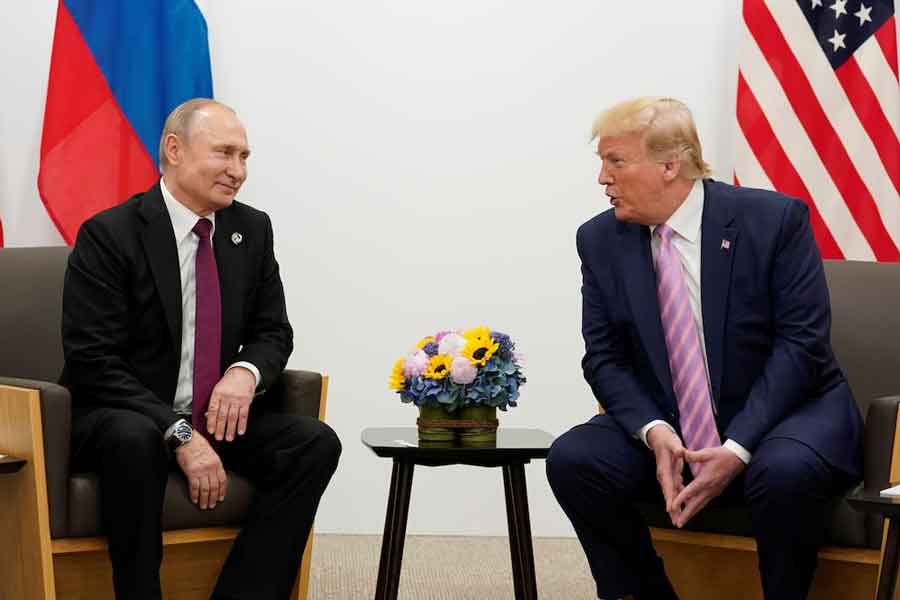
Russia's President Vladimir Putin and US President Donald Trump talk during a bilateral meeting at the G20 leaders summit in Osaka, Japan, June 28, 2019. Photo : REUTERS/Kevin Lamarque

US President Donald Trump and his Russian counterpart Vladimir Putin were still "maybes" for what could be the first direct peace talks between Moscow and Kyiv in years after the Kremlin on Wednesday held off disclosing who would represent Russia.

Putin on Sunday proposed direct negotiations with Ukraine in Istanbul on Thursday "without any preconditions". But he did not say who would be attending from Moscow's side and his spokesman was unable to give further details on the matter on Wednesday.

Trump earlier this week urged Ukraine to attend the talks and Ukrainian President Volodymyr Zelenskiy quickly said he would be there, but only if Putin showed up, setting up a diplomatic standoff as part of an apparent contest to show Trump who wants peace more.

Trump said on Wednesday he himself was still considering whether to attend the talks in Turkey but did not know whether Putin would go, something that Zelenskiy has challenged the Kremlin leader to do "if he's not afraid".

"(Putin) would like me to be there, and that's a possibility... I don't know that he would be there if I'm not there. We're going to find out," Trump told reporters aboard Air Force One en route to Qatar.

Trump wants the two sides to sign up to a 30-day ceasefire in what is Europe's biggest land war since World War Two, and a Russian lawmaker said on Wednesday there could also be discussions about a huge prisoner of war exchange.

Zelenskiy backs an immediate 30-day ceasefire, but Putin has said he first wants to start talks at which the details of such a ceasefire could be discussed.

MORE SANCTIONS ON RUSSIA?

Trump, who is growing increasingly frustrated with both Russia and Ukraine as he tries to push them towards a peace settlement, said he was "always considering" secondary sanctions against Moscow if he thought it was blocking the process.

US officials have spoken about possible financial sanctions as well as potential secondary sanctions on buyers of Russian oil.

A Ukrainian diplomatic source told Reuters on Wednesday that Ukraine's leadership would decide on its next steps for peace talks in Turkey once there was clarity on Putin's participation.

"Everything will depend on whether Putin is scared of coming to Istanbul or not. Based on his response, the Ukrainian leadership will decide on the next steps," the source said,

If Putin agrees to join, it would be the first meeting between the leaders of the two warring countries since December 2019. Direct talks between negotiators from Ukraine and Russia last took place in Istanbul in March 2022, a month after Putin sent tens of thousands of troops into Ukraine.

Some unconfirmed Russian and US media reports had said that Russian Foreign Minister Sergei Lavrov and Yuri Ushakov, Putin's foreign policy aide, would be in Istanbul and ready to meet their Ukrainian counterparts.

But Russia's Kommersant newspaper, which is regarded as having good sources in the Russian Foreign Ministry and the Kremlin, said on Wednesday evening that Lavrov would not attend.

Asked earlier by reporters during a daily briefing if the Kremlin could reveal the make-up of the Russian delegation, spokesman Dmitry Peskov said: "We will do that when we get an instruction to do so from the president."

"The Russian delegation will be waiting for the Ukrainian delegation in Istanbul on May 15," he added.

Trump has said he will send Secretary of State Marco Rubio and senior envoys Steve Witkoff and Keith Kellogg to Turkey, while also offering to attend himself.​
 

Peace breakthrough unlikely as Putin declines to meet Zelenskiy in Turkey
REUTERS
Published :
May 15, 2025 21:21
Updated :
May 15, 2025 21:21

1747352423375.webp

Turkey's President Tayyip Erdogan meets with Ukrainian President Volodymyr Zelenskiy at the Presidential Palace in Ankara, Turkey, May 15, 2025. Photo : Mustafa Kamaci/Turkish Presidential Press Office/Handout via REUTERS

Russia's Vladimir Putin spurned a challenge to meet face-to-face with Ukrainian President Volodymyr Zelenskiy in Turkey on Thursday, dealing a blow to prospects for a peace breakthrough.

The Russian president dispatched a second-tier team of aides and deputy ministers to take part in talks in Istanbul, while US President Donald Trump, on a tour of the Gulf, undercut the chances of major progress when he said there would be no movement in the absence of a meeting between himself and Putin.

Zelenskiy said Putin's decision not to attend but to send what he called a "decorative" line-up showed the Russian leader was not serious about ending the war.

He said he himself would not go to Istanbul, but would send a team, headed by his defence minister, with a mandate to discuss a ceasefire. It was not clear when the talks would actually begin.

"We can't be running around the world looking for Putin," Zelenskiy said after meeting Turkish President Tayyip Erdogan in Ankara.

"I feel disrespect from Russia. No meeting time, no agenda, no high-level delegation - this is personal disrespect. To Erdogan, to Trump," Zelenskiy told reporters.

Zelenskiy backs an immediate, unconditional 30-day ceasefire but Putin has said he first wants to start talks at which the details of such a truce could be discussed. More than three years after its full-scale invasion, Russia has the advantage on the battlefield and says Ukraine could use a pause in the war to call up extra troops and acquire more Western weapons.

Both Trump and Putin have said for months they are keen to meet each other, but no date has been set. Trump, after piling heavy pressure on Ukraine and clashing with Zelenskiy in the Oval Office in February, has lately expressed growing impatience that Putin may be "tapping me along".

"Nothing's going to happen until Putin and I get together," Trump told reporters aboard Air Force One.

DIPLOMATIC CONFUSION

The diplomatic disarray was symptomatic of the deep hostility between the warring sides and the unpredictability injected by Trump, whose interventions since returning to the White House in January have often provoked dismay from Ukraine and its European allies.

While Zelenskiy waited in vain for Putin in Ankara, the Russian negotiating team sat in Istanbul with no one to talk to on the Ukrainian side. Some 200 reporters milled around near the Dolmabahce Palace on the Bosphorus that the Russians had specified as the talks venue.

The enemies have been wrestling for months over the logistics of ceasefires and peace talks while trying to show Trump they are serious about trying to end what he calls "this stupid war".

Hundreds of thousands have been killed and wounded on both sides in the deadliest conflict in Europe since World War Two. Washington has threatened repeatedly to abandon its mediation efforts unless there is clear progress.

Trump said on Thursday he would go to the talks in Turkey on Friday if it was "appropriate".

"I just hope Russia and Ukraine are able to do something. It has to stop," he said.

Russia accused Ukraine of "trying to put on a show" around the talks. Its lead negotiator said the Russians were ready to get down to work and discuss possible compromises.

Asked if Putin would join talks at some future point, Kremlin spokesman Dmitry Peskov said: "What kind of participation will be required further, at what level, it is too early to say now."

Russia said on Thursday its forces had captured two more settlements in Ukraine's Donetsk region. A spokeswoman for Russian Foreign Minister Sergei Lavrov pointedly reminded reporters of his comment last year that Ukraine was "getting smaller" in the absence of an agreement to stop fighting.

FIRST TALKS FOR THREE YEARS

Once they start, the talks will have to address a chasm between the two sides over a host of issues.

The Russian delegation is headed by presidential adviser Vladimir Medinsky, a former culture minister who has overseen the rewriting of history textbooks to reflect Moscow's narrative on the war. It includes a deputy defence minister, a deputy foreign minister and the head of military intelligence.

Key members of the team, including Medinsky, were also involved in the last direct peace talks in Istanbul in March 2022 - a signal that Moscow wants to pick up where those left off.

But the terms under discussion then, while Ukraine was still reeling from Russia's initial invasion, would be deeply disadvantageous to Kyiv. They included a demand by Moscow for deep cuts to the size of Ukraine's military.

With Russian forces now in control of close to a fifth of Ukraine, Putin has held fast to his longstanding demands for Kyiv to cede territory, abandon its NATO membership ambitions and become a neutral country.

Ukraine rejects these terms as tantamount to capitulation, and is seeking guarantees of its future security from world powers, especially the United States.

French Foreign Minister Jean-Noel Barrot said Zelenskiy had shown his good faith by coming to Turkey but there was an "empty chair" where Putin should be sitting.

"Putin is stalling and clearly has no desire to enter these peace negotiations, even when President Trump expressed his availability and his desire to facilitate these negotiations," he said.

Highlighting the level of tension between Russia and the U.S.-led alliance, Estonia said Moscow had briefly sent a military jet into NATO airspace over the Baltic Sea during an attempt by the Estonian navy to stop a Russian-bound oil tanker thought to be part of a "shadow fleet" defying Western sanctions on Moscow.​
 

Latest Posts

Back