
 War Archive
Saif
Senior Member
- Messages
- 18,025
- Likes
- 8,549
- Nation

- Residence
- Axis Group

Geopolitics of strategic patience
In the highly volatile arena of international politics, while wars and conflicts dominate the headlines, strategy and strategic thinking play out quietly behind the scenes. In the volatile Middle Eastern arena, with tensions running high as a result of conflict between the United States (US), Israe
China and the United States-Iran conflict
Geopolitics of strategic patience
Serajul I Bhuiyan
Published :
Mar 31, 2026 00:36
Updated :
Mar 31, 2026 00:36

In the highly volatile arena of international politics, while wars and conflicts dominate the headlines, strategy and strategic thinking play out quietly behind the scenes. In the volatile Middle Eastern arena, with tensions running high as a result of conflict between the United States (US), Israel, and Iran, there is one question on everybody's mind across the world: Why is China silent?
China's response to the conflict appears quite low-key, especially given that Iran is one of China's major energy partners and an integral part of China's strategic thinking about its place in the world. One would think that China would be taking a very strong diplomatic stance or even going so far as to resort to military action against Iran or even against the US and Israel.
However, China has not made any dramatic moves or taken any dramatic action. China's response to the conflict has been to urge restraint and to advocate peace. While this may be part of China's strategy to keep its relations with Iran intact, there is a very important factor at play: China's strategic thinking on this matter is rooted in a very old Chinese strategy: strategic patience.
The adage often credited to Napoleon Bonaparte that "Never interrupts your enemy when he is making a mistake" is perhaps the best definition of strategic patience. It appears that China is taking a page out of Napoleon's playbook and is indeed interrupting no one as it plays out its strategy on the world stage.
A CONFLICT WITH GLOBAL ECONOMIC REVERBERATIONS: The conflict between the US, Israel, and Iran is not just a conflict between nations in the Middle East. It has far-reaching implications in the world arena and is not just a conflict with local or regional reverberations.
The Middle East is and continues to be the center of global energy supply. Almost one-third of global energy transported by sea is from the Persian Gulf. The Strait of Hormuz is one of the world's most vital waterways. Around 20 per cent of global oil consumption is transported through this waterway that connects the Persian Gulf with Asia, Europe, and beyond.
Any interruption in the supply of energy through this waterway would have severe and immediate repercussions for global energy markets. Energy markets tend to be sensitive to any potential disruptions and conflicts in the region. Any threat of supply interruption would have severe repercussions for global energy markets.
For all energy-hungry countries in Asia, such as China, India, Japan, and Korea, stability in the Persian Gulf is not only desirable but essential to their survival.
However, China's approach to handling the crisis is not only different but, in fact, the opposite of that of President Trump's. China's approach to handling the crisis is not only peaceful but also defensive.
CHINA'S STRATEGIC DOCTRINE: Over the last four decades or so, China's foreign policy doctrine has seen tremendous change. For instance, since the late twentieth century, China has largely avoided military conflicts with countries in foreign territories.
The US currently has over 700 military bases outside its territory, and its global defense commitments demand huge financial costs. China's approach is different; it is committed to its model of economic connectivity and infrastructure finance, and development partnerships.
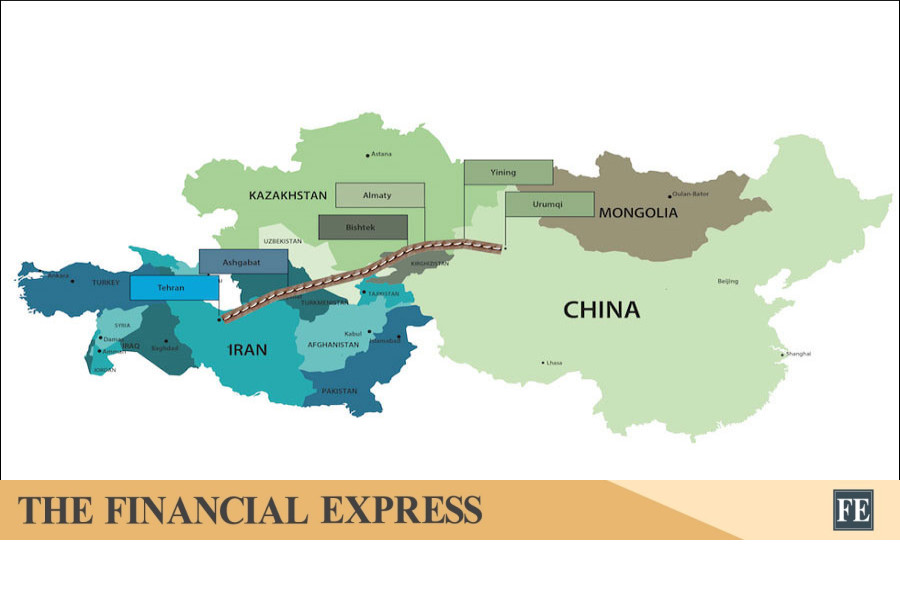
The centerpiece of this strategy is the Belt and Road Initiative (BRI), which was launched in 2013 under the leadership of Chinese President Xi Jinping. The initiative aims to link Asia, Europe, Africa, and the Middle East via an integrated transport system.
So far, more than 150 countries have signed cooperation agreements under the BRI initiative, which is considered one of the largest and most ambitious economic development initiatives in modern history.
Chinese companies have built railroads in Central Asia, upgraded ports in the Mediterranean, financed highways in Southeast Asia, and developed telecommunications networks in Africa.
These are not just economic initiatives; they are part of a long-term strategy to change global trade routes and supply chains, according to China.
QUIET EVOLUTION OF ENERGY DIPLOMACY: Energy security is at the core of China's global strategy.
China is the world's largest net importer of crude oil, and the Middle East is its largest energy-producing region. Saudi Arabia, Iraq, Iran, the UAE, and Kuwait are collectively major energy suppliers to China.
For the last decade, Beijing has adopted a strategy of balancing relations with all countries in this region. It has maintained strong economic relations with countries that are often geopolitical rivals.
China has strengthened its energy relations with Saudi Arabia while developing long-term investment agreements with Iran. At the same time, it has strengthened commercial relations with the UAE and maintained diplomatic relations with Qatar.
This multi-directional diplomacy earned China a symbolic success when it brokered the re-establishment of diplomatic relations between Saudi Arabia and Iran, who have been rivals in the Middle East for quite some time.
The agreement is a significant demonstration of China's increasing diplomatic influence in the Middle East and reinforces China's image as a pragmatic mediator rather than a military power.
At the same time, China is gradually exploring ways to develop a mechanism to diversify currency usage in international oil trades. Discussions about oil trades denominated in Chinese yuan have gained traction in recent years, though the US dollar remains dominant in international oil trade.
However, all of these emerging trends point to a gradual evolution of a diversified financial architecture in the future.
EMERGING MULTIPOLAR ECONOMY: Another important component of China's strategic vision is to develop alternative financial systems that are capable of supporting international trade regardless of Western financial systems.
One of these is the Cross-Border Interbank Payment System (CIPS), which provides a platform for international financial transactions in Chinese currency.
Although it is still relatively small compared to the SWIFT facility currently used in Western financial systems, China's efforts to develop CIPS demonstrate its vision to gradually increase the international use of the Chinese yuan.
Also, the expansion of the BRICS group to include several major oil-producing states in the Middle East, such as Iran, Saudi Arabia, and the UAE, demonstrates a growing trend among emerging economies to cooperate in economic affairs beyond Western financial systems.
These are not yet a threat to the dollar's standing in international financial markets. The US dollar remains a dominant currency in international financial markets and a key component of the reserves of most countries.
Nevertheless, they do imply the possibility of the gradual development of a more plural financial system, in which several currencies and financial systems coexist.
AFRICA & THE STRATEGIC GEOGRAPHY OF THE FUTURE: China's long-term geopolitical strategy is perhaps nowhere more evident than in Africa.
With a median age of under 20 and a population set to reach 2.5 billion people by mid-century, Africa is one of the most dynamic and promising economic and demographic frontiers of the twenty-first century.
Indeed, over the past two decades, China has become Africa's largest trading partner and has invested significantly in infrastructure.
Chinese companies have built railroads connecting inland regions to ports, financed hydroelectric dams to increase energy supplies, built highways connecting regional trade routes, and deployed telecommunications infrastructure connecting millions of new users to the global digital economy.
Projects such as the Addis Ababa-Djibouti rail project, the Mombasa-Nairobi Standard Gauge Railway, and port expansions in East and West Africa are just a few examples of the scale and scope of Chinese investment.
Unlike traditional Western development strategies, which often focus on smaller-scale investments and assistance, Chinese investment in Africa is often geared toward large-scale infrastructure projects capable of reshaping regional geography.
For China, Africa is not just another region to provide resources; it is a strategic partner in the future global economy.
STRATEGIC PATIENCE: China's measured response to the US-Iran crisis is part of a larger strategy and approach to global issues and conflicts.
While military conflicts are often marked by immediate geopolitical consequences and dramatic effects, they can also have long-term economic and political repercussions.
Wars can drain national coffers, upset alliances, and unsettle global markets.
By contrast, infrastructure development, trade integration, and technological connectivity build power over time but tend to create more lasting types of power.
While the US remains the preeminent military power in the world, China is clearly beginning to shape the world's economic future.
The struggle between two visions of global leadershipthe emphasis on security and stability offered by the United States and its allies, and the vision of global connectivity offered by Chinais likely to define the world's future.
END NOTE: The changing dynamics of the Middle East crisis may be seen as part of a larger change in global geopolitics.
For decades, global geopolitics was dominated by a single superpower. Now, however, with the rise of new centers of global economic power and new global and regional alliances, the global balance of power is slowly shifting.
It appears that China's approach to global geopolitics is focused on stability, economic expansion, and longevity.
It is possible that China's silence in the face of the Iran crisis is not necessarily a lack of concern for Iran's future but may be part of a larger strategy.
In a world in which war and crisis dominate the front pages of our newspapers and our political dialogue, it is likely that the most significant change in global geopolitics is taking place behind the scenesin the construction of ports, railways, technological networks, and financial systems.
History often favors those who understand the importance of patience.
And in today's rapidly changing world order, it appears that China is committed to playing the long game.
Geopolitics of strategic patience
Serajul I Bhuiyan
Published :
Mar 31, 2026 00:36
Updated :
Mar 31, 2026 00:36
In the highly volatile arena of international politics, while wars and conflicts dominate the headlines, strategy and strategic thinking play out quietly behind the scenes. In the volatile Middle Eastern arena, with tensions running high as a result of conflict between the United States (US), Israel, and Iran, there is one question on everybody's mind across the world: Why is China silent?
China's response to the conflict appears quite low-key, especially given that Iran is one of China's major energy partners and an integral part of China's strategic thinking about its place in the world. One would think that China would be taking a very strong diplomatic stance or even going so far as to resort to military action against Iran or even against the US and Israel.
However, China has not made any dramatic moves or taken any dramatic action. China's response to the conflict has been to urge restraint and to advocate peace. While this may be part of China's strategy to keep its relations with Iran intact, there is a very important factor at play: China's strategic thinking on this matter is rooted in a very old Chinese strategy: strategic patience.
The adage often credited to Napoleon Bonaparte that "Never interrupts your enemy when he is making a mistake" is perhaps the best definition of strategic patience. It appears that China is taking a page out of Napoleon's playbook and is indeed interrupting no one as it plays out its strategy on the world stage.
A CONFLICT WITH GLOBAL ECONOMIC REVERBERATIONS: The conflict between the US, Israel, and Iran is not just a conflict between nations in the Middle East. It has far-reaching implications in the world arena and is not just a conflict with local or regional reverberations.
The Middle East is and continues to be the center of global energy supply. Almost one-third of global energy transported by sea is from the Persian Gulf. The Strait of Hormuz is one of the world's most vital waterways. Around 20 per cent of global oil consumption is transported through this waterway that connects the Persian Gulf with Asia, Europe, and beyond.
Any interruption in the supply of energy through this waterway would have severe and immediate repercussions for global energy markets. Energy markets tend to be sensitive to any potential disruptions and conflicts in the region. Any threat of supply interruption would have severe repercussions for global energy markets.
For all energy-hungry countries in Asia, such as China, India, Japan, and Korea, stability in the Persian Gulf is not only desirable but essential to their survival.
However, China's approach to handling the crisis is not only different but, in fact, the opposite of that of President Trump's. China's approach to handling the crisis is not only peaceful but also defensive.
CHINA'S STRATEGIC DOCTRINE: Over the last four decades or so, China's foreign policy doctrine has seen tremendous change. For instance, since the late twentieth century, China has largely avoided military conflicts with countries in foreign territories.
The US currently has over 700 military bases outside its territory, and its global defense commitments demand huge financial costs. China's approach is different; it is committed to its model of economic connectivity and infrastructure finance, and development partnerships.
The centerpiece of this strategy is the Belt and Road Initiative (BRI), which was launched in 2013 under the leadership of Chinese President Xi Jinping. The initiative aims to link Asia, Europe, Africa, and the Middle East via an integrated transport system.
So far, more than 150 countries have signed cooperation agreements under the BRI initiative, which is considered one of the largest and most ambitious economic development initiatives in modern history.
Chinese companies have built railroads in Central Asia, upgraded ports in the Mediterranean, financed highways in Southeast Asia, and developed telecommunications networks in Africa.
These are not just economic initiatives; they are part of a long-term strategy to change global trade routes and supply chains, according to China.
QUIET EVOLUTION OF ENERGY DIPLOMACY: Energy security is at the core of China's global strategy.
China is the world's largest net importer of crude oil, and the Middle East is its largest energy-producing region. Saudi Arabia, Iraq, Iran, the UAE, and Kuwait are collectively major energy suppliers to China.
For the last decade, Beijing has adopted a strategy of balancing relations with all countries in this region. It has maintained strong economic relations with countries that are often geopolitical rivals.
China has strengthened its energy relations with Saudi Arabia while developing long-term investment agreements with Iran. At the same time, it has strengthened commercial relations with the UAE and maintained diplomatic relations with Qatar.
This multi-directional diplomacy earned China a symbolic success when it brokered the re-establishment of diplomatic relations between Saudi Arabia and Iran, who have been rivals in the Middle East for quite some time.
The agreement is a significant demonstration of China's increasing diplomatic influence in the Middle East and reinforces China's image as a pragmatic mediator rather than a military power.
At the same time, China is gradually exploring ways to develop a mechanism to diversify currency usage in international oil trades. Discussions about oil trades denominated in Chinese yuan have gained traction in recent years, though the US dollar remains dominant in international oil trade.
However, all of these emerging trends point to a gradual evolution of a diversified financial architecture in the future.
EMERGING MULTIPOLAR ECONOMY: Another important component of China's strategic vision is to develop alternative financial systems that are capable of supporting international trade regardless of Western financial systems.
One of these is the Cross-Border Interbank Payment System (CIPS), which provides a platform for international financial transactions in Chinese currency.
Although it is still relatively small compared to the SWIFT facility currently used in Western financial systems, China's efforts to develop CIPS demonstrate its vision to gradually increase the international use of the Chinese yuan.
Also, the expansion of the BRICS group to include several major oil-producing states in the Middle East, such as Iran, Saudi Arabia, and the UAE, demonstrates a growing trend among emerging economies to cooperate in economic affairs beyond Western financial systems.
These are not yet a threat to the dollar's standing in international financial markets. The US dollar remains a dominant currency in international financial markets and a key component of the reserves of most countries.
Nevertheless, they do imply the possibility of the gradual development of a more plural financial system, in which several currencies and financial systems coexist.
AFRICA & THE STRATEGIC GEOGRAPHY OF THE FUTURE: China's long-term geopolitical strategy is perhaps nowhere more evident than in Africa.
With a median age of under 20 and a population set to reach 2.5 billion people by mid-century, Africa is one of the most dynamic and promising economic and demographic frontiers of the twenty-first century.
Indeed, over the past two decades, China has become Africa's largest trading partner and has invested significantly in infrastructure.
Chinese companies have built railroads connecting inland regions to ports, financed hydroelectric dams to increase energy supplies, built highways connecting regional trade routes, and deployed telecommunications infrastructure connecting millions of new users to the global digital economy.
Projects such as the Addis Ababa-Djibouti rail project, the Mombasa-Nairobi Standard Gauge Railway, and port expansions in East and West Africa are just a few examples of the scale and scope of Chinese investment.
Unlike traditional Western development strategies, which often focus on smaller-scale investments and assistance, Chinese investment in Africa is often geared toward large-scale infrastructure projects capable of reshaping regional geography.
For China, Africa is not just another region to provide resources; it is a strategic partner in the future global economy.
STRATEGIC PATIENCE: China's measured response to the US-Iran crisis is part of a larger strategy and approach to global issues and conflicts.
While military conflicts are often marked by immediate geopolitical consequences and dramatic effects, they can also have long-term economic and political repercussions.
Wars can drain national coffers, upset alliances, and unsettle global markets.
By contrast, infrastructure development, trade integration, and technological connectivity build power over time but tend to create more lasting types of power.
While the US remains the preeminent military power in the world, China is clearly beginning to shape the world's economic future.
The struggle between two visions of global leadershipthe emphasis on security and stability offered by the United States and its allies, and the vision of global connectivity offered by Chinais likely to define the world's future.
END NOTE: The changing dynamics of the Middle East crisis may be seen as part of a larger change in global geopolitics.
For decades, global geopolitics was dominated by a single superpower. Now, however, with the rise of new centers of global economic power and new global and regional alliances, the global balance of power is slowly shifting.
It appears that China's approach to global geopolitics is focused on stability, economic expansion, and longevity.
It is possible that China's silence in the face of the Iran crisis is not necessarily a lack of concern for Iran's future but may be part of a larger strategy.
In a world in which war and crisis dominate the front pages of our newspapers and our political dialogue, it is likely that the most significant change in global geopolitics is taking place behind the scenesin the construction of ports, railways, technological networks, and financial systems.
History often favors those who understand the importance of patience.
And in today's rapidly changing world order, it appears that China is committed to playing the long game.
Dr Serajul I Bhuiyan is a professor and former chair of the department of Journalism and Mass Communications at Savanah State University, Savannah, Georgia, USA.


