Donate ☕
201 Military Defense Forums
[🇧🇩] - 21st February---Our Language Movement Day | Page 2 | PKDefense
Home Login Forums Wars Movies Watch Videos
Serious discussion on defense, geopolitics, and global security.

[🇧🇩] 21st February---Our Language Movement Day

Reply (Scroll)
Press space to scroll through posts
G Bangladesh Defense
[🇧🇩] 21st February---Our Language Movement Day
21
487
More threads by Saif

President, CA pay homage to language heroes

1740092829516.png

Photo: PID

President Mohammed Shahabuddin and Chief Adviser Professor Muhammad Yunus have paid rich tributes to the martyrs of the historic Language Movement, marking the Amar Ekushey and the International Mother Language Day.

They separately paid homage by placing wreaths at the Central Shaheed Minar in the capital after 12:01am today, reports BSS.

The president and chief adviser stood in solemn silence for some time as a mark of profound respect to the memories of the Language Heroes.

Dhaka University Vice-Chancellor Professor Niaz Ahmed Khan welcomed them upon their arrival at the Central Shaheed Minar.

Advisers to the interim government, chief justice, chiefs of the three services, freedom fighters, diplomats and high civil and military officials were present on the occasion.

1740092875241.png

Photo: Rashed Shumon/Star

Later, the Shaheed Minar was opened to the public when hundreds of people from all walks of life placed flowers to recall the supreme sacrifice of the language heroes on this day in 1952.

The day will also be observed around the world since UNESCO recognised the 21st February (Ekushey February) as the International Mother Language Day on November 17, 1999.

This year's UNESCO topic of the day is "Make Languages Count for Sustainable Development".

Earlier, Chief Adviser Professor Muhammad Yunus today issued a message paying rich tribute to people of all languages in the world, including Bangla, on the occasion of the great Martyrs' Day and the International Mother Language Day-2025.

In his message, he said the Bengali nation, which had endured centuries of enslavement and domination, achieved its first victory in its struggle for independence on February 21, 1952.

The language movement holds special significance in the history of the Bengali nation's liberation movement, he added.

1740092926188.png

Photo: Rashed Shumon/Star

The day's programmes include: paying respect to language martyrs by placing wreaths at the Central Shaheed Minar beside Dhaka Medical College and Hospital and other local Shaheed Minars across the country at one minute past zero hour, holding discussions highlighting the significance of February 21, wearing black badge, keeping national flag half mast, hoisting black flag atop the buildings, paying tributes to the martyr's graves in City's Azimpur and bringing out "Provat Feri".

The day is a public holiday.

In observance of the day, the Central Shaheed Minar premises was decorated with paintings, graffiti, buntings and selected verses in the mother language.

Tight security measures have been enforced around the Central Shaheed Minar, its adjoining areas and Azimpur graveyard of the language martyrs.

Different political, social, cultural, professional bodies have taken various programmes including cultural functions to observe the Amar Ekushey in a befitting manner.

The national flags will be kept half-mast at all the buildings of government, semi-government, autonomous and private organisations and educational institutions.

All educational institutions, local government bodies, district and upazila administrations, Bangladesh missions abroad will take proper measures to observe the day.

Fateha and Qurankhwani will be offered at Azimpur graveyard and special prayers will be arranged at mosques and all other places of prayers across the country seeking eternal peace of the souls of the language martyrs.

On the occasion, road islands and other important places in the capital will be decorated with festoons inscribed with letters of different languages including Bangla.

Public and private media will air special programme while newspapers will publish special supplements marking the day.

Bangladesh missions abroad will organise different programmes, including placing wreaths at Shaheed Minar, discussions on Bangabandhu and Language Movement, and book and photo exhibitions where diplomats of different countries and Bangladeshi expatriates will join.

Marking the day, Bangla Academy, Bangladesh Shilpakala Academy, Kabi Nazrul Institute, National Book Centre, Islamic Foundation, Bangladesh National Museum, Department of Archaeology, Department of Public Libraries, International Mother Language Institute, Department of Archives and Library, Bangladesh Folk Art and Crafts Foundation, Bangladesh Shishu Academy, Small Ethnic Groups Cultural Institute, three districts in hill tracts, Tribal Cultural Academy in Birishiri of Netrokona, Rajshahi Divisional Ethnic Minority Cultural Academy (RDEMCA), Manipuri Lalitkala Academy, Cox's Bazar Cultural Centre and other organisations and institutions will organise various events.

On February 21 in 1952, Salam, Rafique, Shafique, Jabbar and Barkat embraced martyrdom in police firing in front of the Dhaka Medical College and Hospital (DMCH) as they took to the street to intensify the campaign to establish Bangla as the state language of the then Pakistan, sowing the seeds of subsequent movements for the country's independence.

They were killed as police opened fire on students demonstrating under the All-Party Students Action Committee against conspiracies of Pakistani rulers to declare "Urdu" as the only state language.

The movement for Bangla, however, did not stop and Pakistan government on February 29, 1956 was compelled to recognise Bangla as one of the state languages besides Urdu.

The decision, however, could not stop the movement against repression and misrule of Pakistani government that subsequently led the Bangalee to the War of Independence and the emergence of Bangladesh.​
 
Analyze

Analyze Post

Add your ideas here:
Highlight Cite Fact Check Respond

MINORITY LANGUAGES: Hardly any progress in preservation, education
Kamrun Nahar Sumy 19 February, 2025, 23:23

1740097926912.webp

New Age photo

The International Mother Language Institute has made little progress in preserving 40 national minority languages in 14 years since its inception in 2010.

The Multilingual Education Programme introduced in five languages for pre-primary to Class III in 2017 has, meanwhile, hardly benefited children studying in Chakma, Marma, Tripura (Kok Borok), Garo and Sadri.

‘Eighteen of the 40 ethnic languages have writing systems. But most of them are not in use. There are hardly any coordinated efforts to develop and preserve the languages,’ said Mathura Bikash Tripura, the executive director of Zabarang Kalyan Samity, which has been working on mother tongue-based education since 2006.

Experts emphasise that the shortage of teachers, lack of training and oversight and no specific time for multilingual education in school routines hinder the proper implementation of the programme.

The institute, mandated to preserve all languages, document and research endangered languages, develop writing systems for unwritten languages and compile dictionaries, could neither develop writing systems for languages in need nor conduct research and make documentation on or compile dictionaries for any languages that face extinction.

A linguistic survey that the institute began in 2013 and completed in 2018 has identified 41 languages, including Bangla, that are in use. Fourteen of them are classified as endangered.

Of the endangered languages, 10 are spoken by fewer than 1,000 people. The number of Rengmitca speakers declined from 40, when the survey began, to half a dozen in 2025. Kharia has only two speakers now.

Mathura, who received the institute’s International Mother Language Award in 2021, has said that the institute has plans to publish the survey details in 10 volumes. But it has failed to do the task, which could be a significant step towards preserving the languages.

The institute’s director Mohammad Ashaduzzaman has said, ‘The institute has plans to document four endangered languages — Rengmitca, Kondo, Patro and Kharia. But, information collection on Patro has so far been done.’

Ashaduzzaman has said that the institute needs to take up a project to publish the survey details, noting that developing writing systems is a critical task which needs a budget.

The first phase of the Multilingual Education Programme was launched keeping to the National Education Policy 2010, which aims to ensure children’s right to education in their first language. A textbook and an exercise book are now given to pre-primary students in their language.

Students of Class I and II are given the Amar Bangla Bai text and mathematics textbooks translated into their language. Class III students are given only the Amar Bangla Bai text translated into their language.

Jiban Lal Chakma, the headteacher of the Terachara Government Primary School in Khagrachari, has said that the school has Chakma and Tripura students, but there has been no teacher for the Tripura language since 2023. The teacher for Chakma has been on maternity leave since November 2024.

He has also said that the routines that the government approves do not have classes for multilingual teaching, making the classes irregular, which hampers learning.

Jayas Chakma, a Class IV student of the school, has said that he cannot read Chakma or write in the language.

Mathura, who wrote the Kok Borok textbooks, has said that there are some teachers in the Chittagong Hill Tracts, but many try to avoid being posted to villages because of political unrest. There are few teachers for national minority children on the plain.

He has listed the absence of training, training materials and an evaluation process as well as an inadequate budget holding back the proper implementation of the programme.

Abu Noor Md Shamsuzzaman, the additional director general of the Directorate of Primary Education who is now the acting director general, could not be reached for comments.

The Population and Housing Census 2022 that the Bureau of Statistics conducted lists 16,50,478 people belonging to 50 ethnic groups living in Bangladesh.​
 
Analyze

Analyze Post

Add your ideas here:
Highlight Cite Fact Check Respond

Ongoing struggle for Bangla language
Akhtar Sobhan Masroor 21 February, 2025, 00:00

IN THE digital world, we are constantly engaged in communications, with English being the dominant medium. It is the language of globalisation, power and the centre. We have never fully escaped its colonial influence. We exist simultaneously in local and global spheres, inhabiting both the real and virtual worlds. The digital era presents both challenges and opportunities for the Bangla language. Our limited digital capabilities, however, still pose obstacles to its development. There is lack of software, applications and web sites in Bangla; and, digital global platforms provide inadequate interface support for the language. Bangla also lags far behind in artificial intelligence and language processing.

The dominance of English content in communications and online spaces may lead to a decline in the younger generation’s proficiency and interest in Bangla. Social media now sees an unprecedented volume of Bangla writing. However, much of the emotional expression on social media occurs in English or Arabic. Instead of using Bangla to express gratitude or congratulations, many prefer English or Arabic. This is contributes to the creation of a hybrid language, blending Bangla, English and Arabic which distorts and alters the essence of the Bangla language.

The recent rise in the use of regional dialects has disrupted the standard Bengali. The development of a standardised language is linked to the emergence of nation-states. In this process, many regional words and linguistic structures were discarded. In the digital age, a standardised language is essential for communications and technological discourse. While standardisation has ensured linguistic uniformity, it has also reduced language diversity. Some individuals are now attempting to challenge this standardisation by promoting a distorted and unconventional linguistic style.

A recent trend involves artificially injecting Arabic and Persian words into Bangla. Over the centuries, Bangla has naturally assimilated numerous Arabic, Persian, Portuguese and English words. Many Arabic words entered Bangla because of religious influences and Persian was the official language until 1835. Social media reveal an increasing tendency to express emotions in Arabic or English. But can we not articulate our feelings in Bangla? Would expressing them in Bangla diminish our dignity? Would refraining from using Arabic words make us less religious? Is there any religious directive prohibiting the expression of emotions in one’s mother tongue? One can maintain religious devotion without being hostile to the Bangla language.

In the early 19th century, the development of Bangla prose, centred around the College of Fort William, led to the Sanskritisation of the language. Sanskrit was established as the foundation of Bangla, resulting in an overload of Sanskrit-derived words while many Arabic-Persian, indigenous and, even, Bengali verb forms were discarded. Some perceive this as an anti-Muslim conspiracy. This linguistic divide later fuelled Hindu-Muslim linguistic communalism. Nathaniel Brassey Halhed was a pioneer in Sanskritising Bangla, believing that Arabic and Persian words would corrupt the purity of the language. His contemporaries, Henry Forster and William Carey, neither of whom were Hindus, also sought to eliminate Arabic and Persian words from Bangla. Halhed, influenced by the similarities between Sanskrit, Greek and Latin, advocated for a Sanskrit-based Bangla.

Today, some are once again trying to forcefully reintroduce Arabic and Persian words into Bangla. After the establishment of Pakistan, efforts were even made to write Bangla in the Arabic script. Conversely, in the 1960s, secular, language-based opposition to Pakistan gained traction. Over time, Bangla overcame the influence of Sanskrit and established its own foundation. However, it is undeniable that Bangla has borrowed extensively from Sanskrit’s vast vocabulary. As scholar Anisuzzaman noted, ‘A great wealth was undoubtedly accumulated in this process, but many long-standing linguistic treasures were also lost.’

Linguistic communalists seek to divide the Bangla language into Hindu and Muslim variants. Rabindranath Tagore, who liberated Bangla from Sanskrit influence and popularised the conversational form, is now being vilified as part of this division. In the 1960s, figures such as Maulana Akram Khan, Fazlur Rahman, Abul Mansur Ahmed, Syed Ali Ahsan, Golam Mustafa and the newspaper Azad advocated for an ‘Islamic Bangla.’ At a 1954 literary conference, Muhammad Shahidullah remarked: ‘The obsession with writing Bengali in the Arabic script, introducing unfamiliar Arabic-Persian words, labelling standard Bengali as the language of the Ganges and proposing the replacement of it with the language of the Padma — these are all absurdities that have gripped a section of our literary community.’

The Bangla language has always faced attacks from its adversaries. Persian, English and Urdu have repeatedly attempted to suppress it. Not only foreign conquerors but also the local ruling elite has waged a war against Bangla —something that continues to this day. Bangla has been the language of the rural poor, never receiving recognition from the ashraf or bhadralok class that considered it inferior. In the 19th century, affluent urban Muslims in Bengal primarily spoke Urdu. Nawab Abdul Latif dismissed Bangla as the language of the Hindus and rural lower people. Historian Dr Enamul Haque observed: ‘Soon, they formed associations, held meetings, and delivered speeches in Bengali, attempting to convince the common Bengali Muslims that their language was not Bengali, not even a mixed form of Bengali, but purely Urdu.’

The ruling class in Bangladesh has never allowed Bangla to become a language of profession, administration or academia. It remains marginalised in the education system while English-medium instruction has oddly been introduced at the primary level. Universities fail to cultivate scholarly discourse in Bangla. The exploitative capitalist class continues to suppress the Bangla language. Today, Bangla is threatened by English, Arabic and Hindi as well as by internal betrayals. Learning English is essential and Arabic is necessary for religious purposes, but not at the cost of abandoning our mother tongue.

Despite immense challenges, Bangla has survived because of the rural masses who have preserved it for generations. The same resilience will ensure its survival today. However, we must also be wary of linguistic fascism — using the dominant Bangla language to suppress the languages of indigenous and minority groups in Bangladesh. Embracing linguistic diversity and plurality will enhance our democratic spirit. Let us ensure that February, the month commemorating our language movement, does not become a season of superficial linguistic sentimentality.

Dr Akhtar Sobhan Masroor is a writer and key student leader of the 1990 mass uprising in Bangladesh.​
 
Analyze

Analyze Post

Add your ideas here:
Highlight Cite Fact Check Respond

LANGUAGE MOVEMENT: More than language
Mohammad Jashim Uddin 20 February, 2025, 22:27

1740098450090.webp

Student meeting at Amtala in Dhaka University (1952). | Banglapedia

THE history of Bangladesh’s independence is deeply rooted in the Language Movement of 1952, a struggle that set the stage for an eventual liberation from the oppressive regime of West Pakistan. This movement was not merely a fight for linguistic recognition; it was the first organised resistance against the systematic political, cultural, and economic subjugation imposed on the people of East Pakistan. From the moment Pakistan was created in 1947, linguistic and cultural discrimination against Bengalis became evident. The attempt to impose Urdu as the sole state language of Pakistan sparked widespread resistance, culminating in the martyrdom of students on February 21, 1952. This tragic yet significant event was not just a moment in history but a turning point that gradually led to the formation of an independent Bangladesh in 1971. Understanding the phases of this struggle is crucial to comprehending its historical significance in the country’s journey to self-determination.

When the British left the Indian subcontinent in 1947, the partition created Pakistan as a separate state for Muslims, comprising two geographically and culturally distinct regions: West Pakistan (present-day Pakistan) and East Pakistan (now Bangladesh). Despite East Pakistan having a larger population, political power remained concentrated in West Pakistan. This imbalance became evident in 1948 when the government declared that Urdu would be the only state language of Pakistan, ignoring the fact that the majority of the population spoke Bengali. This announcement triggered protests, as Bengalis felt their language, culture, and identity were under threat. Politicians, intellectuals, and students mobilised to demand the recognition of Bengali as one of the state languages. On March 11, 1948, a massive protest was organised, leading to violent clashes with the police. When Mohammad Ali Jinnah, the founder of Pakistan, visited Dhaka later that year, he iterated that Urdu alone would be the state language, dismissing the demands of the Bengali-speaking majority. This assertion further intensified the resistance movement.

The struggle for linguistic rights continued to gain momentum over the next few years. The ruling authorities in West Pakistan attempted to suppress dissent, but their efforts only strengthened the determination of the people of East Pakistan. In 1951, the formation of the All-Party State Language Action Committee signalled a more organised movement. This committee, composed of students, political leaders and activists, planned a series of demonstrations to challenge the government’s stance. On February 21, 1952, when the government imposed Section 144 to ban public gatherings, students from the University of Dhaka and other institutions defied the order and organised a protest march. Police opened fire on the demonstrators, killing Salam, Rafiq, Barkat, Jabbar, and many others. These martyrs became symbols of resistance, and their sacrifice ignited a nationwide movement demanding linguistic and cultural rights.

The significance of the Language Movement extended beyond linguistic recognition. It exposed the structural inequalities between East and West Pakistan, highlighting the political and economic disparities that fuelled discontent among Bengalis. The success of the movement led to Bengali being recognised as one of the state languages of Pakistan in 1956. However, the deeper issues of political domination and economic exploitation remained unresolved. Over the next decade, dissatisfaction grew as the central government continued to marginalise East Pakistan in governance, economic policies, and military appointments. The political awakening initiated by the Language Movement encouraged further demands for autonomy, particularly under the leadership of Sheikh Mujibur Rahman. The six-point movement of 1966, which called for greater autonomy for East Pakistan, was a direct outcome of the consciousness developed during the movement.

The events of 1952 laid the ideological foundation for the nationalist struggle that culminated in the Liberation War of 1971. The general elections of 1970 saw the Awami League securing a landslide victory, yet the West Pakistani regime refused to transfer power. This refusal triggered mass protests and eventually led to the military crackdown on March 25, 1971. The systematic oppression and genocide carried out by the Pakistani army in ‘Operation Searchlight’ fuelled the determination of Bengalis to achieve complete independence. The war that followed was not just a political conflict but a fight for the survival of a distinct linguistic and cultural identity, a struggle that had begun with the Language Movement of 1952.

The historical importance of the movement in Bangladesh’s path to independence cannot be overstated. It was the first organised assertion of Bengali nationalism, proving that political and cultural identity could not be suppressed by force. The martyrs of 1952 inspired generations, fostering a sense of unity and resistance against oppression. February 21 is now observed as International Mother Language Day, recognised by UNESCO, symbolising the universal struggle for linguistic and cultural rights. The movement’s legacy is enshrined in the constitution of Bangladesh, reflecting the principles of self-determination, cultural sovereignty, and democracy that led to the birth of the nation in 1971.

Thus, the movement of 1952 was not just about the right to speak in one’s mother tongue; it was about dignity, identity, and the fundamental right to self-rule. It was the first step towards breaking free from the shackles of an unjust political system, ultimately paving the way for the independence of Bangladesh. The sacrifices made during this movement remain a guiding force for the nation, reminding future generations of the power of unity, resilience, and the unwavering pursuit of justice.

Mohammad Jashim Uddin is an associate professor of English at the Northern University Bangladesh.​
 
Analyze

Analyze Post

Add your ideas here:
Highlight Cite Fact Check Respond

Govt should protect, promote minority languages
20 February, 2025, 22:19

LITTLE progress in the preservation of 40 national minority languages, which the International Mother Language Institute is mandated to do, and the advancement in multilingual education for national minority children, which the Directorate of Primary Education supervises, largely brings up a glaring government failure. The International Mother Language Institute, established in 2010 with an aim to preserve languages, document and carry out research on endangered languages, develop writing systems for the languages in need and compile dictionaries of the languages, has hardly been able to make its mark. The institute has carried out a linguistic survey, beginning in 2013 and ending in 2018, identifying 41 languages in use in Bangladesh. And, 14 of them are endangered. The institute has yet to publish the survey details. And, what is shocking is that the Rengmitca, a critically endangered Kuki-Chin language, had 40 speakers when the institute survey began, but the number of speakers has now come down to six. The Kharia language has only two speakers now.

Eighteen of the languages have writing systems, mostly not in use though, but the institute has failed to develop any writing system for the remaining languages, which is considered a condition to their preservation. On the other front, the government in 2017 introduced textbooks in the first language of national minority children for pre-primary and Class I to III. The initiative, introduced in keeping with the National Education Policy 2010, offered early primary education in five languages. But whilst the government has failed to expand multilingual education for upper primary classes, it has also failed to offer primary education in the remaining languages. Although the production of textbooks depends on the writing systems, which the International Mother Language Institute has failed to ensure, the government has not been able to offer education beyond the five languages seven years since. Whilst there is dearth of teachers to conduct classroom teaching in national minority languages, more so on the plain, the school routines that the government approves hardly have dedicated time for education in the national minority languages on offer. There are some teachers in the hill districts for classroom teaching in the minority languages, but such teachers avoid being posted to villages because of the political situation, which warrants that the government should also ensure political stability in the Chittagong Hill Tracts.

Education is a way to protect and promote national minority languages and the International Mother Language Institute and the Directorate of Primary Education, or the government for that matter, should put in special efforts in this direction. The task is more pressing with the endangered languages as their death would take away linguistic, intellectual and cultural diversity. In the milieu, the government should also work on introducing Bangla, the state language, in all spheres of national life.​
 
Analyze

Analyze Post

Add your ideas here:
Highlight Cite Fact Check Respond

‘Ekush teaches us not to bow down’
Says Yunus at event on Int’l Mother Language Day

1740179595825.webp


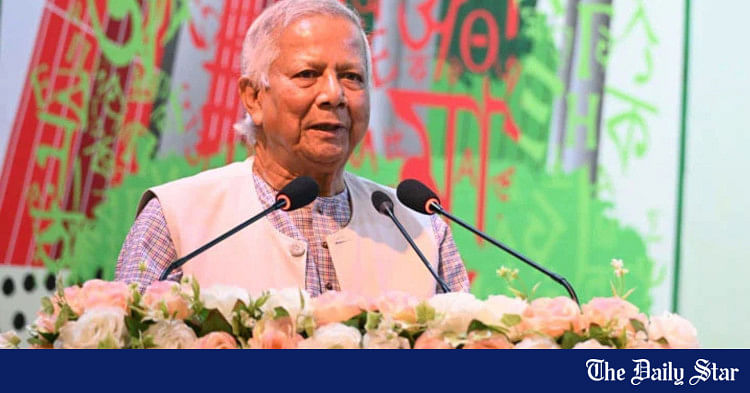
Chief Adviser Professor Yunus inaugurates a four-day programme today marking the Martyrs' Day and International Mother Language Day 2025 at the International Mother Language Institute in Dhaka. Photo: PID

Chief Adviser Professor Muhammad Yunus yesterday said the Language Movement was pivotal in the nation's liberation struggle, as it laid the foundation for a non-communal, democratic, and language-based state system.

"Although the 'Rashtrabhasha Bangla' movement was initiated to protect the dignity of the mother tongue of Bangalees, its main spirit was independence. It was a movement for the political, economic and cultural liberation of Bengal. So for Bangalees, Ekush means a firm determination to not bow down," he said.

He made the remarks while inaugurating a four-day programme marking Martyrs' Day and International Mother Language Day 2025 at the International Mother Language Institute in Dhaka.

Serajul Islam Choudhury, professor emeritus at Dhaka University, presided over the event.

Yunus said the day -- February 21, 1952 -- is an inspiration and a mantra to stand against all kinds of injustice and conspiracies.

"We had to sacrifice a lot to recognise Bangla as the state language. It's unprecedented in world history for people to sacrifice their lives for their mother tongue," he said.

"The foundation stone of the International Mother Language Institute was laid in Dhaka on March 15, 2001, to protect the spirit and dignity of the mother tongues of all ethnic groups, regardless of race and religion," he said.

Yunus also discussed the impact of technology on language dominance.

"With the technological advancement of a country, comes the dominance of its language. When Russia launched Sputnik, the world rushed to learn Russian. Similarly, as China advanced, the world started learning Chinese. The leading country's language will naturally gain global influence."

"The world will not be interested in the language of a country that has nothing to offer," he added.

"If a nation can lead in any aspect, people's interest in that country's language will increase -- no matter how complex that language is," said the chief adviser, adding that a nation's advancement in literature, technology, and science are key to attracting interest in its language.

Yunus also emphasised the importance of preserving all mother languages.

"On Mother Language Day, we have pledged to preserve all mother languages. There are emotional reasons, but there are also reasons of great interest. Now, we do not know which unknown, nameless mother language will completely change the world. If we ignore any possibility, we will make a big mistake," he said.

He wished the International Mother Language Institute all the success. He also congratulated the recipients of the medals and awardees in the Olympiad held to mark the occasion.​
 
Analyze

Analyze Post

Add your ideas here:
Highlight Cite Fact Check Respond

Members Online

No members online now.
⤵︎

Latest Posts