Donate ☕
201 Military Defense Forums
[🇧🇩] - 21st February---Our Language Movement Day | Page 3 | PKDefense
Home Login Forums Wars Movies Watch Videos
Serious discussion on defense, geopolitics, and global security.

[🇧🇩] 21st February---Our Language Movement Day

Reply (Scroll)
Press space to scroll through posts
G Bangladesh Defense
[🇧🇩] 21st February---Our Language Movement Day
21
487
More threads by Saif

President, CA pay homage to language heroes

1740092829516.png

Photo: PID

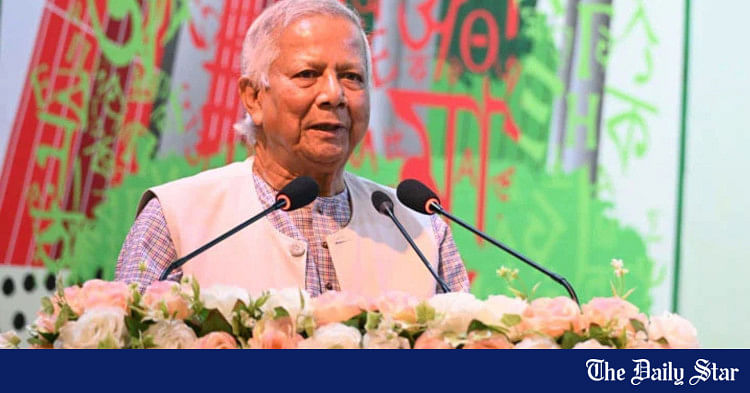
President Mohammed Shahabuddin and Chief Adviser Professor Muhammad Yunus have paid rich tributes to the martyrs of the historic Language Movement, marking the Amar Ekushey and the International Mother Language Day.

They separately paid homage by placing wreaths at the Central Shaheed Minar in the capital after 12:01am today, reports BSS.

The president and chief adviser stood in solemn silence for some time as a mark of profound respect to the memories of the Language Heroes.

Dhaka University Vice-Chancellor Professor Niaz Ahmed Khan welcomed them upon their arrival at the Central Shaheed Minar.

Advisers to the interim government, chief justice, chiefs of the three services, freedom fighters, diplomats and high civil and military officials were present on the occasion.

1740092875241.png

Photo: Rashed Shumon/Star

Later, the Shaheed Minar was opened to the public when hundreds of people from all walks of life placed flowers to recall the supreme sacrifice of the language heroes on this day in 1952.

The day will also be observed around the world since UNESCO recognised the 21st February (Ekushey February) as the International Mother Language Day on November 17, 1999.

This year's UNESCO topic of the day is "Make Languages Count for Sustainable Development".

Earlier, Chief Adviser Professor Muhammad Yunus today issued a message paying rich tribute to people of all languages in the world, including Bangla, on the occasion of the great Martyrs' Day and the International Mother Language Day-2025.

In his message, he said the Bengali nation, which had endured centuries of enslavement and domination, achieved its first victory in its struggle for independence on February 21, 1952.

The language movement holds special significance in the history of the Bengali nation's liberation movement, he added.

1740092926188.png

Photo: Rashed Shumon/Star

The day's programmes include: paying respect to language martyrs by placing wreaths at the Central Shaheed Minar beside Dhaka Medical College and Hospital and other local Shaheed Minars across the country at one minute past zero hour, holding discussions highlighting the significance of February 21, wearing black badge, keeping national flag half mast, hoisting black flag atop the buildings, paying tributes to the martyr's graves in City's Azimpur and bringing out "Provat Feri".

The day is a public holiday.

In observance of the day, the Central Shaheed Minar premises was decorated with paintings, graffiti, buntings and selected verses in the mother language.

Tight security measures have been enforced around the Central Shaheed Minar, its adjoining areas and Azimpur graveyard of the language martyrs.

Different political, social, cultural, professional bodies have taken various programmes including cultural functions to observe the Amar Ekushey in a befitting manner.

The national flags will be kept half-mast at all the buildings of government, semi-government, autonomous and private organisations and educational institutions.

All educational institutions, local government bodies, district and upazila administrations, Bangladesh missions abroad will take proper measures to observe the day.

Fateha and Qurankhwani will be offered at Azimpur graveyard and special prayers will be arranged at mosques and all other places of prayers across the country seeking eternal peace of the souls of the language martyrs.

On the occasion, road islands and other important places in the capital will be decorated with festoons inscribed with letters of different languages including Bangla.

Public and private media will air special programme while newspapers will publish special supplements marking the day.

Bangladesh missions abroad will organise different programmes, including placing wreaths at Shaheed Minar, discussions on Bangabandhu and Language Movement, and book and photo exhibitions where diplomats of different countries and Bangladeshi expatriates will join.

Marking the day, Bangla Academy, Bangladesh Shilpakala Academy, Kabi Nazrul Institute, National Book Centre, Islamic Foundation, Bangladesh National Museum, Department of Archaeology, Department of Public Libraries, International Mother Language Institute, Department of Archives and Library, Bangladesh Folk Art and Crafts Foundation, Bangladesh Shishu Academy, Small Ethnic Groups Cultural Institute, three districts in hill tracts, Tribal Cultural Academy in Birishiri of Netrokona, Rajshahi Divisional Ethnic Minority Cultural Academy (RDEMCA), Manipuri Lalitkala Academy, Cox's Bazar Cultural Centre and other organisations and institutions will organise various events.

On February 21 in 1952, Salam, Rafique, Shafique, Jabbar and Barkat embraced martyrdom in police firing in front of the Dhaka Medical College and Hospital (DMCH) as they took to the street to intensify the campaign to establish Bangla as the state language of the then Pakistan, sowing the seeds of subsequent movements for the country's independence.

They were killed as police opened fire on students demonstrating under the All-Party Students Action Committee against conspiracies of Pakistani rulers to declare "Urdu" as the only state language.

The movement for Bangla, however, did not stop and Pakistan government on February 29, 1956 was compelled to recognise Bangla as one of the state languages besides Urdu.

The decision, however, could not stop the movement against repression and misrule of Pakistani government that subsequently led the Bangalee to the War of Independence and the emergence of Bangladesh.​
 
Analyze

Analyze Post

Add your ideas here:
Highlight Cite Fact Check Respond

Honouring the martyrs of 1952

1740179978860.webp

Photo: Anisur Rahman/Star

"Amar Bhaier Rokte Rangano Ekushey February Ami Ki Bhulitey Pari..."

The song that epitomises Amar Ekushey not only has a special place in the hearts of Bangalees, it also lifts their spirits.

Humming the tune, thousands of people from all walks of life thronged the capital's Central Shaheed Minar and elsewhere to pay homage to the Language Movement heroes today.

1740180018837.webp

Photo: Anisur Rahman/Star

Bare-footed and holding flowers, they wore black and white to honour the supreme sacrifice.

The Shaheed Minar premises, adorned in different colours, wore a festive look with street paintings and graffiti in Bangla alphabets and selected verses about the mother language on the walls.

1740180045486.webp

Photo: Anisur Rahman/Star

Programmes including discussions and cultural sessions nationwide and in Bangladesh missions abroad reminisced the sacrifice made by Salam, Barkat, Rafiq, Jabbar, Shafique and others, according to messages received yesterday.

The day is being observed worldwide as the Unesco in 1999, declared February 21 as International Mother Language Day.

On February 21, 1952, students and people from all walks of life took to the streets in Dhaka to protest the then Pakistan government's refusal to recognise Bangla as one of the state languages and imposition of Urdu as the only official language of Pakistan.

Salam, Barkat, Rafiq, Shafiur, Jabbar and a few others were killed when police opened fire on their procession.

In Dhaka, people gathered at the Shaheed Minar since the early hours to pay homage to the language heroes.

President Mohammed Shahabuddin and Chief Adviser Professor Muhammad Yunus paid rich tributes to the martyrs of the Language Movement, marking the day. One-minute past midnight, the president laid a wreath. Prof Yunus paid his tributes around 12:10am after the president left the Shaheed Minar premises.

Dhaka University Vice-Chancellor Professor Niaz Ahmed Khan received them upon arrival.

Chief Justice Syed Refaat Ahmed with other judges paid their tributes and then the advisers to the interim government, foreign diplomats, invited guests and high-ranking military and civil officials, Dhaka University teachers paid their tributes at the alter.

Various parties including BNP, JCD, Workers Party, Jasod, CPB, Gono Forum, Chhatra Union, Chhatra Front, and Chhatra Federation also paid their tributes. Later, the Shaheed Minar was opened to public.​
 
Analyze

Analyze Post

Add your ideas here:
Highlight Cite Fact Check Respond

Legacy of Ekushey February: My mother’s story of 1952

1740180481948.webp

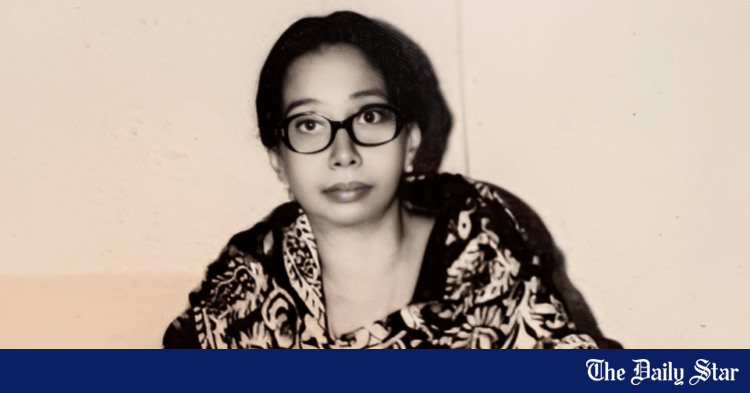
Principal Jahan Ara Karim in the 1960s at Intermediate Girls College, Bakshi Bazaar. Photo: Courtesy

I remember my mother, Syeda Jahan Ara Karim, as a woman of remarkable fortitude, mild in manner yet formidable in resolve.

As an educator, she broke barriers, serving as the first principal of the Intermediate Girls' College in Bakshi Bazar before transitioning to the Directorate of Public Instruction (DPI) as an assistant director in 1972. Throughout her life, she frequently spoke of the systemic discrimination against Bangalees in West Pakistan and the conspicuous absence of Bangalee representation in government administrative services. This narrative, drawn from my memory, recounts her experience speaking at a public forum in New York City about the Language Movement of 1952.

Born in Jalpaiguri, West Bengal, my mother spent her formative years in Darjeeling before her father's work took the family to various regions of Bengal. We often engaged in discussions about history, politics, and her experiences as an educated Bangalee Muslim woman. She spoke vividly of the grandeur of Mount Kanchenjunga, the splendour of Victoria Memorial, the bustling streets of Esplanade, and the unique taste of "chaap" at Nizam's from her childhood memories. Yet, her reminiscences were also marked by painful recollections of the harrowing Calcutta riots, of being trapped in a women's dormitory while violent mobs roamed outside, demands that "any Muslim woman be given up." Eventually, in 1948, her family relocated to Dhaka in the then East Pakistan.

A distinguished scholar, my mother earned her master's degree in economics from Calcutta University in 1948, followed by another MA in Economics from Columbia University in the US in 1952, before embarking on her teaching career at Eden Girls' College in Dhaka the following year. In 1950, she married my father, another academic. Both were awarded prestigious scholarships for higher studies at Columbia University. Notably, my mother ranked first in the All-Pakistan Scholarship Board, a distinction open to both men and women from both wings of Pakistan.

For my mother, this transcontinental move was transformative. Boarding an aeroplane for the first time, she transitioned from a society where Bangla was the dominant language to one where it was English. She had to navigate an entirely new cultural landscape, adjusting to new customs, behaviours, climates, diets, and the pace of New York City.

Despite these changes, she remained deeply proud of her Bangalee heritage—language, customs, literature, and music. She never abandoned her cultural identity, always wearing sarees, the Bangalee woman's attire. Once, while studying at the Low Memorial Library, an older American gentleman approached her and inquired about her origins. When she responded that she was from East Pakistan, he asked why she did not adopt the Western attire. Without hesitation, she replied, "I come from a civilisation much older than yours, and I have no need to adopt your ways."

The events of February 21, 1952 had left an indelible mark on her. That day, in Dhaka, police opened fire on protesting students who were demanding the recognition of Bangla as one of the state languages of Pakistan. The tragic loss of life and the brutal suppression of linguistic rights made my parents very concerned. News of the killings reached the international press, raising many questions about the status of Bangalees in the newly independent Pakistan.

In response, the Pakistan Embassy in New York organised a teach-in, inviting foreign journalists and the few Pakistani students studying in the city. During the event, the then Pakistani consul general to New York dismissed the reports as "propaganda" and "mischief-making by political troublemakers." He categorically denied any state-led violence, asserting that no "atrocities" had been committed. None of the students in attendance dared to challenge him, except my mother. She stood up and said, "I would like to say a few things."

With unwavering clarity, she dismantled the consul general's claims, presenting a structured argument that validated the students' demands for the recognition of Bangla. She noted that the demonstrators had acted within their legitimate rights, emphasising that Bangla was fundamentally distinct from Urdu—not only linguistically, but in script, phonetics, and cultural heritage. "We write in a different script, our language has Prakrit roots, while Urdu follows the Perso-Arabic script. We are ethnically and historically distinct," she said in the room full of people. Her words left an impression with the reporters who came over to talk to her. As my parents were leaving the auditorium, the consul general ran after them to ask where they were studying. My mother said that event became a scar against her in the Pakistani administration. As a government official, she needed permission to attend conferences overseas, which used to never be granted to her following the incident.

Her courage that day was symbolic of a broader struggle—to prevent the erasure of our linguistic and cultural identity. The Language Movement of 1952 was not merely about the right to speech; it was an assertion of our existence. On that day, my mother, like countless other Bangalees, refused to be silenced. Today, as we commemorate the sacrifices made during the movement, I honour my mother's voice. It was the collective voice of Bangalees advocating the rightful recognition of our native language and land.

Dr Lamia Karim is professor of anthropology at the University of Oregon, Eugene in the US.​
 
Analyze

Analyze Post

Add your ideas here:
Highlight Cite Fact Check Respond

Technology can play a crucial role in language preservation

1740180641508.webp

File photo: Anisur Rahman

After championing International Mother Language Day to become recognised by the United Nations 25 years ago, Bangladesh became known globally as a land of many languages. The foundation of this movement was the demand for official recognition of mother tongues, including Bangla. This 25th jubilee year reaffirms the importance of linguistic diversity and multilingualism in fostering dignity, peace, and understanding.

Currently, Bangladesh officially recognises 50 Indigenous communities, each with its own linguistic heritage, collectively speaking approximately 41 native languages. These languages belong to four distinct language families. According to the International Mother Language Institute (IMLI), a Category II institute of UNESCO, around 15 languages in Bangladesh face the threat of extinction. Among them, Rengmitcha language is notable—only seven people currently speak this language. International Mother Language Day is an opportunity for us to reflect on and propose actions to address situations such as this.

Evidence suggests that mother tongue education supports cognitive development, improves communication skills, and improves educational performance. According to Chakma Jati (Jatiya Chitra O Itibritta) by Satish Chandra Gosh, education in the Chakma and Marma languages was introduced in the Chittagong Hill Tracts (CHT) in 1862, but was later discontinued. Despite several attempts over the years to revive language education programmes, they have all been short-lived.

The 1997 CHT Peace Accord reaffirmed the right of Indigenous children to receive education in their mother tongue. In 2012, the government took steps to introduce Indigenous language education under the National Education Policy. Since 2017, learning materials in Chakma, Marma, Tripura, Garo, and Sadri languages have been introduced at the primary level. However, the initiative has faced serious roadblocks due to lack of trained teachers, inadequate evaluation of teaching materials, budget constraints, a shortage of language-based teachers, and the inactivity of committees formed to implement education in Indigenous communities. As a result, the programme has not progressed as expected.

It is crucial to take effective measures for the revival, development, and preservation of Indigenous languages. This includes effective implementation of primary education programmes in Indigenous languages, formulation of a national language policy, introduction of departments or institutes on Indigenous language and culture in universities, promotion of mother tongue practice among the youth, initiatives for language development through information technology, and establishment of Indigenous language cells in government institutions such as Bangla Academy, IMLI, and the National Curriculum and Textbook Board (NCTB).

The use of technology is one way that we can work to support these efforts. This year's theme for International Mother Language Day makes it an important time to consider how to tackle the issues above using technology. A cheaper and more accessible way to provide language instruction could be using internet-based language modules. These are already in widespread use on commercial platforms.

Artificial intelligence is at the forefront of many current discussions on education, and is a tool that could be utilised to address barriers such as teacher shortage. More sophisticated tech solutions, including development of content in Indigenous languages, have also been proposed. But as we lack content in these languages, these are not quite within our grasp.

Technology also offers many opportunities for documentation and preservation. As several of Bangladesh's Indigenous languages are critically endangered, ensuring that we act now is important. Collecting recordings and partnering with tech companies that can provide tools to develop orthographies and transcribe these into written content could help preserve these languages.

No language should be allowed to become extinct. Language is central to our identity and part of our culture, and therefore central to social and emotional well-being. To preserve endangered languages, long-term planning and collective efforts are essential. When a language dies, we lose invaluable treasures of its environment, culture, and history.

Mathura Bikash Tripura is executive director at Zabarang Kalyan Samity and national awardee of the International Mother Language Award 2021.

Dr Susan Vize is head of office and UNESCO representative to Bangladesh.​
 
Analyze

Analyze Post

Add your ideas here:
Highlight Cite Fact Check Respond

BHADRALOK TO SUSHEEL: Language, identity and hegemony in post-colonial Bangladesh
Abdul Monaiem Kudrot Ullah 21 February, 2025, 00:00

1740182408255.webp


IN MY small town, Bheramara, Ekushey February was a ritual. Barefoot we roamed, demanding the same of every passerby — a shedding of shoes, a mark of respect. Bangla, bhasha shaheed — these weren’t just words, they were close to the heart, a pulse. And how could they not be? Bangladesh, a nation birthed from language, its very being woven into the struggle for self-determination. The Language Movement of 1952, a defiant cry, the bedrock of a future. Yet, this sacred connection to language, this fierce embrace of identity, has twisted, contorted, into something else. Linguistic fundamentalism. A rigidity, an exclusion, a weapon. How did we arrive here? To understand this linguistic puritanism, this policing of tongues, we must excavate the layers of history, the sediment of Orientalism, the lingering poison of colonial legacy, the subtle, insidious grip of elite linguistic hegemony. These forces, these whispers from the past, have not just shaped policies, they have sculpted the very way we perceive language, the way it is politicised, the way it is used, even against ourselves, in this postcolonial landscape of South Asia.

Orientalism and the colonial construction of language

THE very term ‘Orientalism’ carries within it the unmistakable stench of empire. It is not merely a descriptor but an instrument — a linguistic scalpel wielded by colonial hands to carve the world into binaries: the west and the rest, the civilised and the exotic, the rational and the irrational. The ‘Orient’ was not discovered; it was manufactured, a convenient fiction — seductive yet subordinate, fascinating yet fundamentally flawed.

And like all imperial constructs, this was not confined to mere rhetoric; it was embedded into the very foundations of colonial rule. Consider language, the primary conduit of culture and identity. The British did not simply govern; they imposed. Their language — English — was enthroned as the language of power, the medium of governance, administration and prestige. The dialects and tongues of the subcontinent, the linguistic arteries of its civilisations, were systematically demoted. They were not just marginalised but ideologically vilified, their vibrancy dismissed as provincial, their speakers relegated to the periphery of power.

The intent was clear: this was not about efficiency; it was about hegemony. Language became a tool of hierarchy, a marker of worth, a means of stratification. To be fluent in English was not merely to acquire a skill but to ascend in the colonial pecking order. It was to be deemed cultured, refined, and, by extension, superior. This was not just the mechanics of empire; it was its very ethos — a deliberate, methodical assertion of western dominance, carefully disguised as enlightenment.

The making of the bhadralok: a tale of assimilation and abandonment

IN THEIR eagerness to secure a place in the colonial order, the Bengali elite absorbed the ethos of empire with an unsettling zeal. English became their scripture, western manners their creed. In the process, they crafted a new identity — bhadralok — the self-proclaimed torchbearers of sophistication. This reinvention, however, came at a cost: a calculated estrangement from their own people, those dismissed as pa-fata-Chasha, the unpolished, the unworthy.

Authentic local traditions — attire, cuisine, even the intimate comforts of home — were recast as relics of backwardness. To be ‘modern’ meant to erase oneself, to become a mirror reflecting the coloniser’s gaze. The British, ever shrewd, encouraged this transformation, entrenching a hierarchy that kept power firmly within a compliant, anglicised minority.

Calcutta: the imperial workshop of cultural division

THIS so-called Bengali Renaissance, so carefully cultivated under British patronage, bloomed in Calcutta, producing an intermediary class — overwhelmingly upper-caste Hindus — who became the loyal functionaries of the Raj. Their western education secured them access to privilege, but it also widened the gulf between them and the rest of Bengal.

Colonial policy, calculated and deliberate, positioned these elites as cultural and administrative gatekeepers, reinforcing a linguistic and social elitism that left East Bengal in the shadows. Folk traditions, rural dialects, indigenous wisdom — all were pushed to the margins, deemed too crude for the empire’s grand narrative. English was the passport to power, but only a select few were granted passage.

The internalisation of a hierarchy

OVER time, this hierarchy ceased to be simply imposed — it was embraced. Calcutta’s elite, eager to maintain their proximity to power, distanced themselves from the rural poor, dismissing indigenous customs as impediments to progress. Clothing, cuisine and daily rituals — once markers of identity — became symbols of provinciality, to be discarded in favour of European refinement.

The Bengali Renaissance of the 19th and early 20th centuries, though celebrated for its intellectual achievements, further solidified this divide. Its leaders, shaped by western education, championed a sanitised, ‘susheel’ culture that alienated the vernacular-speaking majority. British policies, carefully orchestrated, ensured that this elite class remained dependent on colonial structures while leaving the masses locked out of opportunity.

The consequence was a fractured society, where linguistic and cultural barriers, first drawn by colonial hands, were later reinforced from within. East Bengal — destined to become Bangladesh — remained on the periphery, denied the same access to English education and the advantages it conferred. What began as a colonial strategy of control became a self-sustaining system of exclusion, a legacy that lingers long after the empire’s flags were lowered.

Linguistic evolution and divergence after 1947

THE writers, the poets, they began to mimic the English. A shadow of their literature fell across the page, a borrowed cadence. In Calcutta, amongst the elite, there was this surrender, a quiet acceptance of British cultural dominance. They shaped their own literature, their own culture, into a pale reflection of what the colonisers had created. Even later, after the 1930s, when the characters became a little more local, a little more familiar, it was still through a British lens, a British gaze. And then, partition. The line drawn, a new nation born — East Bengal. And with it, a language beginning to breathe differently. Like American English, finding its own rhythm, Bangladeshi Bangla started to move away from the Sanskritised, almost brittle, dialect of Calcutta. It wasn’t just a change in words, but something deeper — a nation, finally, trying to find its own voice, its own story and a language trying to open itself, to include more, to reflect the lives of ordinary people. But there was resistance, of course. Those who believed in some pure, unchanging form of the language, who clung to the idea that Calcutta held the only true way. So, this new Bangla, this Bangladeshi Bangla, became more than just a language. It became a symbol of identity, of self-assertion. It became a quiet rebellion against the old hierarchies, the linguistic elitism that had been left behind by the British. It became a way, perhaps, to finally step out of the long shadow of the Raj.

Language, power and the politics of identity in postcolonial East Bengal

THE partition of British India in 1947 placed East Bengal within the newly created state of Pakistan, a nation ostensibly founded on the principles of Muslim nationalism. For Bengali Muslims, this was expected to mark a fresh beginning, with Dhaka University emerging as the intellectual and cultural nucleus of a new elite — one that sought recognition within the broader framework of Pakistan. Yet, the linguistic and cultural asymmetries between East and West Pakistan quickly surfaced as a fault line in the nascent state’s political landscape.

The imposition of Urdu as the sole national language by the ruling elite in Pakistan was viewed in East Bengal as an unmistakable act of cultural domination. Far from being a unifying force, the language policy reinforced existing regional grievances, transforming Bengali into both a symbol of resistance and a crucial marker of political identity. The Language Movement of 1952 became a defining moment, challenging the state’s attempt to enforce homogeneity and laying the groundwork for the assertion of Bengali nationalism that would later culminate in the struggle for independence.

However, post-independence Bangladesh did not entirely break free from the colonial legacy of linguistic hierarchy. The very forces that had mobilised around the demand for linguistic rights became entrenched in a linguistic majoritarianism that mirrored earlier exclusions. In its efforts to consolidate a unified national identity, the Bangladeshi state elevated Bengali at the expense of other languages spoken within its borders — Chakma, Santali and Urdu among them. This linguistic fundamentalism, while born from the experience of marginalisation, has often led to the marginalisation of others, reinforcing the same structures of exclusion that had once been imposed upon Bengalis.

A particularly paradoxical outcome has been the growing ambivalence towards foreign languages, including English. While English remains a global lingua franca and an essential tool for economic and intellectual engagement, it is often perceived with suspicion — a residual effect of the colonial experience. The enduring legacy of Orientalist knowledge production, which framed language as both an instrument of domination and a marker of civilisation, continues to shape Bangladesh’s contested relationship with linguistic diversity and global integration.

Linguistic hegemony and politics of exclusion in Bangladesh

A CRITICAL aspect of Bangladesh’s linguistic landscape is the political rhetoric that has shaped attitudes towards English in official and academic spheres. The post-independence elite — the newly emerged susheel class — embedded itself within the Awami League’s construction of Bengali nationalism, drawing its intellectual and cultural moorings from Calcutta and Shantiniketan. While cultural movements played a significant role in galvanising support for the Liberation War, those who championed this vision often remained insulated from the direct experiences of conflict and suffering. Yet, they assumed the authority to dictate the contours of Bangladesh’s cultural and intellectual discourse, narrowing it to a singular, homogenised Bengali identity — rooted in Promito Bangla as spoken in Calcutta.

This essentialised notion of Bengali culture actively marginalised regional linguistic variations and local heritage, rejecting diverse narratives that could have contributed to a richer and more inclusive national identity. A rigid binary was established, wherein conformity to this elite-determined cultural framework was equated with being ‘cultured,’ while deviations — particularly those incorporating religious traditions or local dialects — were dismissed as regressive or politically suspect. With media and academic institutions soon falling under this cultural monopoly, the susheel class became the self-appointed arbiters of cultural legitimacy. The result was a profound schism: Islamic rituals and Bengali culture were framed as irreconcilable, leading to a protracted ideological contestation that continues to shape national discourse.

While the Language Movement of 1952 justifiably resisted the imposition of Urdu, the subsequent rejection of English as a primary medium of higher education and governance has had long-term consequences. The rhetoric of ‘Sarbostore Bangla’ (Bengali at all levels), while rooted in nationalist sentiment, inadvertently disadvantaged those outside elite circles. This became evident in institutional settings where English proficiency was a prerequisite for advancement. For instance, when I joined the Bangladesh Navy as a cadet, the first directive was clear: ‘No vernacular.’ Those from urban backgrounds or English-medium institutions navigated this transition with ease, while those from rural backgrounds — previously assured that Bengali alone would suffice — found themselves at a disadvantage. The promise of linguistic egalitarianism had, in reality, reinforced structural inequalities.

This ideological rigidity was further reinforced by elite institutions that, while publicly endorsing Bengali exclusivity, ensured their own children accessed alternate, English-oriented education systems — both at home and abroad. In contrast to other postcolonial nations that have adopted bilingualism as a pragmatic tool for global engagement, Bangladesh’s resistance to English integration has stifled its competitiveness in international markets. The aversion to English, often framed as an anti-colonial stance, disregards its necessity in global trade, diplomacy, and scientific research. The educational divide has widened, with access to English proficiency — and the economic mobility it enables — remaining confined to the privileged few.

Yet, these entrenched hierarchies did not go unchallenged. The July Uprising directly confronted the dominance of elite cultural narratives, rejecting both the Calcutta-centric intellectual framework and the authority of the shusheel class in determining national identity. In doing so, they disrupted the monopoly over cultural legitimacy, forcing a reckoning with the plurality that had long been sidelined.

Breaking the sound barrier

SO THE Monsoon Uprising roars, tearing through the tired script of linguistic fundamentalism — this brittle, suffocating obsession with one language, one people, one history. A nation that chants in a single voice, marching in step, its feet shackled to the weight of a colonial hangover. Good luck with that. Because before Bangladesh can walk forward, it has to look over its shoulder. Confront the ghosts — the Orientalists who romanticised and ridiculed in the same breath., the colonial gatekeepers who decided which tongues were polished and which were provincial and the post-independence elite who inherited that power, who wrapped their own people in the same silk noose. Language was never just language. It was always power.

And it’s not just about Bengali. It’s about the silencing of voices. It’s about the fear of difference, the terror of plurality. We are told, again and again, that language is sacred, untouchable. That it must remain pure, preserved in a museum of nostalgia, polished and frozen like an artefact behind glass. But that’s a lie. Language moves. It leaks. It mutates. It doesn’t care for borders or politics or carefully curated purity. If we want to compete, if we want to be more than an island of self-congratulation, we need to step out into the world of languages — not just English, but Arabic, Japanese, Chinese — the tongues of trade, technology, revolution.

We need a new language politics — not the politics of exclusion, but of expansion, pluralism and inclusion. The quiet understanding that Bangladesh is not one voice, but many — not a monolith, but a symphony. Supporting minority languages isn’t just some sentimental act of redress — it’s a radical act of enrichment. It is an act of defiance against the idea that identity must be a singular thing, stitched in rigid lines.

And so, the real battle begins — not just against the old colonialists, but against their heirs, the ones who still police language, who still decide who is ‘cultured’ and who is not, the ones who mistake uniformity for strength and who hold onto linguistic hegemony like a relic from an empire that no longer exists.

But language is not a monument. It is a river. It carries things. It erodes old walls. It refuses to stay in place. And maybe, just maybe, that is where true unity lies — not in the silencing of voices, but in the listening.

Conclusion

‘AMAR Bhaier Rokte Rangano Ekushe February.’ The songs, the poetry, they tug at the heartstrings. Ekushey February, a date etched in blood, some martyrs, their sacrifice, ‘Shoto Shaheeder Rokte Gora’ — built on the blood of hundreds of martyrs. The emotion, raw and real, but so easily manipulated. The susheels, the self-proclaimed guardians of Bengali identity, the Awami League, riding the wave of sentiment, clinging to power. Millions mimed, thousands killed. A terrible price paid for this carefully crafted narrative. We were fooled, yes. But the young ones, Generation Z, they see through the charade. They’ve called time on this game. Or so they think.

The old elite, the susheels, the media, the bureaucratic leftovers, they’re still there, lurking in the shadows. And they’re not about to give up their grip on power. The game plan is changing, not ending. A new strategy, a new way to impose their cultural hegemony. Linguistic fundamentalism, this rigid, exclusionary approach to language, it’s not some spontaneous phenomenon. It’s a product of history, of colonialism, of Orientalism. The old hierarchies, the essentialist view of language, the elitism of the Bengali Renaissance — they all play their part. And the rhetoric around English, the global language, it’s just another tool, used to create divisions, to justify stagnation, to keep Bangladesh from finding its place in the world.

To break free from this, Bangladesh has to confront its past, the ugly truths, and the uncomfortable realities. It has to embrace a different vision, one that’s pluralistic, inclusive, that understands that language and identity are not monolithic. Only then can it move beyond the divisions, the hatreds, the lies. Only then can it build a future that celebrates its diversity, its complexity, and its many voices — a future where language is not a weapon, but a bridge. The time for rethinking, for acting, is not just perfect. It’s long overdue.

Abdul Monaiem Kudrot Ullah is a retired captain of Bangladesh Navy and a cross-disciplinary researcher.​
 
Analyze

Analyze Post

Add your ideas here:
Highlight Cite Fact Check Respond

Ongoing struggle for Bangla language
Akhtar Sobhan Masroor 21 February, 2025, 00:00

1740182767582.webp

Screengrab off YouTube

IN THE digital world, we are constantly engaged in communications, with English being the dominant medium. It is the language of globalisation, power and the centre. We have never fully escaped its colonial influence. We exist simultaneously in local and global spheres, inhabiting both the real and virtual worlds. The digital era presents both challenges and opportunities for the Bangla language. Our limited digital capabilities, however, still pose obstacles to its development. There is lack of software, applications and web sites in Bangla; and, digital global platforms provide inadequate interface support for the language. Bangla also lags far behind in artificial intelligence and language processing.

The dominance of English content in communications and online spaces may lead to a decline in the younger generation’s proficiency and interest in Bangla. Social media now sees an unprecedented volume of Bangla writing. However, much of the emotional expression on social media occurs in English or Arabic. Instead of using Bangla to express gratitude or congratulations, many prefer English or Arabic. This is contributes to the creation of a hybrid language, blending Bangla, English and Arabic which distorts and alters the essence of the Bangla language.

The recent rise in the use of regional dialects has disrupted the standard Bengali. The development of a standardised language is linked to the emergence of nation-states. In this process, many regional words and linguistic structures were discarded. In the digital age, a standardised language is essential for communications and technological discourse. While standardisation has ensured linguistic uniformity, it has also reduced language diversity. Some individuals are now attempting to challenge this standardisation by promoting a distorted and unconventional linguistic style.

A recent trend involves artificially injecting Arabic and Persian words into Bangla. Over the centuries, Bangla has naturally assimilated numerous Arabic, Persian, Portuguese and English words. Many Arabic words entered Bangla because of religious influences and Persian was the official language until 1835. Social media reveal an increasing tendency to express emotions in Arabic or English. But can we not articulate our feelings in Bangla? Would expressing them in Bangla diminish our dignity? Would refraining from using Arabic words make us less religious? Is there any religious directive prohibiting the expression of emotions in one’s mother tongue? One can maintain religious devotion without being hostile to the Bangla language.

In the early 19th century, the development of Bangla prose, centred around the College of Fort William, led to the Sanskritisation of the language. Sanskrit was established as the foundation of Bangla, resulting in an overload of Sanskrit-derived words while many Arabic-Persian, indigenous and, even, Bengali verb forms were discarded. Some perceive this as an anti-Muslim conspiracy. This linguistic divide later fuelled Hindu-Muslim linguistic communalism. Nathaniel Brassey Halhed was a pioneer in Sanskritising Bangla, believing that Arabic and Persian words would corrupt the purity of the language. His contemporaries, Henry Forster and William Carey, neither of whom were Hindus, also sought to eliminate Arabic and Persian words from Bangla. Halhed, influenced by the similarities between Sanskrit, Greek and Latin, advocated for a Sanskrit-based Bangla.

Today, some are once again trying to forcefully reintroduce Arabic and Persian words into Bangla. After the establishment of Pakistan, efforts were even made to write Bangla in the Arabic script. Conversely, in the 1960s, secular, language-based opposition to Pakistan gained traction. Over time, Bangla overcame the influence of Sanskrit and established its own foundation. However, it is undeniable that Bangla has borrowed extensively from Sanskrit’s vast vocabulary. As scholar Anisuzzaman noted, ‘A great wealth was undoubtedly accumulated in this process, but many long-standing linguistic treasures were also lost.’

Linguistic communalists seek to divide the Bangla language into Hindu and Muslim variants. Rabindranath Tagore, who liberated Bangla from Sanskrit influence and popularised the conversational form, is now being vilified as part of this division. In the 1960s, figures such as Maulana Akram Khan, Fazlur Rahman, Abul Mansur Ahmed, Syed Ali Ahsan, Golam Mustafa and the newspaper Azad advocated for an ‘Islamic Bangla.’ At a 1954 literary conference, Muhammad Shahidullah remarked: ‘The obsession with writing Bengali in the Arabic script, introducing unfamiliar Arabic-Persian words, labelling standard Bengali as the language of the Ganges and proposing the replacement of it with the language of the Padma — these are all absurdities that have gripped a section of our literary community.’

The Bangla language has always faced attacks from its adversaries. Persian, English and Urdu have repeatedly attempted to suppress it. Not only foreign conquerors but also the local ruling elite has waged a war against Bangla —something that continues to this day. Bangla has been the language of the rural poor, never receiving recognition from the ashraf or bhadralok class that considered it inferior. In the 19th century, affluent urban Muslims in Bengal primarily spoke Urdu. Nawab Abdul Latif dismissed Bangla as the language of the Hindus and rural lower people. Historian Dr Enamul Haque observed: ‘Soon, they formed associations, held meetings, and delivered speeches in Bengali, attempting to convince the common Bengali Muslims that their language was not Bengali, not even a mixed form of Bengali, but purely Urdu.’

The ruling class in Bangladesh has never allowed Bangla to become a language of profession, administration or academia. It remains marginalised in the education system while English-medium instruction has oddly been introduced at the primary level. Universities fail to cultivate scholarly discourse in Bangla. The exploitative capitalist class continues to suppress the Bangla language. Today, Bangla is threatened by English, Arabic and Hindi as well as by internal betrayals. Learning English is essential and Arabic is necessary for religious purposes, but not at the cost of abandoning our mother tongue.

Despite immense challenges, Bangla has survived because of the rural masses who have preserved it for generations. The same resilience will ensure its survival today. However, we must also be wary of linguistic fascism — using the dominant Bangla language to suppress the languages of indigenous and minority groups in Bangladesh. Embracing linguistic diversity and plurality will enhance our democratic spirit. Let us ensure that February, the month commemorating our language movement, does not become a season of superficial linguistic sentimentality.

Dr Akhtar Sobhan Masroor is a writer and key student leader of the 1990 mass uprising in Bangladesh.​
 
Analyze

Analyze Post

Add your ideas here:
Highlight Cite Fact Check Respond

Members Online

No members online now.
⤵︎

Latest Posts