Bangladesh Defense
Saif
Senior Member
- Jan 24, 2024
- 21,580
- 9,791
- Nation

- Residence
- Axis Group


What's keeping Bangladesh from becoming an agricultural export hub
We all want safe food and agricultural products. Consumers want to know what they are eating and where it comes from.
What's keeping Bangladesh from becoming an agricultural export hub
Ahmed Rifat Kabir Sristy
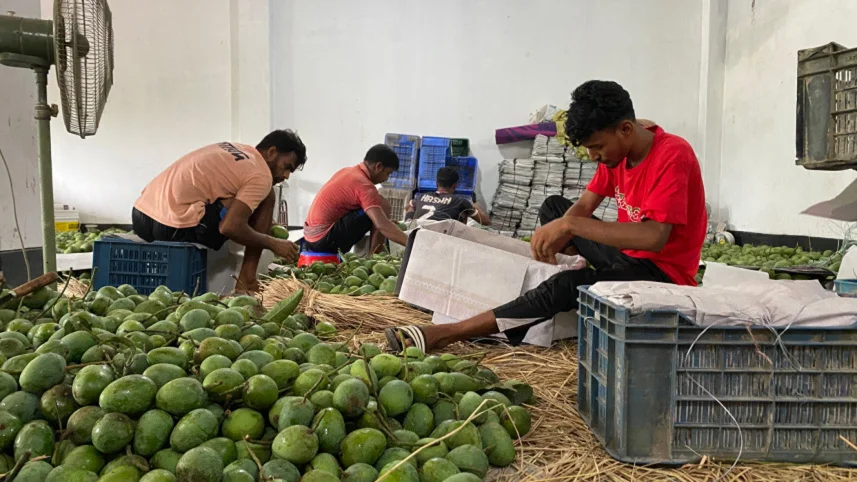
'Bangladeshi agricultural products are regularly rejected for pesticide residue, pest contamination, and inadequate traceability.' File photo: Star
We all want safe food and agricultural products. Consumers want to know what they are eating and where it comes from. And policymakers, at least in principle, want Bangladesh to supply safe products. What we lack, however, is the specific, unglamorous institutional work that such an ambition requires.
Currently, Bangladesh ranks among the world’s top producers of at least 22 agricultural products and has European Union (EU) permission to export fish and fishery products. Yet agricultural exports fell by more than 1 percent year on year and earned $975 million in FY2025-26, which is close to 2 percent of the country’s merchandise earnings. Therefore, even though our production base is large, the trade is not. Vegetables show the pattern most clearly. Exports earned $88.88 million in FY2025-26, up almost 10 percent on the year, but short of the $103.24 million the sector earned a decade earlier in FY2014-15. Production and domestic consumption both expanded sharply over those 10 years but export earnings did not.
The EU keeps Bangladesh under increased official control, and according to its January 2026 update, it increased the frequency of physical checks on Bangladeshi seed and bean shipments over concerns about pesticide residues. At the same time, it eased controls on Indian okra and rice due to improved compliance. Bangladeshi shipments are regularly rejected for pesticide residue, pest contamination, and inadequate traceability. Safe agricultural products require a production system that consistently delivers on those three counts. Bangladesh does not yet have that production system.
The most widely accepted signal of safe production is Good Agricultural Practice (GAP). We already run regular GAP training programmes across hundreds of upazilas—proving that the true bottleneck lies elsewhere. Farmers adopt GAP through donor-funded interventions. When it has to be self-financed, the economics do not work, because buyers rarely pay a premium for GAP-certified produce. This is a failure of market structure, not awareness.
The most direct fix is domestic consumer activation. Right now, GAP exists almost exclusively as an export instrument, and the domestic market is untouched. When a simple milk purity testing tool was made accessible to ordinary consumers a few years ago, sellers who adulterated milk faced reputational consequences and changed behaviour. The incentive architecture shifted because transparency shifted first. A premium verification label backed by batch-level testing results accessible via QR verification would create the demand-side pull that no export promotion scheme has so far generated.
The second constraint is institutional fragmentation. Sanitary and Phytosanitary (SPS) regulation is distributed across several bodies, including the Ministry of Agriculture, the Ministry of Food, the Ministry of Fisheries and Livestock, the Bangladesh Food Safety Authority, the Plant Quarantine Wing, and the Bangladesh Standards and Testing Institution (BSTI). Each governs a slice of the compliance chain, but none has overall authority. Successive SPS capacity assessments have flagged the absence of a lead coordinating body. Because trained quarantine officers are routinely rotated out of their postings, the system constantly bleeds institutional memory. A coordination body with real authority to resolve disputes and unify inspection standards is no longer a structural luxury, but rather a prerequisite.
Third, the geography of testing is wrong. Premium horticulture products are funnelled through a central packing house in Dhaka’s Shyampur and tested there, after travelling from major horticulture zones like Rajshahi or Chapainawabganj.
Decentralised testing at origin, through satellite facilities in the main export zones of the north, would catch problems earlier, reduce post-harvest losses, and put data in the hands of exporters before the produce leaves the farm.
Fourth, Bangladesh’s digital traceability infrastructure is fragmented across incompatible donor-funded platforms. While Bangladesh is registered with the IPPC’s ePhyto network, it cannot utilise it. The centralised domestic platform needed to plug into that global system has been stalled for over a decade, leaving our digital traceability completely fractured.
Fifth, the certification architecture for safe origin needs to be built from the ground up. Under the International Plant Protection Standard (ISPM) 10, individual farms can be registered as pest-free places of production, the building blocks for eventual area-level recognition. The north-western mango belt and vegetable zones in Narsingdi could begin this now.
What is missing is a national zoning study that maps which districts can credibly claim low pest prevalence for which crops.
The production base, the diaspora market connections, and the proximity to high-value markets in the Middle East and Southeast Asia are genuine advantages. What is not yet real is the institutional infrastructure that translates all of that into trusted, safe-origin supply. Bangladesh can be a regional hub. But that status must be built, inspection point by inspection point, coordination body by coordination body, across a decade of choices.
Ahmed Rifat Kabir Sristy is coordinator at Trade Facilitation at Swisscontact Bangladesh.
Ahmed Rifat Kabir Sristy
'Bangladeshi agricultural products are regularly rejected for pesticide residue, pest contamination, and inadequate traceability.' File photo: Star
We all want safe food and agricultural products. Consumers want to know what they are eating and where it comes from. And policymakers, at least in principle, want Bangladesh to supply safe products. What we lack, however, is the specific, unglamorous institutional work that such an ambition requires.
Currently, Bangladesh ranks among the world’s top producers of at least 22 agricultural products and has European Union (EU) permission to export fish and fishery products. Yet agricultural exports fell by more than 1 percent year on year and earned $975 million in FY2025-26, which is close to 2 percent of the country’s merchandise earnings. Therefore, even though our production base is large, the trade is not. Vegetables show the pattern most clearly. Exports earned $88.88 million in FY2025-26, up almost 10 percent on the year, but short of the $103.24 million the sector earned a decade earlier in FY2014-15. Production and domestic consumption both expanded sharply over those 10 years but export earnings did not.
The EU keeps Bangladesh under increased official control, and according to its January 2026 update, it increased the frequency of physical checks on Bangladeshi seed and bean shipments over concerns about pesticide residues. At the same time, it eased controls on Indian okra and rice due to improved compliance. Bangladeshi shipments are regularly rejected for pesticide residue, pest contamination, and inadequate traceability. Safe agricultural products require a production system that consistently delivers on those three counts. Bangladesh does not yet have that production system.
The most widely accepted signal of safe production is Good Agricultural Practice (GAP). We already run regular GAP training programmes across hundreds of upazilas—proving that the true bottleneck lies elsewhere. Farmers adopt GAP through donor-funded interventions. When it has to be self-financed, the economics do not work, because buyers rarely pay a premium for GAP-certified produce. This is a failure of market structure, not awareness.
The most direct fix is domestic consumer activation. Right now, GAP exists almost exclusively as an export instrument, and the domestic market is untouched. When a simple milk purity testing tool was made accessible to ordinary consumers a few years ago, sellers who adulterated milk faced reputational consequences and changed behaviour. The incentive architecture shifted because transparency shifted first. A premium verification label backed by batch-level testing results accessible via QR verification would create the demand-side pull that no export promotion scheme has so far generated.
The second constraint is institutional fragmentation. Sanitary and Phytosanitary (SPS) regulation is distributed across several bodies, including the Ministry of Agriculture, the Ministry of Food, the Ministry of Fisheries and Livestock, the Bangladesh Food Safety Authority, the Plant Quarantine Wing, and the Bangladesh Standards and Testing Institution (BSTI). Each governs a slice of the compliance chain, but none has overall authority. Successive SPS capacity assessments have flagged the absence of a lead coordinating body. Because trained quarantine officers are routinely rotated out of their postings, the system constantly bleeds institutional memory. A coordination body with real authority to resolve disputes and unify inspection standards is no longer a structural luxury, but rather a prerequisite.
Third, the geography of testing is wrong. Premium horticulture products are funnelled through a central packing house in Dhaka’s Shyampur and tested there, after travelling from major horticulture zones like Rajshahi or Chapainawabganj.
Decentralised testing at origin, through satellite facilities in the main export zones of the north, would catch problems earlier, reduce post-harvest losses, and put data in the hands of exporters before the produce leaves the farm.
Fourth, Bangladesh’s digital traceability infrastructure is fragmented across incompatible donor-funded platforms. While Bangladesh is registered with the IPPC’s ePhyto network, it cannot utilise it. The centralised domestic platform needed to plug into that global system has been stalled for over a decade, leaving our digital traceability completely fractured.
Fifth, the certification architecture for safe origin needs to be built from the ground up. Under the International Plant Protection Standard (ISPM) 10, individual farms can be registered as pest-free places of production, the building blocks for eventual area-level recognition. The north-western mango belt and vegetable zones in Narsingdi could begin this now.
What is missing is a national zoning study that maps which districts can credibly claim low pest prevalence for which crops.
The production base, the diaspora market connections, and the proximity to high-value markets in the Middle East and Southeast Asia are genuine advantages. What is not yet real is the institutional infrastructure that translates all of that into trusted, safe-origin supply. Bangladesh can be a regional hub. But that status must be built, inspection point by inspection point, coordination body by coordination body, across a decade of choices.
Ahmed Rifat Kabir Sristy is coordinator at Trade Facilitation at Swisscontact Bangladesh.