[H3]Bangladeshi teenager killed by BSF firing at Thakurgaon border[/H3]
Jayant Kumar Singh's father Mahadev Kumar Singh and Darbar Ali of the same upazila were shot dead.
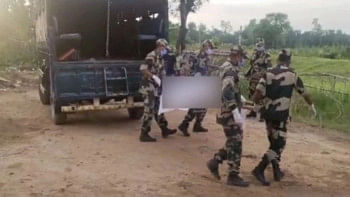
Symbolic image. Star Online Graphics
A 14-year-old Bangladeshi teenager (Jayant Kumar Singh) was killed by the Indian Border Security Force (BSF) on the Kantivita border of Thakurgaon's Baliadangi upazila.
This incident happened on Monday morning. The name of the deceased teenager is Jayant Kumar Singh.
The Officer-in-Charge (OC) of Baliadangi Police Station Feroz Kabir told The Daily Star, 'Fakirvita Belpukur's father, Jayant Kumar Singh's father, Mahadev Kumar Singh of Belpukur and Nitoldoba village of the same upazila. Darbar Ali (50) was also injured in BSF firing.'
According to the locals, the BSF members of Dingapara camp opened fire on a group of people illegally entering India by cutting the barbed wire fence around 3:30 am today. Jayant was killed on the spot and two others were shot dead.
Mahadev Singh and Darbar Ali, who were shot, are undergoing treatment at a hospital in Rangpur.
Chairman of Dhantala Union Parishad Samar Kumar Chatterjee claimed that BSF has arrested at least 16 other people from different areas who went to India through that border.
When asked about this, 50 BGB Battalion Commanding Officer Lt. Col. Tanzir Ahmad told The Daily Star, "We have come to know about the matter and are investigating."
In response to a question, he said, 'We have asked the BSF to hold a flag meeting in this regard.'
Foreign Adviser Md Touhid Hossain today said border killings by the Indian Border Security Force (BSF) remain an obstacle to fostering better relations between Bangladesh and India
www.thedailystar.net
Border killings a barrier to good ties with India: foreign adviser
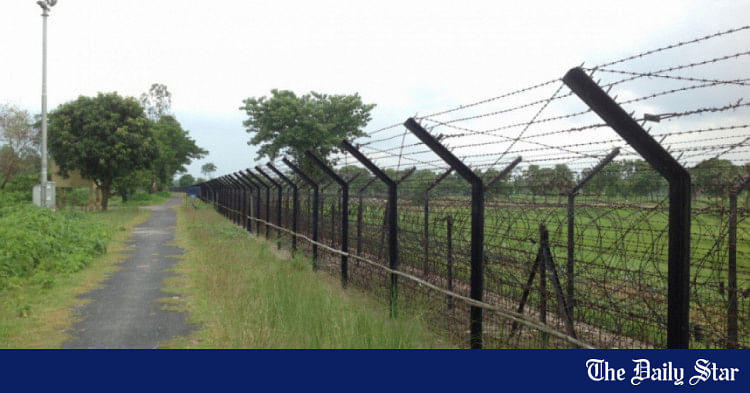
File photo of India-Bangladesh border. Photo taken from Wikimedia Commons.
Foreign Adviser Md Touhid Hossain today said border killings by the Indian Border Security Force (BSF) remain an obstacle to fostering better relations between Bangladesh and India.
"We definitely want good relations with India based on equity. It [the bi-lateral ties] should be two-way, not one-sided… Border killings are a barricade to good relations between the two countries," he said in response to reporters' questions at the foreign ministry.
His remarks came after a teenage boy, Jayanta Kumar Singh, 14, was shot dead by BSF along the Kantivita border in Thakurgaon's Baliadangi upazila early yesterday, according to police.
Asked whether the foreign ministry would lodge a formal protest, the adviser said the ministry would act after receiving confirmation of the incident from the Border Guard Bangladesh (BGB).
Earlier, on September 5, Dhaka had requested New Delhi to investigate all border killings, identify those responsible, and hold them accountable. This followed the killing of a 13-year-old Bangladeshi girl, Shwarna Das, who was shot dead by BSF on September 1 in Moulvibazar's Juri upazila.
According to the human rights organisation Ain O Salish Kendra (ASK), 31 Bangladeshis have been killed by BSF in 2023, with 28 of them shot dead. Between 2009 and 2022, 563 Bangladeshis were killed by BSF.
"Such killings occurred even when the relationship was described as the golden chapter. There has been no change so far. This is unacceptable," Hossain said.
He emphasised that good relations between countries are not just about government-to-government ties. It also depends on the perception of people of those countries about each other, and border killings do not help in that regard.
Asked about media reports claiming President Mohammed Shahabuddin has a second home in Malaysia and a residency permit in Dubai, the adviser declined to comment, stating that the foreign ministry cannot act on speculation.
He, however, stated that the claims should be addressed by the relevant authorities.
Asked about the Rohingya crisis, Touhid said repatriation of the Myanmar citizens is not feasible at the moment due to ongoing clashes between the junta military and the Arakan Army in Myanmar's Rakhine State. Repatriation can only take place when conditions are stable, he added.
He also commented on the slow pace of third-country resettlement for Rohingya refugees. He mentioned that while there were initial hopes for the US to resettle 200,000 Rohingya over 10 years, progress has been slow, with only 2,500 resettled so far.
The government will expedite the approval process for those selected for resettlement, he said.
Recurrent border killings a thorn in bilateral relations
www.thedailystar.net
BSF must stop killing Bangladeshis
Recurrent border killings a thorn in bilateral relations
VISUAL: STAR
We condemn the killing of a Bangladeshi minor by the Indian Border Security Force (BSF) along the Kantivita border in the Baliadangi upazila of Thakurgaon. According to local sources, BSF personnel opened fire on a group of individuals early Monday as they attempted to enter India by cutting through a barbed-wire fence. In the shooting, 14-year-old Jayanta Kumar Singh was killed, while two others were injured. Just a week ago, another victim, 16-year-old Swarna Das, was similarly killed by the BSF. These incidents once again underscore India's failure to fulfil its promise to reduce border deaths to zero.
What's at stake here is not just the inalienable right to life of the people illegally crossing borders, many among them poor, unarmed villagers; these border incidents also exacerbate tensions between the two countries. As our foreign adviser has said, BSF border killings remain a significant obstacle to maintaining good relations between Bangladesh and India—which is crucial for both countries. While we seek improved relations, these killings continue to pose a major challenge. Even during what India referred to as the golden chapter of our bilateral relations, such incidents occurred regularly. According to Ain O Salish Kendra, between 2009 and 2022, 563 Bangladeshis were killed by BSF. In 2023 alone, 31 Bangladeshis were killed. Clearly, despite how India justifies its actions, very little has been done to bring border deaths down to zero.
The need for using non-lethal weapons at the Bangladesh-India border has been raised many times. On numerous occasions, both sides have committed to using non-lethal weapons to prevent deaths. However, the BSF has still resorted to lethal force repeatedly. We struggle to see how this benefits India. For example, how does the killing of a 14-year-old boy or a 16-year-old girl enhance its border security? These killings are only aggravating the people of Bangladesh, which in turn affects bilateral ties.
We hope the Indian government will take this matter with the seriousness that it deserves. It must recognise that such actions by the BSF do not reflect the behaviour of a friendly neighbour, which is how we have regarded India. Moreover, as a gesture of goodwill, India should honour Bangladesh's request to investigate all border killings, identify those responsible, and hold them accountable. Additionally, we urge the Indian government to take steps to ensure that such killings are brought to an end.
This is unacceptable that the Indian Border Security Force does not oblige by any international laws or bilateral agreements in border management and continues with a trigger-happy...
www.newagebd.net
An end to border killing for improved BD-India relations
11 September, 2024, 00:00
This is unacceptable that the Indian Border Security Force does not oblige by any international laws or bilateral agreements in border management and continues with a trigger-happy attitude. Dozens of conferences, talks between leaders of the two countries and directors general of border forces of India and Bangladesh and bilateral pledges appear to have yielded no result in ending the killing of Bangladeshis by India’s Border Security Force along the border. The Indian guards and the political leaders have on many occasions promised to end border killing, but the Border Security Force has continued to use lethal weapons and kill and torture Bangladeshis. In the latest incidents, the Indian guards shot dead a 15-year-old boy, Jayanta Kumar Sinha, near the Kantivita border in Thakurgaon district on September 9. Two others, including the father of the deceased, also received bullets in the incident. Earlier on September 1, the Indian guards shot a 13-year-old girl, Swarna Das, near the Lalarchak bordering area in Moulvibazar. With the two, a total of five Bangladeshis were killed by the BSF in different bordering areas since the present interim government assumed power on August 8.
In 2023, 30 Bangladeshis were killed by the Indian guards while at least 1,236 Bangladeshis were killed in Indian guard fire between 2000 and 2020, as rights organisation Odhikar says. When rampant border killings show the blatant disregard of Indian authorities for human rights and international laws, the recent killing of two teenagers belonging to the Hindu community shows the hollowness of the sympathy that Indian authorities often show to the Hindus in Bangladesh. The Indian authorities and Indian media do not let go of any chance of raising concern over rights violations of religious minorities in Bangladesh, but when it comes to killing Bangladeshis on the India-Bangladesh border, Indian guards do not take into account the religious identities. Those in Bangladesh who believe in India’s such rhetoric should also understand and unite against India’s aggressive border management. Indian authorities routinely claim that their border guards kill ‘criminals’ and ‘smugglers’ on the border, but deny to recognise that cross-border smuggling involves people from both sides of the border and that such people should be dealt with in accordance with the laws. The Indian guards continue to pursue a shoot-to-kill policy, dishonouring the many agreements and memoranda between Bangladesh and India. In many instances, Indian guards are also reported to have tortured and killed Bangladeshis, mostly farmers working on fields, well inside the Bangladesh territory.
Border killing has remained a major obstacle to fostering good relations between Bangladesh and India. An end to border killing and a peaceful border could have been achieved if justice had been ensured in earlier incidents of border killing. But sadly, India has never brought any of those accused to justice. Dhaka must, therefore, push for an immediate implementation of a zero-border killing policy and take up the issue at international forums as it is a violation of the international laws. Indian authorities should also deliver on their promises.
Tragic death of Bangladeshi citizens at the hands of the Indian Border Security Force (BSF) has been going on unabated for year after year, casting a long shadow over an otherwise historically friendly relation between Bangladesh and India. The latest incident took place on 09 September, when a 16
thefinancialexpress.com.bd
India must stop border killings
Mir Mostafizur Rahaman
Published :
Sep 11, 2024 22:16
Updated :
Sep 11, 2024 22:16
Tragic death of Bangladeshi citizens at the hands of the Indian Border Security Force (BSF) has been going on unabated for year after year, casting a long shadow over an otherwise historically friendly relation between Bangladesh and India.
The latest incident took place on 09 September, when a 16-year-old Bangladeshi boy named Shri Jayanta Jambu of Baliadangi upazila of Thakurgaon district, was shot and killed by the BSF.
And it is shocking to note that just 8 days ago on September 1 another Bangladeshi from Moulovibazar district, was killed at the border by the BSF.
Despite the close geographical proximity and cultural ties, the continued killings of Bangladeshis along the Indo-Bangladesh border have raised significant concern and deep frustration among Bangladeshis. These incidents not only violate the basic human rights of the victims but also harm diplomatic efforts aimed at fostering closer economic, political, and people to people cooperation between the two countries.
Border killings have been an ongoing problem for years, and the number of victims continues to rise, despite repeated promises from both sides to bring them under control. According to reports from human rights organisations, since 2000, more than 1000 Bangladeshis have been killed by the BSF. The actual number could be higher, given the challenges in tracking these incidents.
The reasons for these deaths vary. Some victims are alleged cattle smugglers, while others are innocent civilians who unknowingly stray too close to the heavily patrolled border. In many cases, the victims are unarmed and pose no immediate threat to Indian security forces, making the disproportionate use of lethal force by the BSF difficult to justify under international law.
The consequences of these border killings extend beyond the lives lost. For Bangladesh, these incidents represent a gross violation of the country's sovereignty and fundamental human rights of its citizens. The Bangladesh government and its people have repeatedly expressed frustration over the Indian government's failure to control the BSF, leading to diplomatic strains.
While both Bangladesh and India have worked closely on trade, connectivity, and counter-terrorism, border killings have undermined trust. Frequent meetings between top officials from both sides have failed to produce a lasting solution, with India often downplaying the issue or offering assurances that do not translate into action on the ground. Bangladeshis increasingly view India's reluctance to rein in the BSF as a sign of indifference toward their lives and interests, which stirs public resentment.
Politically, this tension is exploited by various factions within Bangladesh. Anti-Indian rhetoric is gaining momentum, particularly among opposition parties, which point to the border killings as evidence of India's disregard for Bangladesh's sovereignty. This sentiment creates additional pressure on the government of Bangladesh, which seeks to maintain cordial relations with India due to economic and geopolitical interests. However, continued border killings weaken the government's position domestically, especially as the public demands accountability and concrete action.
India has repeatedly stated that the BSF is tasked with controlling illegal activities along the border, particularly smuggling. However, the current use of lethal force is disproportionate to the threat those crossing the border pose, especially when many of them are desperate individuals seeking economic opportunities or reuniting with family members. International law and human rights norms require that lethal force only be used as a last resort, in situations where lives are at immediate risk. Clearly, the excessive force currently employed violates these standards.
To curb the violence, both Bangladesh and India must adopt a cooperative, humane approach. Strengthening border management through non-lethal means, such as advanced surveillance technologies, can help detect and prevent smuggling without the loss of life.
In addition, the two nations must intensify their diplomatic efforts to reach a binding agreement on border management that emphasizes human rights and accountability. While several bilateral agreements already exist to promote peace along the border, they remain largely unenforced. What is needed is an independent monitoring mechanism to investigate border killings and hold those responsible accountable. India, as the more powerful nation, must demonstrate its commitment to protecting lives rather than perpetuating violence.
By ending border killings, the two countries can move beyond this source of tension and build a relationship that is based on mutual respect, cooperation, and the shared goal of regional peace and prosperity.
The deceased's parents categorically mentioned that their daughter was shot dead by BSF. Also, they did not allege any communal violence on them.
en.prothomalo.com
Indian media falsely blames BGB for killing of Swarna Das, mentions 'communal persecution' as reason
Prothom Alo English Desk
Updated: 10 Sep 2024, 21: 56
Bangladesh-India borderFile photo
Claim
An Indian media outlet, OpIndia, has claimed that the Border Guard of Bangladesh (BGB) shot Swarna Das dead in the morning on 2 September, when she, along with her parents, was illegally going to India to escape ‘ongoing religious persecution of Hindus in the Islamic Nation.’
The incident came to light when the Indian Border Security Force (BSF) spotted the body at the zero point. The Bangladeshi authorities were unable to retrieve her body as she died within Indian territory.
The OpIndia quoted Tripura Times while blaming the BGB firing for Swarna Das' death. However, neither the OpInida, nor the Tripura Times mentioned any direct statement from the victim's family or any of the Indian authorities in favour of their claims. Both the reports were based on anonymous sources.
Also, the Tripura Times did not mention any communal violence of persecution on the Hindus in Bangladesh.
Fact
Swarna Das, a class-eight student of Nirod Bihari High School, was the younger daughter of Porendra Das and Sanjita Rani Das from Kalnigar village in Paschim Juri union under Juri upazila.
Speaking to Prothom Alo, the parents said their elder son has long been in Tripura in India. On the fateful day, Swarna Das, along with her mother, attempted to cross into India illegally to visit her elder brother through the Lalarchak border with the assistance of two local brokers.
When they reached the fence on the Indian side around 9:00 pm, some BSF personnel opened fire at them, resulting in Swarna’s death on the spot and injuries to other fellow trespassers. Sanjita Rani Das narrowly escaped the firing and took refuge in a nearby residence before returning home.
Nayek Obayed, commander of the Lalarchak Border Outpost of BGB, said on the day that they came to know that one person died in BSF firing, but they were yet to get the body back from the Indian side.
Sanjita Rani Das categorically mentioned that her daughter was shot dead by BSF. Also, they did not allege any communal violence on them.
Meanwhile, the foreign affairs ministry lodged a formal protest to the government of India on the killing of Swarna Das. It reminded that such incidents of border killing are undesirable and unwarranted and such actions are in violation of the provisions of the Joint Indo-Bangladesh Guidelines for Border Authorities, 1975.
The interim government of Bangladesh also called upon the government of India to stop repetition of such heinous acts and conduct enquiries into all border killings, identify the responsible persons and bring them to justice.
We condemn the killing of a Bangladeshi minor by the Indian Border Security Force (BSF) along the Kantivita border in the Baliadangi upazila of Thakurgaon. According to local sources, BSF personnel opened fire on a group of individuals early Monday as they attempted to enter India by cutting through a barbed-wire fence. In the shooting, 14-year-old Jayanta Kumar Singh was killed, while two others were injured. Just a week ago, another victim, 16-year-old Swarna Das, was similarly killed by the BSF. These incidents once again underscore India's failure to fulfil its promise to reduce border deaths to zero.
What's at stake here is not just the inalienable right to life of the people illegally crossing borders, many among them poor, unarmed villagers; these border incidents also exacerbate tensions between the two countries. As our foreign adviser has said, BSF border killings remain a significant obstacle to maintaining good relations between Bangladesh and India—which is crucial for both countries. While we seek improved relations, these killings continue to pose a major challenge. Even during what India referred to as the golden chapter of our bilateral relations, such incidents occurred regularly. According to Ain O Salish Kendra, between 2009 and 2022, 563 Bangladeshis were killed by BSF. In 2023 alone, 31 Bangladeshis were killed. Clearly, despite how India justifies its actions, very little has been done to bring border deaths down to zero.
The need for using non-lethal weapons at the Bangladesh-India border has been raised many times. On numerous occasions, both sides have committed to using non-lethal weapons to prevent deaths. However, the BSF has still resorted to lethal force repeatedly. We struggle to see how this benefits India. For example, how does the killing of a 14-year-old boy or a 16-year-old girl enhance its border security? These killings are only aggravating the people of Bangladesh, which in turn affects bilateral ties.
We hope the Indian government will take this matter with the seriousness that it deserves. It must recognise that such actions by the BSF do not reflect the behaviour of a friendly neighbour, which is how we have regarded India. Moreover, as a gesture of goodwill, India should honour Bangladesh's request to investigate all border killings, identify those responsible, and hold them accountable. Additionally, we urge the Indian government to take steps to ensure that such killings are brought to an end.

 Bangladesh Defense