New Tweets

[🇧🇩] Bangladesh Film Industry

G Bangladesh Defense
[🇧🇩] Bangladesh Film Industry
86
7K
More threads by Saif


Abolishing film censor board is a positive step
25 September, 2024, 00:00

As masses of people engage in discussions on state reform, we must remember that simply changing the individuals in certain roles and positions means changing the managers of the state while keeping the old state apparatus intact. Abolishing the Censor Board has shown that radical steps can be taken, writes Sarah Nafisa Shahid

THE interim government just announced that Bangladesh’s Film Censor Board will be discarded and turned into a Certification Board. This is a huge relief for those of us who have been vocal against all kinds of censorship not only during the Awami League regime but even prior. This decision, while long overdue, is a significant one as it acknowledges the irrelevance of colonial institutions like the Censor Board in our post-July Uprising reality and similar steps must be taken in other sectors as well.

Bangladesh’s Film Censor Board was a colonial legacy whose role throughout history has been to control culture and suppress opposition for the benefit of the state. It was created in 1918 by the British Raj ‘to prevent the exhibition of objectionable films.’ The first film banned by the British imperial government was Bhakta Vidur in 1921 where the protagonist was depicted wearing the cap in the fashion of Mahatma Gandhi. During Pakistani dictator Ayub Khan’s regime in 1952, the East Bengal Censor Board banned Bengali filmmaker Zahir Raihan’s Jibon Theke Neya. Raihan’s film was critical of Pakistani rule and upheld the emerging revolutionary spirit of the people in then-East Pakistan.

After the Liberation War in 1971, there was an opportunity to get rid of this archaic notion of a Censor Board. But as a new nation state of Bangladesh emerged, consequent ruling classes adapted the oppressive state apparatus of its colonial predecessors.

For many years, filmmakers in Bangladesh have cited the Censor Board as a key reason for not being able to produce quality, thought-provoking mass cinema. In the absence of which, Hindi-language Indian mass cinema has filled that void. But even in India, filmmakers like Anurag Kashyap, Vishal Bhardwaj, Chaitanya Tamhane, Rima Das, and others have been able to challenge their own state narratives and engage in new types of cultural dialogue with mass audiences. The opportunity to engage mass audiences in understanding and challenging state narratives is a privilege that has been denied to filmmakers in Bangladesh for decades.

Few days after the Hasina government fell, an open-air public screening was organised of the banned film Mor Thengari (My Bicycle) by Aung Rakhine, an indigenous filmmaker. The film is set in Chittagong Hill Tracts and explores the language, culture, and politics of the Chakma community who are regularly subjected to surveillance, displacement, and oppression by the Bangladesh Army. To me, this screening embodied the hard-fought freedom and spirit of the July Uprising where any sort of state or military violence can and must be challenged whether on the streets or on the screen.

The recent violence allegedly by Bengali settlers against our Adivasi siblings in Khagrachori and Rangamati stresses the urgency of using cinema and culture as a site of resistance and a site of rejecting hegemonic Bengali nationalism. It also reminded me that the Censor Board is only one of many institutions that we have inherited from our colonial predecessors. There are many others, including the police force and the military.

As masses of people engage in discussions on state reform, we must remember that simply changing the individuals in certain roles and positions means changing the managers of the state while keeping the old state apparatus intact. Abolishing the Censor Board has shown that radical steps can be taken. In fact, now is the time to do it.

Sarah Nafisa Shahid is a Bangladeshi writer and labour activist based in Toronto, Canada. She has written extensively on cinema, culture, and politics in NOW magazine, Hyperallergic, Spring Magazine, and The Daily Star.​
 
Analyze

Analyze Post

Add your ideas here:
Highlight Cite Respond
  • Like (+1)
Reactions: Bilal9

Bangladesh filmmaker's 'The Story of a Rock' premiered in US
Staff Correspondent 24 October, 2024, 18:20

1729814608777.webp

Zak Mir | Press release

The debut feature film of filmmaker Zak Mir titled ‘The Story of a Rock’ was premiered at the 19th Tasveer Film Festival in Seattle in the United States on October 19.

Zak Mir said that he was truly honoured to be part of this selection.

The film portrays a teenage girl navigating life in a city slum after her mother migrates to the Middle East for work.

Shouldering her mother’s responsibilities, she cares for her younger siblings, facing eviction, overdue tuition and a grocer’s ultimatum when her mother fails to send money.

Reluctantly, she takes a job as a maid, and the position quickly turns harrowing under an abusive employer, and just as she decides to quit, a fateful encounter changes her life.

After an assault by the house guard, she finds herself imprisoned, only to be unexpectedly freed, and the story of the film moves forward.

Zak stated that he had transitioned from screenplays to his debut feature. ‘While the film isn’t based on a specific true story, it draws from real-life experiences, particularly the struggles faced by women in domestic roles.’

Zak said that music played a crucial role in his filmmaking process. He selected composer Jeffrey Carabelos to create an original score that blended eastern and western instruments.

Safana Nomoni stars as the lead character in the film. The film also features Sahana Rahman Sumi, Nafisa Jarin Moumi, Lara Lotus, and Simrin Lubaba, with notable contributions from Rafaytullah Sohan, Muhtasim Mahim, and Monir Islam in supporting roles, said a press release.​
 
Analyze

Analyze Post

Add your ideas here:
Highlight Cite Respond
  • Like (+1)
Reactions: Bilal9

Jisshu Sengupta to finally share screen with Shakib Khan in ‘Borbaad'

1729988787701.webp

Photos: Collected

The filming of Dhallywood superstar Shakib Khan's latest movie "Borbaad" is currently underway. Under the direction of Mehdi Hasan Hridoy, the project is being shot in Mumbai, India.

Rumours surrounding the film have hinted at some exciting additions to the cast of "Borbaad." It has now been confirmed that celebrated West Bengal actor Jisshu Sengupta, a name that Bangladeshi viewers are already quite familiar with, will be joining the ensemble cast.

Previously, there was excitement around Jisshu Sengupta potentially starring alongside Shakib Khan in the widely talked-about film "Toofan". However, scheduling issues prevented that collaboration. Now, Jisshu has officially joined the cast of "Borbaad".

This upcoming project will mark the first time Shakib and Jisshu appear together on screen. Several individuals involved with "Borbaad" have confirmed Jisshu's participation to The Daily Star.

The majority of the filming for the action-romance movie "Borbaad" is taking place in Mumbai. Shakib Khan is starring alongside Idhika Paul, who plays the female lead. The film is set for a theatrical release on Eid-ul-Fitr next year.​
 
Analyze

Analyze Post

Add your ideas here:
Highlight Cite Respond
  • Like (+1)
Reactions: Bilal9

Mahesh Bhatt surprises Shakib Khan at ‘Borbaad’ set

1730165344911.webp

Photos: Collected

Bollywood's celebrated producer-director Mahesh Bhatt recently made a surprise visit to Bangladeshi superstar Shakib Khan on the set of his latest film, "Borbaad", at Mumbai's Ellora Studio.

Shakib has been shooting there for the past few days, and just next door was Bhatt, who shares a strong bond with Shailesh Awasthhi, the cinematographer of Borbaad".

1730165396003.webp

Mahesh Bhatt warmly welcomes Shakib Khan on set, sparking cross-border cinema talks

After learning from Shailesh that Shakib Khan was filming nearby, Bhatt decided to drop by. His visit was a delightful surprise, as he spent around 20 minutes with the Dhallywood superstar, engaging in a warm conversation centred around cinema.

Shakib's manager, Monir Zaman, shared that Bhatt expressed deep interest in Bangladesh's film industry, hinting at potential collaborations between the two nations.

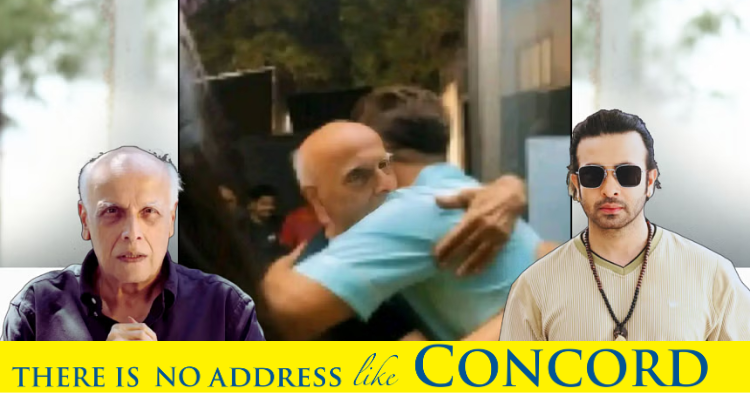
Before departing, Bhatt embraced Shakib in a heartfelt moment that has since gone viral. A photo of the embrace, widely shared on social media, has fueled discussions across film-related groups. While efforts were made to reach Shakib Khan, he was unavailable due to his busy shooting schedule.

"Mahesh Bhatt sat with Shakib and discussed how cinema can bridge ties between Bangladesh and India," Monir added. "Bhatt's family's legacy in Indian cinema is vast, and his interest in Bangladesh's film scene is truly encouraging. Who knows, something remarkable might come of this. He even invited Shakib for a future meeting."

The Bollywood stalwart also made time to meet each Bangladeshi crew member on set, greeting them with his characteristic warmth and humour.

Shakib Khan arrived in Mumbai on October 22 for "Borbaad", directed by Mehedi Hasan. Filming began on October 24, and the initial shooting phase will continue until November 10.

While "Borbaad" marks Hasan's debut as a director, he is already a prominent actor with over a hundred TV dramas to his name. The film reunites Shakib Khan with actress Idhika Paul, following their hit pairing in "Priyotoma".

Upon hearing of Mehedi Hasan's directorial debut, Bhatt extended his congratulations, even posting a heartwarming photo on Facebook where he's seen embracing Mehedi with a kiss on the cheek, surrounded by smiling crew members. In his response, Mehedi expressed his gratitude for the gesture.

Set as an action-packed romantic drama, "Borbaad" is slated for release next Eid-ul-Fitr.​
 
Analyze

Analyze Post

Add your ideas here:
Highlight Cite Respond
  • Like (+1)
Reactions: Bilal9

The challenges the film certification board faces

1730424070752.webp

VISUAL: STAR

Bangladesh is in the process of changing. Some call it progress, some term it disrespecting the past, while many seem to be showing the courage to face challenges that are common during transitions—painful, yet necessary. Changes are hard for sure, and one might admit that it is easier for things to remain as they have for centuries, for life to go on as it does in Bruegel's Landscape with the Fall of Icarus. It was, however, the Irish playwright and critic George Bernard Shaw who said that "progress is impossible without change, and those who cannot change their minds cannot change anything."

Ever since September 22, 2024, when the Bangladesh Film Censor Board was dissolved and the Bangladesh Film Certification Board was established, filmmakers and creators alike have been waiting for a positive change. As seen during major transitions all over the world, organisations go through re-shelving operations—to archive, discard and eventually introduce new ideas. Similarly, the new film certification board has been trying to do the same: pave new avenues, update policies, and learn more, in the process, about the survival techniques of the Bangladeshi film industry. But most importantly, the new committee is also trying to figure out ways to release the films that have been gathering dust for several years.

The basic difference between a censor board for films and a certification board is that of creating limits where content is concerned. "While one has the power to restrict the showcasing of movies according to the censorship act of 1963, the other analyses the content, and certifies releases for appropriate audiences based on age," says Rafiqul Anowar Russell, a filmmaker, an educator and also member of the current board. According to the rules or bidhimala created in 1977 and 1985 based on the act, the censor board had the power to either restrict a film or let it go with a clearance certificate.

The Censorship of Films Act, 1963, composed of board members designated by the government, would examine, review and certify films for public screening, adds Russell. According to Section 3 of the 1963 act, the board could basically determine if a film was viewable or right for the general audience or not. "In a nutshell, it was either yes or no from the board—if a film would be allowed to run or not," adds Russell.

In 2023, the government decided to amend the act, calling it the Bangladesh Chalachitra Certification Act, 2023. The newly formed film certification board focuses more on a "rating system" where films are rated and made available for age-appropriate audiences. This system is followed in countries like the US, UK and also in India. "Some of the most successful and biggest industries have been following the certification system for films for years," says Russell.

"Films do get pulled out even under the certification system, and this has happened in many developed industries as well," he adds. In rare cases, certain films were pulled out or not allowed to be released due to extreme levels of violence or nudity or even attacks on certain communities and minorities. However, according to Russell, while a censor board would restrict the release of at least 50-60 percent of films due to the existing rules related to the 1963 act, the certification system would still allow at least 90 percent of the films or more to be released, as long as they are tagged with the right age references.

Going back to the 1963 censorship act, two sets of rules or bidhimala were formed: the first one in 1977, and then the second in 1985, an elaboration of the previous set. Even though the act is not in existence anymore, the bidhilmala are, which include clauses, based on which a film can be restricted or cleared in terms of vulgarity, violence, nudity, obscenity, controversial topics, sensitive issues, etc showcased on screen.

Filmmaker and actor Khijir Hayat Khan says that there is a difference in mentality between the censor and the certification board in terms of philosophy and thought process. "There are these existing laws that we still have to abide by," referring to the rules from 1977 and 1985. "But it is definitely the mentality. We ask ourselves the questions: how and where do we want to see Bangladeshi films in the future? How much freedom do Bangladeshi filmmakers actually enjoy? And so much more. But there are some bigger issues that we have to overcome, which is forming the bidhimala or rules explaining the 2023 certification act. We are still following the explanations provided to us in 1977 and 1985. As per the constitution, if a set of rules does not exist, the law or act in question cannot be executed. Hence, we are actually stuck in between the old rules, filled with flaws, and a new act, which does not have any set of rules."

As seen during major transitions all over the world, organisations go through re-shelving operations—to archive, discard and eventually introduce new ideas. Similarly, the new film certification board has been trying to do the same: pave new avenues, update policies, and learn more, in the process, about the survival techniques of the Bangladeshi film industry. But most importantly, the new committee is also trying to figure out ways to release the films that have been gathering dust for several years.

Russell talks of several challenges that the current board faces. Starting from getting access to the films that were restricted by the previous regime or pending decisions from the High Court to creating a new law for the benefit of the filmmakers, the tasks at hand for the current board are turning out to be all the more strenuous and demanding than expected. "A major challenge for us is how to work around these rules and start the process of releasing films for age-appropriate audiences, the way we had always wanted to do," adds Russell. "Because the new act is still under construction, we have no choice but to follow the rules from 1977 and 1985 when it comes to reviewing films. Currently, we are also studying film certification acts and regulations of the more developed industries around the world and trying to implement them within our system."

There is also the issue of trying to secure access to the films which were restricted or "banned" for some reason or another by the previous regime. Quazi Nawshaba Ahmed, actor, theatre director, puppeteer and also one of the committee members of the certification board, says that the evidence of certain films being "officially banned" during the past regime is missing. "Of course, there were observations," she says. "The current certification board is taking the necessary steps to ensure that films don't stay in a 'hold' status. Only a few films are currently with the 'appeal' division, and those fall outside the scope of the board's work."

"We still do not have access to these films," says Russell. "It is necessary to review them so that the actual reason behind the restrictions could be understood. That would help the current board take proper steps to move forward as well."

The complications do not end there. For instance, Nawshaba says, "Production houses must clear all payments due to technicians and actors before the film is submitted for certification. A clearance certificate from the relevant industry association should be a mandatory document during the certification process, ensuring transparency and fairness in the payment of all professionals involved." She also emphasises animal welfare in films so that if animals are used in a film, it must be ensured that no harm is inflicted on them. "The certification board must have the authority to take legal action against those responsible if an animal's health is compromised due to the shoot. Scenes involving animal cruelty should be simulated through animation or VFX to prevent real harm," she adds.

Nawshaba also mentions including strict criteria to address the logical and illogical use of tobacco and alcohol on screen and speaks about how the certification board should consist of a diverse panel of members representing different sections of society.

Clearly, hopeful outcomes from the new establishment will take months or years of work, research and the final formation of the act and its accompanying set of regulations. One can either choose to be fearful of the many challenges and obstacles that are springing up like mushrooms, or simply embrace these changes to create a better Bangladesh for the future, as intended. After all, as Leo Tolstoy writes, "True life is lived when tiny changes occur."

Elita Karim is a singer and journalist.​
 
Analyze

Analyze Post

Add your ideas here:
Highlight Cite Respond
  • Like (+1)
Reactions: Bilal9

Shakib Khan injured during Mumbai shoot


1731199347948.webp

Photo: Collected

Superstar Shakib Khan is currently filming the film "Borbaad" in Mumbai, India. The production was progressing smoothly until an unexpected mishap occurred. The "Toofan" actor sustained an injury after accidentally colliding with a door on set. The impact of the incident was just above his eye, as film director Mehedi Hassan Hridoy shared with Prothom Alo.

According to the director, Shakib was promptly taken to a hospital in Mumbai, where a CT scan was conducted to assess the injury. The medical team reassured them that there was no immediate cause for alarm, though they prescribed him pain relief medication.

The filming of "Borbaad" is presently taking place at Ellora Studio in Mumbai. The film's director informed Prothom Alo on Friday night that the incident had occurred last Thursday afternoon. He explained, "In one scene, Shakib bhai was supposed to walk through a door, and we had prepared everything accordingly."

"While opening the door, he accidentally struck his forehead, resulting in a cut near his eyebrow. We immediately paused the shoot and rushed to the nearby hospital. After conducting all necessary tests, the doctor assured us there was no need for worry and provided the appropriate medication."

Director Hridoy expressed, "Shakib bhai's dedication and professionalism, even after sustaining an injury, left us all truly impressed."

He went on to explain, "Following the treatment, we headed back to the set. Our initial plan was to call off the day's shoot to let Shakib bhai rest. However, to our surprise, he insisted, "Let's carry on and wrap up the day's shoot." That evening, we resumed filming and continued until midnight. The following day, we were able to proceed with our shoot as originally scheduled."

Shakib Khan departed from Dhaka to Mumbai on October 22 to join the filming of "Borbaad". He commenced shooting at a studio there on October 24. While the original plan was to wrap up the first phase of filming by November 10, the director announced yesterday that this phase will now extend until November 16. After a brief intermission, they intend to begin the second and concluding phase of filming in December.

Director Mehedi Hassan Hridoy, known for directing over a hundred television dramas, is making his debut in film direction with "Borbaad". He is bringing back the popular on-screen pair of Shakib Khan and Idhika Paul, who previously starred together in "Priyotoma". This action-romantic film is being readied for a nationwide theatrical release during Eid-ul-Fitr next year.

In the meantime, Shakib Khan's film "Dard" is scheduled for release on November 15. The director, Anonno Mamun, has announced that the film will debut simultaneously in 20 countries. In "Dard," Shakib Khan is paired with Bollywood actress Sonal Chauhan.​
 
Analyze

Analyze Post

Add your ideas here:
Highlight Cite Respond
  • Like (+1)
Reactions: Bilal9

175 cultural activists call for a separate film division at BSA

1732495214010.webp

Bangladesh Shilpakala Academy | Star File Photo

In protest of the exclusion of the "Film" section from the "Drama and Film" sub-division in the revised Bangladesh Shilpakala Academy Act, 175 film-related individuals have issued a public statement, demanding the formation of a separate film division.

The statement presented arguments in support of this demand, signed by filmmakers, producers, cinematographers, editors, sound designers, film critics, researchers, teachers, film workers and organisers, actors, musicians, and photographers.

They argued that the new generation of filmmakers, capturing the nation's current aspirations and needs through diverse forms such as feature films, documentaries, and short films, should not rely on commercial entities for support. They believe that only a national institution like Bangladesh Shilpakala Academy can meet these expectations. They also expressed hopes that films would be showcased regularly across the Academy's district branches.

"We are shocked to see that the new draft ordinance has removed the 'Film' section from the previous 'Drama and Film' sub-division. We strongly protest this and demand that a separate film division be established," the signatories said.

Films have been part of the Bangladesh Shilpakala Academy since its inception. Based on this tradition and historical significance, removing the section from the Academy is unacceptable, they added.

At a time when the entire nation is united in rebuilding and reforming the country following the student-led mass uprising, films—one of the key branches of the arts—can best represent this new renaissance. Therefore, rather than excluding the section from the Academy, the government should establish a distinct film division, they urged.

Notable signatories include Nurul Alam Atique, N Rashed Chowdhury, Akram Khan, Shabnam Ferdousi, Tokon Thakur, Noman Robin, Wahid Tareq, Prasun Rahman, Redoan Rony, Khijir Hayat Khan, Palash Rasul, Krishnendu Chattopadhyay, Sadia Khalid Reeti, Zakia Bari Mamo, Rawnak Hasan, Deepak Suman, Shohel Mondol, Nahida Sharmin (Shormi Mala), Abdullah Al Sentu, Tanvir Ahmed, and Nasir Ali Mamun amongst many others.​
 
Analyze

Analyze Post

Add your ideas here:
Highlight Cite Respond
  • Like (+1)
Reactions: Bilal9

Shakib Khan’s ‘Toofan’ shatters two decades of records at Star Cineplex

1735258347366.webp

Photo: Collected

Star Cineplex, the country's most advanced cine-theatre, has marked 20 years since its establishment. This milestone year witnessed a groundbreaking achievement with the Shakib Khan-starrer "Toofan". The global blockbuster became the most successful movie at Star Cineplex, surpassing Hollywood and Bollywood hits.

Directed by Raihan Rafi, the film was released during last Eid-ul-Azha and broke several records at Star Cineplex, as confirmed by the country's biggest theatre franchise in an announcement on their official Facebook page.

Star Cineplex's Senior Marketing Officer Mesbah Uddin Ahmed, told Channel i Online, "'Toofan' has emerged as the most beloved film of the year. In fact, among all the movies screened at Star Cineplex over the past two decades, 'Toofan' holds the best record. Consequently, Star Cineplex considers the film to be unparalleled in every respect, both in commercial success and audience acclaim."."

However, two months after the release of "Toofan," student protests erupted in the country. Prior to that, the nation faced unusual circumstances, leading to widespread changes across all sectors.

Mesbah Ahmed added that if the country's situation had remained normal, "Toofan" might have reached even greater milestones.

Before Toofan, the highest-grossing films at Star Cineplex were "Avatar" and "Jawan". This year, however, "Toofan" surpassed both to become the top-performing movie.

The impact of "Toofan" wasn't limited to Cineplexes alone; it also made history in Bangladesh's single-screen theatres, with houseful shows running late into the night.

The film garnered blockbuster success not only in Bangladesh but also in over 20 countries worldwide. Encouraged by this tremendous response, its production company, Alpha i, is now amping up the production of "Toofan 2."

Chorki served as the digital partner for "Toofan", while its international collaboration was with SVF. The film boasted a star-studded cast, including Shakib Khan, Mimi Chakraborty, Masuma Rahman Nabila, Misha Sawdagar, Fazlur Rahman Babu, Shahiduzzaman Selim, Salahuddin Lavlu, and many others.

Adnan Adib Khan penned the screenplay, while Tahsin Rahman managed the cinematography. The art direction was overseen by Shihab Nurun Nabi, with costume design by Farzana Sun.​
 
Analyze

Analyze Post

Add your ideas here:
Highlight Cite Respond
  • Like (+1)
Reactions: Bilal9

Members Online

Latest Posts

Back
PKDefense - Recommended Toggle