Home Watch Videos Wars Movies Login

[🇧🇩] Bangladesh Railway

[🇧🇩] Bangladesh Railway
92
6K
More threads by Saif

G Bangladesh Defense

Govt should change obsolete railway law to better services

THE state of the Bangladesh Railway’s legal framework is concerning. A New Age report says that efforts by successive governments to amends the 136-year-old British-era railway law with a view to improving passenger services, safety and preventing fraud have remained stalled for seven years without any tangible progress. Railways ministry officials say that the Railway Act 1890 needs to be revised to reflect technological advancement, incorporate provisions against digital fraud and update fines for various offences, many of which have become outdated and ineffective. They also say that the proposed reform would provide for harsher punishments for offences, improve passenger services and address allegations of underhand ticket sales by dishonest railway employees despite the introduction of online ticketing. The government has initiated a fresh review of the draft amendment to the law prepared during the previous administration after deciding that the earlier draft was inadequate. Officials, however, have indicated that the process of finalising the legislation will require further reviews and consultations and could still take several years. The proposed law with 157 sections is expected to replace the existing law and incorporate modern provisions aimed at better protection of passengers and railway property.

The prolonged failure to update the law has implications that extend far beyond an outdated statute. A legal framework that does not keep pace with technological and operational changes weakens the state’s ability to prevent emerging forms of fraud, hold offenders accountable and protect passenger rights. The introduction of online ticketing was expected to improve transparency. Yet, studies find that mismanagement, corruption and procedural weaknesses continue to undermine service quality and public confidence, indicating that technological innovation alone cannot overcome institutional shortcomings. The reported resistance of vested interests to stronger penalties further suggests that the reform process is constrained by institutional interests rather than guided by passenger welfare. Such resistance should reinforce, rather than weaken, the government’s resolve to enact meaningful reforms. The Anti-Corruption Commission earlier identified corruption in at least 10 areas of the Bangladesh Railway, including ticket sales, procurement, recruitment and land management, and recommended measures to improve accountability. The proposed legislation should, therefore, be accompanied by transparent implementation rules, digital audit mechanisms, regular independent oversight and defined accountability for officials responsible for enforcing the law. The new law is, otherwise, unlikely to deliver the institutional transformation necessary to improve governance, curb corruption and restore public confidence.

The government should, therefore, expedite the amendment process and ensure that the new law is accompanied by robust enforcement mechanisms, independent oversight and institutional accountability instead of allowing it to remain another delayed legal exercise. Legal reform will have little practical value if the institutions entrusted with implementing it continue to operate under the same culture of impunity that has impeded efficient railway services.​
 
Analyze

Analyze Post

Add your ideas here:
Highlight Cite Respond

Fast-tracking railway's latest master plan

1787354097109.webp


The Bangladesh Railway (BR), one of the oldest public transport systems in the country, has remained for far too long a neglected sector despite the railway emerging globally as the most modern, efficient and rapidly developing mode of land-based mass transport. Against this backdrop, the report that the BR has drafted its third master plan, envisaging an investment of around Tk2.9 trillion by 2060, is no doubt a development worth noting. The draft, prepared reportedly with BR's own resources, proposes 118 civil projects focusing on demand-based track development, electrification, unification of the mixed-gauge network and expansion of railway services to 10 more districts. Priority schemes include the Bogura-Sirajganj, Joydebpur-Ishwardi, Akhaura-Sylhet and Tongi-Bhairab dual-gauge double lines. What is more, the plan is expected to integrate track development with procurement of coaches and locomotives, maintenance facilities, workshops and manpower development. This is important because railway development cannot simply mean laying new tracks while trains, skilled hands and maintenance facilities remain in short supply.

Indeed, Bangladesh's experience with railway planning has not always been an enviable one. The first master plan, approved in 2013, envisaged 235 projects, while its revised version, approved in 2019, proposed 215 projects to be completed by 2045. Some important schemes including the Padma Bridge rail link and the Dohazari-Cox's Bazar line have since been completed, yet many projects under the existing plan are unlikely to be implemented within its stipulated period. Meanwhile, the country now has around 3,400 kilometres of rail network, but shortages of locomotives, coaches and operational facilities have often prevented the infrastructure already built from being utilised fully. More significantly, railway's share in freight movement remains below 5.0 per cent, though the government's transport strategy reportedly aims to raise it to at least 20 per cent. Small wonder that expansion of tracks alone has failed to transform the BR into a dependable passenger and freight carrier a densely-populated and fast-urbanizing economy needs. The third master plan should, therefore, learn from the mismatch between physical expansion and actual service delivery.

At this point, however, the government needs to distinguish between what can be delivered now and what necessarily belongs to the longer horizon. Projects capable of improving the quality, frequency and reliability of train services within the tenure of the incumbent government should be identified and put on the fast track. Issues like double-tracking congested corridors, completing missing links, modernising signalling, procuring adequate locomotives and carriages, introducing electric traction on suitable busy routes and so on are hardly ambitions that should remain on paper for decades. In particular, the proposed electrification of the Narayanganj-Dhaka-Joydebpur corridor and its extension towards Chattogram deserves serious attention. The point is that people should be able to experience visible improvement in railway service during the present government's term. Otherwise, another long list of projects extending to 2060 may end up becoming yet another catalogue of aspirations whose deadlines are repeatedly shifted and costs revised.

Long-term planning should not be confined to catching up with what other countries have achieved. Notably, high-speed rail is expanding rapidly, with over 56,000 kilometres in operation globally, and Bangladesh cannot indefinitely remain outside that transition. In fact, there is history of earlier moves to explore a high-speed railway between Dhaka and Chattogram. Even if today's fiscal realities do not permit immediate construction of such an expensive system, the third master plan should reserve corridors, undertake feasibility studies, protect land and create infrastructure standards compatible with high-speed trains. For a small, densely populated country where major economic centres are separated by manageable distances, faster rail can change the geography of travel, business and regional development. But visions for 2060 will have value only if today's basic railway is first made efficient, safe and reliable. So, the government would do well to act fast on achievable railway modernisation projects while laying the infrastructural groundwork for the high-speed railway in the future.​
 
Analyze

Analyze Post

Add your ideas here:
Highlight Cite Respond

US Ambassador highlights American engineering in Bangladesh’s railway connectivity

Staff Correspondent
Published: 01 Sep 2026, 20: 30

1788306978772.webp

US Embassy in Dhaka

US Ambassador Brent T Christensen visited Bangladesh Railway’s Central Locomotive Workshop in Parbatipur, where Bangladeshi technicians maintain American-made locomotives supporting passenger and freight transportation across the country.

The US Embassy in Dhaka said this in a press release sent to the media by US Mission spokesperson Poornima Rai on Tuesday.

1788307008930.webp

US Embassy in Dhaka

Ambassador Christensen toured the workshop, viewed a locomotive manufactured by US company Progress Rail, and met the Bangladeshi railway professionals who maintain the locomotives.

He then traveled by train to Saidpur, spoke with passengers, and visited the historic Saidpur Railway Workshop and Museum.

1788307041006.webp

US Embassy in Dhaka

Bangladesh Railway’s purchase of 40 Progress Rail locomotives demonstrates how US exports and technology can support Bangladesh’s infrastructure and development priorities.

The visit highlighted the practical and enduring value of expanded trade and commercial cooperation between the United States and Bangladesh.​
 
Analyze

Analyze Post

Add your ideas here:
Highlight Cite Respond

Bangladesh Railway plans first electric train project worth Tk 38.23b

Project likely to be placed before the ECNEC today


1789533602353.webp


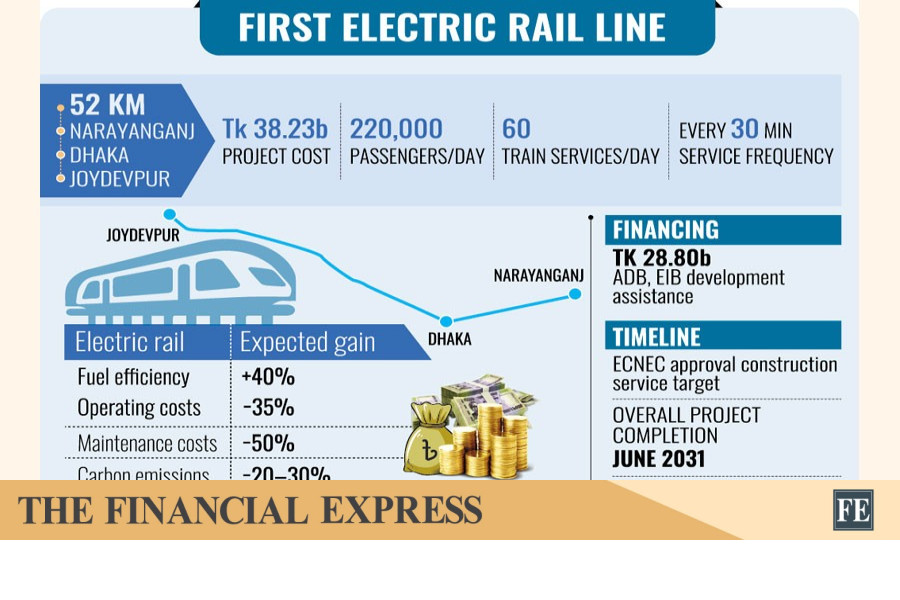
Bangladesh Railway is set to take its first major step towards electrifying the country's rail network with a Tk38.23-billion project to build an electric train line connecting Narayanganj, Dhaka and Joydevpur.

Upon its completion, the project aims to run 60 daily services every 30 minutes and carry around 220,000 passengers a day on the 52-kilometre route, BR officials said.

Each of the trains will carry up to 3,600 passengers, with five-car EMUs (Electric Multiple Units) plying the route, they said.

Two sets of EMUs will operate every 30 minutes from 6:00am to midnight, the BR said.

The project is likely to be placed before the ECNEC (Executive Committee of the National Economic Council) today (Wednesday) for approval.

"It will be our first initiative to build an electric train line in Bangladesh. If the ECNEC approves the project, we will go ahead with constructing the railway line," said a senior official at the Ministry of Railways (MoR).

He said the train would be a commuter service carrying thousands of passengers daily between Narayanganj, Dhaka and Joydevpur.

Dhaka is one of the busiest cities in the world and suffers from massive traffic gridlock. The proposed electric train will operate at a higher speed than conventional trains.

According to the BR, a workshop for electric trains and EMUs will be constructed somewhere between Joydevpur and Mouchak in Gazipur.

According to the BR project proposal, the Asian Development Bank (ADB) and the European Investment Bank (EIB) will provide Tk28.80 billion in development assistance.

The project is scheduled to be implemented by June 2031, BR officials said.

Electric trains offer 40 per cent greater fuel efficiency and are expected to reduce operating costs by 35 per cent and maintenance costs by up to 50 per cent compared with current levels. Additionally, carbon emissions are expected to decrease by 20 to 30 per cent.

Initially, the service will operate across three districts, with plans also in place to introduce electric trains on the Dhaka-Chittagong route.

The Development Project Proposal (DPP) states that electric trains will bring significant changes to the economy and transport sector.

Electric trains can accelerate and decelerate much faster than diesel engines, allowing them to reach top speeds quickly after departing from stations.

Consequently, travel time on the Narayanganj-Dhaka-Joydevpur route is expected to be cut by more than half.

Bangladesh Railway currently uses diesel-electric traction. Official documents say the proposed electric system will be roughly 40 per cent more fuel-efficient and allow significantly higher operating speeds.

Indian Railways has electrified 99.6 per cent of its broad-gauge network, completing one of the world's largest infrastructure transformation programmes in a decade.

Switzerland is the first country to have 100 per cent electric train lines across the country.​
 
Analyze

Analyze Post

Add your ideas here:
Highlight Cite Respond

Three more trains to be handed over to private management to increase revenue

Sujan Ghose
Chattogram

1790381496020.webp

Bangladesh Railway File photo.

Railway Eastern Zone has taken an initiative to hand over the commercial operations of three more trains to private management to increase revenue. The trains are the Jaria Local on the Mymensingh–Jaria Jhajhaingail route, Narayanganj Commuter on the Dhaka–Narayanganj route and Narsingdi Commuter on the Dhaka–Narsingdi route.

At present, eight trains in the Eastern Zone are operated under private management. With the addition of the three new trains, the number will rise to 11.

Railway officials say that because of a shortage of manpower, tickets cannot be checked regularly for all passengers. Many people board trains without tickets. Others buy tickets for shorter distances but travel to destinations farther away.

Against this backdrop, the three trains are being considered for private management. Officials expect this to make ticket sales, ticket inspection and fare collection more effective.

Sujit Kumar Biswas, chief commercial manager of Railway Eastern Zone, told Prothom Alo that the railway expects to earn more revenue from the three trains once they are placed under private management.

The eight trains currently operating under private management in the Eastern Zone are Karnaphuli Commuter on the Dhaka–Chattogram route, Sagarika Commuter on the Chattogram–Chandpur route, Balaka Commuter on the Dhaka–Jaria Jhajhaingail route, Titas Commuter on the Dhaka–Akhaura route, Titas Commuter on the Dhaka–Brahmanbaria route, Mahua Commuter on the Dhaka–Mohanganj route, Jamalpur Commuter on the Dhaka–Dewanganj Bazar route and Dewanganj Commuter.

Decision taken for six trains, three for now

According to railway sources, a decision was taken in April this year to place six trains under private management to improve passenger services and increase revenue.

Besides Jaria Local, Narayanganj Commuter and Narsingdi Commuter, the list included Samatat Express on the Noakhali–Laksam route, Noakhali Express on the Noakhali–Dhaka route and Nazirhat Local on the Chattogram–Nazirhat route.

However, sources in Railway Eastern Zone said only three trains are being handed over to private management for now. Samatat Express and Noakhali Express are currently out of service because of a shortage of locomotives.

Nazirhat Local, meanwhile, is not being handed over to private management at this stage because an initiative has been taken to upgrade its coaches. Once the upgrade is complete, the train is also planned to be placed under private management.

The Jaria Local, which is being considered for private management for now, operates eight times a day (four pairs), Narayanganj Commuter 16 times (eight pairs) and Narsingdi Commuter twice (one pair). Railway recently published a tender notice to appoint private contractors to handle the commercial operations of the three trains. Tender forms can be collected until 5 October, and the deadline for submitting bids is 6 October.

Ticket inspection difficult

Railway officials say passenger turnover is high on local and commuter trains. These trains operate over short distances and stop at many stations along the way. As a result, large numbers of passengers board and get off at each station. Adequate manpower is needed to check their tickets and manage passengers.

However, the railway has been facing a manpower shortage for a long time. In particular, because of shortages in the commercial department, including ticket examiners, it is not possible to check tickets regularly on all trains.

As a result, passengers can sometimes board trains without buying tickets at the station. Others travel to destinations farther away after buying tickets for only part of the journey. This causes revenue losses for the railway. Railway officials believe that assigning responsibility for ticket sales and inspection, fare collection and record-keeping to private companies could help reduce the number of passengers travelling without tickets.

Three trains generate nearly Tk 45 million

According to railway data, Narayanganj Commuter, Narsingdi Commuter and Jaria Local generated Tk 44.4 million in revenue in the latest 2025–26 fiscal year. During the period, the three trains carried 1.095 million passengers. Railway officials expect these trains to generate more revenue after being placed under private management.

According to railway data, the eight trains whose commercial operations are currently being managed privately generated Tk 105.1 million in revenue when they were last operated under government management. After being placed under private management, they generated Tk 263.3 million in the 2024–25 fiscal year. That means revenue increased by Tk 158.2 million.​
 
Analyze

Analyze Post

Add your ideas here:
Highlight Cite Respond

Latest Posts

Back
 
G
O
 
H
O
M
E