Bangladesh Defense
Saif
Senior Member
- Jan 24, 2024
- 21,479
- 9,743
- Nation

- Residence
- Axis Group

Tourism picks up as hotels, resorts report 60% occupancy
Hotels and resorts in major tourist destinations across Bangladesh are reporting 60 percent to 80 percent occupancy this December, showing strong demand and a busy holiday season.
Tourism picks up as hotels, resorts report 60% occupancy

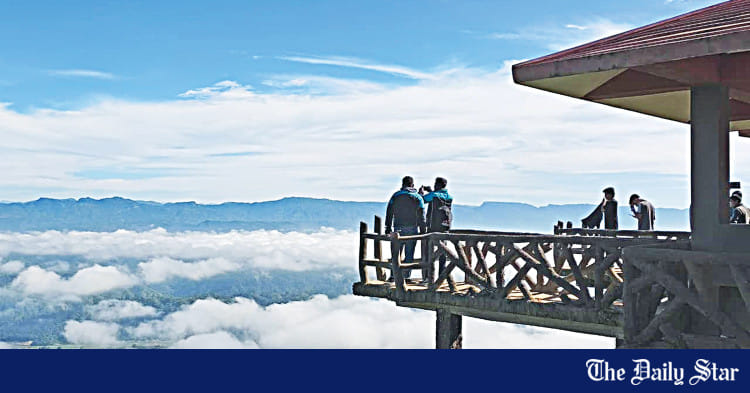
Tourists capture photos and enjoy the views at Double Hands View Point on Bandarban-Thanchi road, as the tourism sector bounces back after last year’s dip. The photo was taken recently. Photo: Mong Sing Hai Marma
Hotels and resorts in major tourist destinations across Bangladesh are reporting 60 percent to 80 percent occupancy this December, showing strong demand and a busy holiday season.
Business owners said that political instability last December had caused a drop in tourism, but this year, visitor numbers have returned to normal levels.
The peak tourism season in the country runs from November to April. According to the Bangladesh Bureau of Statistics, tourism accounted for 3 percent of the country's GDP and 8 percent of total employment in the fiscal year 2018-19.
Abdul Awal, group director of sales and marketing at Sea Pearl Beach Resort in Cox's Bazar, said the resort is seeing a seasonal increase in business, with occupancy around 60 percent, similar to 2023.
"2024 was an exception due to political uncertainty, but the current performance reflects a return to normal patterns," he said.
Awal added that most visitors stay for two days, as Cox's Bazar has limited attractions beyond the beach. "Group bookings, conventions, and incentive travel continue to be our strongest business segments," he said.
Rana Karmakar, operations manager of Mermaid Beach Resort in Cox's Bazar, said that despite the upcoming election, business is doing well this December.
"Reservations are better than in 2024, which was an unpredictable year due to significant political uncertainty. Compared to 2023, reservations are also strong and broadly similar," he said.
Karmakar added that occupancy in December is currently around 80 percent, similar to December 2023, which is generally satisfactory.
However, he noted a decline in out-of-house restaurant guests, particularly foreign tourists. "Earlier, many tourists who could not stay at the resort would eat at the restaurant at least once during their visit, but that is no longer the case," he said.
He attributed this to reduced tourist movement caused by security concerns and poor road conditions.
Md Bahar Khan, senior supervisor of The Palace Luxury Resort in Bahubal, Habiganj, said that average occupancy this December is around 60 percent, slightly lower than December 2023.
"We are seeing a lower response this year due to political uncertainty and ongoing road construction on the Dhaka–Sylhet route, which has increased travel time," he said. Despite this, he described business as moderately stable during the peak season.
Imranul Alam, managing director of Tour Group Bangladesh, which runs resorts and other tourism businesses across the country, said business is performing reasonably well, but profits have dropped to about one-third of the level recorded in 2023.
"Although there is a demand for travel to Saint Martin's Island, the shortage of ship tickets and long, uncomfortable journeys have significantly discouraged tourists," he said.
Alam added that many regular visitors who previously travelled every year are no longer coming and have discouraged their friends and family based on recent experiences.
He further said, "The journey to Saint Martin's now takes more than six hours by sea, in addition to long boarding and disembarkation times and severe congestion at the jetty. These issues have reduced tourist mobility and shortened travel plans."
"Visitors are becoming more selective, opting for higher-end resorts to justify the increased travel expenses," he added.
"Overall occupancy for Sajek resorts in December is around 70 percent," said Suparna Deb Barman, president of the Cottage Malik Samity of Sajek, a forum of resort owners.
"Sajek is no longer empty at any time, with visitors coming even on weekdays. Fridays and Saturdays are the busiest, but tourist activity continues throughout the week. On dates like December 26 and 27, accommodations are fully booked," Barman said.
She added, "The season here gradually starts in August and lasts through February, with activity peaking during this period."
Md Rafeuzzaman, president of the Tour Operators Association of Bangladesh, said, "This December is performing better than December 2024, with bookings close to a normal season."
He added, "Although political tensions ahead of the upcoming election have slowed tourism, the sector is expected to improve further in 2026 once a new government is in place."
Tourists capture photos and enjoy the views at Double Hands View Point on Bandarban-Thanchi road, as the tourism sector bounces back after last year’s dip. The photo was taken recently. Photo: Mong Sing Hai Marma
Hotels and resorts in major tourist destinations across Bangladesh are reporting 60 percent to 80 percent occupancy this December, showing strong demand and a busy holiday season.
Business owners said that political instability last December had caused a drop in tourism, but this year, visitor numbers have returned to normal levels.
The peak tourism season in the country runs from November to April. According to the Bangladesh Bureau of Statistics, tourism accounted for 3 percent of the country's GDP and 8 percent of total employment in the fiscal year 2018-19.
Abdul Awal, group director of sales and marketing at Sea Pearl Beach Resort in Cox's Bazar, said the resort is seeing a seasonal increase in business, with occupancy around 60 percent, similar to 2023.
"2024 was an exception due to political uncertainty, but the current performance reflects a return to normal patterns," he said.
Awal added that most visitors stay for two days, as Cox's Bazar has limited attractions beyond the beach. "Group bookings, conventions, and incentive travel continue to be our strongest business segments," he said.
Rana Karmakar, operations manager of Mermaid Beach Resort in Cox's Bazar, said that despite the upcoming election, business is doing well this December.
"Reservations are better than in 2024, which was an unpredictable year due to significant political uncertainty. Compared to 2023, reservations are also strong and broadly similar," he said.
Karmakar added that occupancy in December is currently around 80 percent, similar to December 2023, which is generally satisfactory.
However, he noted a decline in out-of-house restaurant guests, particularly foreign tourists. "Earlier, many tourists who could not stay at the resort would eat at the restaurant at least once during their visit, but that is no longer the case," he said.
He attributed this to reduced tourist movement caused by security concerns and poor road conditions.
Md Bahar Khan, senior supervisor of The Palace Luxury Resort in Bahubal, Habiganj, said that average occupancy this December is around 60 percent, slightly lower than December 2023.
"We are seeing a lower response this year due to political uncertainty and ongoing road construction on the Dhaka–Sylhet route, which has increased travel time," he said. Despite this, he described business as moderately stable during the peak season.
Imranul Alam, managing director of Tour Group Bangladesh, which runs resorts and other tourism businesses across the country, said business is performing reasonably well, but profits have dropped to about one-third of the level recorded in 2023.
"Although there is a demand for travel to Saint Martin's Island, the shortage of ship tickets and long, uncomfortable journeys have significantly discouraged tourists," he said.
Alam added that many regular visitors who previously travelled every year are no longer coming and have discouraged their friends and family based on recent experiences.
He further said, "The journey to Saint Martin's now takes more than six hours by sea, in addition to long boarding and disembarkation times and severe congestion at the jetty. These issues have reduced tourist mobility and shortened travel plans."
"Visitors are becoming more selective, opting for higher-end resorts to justify the increased travel expenses," he added.
"Overall occupancy for Sajek resorts in December is around 70 percent," said Suparna Deb Barman, president of the Cottage Malik Samity of Sajek, a forum of resort owners.
"Sajek is no longer empty at any time, with visitors coming even on weekdays. Fridays and Saturdays are the busiest, but tourist activity continues throughout the week. On dates like December 26 and 27, accommodations are fully booked," Barman said.
She added, "The season here gradually starts in August and lasts through February, with activity peaking during this period."
Md Rafeuzzaman, president of the Tour Operators Association of Bangladesh, said, "This December is performing better than December 2024, with bookings close to a normal season."
He added, "Although political tensions ahead of the upcoming election have slowed tourism, the sector is expected to improve further in 2026 once a new government is in place."