Home Watch Videos Wars Login

[🇧🇩] Banking System in Bangladesh

[🇧🇩] Banking System in Bangladesh
277
9K
More threads by Saif

G Bangladesh Defense

Banks' surging investments in bills, bonds shrink loanable funds
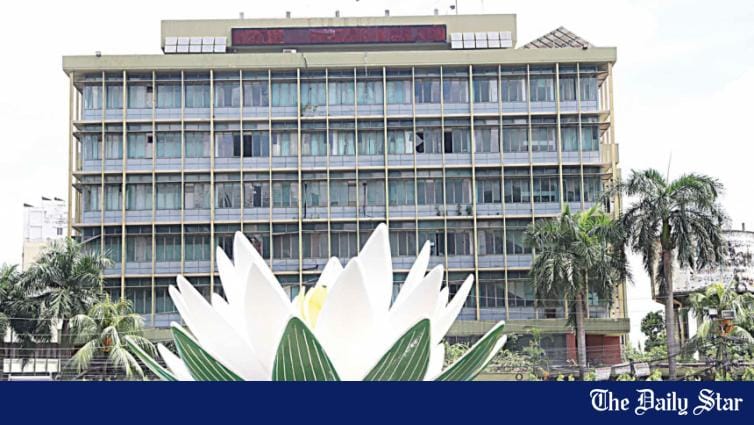
1718579066846.webp


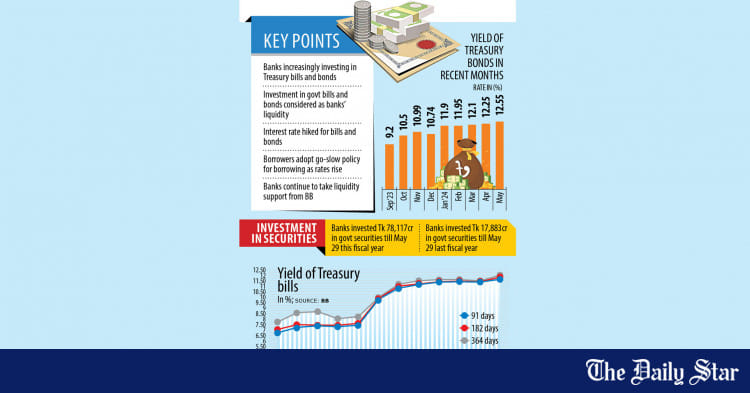
Banks in Bangladesh are increasing their investments in Treasury bills and bonds to net higher profits from the rising interest rate, a development that has squeezed the availability of loans for borrowers.

This has forced a section of banks to continuously secure liquidity support from the Bangladesh Bank to meet their day-to-day fund requirements.

The government has used the bills and bonds to borrow Tk 78,117 crore from banks between July 1 and May 29 this fiscal year, up 337 percent from Tk 17,883 crore during the same period a year ago, central bank data BB showed.

The escalated borrowing through bills and bonds came after the central bank stopped lending to the government since such injection of funds into the economy fuels inflation, which has stayed above 9 percent for nearly two years and shows no signs of cooling.

The government plans to borrow Tk 137,500 crore from banks to finance the deficit in the proposed budget for 2024-25.

Banks are also more interested in investing in bills and bonds than lending to the private sector because of the rising interest rate. Government instruments are also secure whereas loans can turn sour.

"Therefore, banks are keener about Treasury bills and bonds and a major portion of their surplus liquidity has been invested in the tools," a central banker said.

The interest rate of Treasury bills now ranges from 11.60 percent to 12 percent whereas it was 6.75 percent to 7.75 percent in June last year. The interest rate of bonds recently jumped to a 15-year high of 12.75 percent.

Bills have short-term maturities while bonds have long maturities.

Owing to the higher investments by banks in government securities, excess liquidity, which includes cash and cash-equivalent assets, including Treasury bills and bonds, has risen in the banking system.

Excess liquidity stood at Tk 1,76,205 crore at the end of April, up 5 percent from Tk 1,66,825 crore a month earlier, central bank data showed.

A senior banker said although bills and bonds are considered liquid assets, they can't be turned into cash instantly because the secondary market is yet to become vibrant. Thus, the volume of surplus liquidity reported by the BB is not the actual liquid asset situation.

"This is evidenced by the liquidity stress confronting several banks."

Banks have collectively obtained around Tk 20,000 crore from the central bank through repo (repurchase agreement) and assured liquidity support tools in the past six months.

Mirza Elias Uddin Ahmed, managing director of Jamuna Bank, said although the surplus liquidity has increased, many banks are still taking liquidity support from the central bank.

"There is a liquidity mismatch in the banking sector. Some Islamic banks have been experiencing a liquidity crisis for more than one year. This has impacted the overall banking sector."

Another factor that has made banks cautious when it comes to lending is unbridled bad loans: default loans hit an all-time high of Tk 182,295 crore in March.

The demand for fresh loans has also declined as there has been a slowdown in the economy for the past two years owing to the lingering impacts of the coronavirus pandemic and the Russia-Ukraine war.

Recently, borrowers have adopted a go-slow approach in expanding their footprint amid the climbing interest rate.

Customers enjoyed a maximum 9 percent lending rate between April 2020 and June last year after the central bank introduced the ceiling to keep the cost of funds lower with a view to spurring industrialisation. However, amid lingering inflation, it was forced to scrap the cap in July last year, and on May 8, it even left the interest rate in the hands of the market.

To read the rest of the news, please click on the link above.
 
Analyze

Analyze Post

Add your ideas here:
Highlight Cite Fact Check Respond

Push-button mobile banking outshining traditional bank operations
Published :
Jun 20, 2024 00:06
Updated :
Jun 20, 2024 00:06
1718840582583.png


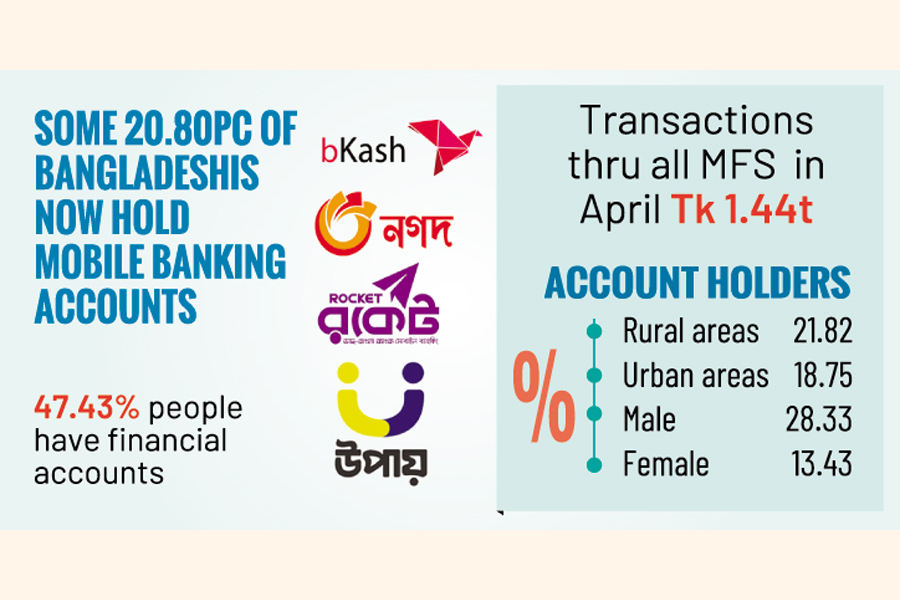
Push-button mobile banking is flourishing fast as 20.80 per cent of Bangladesh's people now hold such device-based bank accounts with unbanked population increasingly coming under its network, latest official findings show.

As of last April, the volume of transactions through all types of MFS ballooned to Tk 1.44 trillion.

Mobile-banking transactions can be done by using the mobile phone or from agent points. This is now much popular as Tk 25,000 can be transacted a day by an accountholder or Tk 150,000 a month.

In rural areas, the rate of mobile accountholders is 21.82 per cent while 18.75 per cent in urban areas.

Such picture comes clear from a latest survey conducted by Bangladesh Bureau of Statistics or BBS under the headline 'Socioeconomic and Demographic Survey 2023'. Population aged 10 years and above in the country with account in financial services came under such headcount.

They mainly open account with leading mobile-phone financial services --- bKash, Nagad, Rocket, Upay etc --with the rate being 28.33 per cent for male and 13.43 per cent for female.

The national statistical bureau says if a person has an account in a bank or non-bank financial institution, either individually or jointly, with any institution where financial transactions occur, that person is regarded as an accountholder in that financial institution.

Some 18.09 per cent have accounts with multiple financial institutions-with 26.02 per cent and 10.33 per cent for male and female respectively.

It is stated that 47.43 per cent of people in the country have financial accounts in banks, financial institutions, MFS, insurance, microcredit institutions, post offices, capital markets (BO or beneficiary owner account) and National Savings Directorate.

However some 52.57 per cent of the population does not have any account in financial institution.

In banks, some 5.85 per cent of the population has accounts while 0.09 per cent in non-bank financial institutions. Some 2.36 per cent of people have accounts with microcredit institutions or NGOs while 0.11 per cent in insurance companies.

And 0.10 per cent of the people have accounts with cooperative societies while 0.02 per cent in post office accounts.

Upcountry area like Rangpur division has the highest number of MFS accounts of 28.1 per cent followed by Barishal with 24.26 per cent.

Chattogram has the lowest number of MFS accounts at 18.11 per cent.

"Government payments and salary disbursement and cash-out transactions are major products," says the BBS in its survey report.

Currently, 10 banks and 3 subsidiary companies are providing MFS as an alternative payment channel in the country.​
 
Analyze

Analyze Post

Add your ideas here:
Highlight Cite Fact Check Respond

Islami Bank dethrones Sonali Bank to become largest lender by deposits
1719789025243.webp


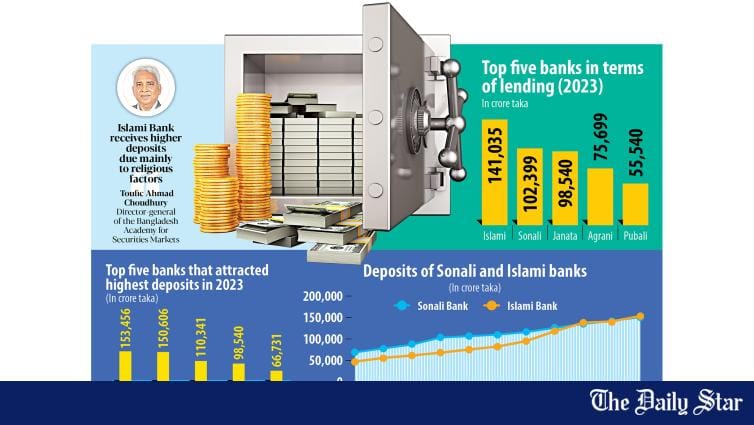
Islami Bank Bangladesh PLC has become the largest lender in the country by total deposits for the first time, surpassing Sonali Bank PLC, despite loan scams in recent years.

The Shariah-compliant bank attracted deposits of Tk 153,456 crore in 2023, an increase of around 9 percent year-on-year.

Sonali Bank, the largest state-run lender, mobilised deposits worth Tk 150,606 crore, up 6 percent, according to the financial reports.

This makes Islami Bank the largest bank in Bangladesh in terms of deposits and loans (investments). Its lending has been much higher than the state-run lender for several years.

"Islami Bank receives higher deposits due mainly to religious factors," said Toufic Ahmad Choudhury, director-general of the Bangladesh Academy for Securities Markets.

"Apart from this, people have limited investment opportunities to keep their funds safe. People can buy land and flats, but they are also cheated. Therefore, banks have managed to retain the trust of depositors."

Established in 1983, Islami Bank was the first Shariah-based bank in Southeast Asia. It has been facing crisis since 2017 when S Alam Group took it over. Since then, its financial health has been deteriorating and many sponsors have already pulled out.

It has recently come under scrutiny due to widespread financial scams. For example, the bank allegedly disbursed Tk 7,246 crore in loans to nine companies in 2022 violating banking norms.

Choudhury, also a former director-general of the Bangladesh Institute of Bank Management, said many depositors don't bother about whether banks are safe options or not, and they have little knowledge about how financial institutions use the funds to generate incomes.

Private banks are also expanding their footprint by setting up agent banking outlets and by launching mobile financial services and internet banking. On the back of new technologies, they are growing fast while state-run banks are lagging.

In terms of network, Sonali Bank is still the largest lender in Bangladesh and much ahead of Islami Bank.

Islami Bank had 394 branches at the end of 2023 whereas it was 1,232 for Sonali Bank. State-run Agrani Bank came second with 978 branches and Janata was third-placed with 928 branches.

Choudhury said Sonali Bank has to give many government services, and it can't focus on collecting deposits like its private-sector competitors. "However, this bank's financial performance is improving."

Historically, people have had more trust in state-run banks, and they expanded their footprint across the country through branches, which netted them comparatively higher deposits.

Janata Bank collected the third-highest volume of deposits of Tk 110,341 crore last year. It was Tk 98,540 crore for Agrani Bank, Tk 66,731 crore for Rupali Bank, and Tk 60,574 crore for Pubali Bank, their financial reports showed.

Among the foreign banks, Standard Chartered Bangladesh raised the highest deposit at Tk 41,940 crore, a year-on-year increase of around 15 percent.

Pubali Bank posted a 19 percent growth to Tk 60,574 crore, becoming the top deposit collector among local conventional banks.

A top banker said depositors of Shariah-based banks usually don't keep funds with conventional banks, and the number of depositors in Islamic banks is rising steadily.

"Besides, financially strong and sound banks get more deposits."

Islami Bank lent Tk 141,035 crore in 2023. Sonali Bank came second in the category by extending loans amounting to Tk 102,399 crore.

Janata, Agrani, and Pubali Bank were among the top lenders.

Although Islami Bank topped the chart in attracting deposits and providing loans, it ranked lowly in the list of top profit-makers.

Standard Chartered Bangladesh posted the highest profit among all banks, netting a record Tk 2,335 crore in 2023 followed by HSBC's Tk 999 crore, BRAC Bank's Tk 827 crore, Dutch-Bangla Bank's Tk 801 crore, Sonali Bank's Tk 747 crore, and Pubali Bank's Tk 697 crore.

Another top banker said many people keep their funds with Shariah-based banks even if they offer a lower return or their financial strength is weak.

"They keep funds with a view to avoiding interests in conventional banks. Even, some of my close relatives don't keep funds in my banks," he said. "So, this is a pure case of belief."​
 
Analyze

Analyze Post

Add your ideas here:
Highlight Cite Fact Check Respond

State banks nowhere near target to retrieve funds from top defaulters


1720572377182.webp


Four state-run banks in Bangladesh are finding it difficult to recoup loans from their top 20 defaulters, a failure that has worsened their financial health and squeezed their capacity further to lend.

Sonali, Janata, Agrani and Rupali repeatedly hit the loan recovery target set by the central bank as per its memorandum of understanding (MoU) with the four largest banks of the country by branches.

It came although the government is under pressure to reduce the bad loans of state-run banks to 10 percent by 2026 as per prescriptions of the International Monetary Fund as part of its $4.7 billion loan programme.

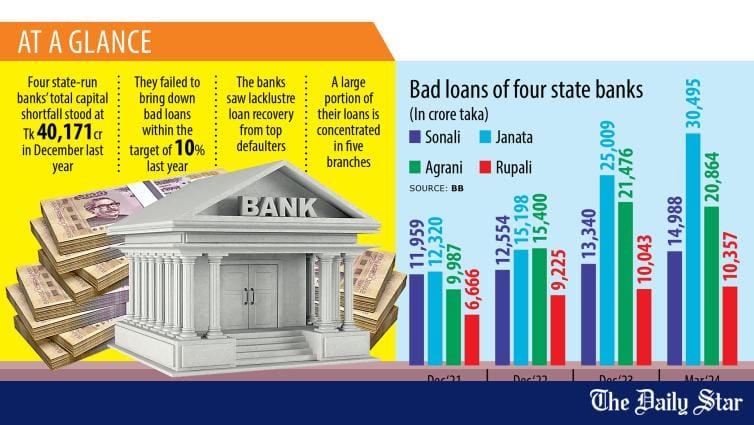
Bad loans held by the six state-owned banks, which also include Bangladesh Development Bank Ltd and BASIC Bank, totalled Tk 65,781 crore in December, making up 20.99 percent of their outstanding credits.

Last year, Sonali Bank was asked to recoup Tk 300 crore from the top defaulters, data from the Bangladesh Bank showed. The lender managed to recover only 12 percent of the amount fixed. It was, however, an improvement from the 4 percent posted in 2022.

The bank's bad loans amounted to Tk 13,340 crore in December. Of the sum, more than Tk 4,000 crore was held by the top 20 defaulters.

T & Brothers, Hallmark Group, Modern Steel Mills, Fairtrade International, Ratanpur Steel Re-Rolling Mills, and Sonali Jute Mills are the largest delinquent borrowers.

Among them, Hallmark's loan hit hard the largest lender of Bangladesh by branches.

The bank's Ruposhi Bangla Hotel branch lent Hallmark Group and five other companies Tk 3,547 crore between 2010 and 2012 on forged documents. The businesses embezzled the entire amount in collusion with some bank officials.

Officials said that despite repeated attempts, the bank has not been able to make significant gains in reclaiming funds from the major defaulters.

Speaking to The Daily Star, Md Afzal Karim, managing director of Sonali Bank, said legal proceedings are underway to recover funds from Hallmark.

"We have come a long way under the process," he said, adding that several properties of Hallmark Group will come under the bank's control this year.

Janata Bank was given a target to raise Tk 870 crore from the top defaulters last year. It was able to recover only 5 percent of the target, down from 11 percent in 2022.

In December, AnonTex Group, S Alam Group, Crescent Group, Ranka Group, Ratanpur Group, Rimex Footwear, Chowdhury Group, Thermax Group, and Sikder Group were on the list of top 20 defaulters of Janata Bank.

However, Thermax and Sikder Group's bad loans were shown as unclassified in the classified loan statement since a writ has been filed with the High Court.

AnonTex has the highest amount of bad loans at Tk 7,708 crore with Janata Bank. The garment manufacturer is largely responsible for the ailing situation of the lender.

In 2022, Janata Bank decided to waive an interest of Tk 3,359 crore of AnonTex on the condition of a one-off loan repayment. The waiver was cancelled later.

Officials of Janata Bank said AnonTex is going to get an opportunity to repay the loans by selling collateralised properties.

At Tk 25,009 crore, Janata Bank had the highest volume of default loans among lenders in Bangladesh in December. It rose to Tk 30,495 crore in March this year, central bank data showed.

This forced the bank to stop giving out large loans and focus on getting back the unpaid loans from the top borrowers.

Recently, Janata's Managing Director Md Abdul Jabbar told The Daily Star that he was worried that the bank's bad loans would surge.

Agrani Bank got back only 3 percent of the Tk 685 crore recovery target set for 2023. Owing to the lacklustre collection from the defaulters, the bank's bad loans increased to Tk 21,476 crore from Tk 15,400 crore in 2022.

Zakia Group, JoJ Bhuiya Group, Tanaka Group, and Dhaka Hide & Skin Ltd are the top defaulters of the bank.

A senior official of the bank said Agrani is going to form a separate team to recover the bad loans from the top defaulters.

Of the four state-run banks, Rupali's performance was comparatively better than the other in terms of loan recovery.

The BB gave a goal of retrieving Tk 350 crore from the big defaulters last year. The lender attained 20 percent of the target.

As of June last year, Nurjahan Group, Benetex Industries, A Net Spin Ltd, Virgo Media (Channel 9), HR Spinning Mills, Ibrahim Consortium, SA Group and M Rahman Steel were among its top defaulters.

The bank's bad loans were at Tk 10,043 crore in 2023, up from Tk 9,225 crore a year ago, BB data showed.

Yesterday, Rupali Bank Managing Director Mohammad Jahangir said the bank has maintained regular contact with the top defaulters and taken steps to fast-track the legal procedures against the defaulters.

"We got good results last year thanks to our efforts. We will keep up the momentum."​
 
Analyze

Analyze Post

Add your ideas here:
Highlight Cite Fact Check Respond

Two banks, one NBFI top sustainable lenders' list for fourth straight year
1720658084641.webp

File photo

Two banks and one non-bank financial institution (NBFI) have featured as the top lenders in sustainable financing for four years in a row, according to the Sustainability Rating 2023 report published by the Bangladesh Bank today.

The latest rating showed that BRAC Bank and City Bank have been part of the list since the BB launched the rating in 2020. Among NBFIs, IDLC Finance kept its place as one of the top sustainable financial companies.

The number of banks and financial institutions in the list increased to 13 in 2023 from 11 the previous year, as per the BB report.

The central bank introduced the rating four years ago to encourage lending to green, environment-friendly initiatives and sustainable agriculture.

The rating also listed Eastern Bank, Exim Bank, Jamuna Bank, Mutual Trust Bank, Trust Bank and Uttara Bank as the top sustainable banks, with IPDC Finance and United Finance featuring under the finance companies category.

The central bank considers financing green projects, sustainable agriculture, and cottage, micro, small, and medium enterprise finance as sustainable financing.

It also considers the performance of the lenders in giving access to sustainable finance for women, in-house green banking and environment and social risk management compliance.

Moreover, the BB evaluates the sustainability criteria of the banks by analysing factors like intervention by the directors of the financial institutions, capacity-building initiatives, and sustainable finance disclosures among others.​
 
Analyze

Analyze Post

Add your ideas here:
Highlight Cite Fact Check Respond

Members Online

Latest Posts

Back
 
G
O
 
H
O
M
E