Home Login Watch Videos Wars Movies

[🇧🇩] BDR Mutiny---An Irreparable Damage to Bangladesh's First Line of Defense

[🇧🇩] BDR Mutiny---An Irreparable Damage to Bangladesh's First Line of Defense
115
5K
More threads by Saif

G Bangladesh Defense

15 YEARS OF BDR MUTINY​

No end to wait for justice​

Judge shortage holds back hearing of appeals against conviction, 283 in jail after acquittal of murder charges​

Muktadir Rashid and M Moneruzzaman | Published: 00:34, Feb 25,2024


facebook sharing button
226321_173.jpg

twitter sharing button

Families of the victims as well as the accused soldiers still cry for justice as appeals against convictions in the murder case for the February 25–26, 2009 mutiny in the border force are still pending with the Appellate Division, while a case under the explosives act is pending with the trial court.

Justice into the killings of 75 people, mostly army officers deputed in the erstwhile Bangladesh Rifles, has not been delivered even after 15 years of the mutiny in the border force, while many former soldiers and civilians have been languishing in jail for years and dozens have died pending trials.

Those who were acquitted by a trial court in November 2013 of the murder charge have been in jail as another case related to explosive substances is still pending with the trial court.

The families of the accused and convicts said at least 48 people have died in jail custody since the trial started, while the plot and plotters are yet to be identified.
‘Many questions about the incident are yet to be answered,’ said retired Lieutenant Colonel Mustafizur Rahman, who investigated the incident during his posting in army intelligence and later left the job and the country.

He said that their investigation could not identify many perpetrators.

Family members of the accused and convicts said that they were devastated by the event and its aftermath, and they wanted immediate disposal of the trials pending both in the Supreme Court and trial court.

The shortage of Appellate Division judges caused the delay in holding hearings on 71 appeals filed by the government and the convicts, according to attorney general AM Amin Uddin.

‘A special bench with at least four judges will be needed to hear and dispose of the large volume of appeals,’ Amin told reporters at his office on Thursday.

On February 25, 2009, several hundred BDR soldiers took arms against their officers deputed from the army at Durbar Hall during their annual gathering at the paramilitary headquarters in Dhaka, leaving 75 people—57 army officers, two wives of army officers, nine BDR soldiers, five civilians, an army soldier, and a police constable—killed.
Border guard special courts sentenced 5,926 soldiers to varying terms on mutiny charges in 57 cases, including 11 in Dhaka, while two criminal cases—one filed for the murders and the other filed under the Explosive Substances Act—are still pending with the court.

A case filed under the Explosive Substances Act against 833 BDR personnel and a civilian is pending with the Dhaka Metropolitan Sessions Judge Court, and 273 of the 1,344 prosecution witnesses have so far been examined, said deputy chief prosecutor Sheikh Baharul Islam.

Only 18 prosecution witnesses were examined between February 2023 and February 2024, according to a court document.

The appeals filed by death-row convicts against their sentences and another by the government against the acquittal of some soldiers by the High Court in the murder case await an Appellate Division hearing.

Attorney general Amin said that the special bench required for the pending hearings could not be constituted unless new judges were appointed to the Appellate Division.
Two major cases were investigated jointly by the Criminal Investigation Department, and the trial started in 2011 against 850 riflemen and civilians.

Amid the simultaneous trial, the trial court continued the trial of the case filed for murder and other offences, slowing down proceedings in the explosives case.

On November 5, 2013, additional sessions judge Akhtaruzzaman, who was later elevated to the High Court as judge, pronounced the verdict in the murder case, sentencing 151 soldiers and civilian Zakir Hossain to death.

The court also jailed 160 soldiers, including late Bangladesh Nationalist Party leader Nasiruddin Pintu, local Awami League leader and retired BDR subedar Md Torab Ali, for life terms, and 256 others for varying terms.

It acquitted 278 people. Four others died before the verdict.

In November 2017, the special High Court bench of Justice Md Shawkat Hossain, Justice Md Abu Zafor Siddique, and Justice Md Nazrul Islam Talukder upheld the death sentences of 139 soldiers. It commuted the death sentences of seven soldiers and Md Zakir Hossain, then a local Awami League leader, to life in jail.

The court acquitted four soldiers of the charges, and BDR deputy assistant director Habibur Rahman died in jail custody in February 2014 while his appeal against the death sentence was pending with the High Court.

The High Court upheld the life terms of 146 BDR personnel and acquitted 12 others of their life terms. Two others died during the pendency of their appeals.

Defence lawyers and family members said that a total of 283 acquitted people and 190 others, who completed their short jail terms in other cases, were still languishing in jail due to the delayed trial of the explosives case.

‘My brother sepoy Darul Islam was in Peelkhana during the mutiny. He was arrested later. He was jailed for seven years on the charge of murder but acquitted of the charges of murder, arson, and other heinous crimes. It’s been 10 years, he was not released,’ Sabuj Miah told New Age over phone.

He said that they had been trying to draw the attention of the government and judiciary to how the former troopers were facing injustice.

The attorney general said that the government filed 20 appeals in December 2020.

Death-row convicts filed 35 appeals in January and February 2021 against their sentences, a court official said. The attorney general said all appeals would be heard together.

Both the government inquiry committee, headed by former secretary Anis-uz-Zaman Khan, and an investigation conducted by the army failed to identify the plot and the plotters.

The report by Anis-uz-Zaman recommended an investigation into the failure to gather intelligence about the planned mutiny. The army did not make the results of its investigation public.

New York-based rights group Human Rights Watch said that it had obtained the report and stated that the report faulted the government for not having taken a stronger line against BDR before the rebellion.

The successive Awami League government has so far initiated no further investigation recommended by the two probe bodies, while the main opposition Bangladesh Nationalist Party has been saying that they will identify the perpetrators if voted to power.

HRW also urged the government to establish an independent investigative and prosecutorial task force with sufficient expertise, authority, and resources to rigorously investigate and, where appropriate, prosecute all allegations of unlawful deaths, torture, and mistreatment of suspects in the BDR mutiny, regardless of the perpetrator’s rank or institutional affiliation.

Families of slain officers and convicted soldiers said that the nation should know the reason for the rebellion, as well as the plot and plotters because neither an investigation nor a trial revealed them.

Slain Colonel Quadrat Elahi Rahman Shafique’s son, Saquib Rahman, repeatedly said that the pawns were tried but the plotters were not identified.

As of February 24, a total of 761 BDR jawans have been detained in Dhaka Central Jail, Kashimpur High Central Jail-1, Kashimpur Central Jail-2, and Kashimpur High Security Central Jail, according to the directorate of the prisons.

Senior military and civilian officials will pay tribute to the graves of killed soldiers at their military graveyard in the capital’s Banani today.​
 
Analyze

Analyze Post

Add your ideas here:
Highlight Cite Fact Check Respond
পিলখানা হত্যাকাণ্ডের বিচার ও ‘শহীদ সেনা দিবস’ ঘোষণার দাবি

 
Analyze

Analyze Post

Add your ideas here:
Highlight Cite Fact Check Respond
  • Sad (0)
Reactions: Bilal9

Govt statement on Pilkhana probe commission 'contradictory': lawyer
FE ONLINE DESK
Published :
Dec 15, 2024 23:43
Updated :
Dec 15, 2024 23:43

1734309132464.webp


The lawyer who filed the petition on the formation of an independent investigation commission on the killings at the then BDR headquarters in Dhaka’s Pilkhana considers the home ministry's statement regarding the matter "contradictory”.

In response to the petition, the government submitted a report to the High Court bench of Justice Farah Mahbub and Justice Debasish Roy Chowdhury on Sunday.

The hearing on the issue was subsequently adjourned until Jan 5, reports bdnews,24.com.

Supreme Court lawyers Tanvir Ahmed and Biplab Kumar Poddar filed the petition last month, seeking directions to establish a national independent commission/committee to re-investigate the killings in Pilkhana on Feb 25 and 26, 2009.

Tanvir told reporters: "Previously, on the due date, they informed the court through the attorney general that a committee had been formed.

“Later, it was stated that the law ministry had vetted the committee's formation.

"The High Court dismissed my representation on this, citing two pending cases in the Supreme Court as the reason the committee could not be formed.

“They have issued a letter to this effect, which I find contradictory to the home advisor's statements."

The petitioners personally conducted the hearing on Sunday.

Deputy Attorney General Tanim Khan and Assistant Attorney General Muzahedul Islam Shahin represented the state.

The petition, filed on Oct 20, lists the home secretary, cabinet secretary, law secretary, inspector general of police, and director general of RAB as respondents.

Before filing the petition, the lawyers had submitted an application to the home ministry requesting a re-investigation of the incident.

After receiving no response, they pursued the matter in court.

Following the initial hearing, the High Court issued an order and a rule on Nov 5, directing the home secretary to dispose of the application within 10 days and submit a report to the court.

On Dec 2, the state informed the High Court that relevant authorities had initiated the process of forming an independent committee.

The deputy attorney general requested two additional weeks, prompting the court to set Dec 15 as the date for the order.

On Feb 25 and 26, 2009, 74 individuals, including 57 army officers, were killed in a mutiny at the Bangladesh Rifles, or BDR, headquarters in Pilkhana, Dhaka.

The incident caused widespread concern both nationally and internationally.

Following the mutiny, the BDR was renamed Border Guard Bangladesh, or BGB, with changes to its uniforms.

While the mutiny was tried in a BGB court, the murder case proceeded in the conventional judicial system.

Two cases were filed under the Murder and Explosives Act in connection with the incident.

Of the accused, 468 BDR members, acquitted or having served their sentences in the murder case, remain in custody due to charges under the explosives case.

The trial of 850 individuals in the murder case concluded on Nov 5, 2013.

Among the verdicts, 152 people were sentenced to death, 160 received life imprisonment, and 256 were given varying terms of imprisonment.

A total of 278 individuals were acquitted.

On Nov 27, 2017, the High Court delivered its death reference and appeal verdicts.

It upheld the death sentences of 139 accused, sentenced 185 to life imprisonment, and imposed varying prison terms on 228 others, while acquitting 283.

A total of 54 accused, including 15 who passed away, did not face trial.

Currently, 226 accused have filed appeals against the High Court verdict, and the state has sought leave to appeal against the acquittal or reduced sentences of 83 accused.

These appeals and leave petitions await hearings.

Separately, the trial of 834 accused under the Explosives Act began in 2010.

However, mid-trial, the state paused proceedings to prioritise presenting evidence in the murder case, causing delays in the explosives case.

Since the interim government took office, calls for a re-investigation into the BDR mutiny have intensified.

Home Advisor Jahangir Alam Chowdhury recently confirmed that the fresh inquiry nto the BDR mutiny killings would commence soon.

During a visit to the BGB headquarters in Pilkhana last month, he said: "The re-investigation of the BDR killings will and must proceed.

“An investigation team will be formed soon. Since other matters are being addressed, this too will follow suit."​
 
Analyze

Analyze Post

Add your ideas here:
Highlight Cite Fact Check Respond
  • Sad (0)
Reactions: Bilal9
Finally, the interim government is all set to form a committee to probe into BDR massacre. This has been announced by the Home Ministry.

 
Analyze

Analyze Post

Add your ideas here:
Highlight Cite Fact Check Respond
  • Love (+3)
Reactions: Bilal9

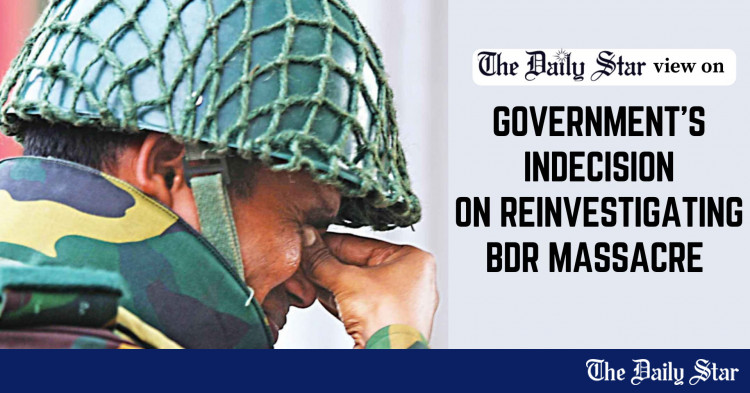
BDR massacre must be reinvestigated
Decision not to form a probe committee now is disappointing

1734479221259.webp

VISUAL: STAR

We are both perplexed by the government's decision not to form a committee right now to reinvestigate the 2009 killings at the Pilkhana headquarters of the erstwhile Bangladesh Rifles (BDR). The government's backtracking from the issue is devastating not only for the families who lost their loved ones during the February 25-26, 2009 massacre—in which 74 people, including 57 army officials, were killed—but also for the nation.

After Sheikh Hasina's fall, the issue of reinvestigating the carnage came up as many questions regarding the massacre remained unanswered during the Awami League regime. Most of the 152 people sentenced to death, and more than 300 people handed down imprisonment of various terms in relation to the BDR mutiny, were BDR jawans or soldiers. The real culprits and the mastermind were never identified. With a non-political government at the helm of the country, the aggrieved families hoped for a proper investigation, and the interim government initially responded positively.

Following a petition by two lawyers on October 20 seeking the Supreme Court's directive to the government to constitute a national independent committee to investigate the massacre, Home Adviser Lt Gen (retd) Jahangir Alam Chowdhury told the press on November 4 that the government would do so. Even on December 2, during the first hearing of the petition, the attorney general (AG) said that the process of forming the commission was underway and they would require two weeks to finalise it. However, during the second hearing on December 15, the AG told the court they could not form the commission at this moment because two criminal cases related to the BDR massacre are still pending—one with the Appellate Division and the other with a Dhaka court. It is not clear why the government needed more than a month to divulge this information.

The Pilkhana massacre, in which the country's top-tier army officials were killed, had a direct implication on our national security. So, it calls for rigorous investigation and a resolute mind to do so. While the interim government may not be able to complete the reinvestigation during its term, it should at least start it. As we look forward to the Supreme Court's order on the issue on January 5, we hope that the enormity of the massacre, its implication on national security, and mostly the suffering of the families of the victims will be taken into account to pave the way for justice.​
 
Analyze

Analyze Post

Add your ideas here:
Highlight Cite Fact Check Respond
  • Love (+3)
Reactions: Bilal9

Committee to be formed in five working days to ensure justice in BDR massacre
Staff Correspondent 17 December, 2024, 10:22

1734481307007.webp

Members of the former Bangladesh Rifles, their family members stage a demonstration demanding justice for BDR mutiny victims at the Central Shaheed Minar in Dhaka on Tuesday. | Md Saurav

Home affairs adviser Jahangir Alam Chowdhury on Tuesday announced that a committee would be formed within the next five working days to ensure justice for the BDR massacre.

Addressing an urgent press conference at his ministry in the secretariat in the morning, the adviser announced that the committee would comprise retired judges, civil service officials, police officials and members of the armed forces.

‘The interim government is determined to reinvestigate the incident and ensure justice for the BDR massacre,’ said Jahangir.

He said, ‘A committee will be formed within the next five working days to ensure justice for the BDR massacre.’

Answering questions by journalists, he said that court had the authority to order a reinvestigation and the government was going to form a ‘fresh inquiry committee’.

He also said that the number of the committee members would be decided soon and whether it would be a committee or commission would also be decided after discussions.

The announcement from the government came amid growing calls for justice and accountability for BDR massacre in 2009.

Md Mahin, central member of the Student Movement Against Discrimination, meanwhile, on Monday announced a programme of laying siege to the law and home affairs advisers’ offices on Tuesday demanding a commission to ensure justice for the BDR massacre.

Addressing a rally on the Central Shaheed Minar premises, Mahin welcomed the announcement and said that students along with the BDR massacre victims would take to the street if the committee would not be formed within five working days.

Mahin said that the massacre not only left the border areas insecure but also threatened the country’s independence and sovereignty.

Former law enforcement official Shamsul Islam, one of the first six sacked officers in the BDR massacre, said that victims of the massacre had been waiting for the past 15 years for the fall of fascist Sheikh Hasina and a complete justice for the massacre.

On February 25, 2009, several hundred Bangladesh Rifles soldiers took arms against their officers deputed from the army at Durbar Hall during their annual gathering at the paramilitary force’s headquarters in Dhaka, leaving 75 people—57 army officers, two wives of army officers, nine BDR soldiers, five civilians, an army soldier, and a police constable—killed.​
 
Analyze

Analyze Post

Add your ideas here:
Highlight Cite Fact Check Respond
  • Like (+1)
Reactions: Bilal9

Members Online

Latest Posts

Back
PKDefense
G
O
 
H
O
M
E