Donate ☕
201 Military Defense Forums
[🇧🇩] - BDR Mutiny---An Irreparable Damage to Bangladesh's First Line of Defense | Page 15 | PKDefense
Home Login Watch Videos Wars Movies
Serious discussion on defense, geopolitics, and global security.

[🇧🇩] BDR Mutiny---An Irreparable Damage to Bangladesh's First Line of Defense

[🇧🇩] BDR Mutiny---An Irreparable Damage to Bangladesh's First Line of Defense
115
5K
More threads by Saif

G Bangladesh Defense

15 YEARS OF BDR MUTINY​

No end to wait for justice​

Judge shortage holds back hearing of appeals against conviction, 283 in jail after acquittal of murder charges​

Muktadir Rashid and M Moneruzzaman | Published: 00:34, Feb 25,2024


facebook sharing button
226321_173.jpg

twitter sharing button

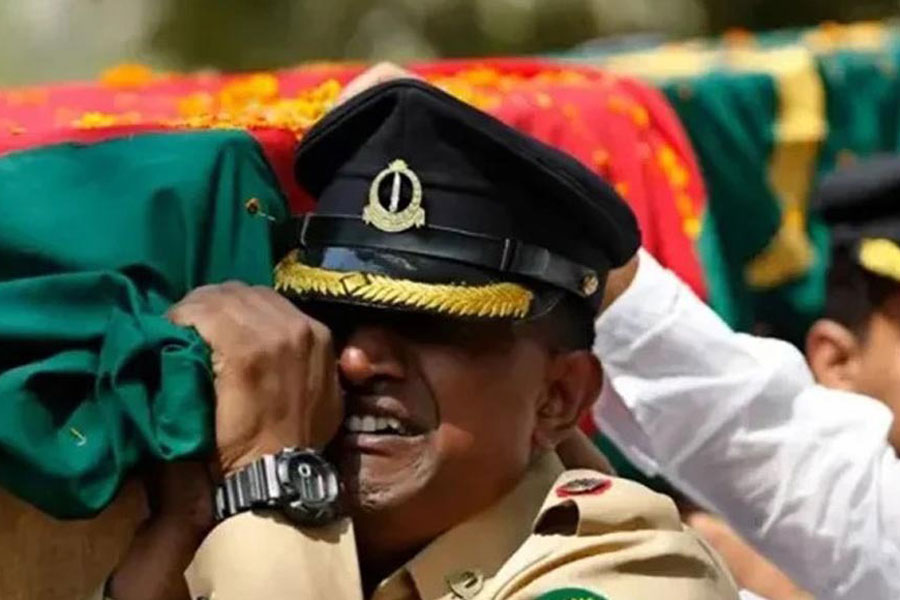
Families of the victims as well as the accused soldiers still cry for justice as appeals against convictions in the murder case for the February 25–26, 2009 mutiny in the border force are still pending with the Appellate Division, while a case under the explosives act is pending with the trial court.

Justice into the killings of 75 people, mostly army officers deputed in the erstwhile Bangladesh Rifles, has not been delivered even after 15 years of the mutiny in the border force, while many former soldiers and civilians have been languishing in jail for years and dozens have died pending trials.

Those who were acquitted by a trial court in November 2013 of the murder charge have been in jail as another case related to explosive substances is still pending with the trial court.

The families of the accused and convicts said at least 48 people have died in jail custody since the trial started, while the plot and plotters are yet to be identified.
‘Many questions about the incident are yet to be answered,’ said retired Lieutenant Colonel Mustafizur Rahman, who investigated the incident during his posting in army intelligence and later left the job and the country.

He said that their investigation could not identify many perpetrators.

Family members of the accused and convicts said that they were devastated by the event and its aftermath, and they wanted immediate disposal of the trials pending both in the Supreme Court and trial court.

The shortage of Appellate Division judges caused the delay in holding hearings on 71 appeals filed by the government and the convicts, according to attorney general AM Amin Uddin.

‘A special bench with at least four judges will be needed to hear and dispose of the large volume of appeals,’ Amin told reporters at his office on Thursday.

On February 25, 2009, several hundred BDR soldiers took arms against their officers deputed from the army at Durbar Hall during their annual gathering at the paramilitary headquarters in Dhaka, leaving 75 people—57 army officers, two wives of army officers, nine BDR soldiers, five civilians, an army soldier, and a police constable—killed.
Border guard special courts sentenced 5,926 soldiers to varying terms on mutiny charges in 57 cases, including 11 in Dhaka, while two criminal cases—one filed for the murders and the other filed under the Explosive Substances Act—are still pending with the court.

A case filed under the Explosive Substances Act against 833 BDR personnel and a civilian is pending with the Dhaka Metropolitan Sessions Judge Court, and 273 of the 1,344 prosecution witnesses have so far been examined, said deputy chief prosecutor Sheikh Baharul Islam.

Only 18 prosecution witnesses were examined between February 2023 and February 2024, according to a court document.

The appeals filed by death-row convicts against their sentences and another by the government against the acquittal of some soldiers by the High Court in the murder case await an Appellate Division hearing.

Attorney general Amin said that the special bench required for the pending hearings could not be constituted unless new judges were appointed to the Appellate Division.
Two major cases were investigated jointly by the Criminal Investigation Department, and the trial started in 2011 against 850 riflemen and civilians.

Amid the simultaneous trial, the trial court continued the trial of the case filed for murder and other offences, slowing down proceedings in the explosives case.

On November 5, 2013, additional sessions judge Akhtaruzzaman, who was later elevated to the High Court as judge, pronounced the verdict in the murder case, sentencing 151 soldiers and civilian Zakir Hossain to death.

The court also jailed 160 soldiers, including late Bangladesh Nationalist Party leader Nasiruddin Pintu, local Awami League leader and retired BDR subedar Md Torab Ali, for life terms, and 256 others for varying terms.

It acquitted 278 people. Four others died before the verdict.

In November 2017, the special High Court bench of Justice Md Shawkat Hossain, Justice Md Abu Zafor Siddique, and Justice Md Nazrul Islam Talukder upheld the death sentences of 139 soldiers. It commuted the death sentences of seven soldiers and Md Zakir Hossain, then a local Awami League leader, to life in jail.

The court acquitted four soldiers of the charges, and BDR deputy assistant director Habibur Rahman died in jail custody in February 2014 while his appeal against the death sentence was pending with the High Court.

The High Court upheld the life terms of 146 BDR personnel and acquitted 12 others of their life terms. Two others died during the pendency of their appeals.

Defence lawyers and family members said that a total of 283 acquitted people and 190 others, who completed their short jail terms in other cases, were still languishing in jail due to the delayed trial of the explosives case.

‘My brother sepoy Darul Islam was in Peelkhana during the mutiny. He was arrested later. He was jailed for seven years on the charge of murder but acquitted of the charges of murder, arson, and other heinous crimes. It’s been 10 years, he was not released,’ Sabuj Miah told New Age over phone.

He said that they had been trying to draw the attention of the government and judiciary to how the former troopers were facing injustice.

The attorney general said that the government filed 20 appeals in December 2020.

Death-row convicts filed 35 appeals in January and February 2021 against their sentences, a court official said. The attorney general said all appeals would be heard together.

Both the government inquiry committee, headed by former secretary Anis-uz-Zaman Khan, and an investigation conducted by the army failed to identify the plot and the plotters.

The report by Anis-uz-Zaman recommended an investigation into the failure to gather intelligence about the planned mutiny. The army did not make the results of its investigation public.

New York-based rights group Human Rights Watch said that it had obtained the report and stated that the report faulted the government for not having taken a stronger line against BDR before the rebellion.

The successive Awami League government has so far initiated no further investigation recommended by the two probe bodies, while the main opposition Bangladesh Nationalist Party has been saying that they will identify the perpetrators if voted to power.

HRW also urged the government to establish an independent investigative and prosecutorial task force with sufficient expertise, authority, and resources to rigorously investigate and, where appropriate, prosecute all allegations of unlawful deaths, torture, and mistreatment of suspects in the BDR mutiny, regardless of the perpetrator’s rank or institutional affiliation.

Families of slain officers and convicted soldiers said that the nation should know the reason for the rebellion, as well as the plot and plotters because neither an investigation nor a trial revealed them.

Slain Colonel Quadrat Elahi Rahman Shafique’s son, Saquib Rahman, repeatedly said that the pawns were tried but the plotters were not identified.

As of February 24, a total of 761 BDR jawans have been detained in Dhaka Central Jail, Kashimpur High Central Jail-1, Kashimpur Central Jail-2, and Kashimpur High Security Central Jail, according to the directorate of the prisons.

Senior military and civilian officials will pay tribute to the graves of killed soldiers at their military graveyard in the capital’s Banani today.​
 
Analyze

Analyze Post

Add your ideas here:
Highlight Cite Fact Check Respond

BDR Massacre: Commission to uncover domestic, foreign conspiracies

1735344023220.webp


The commission formed to reinvestigate the 2009 BDR (now Border Guard Bangladesh) massacre yesterday said it will identify local and foreign entities and conspiracies behind the carnage during its probe.

The commission chief and former director general of BGB Maj Gen (retd) ALM Fazlur Rahman made the remarks while briefing reporters following its first meeting at the BGB Headquarters.

He said, "We have been tasked with identifying the individuals and entities -- both domestic and foreign -- responsible for the BDR massacre."

When asked if the commission will identify any specific country, he said they will not single out any specific country; but will conduct an impartial investigation. "If anyone is found responsible, we will provide our opinion accordingly," he added.

The commission aims to identify individuals, groups, organisations, institutions, departments, or associations responsible for the killings, those who aided the crimes, conspired, or tampered with evidence.

"We will remain impartial and uninfluenced by any external factors. I express my gratitude to the chief adviser for addressing this issue and attempting to resolve it," he said.

Seeking media cooperation, he said, "We request that you interpret our statements positively. Any misrepresentation may harm the national interest."

Fazlur stated that the commission's office will initially operate out of the BGB Dhaka Battalion office. It will soon write to relevant authorities, including the chief adviser, to secure necessary secretariat support.

It will request additional facilities, such as security for its members and their families, transport, secretariat and office resources. It will also propose granting the commission chief a position equivalent to an adviser to effectively deal with domestic and foreign stakeholders.

Additionally, the commission will suggest that its other members receive a status equivalent to that of judges of the Appellate Division of the Supreme Court, said the commission chief.

After securing these provisions, the commission has a plan to hold its next meeting and begin taking statements.

"After every meeting, if necessary, we will update the media to ensure transparency and keep the nation informed," the Major Gen said.

When asked about aligning the commission's investigation with the International Crimes Tribunal, he stated that they will seek the inclusion of four legal experts specialising in civil, criminal, military, and international law.

He said the commission will consider measures to prevent individuals involved from leaving the country, following discussions with commission members.

Regarding extradition, he said efforts will be made to contact individuals living abroad through the foreign ministry. If extradition proves impossible, a team will be sent to record their statements.

On December 23, the government formed the seven-member commission to reinvestigate the BDR massacre and uncover the nature of the crimes committed during, before, and after the killings.

The commission has been tasked with submitting a report within 90 days.

"We hope to complete our report within the designated time. If delays occur for valid reasons, we will seek an extension," he concluded.​
 
Analyze

Analyze Post

Add your ideas here:
Highlight Cite Fact Check Respond

Pilkhana Tragedy: Martyred army families demand fair probe
Call for Martyred Army Day

1735602586049.webp

Photo: PID

Members of the martyred army families have called for a fair investigation into the 2009 Pilkhana massacre and demanded that February 25 be officially declared Martyred Army Day.

The families made their demands during a meeting with Chief Adviser Prof Muhammad Yunus at the State Guest House Jamuna today.

During the meeting, the family members recounted their ongoing suffering, claiming they had been subjected to mental torture and harassment under Sheikh Hasina's regime.

They described how they were repeatedly intimidated and subjected to ill treatment when seeking justice for the victims of the massacre.

The families allege that they were hindered from speaking out about the truth through various forms of oppression.

The martyred army family members also criticised the government's claims about resettling the families in Dhaka Cantonment's Mainul Road.

They said that the government's promise of housing for the families has not been fulfilled, and no houses have been allocated to any of the martyred army members' families.

Furthermore, the families highlighted that many other promises, such as free education for the children of martyrs, have been left unaddressed.

The chief adviser expressed his surprise that a comprehensive investigation into the massacre had not been conducted even after all these years.

He remarked, "It is incredible that the details of this tragedy have been kept secret for so long. Today, I have learned many things from you."

Yunus further committed to publishing all available information about the massacre.

"We will gather all the details about this incident as soon as possible. The people of Bangladesh are witnesses to this crime. As representatives of the nation, we believe that bringing those responsible to justice is our duty," he added.

Law Adviser Asif Nazrul, Industries and Public Works Adviser Adilur Rahman Khan, Environment Adviser Syeda Rizwana Hasan, Power and Energy Adviser Muhammad Fauzul Kabir Khan, Adviser Mahfuj Alam, and Youth and Sports Adviser Asif Mahmud, were also present.​
 
Analyze

Analyze Post

Add your ideas here:
Highlight Cite Fact Check Respond
  • Love (+3)
Reactions: Bilal9

BDR carnage: Probe commission may interrogate Hasina in India
FE Online Desk
Published :
Jan 06, 2025 19:41
Updated :
Jan 06, 2025 19:52

1736215201235.webp


The chairman of the National Independent Investigation Commission, formed to reinvestigate the mutiny at the BDR headquarters at Pilkhana in 2009, has stated that the commission will seek permission to interrogate Sheikh Hasina in India if the Indian government does not repatriate her.

The commission's chief Major General (retd) ALM Fazlur Rahman made the statement during an event held at the RAOWA Club in the capital on Monday.

Speaking at the event, organized to exchange views with family members of the martyrs of the BDR massacre, he said, "It is not enough to claim that local and foreign entities were involved in the BDR massacre or to allege India's involvement. Concrete evidence must be presented to support such claims."

He assured that the commission will remain impartial while investigating the massacre.

"Over the past 16 years, many evidences related to the BDR massacre have been lost. What happens now will be open," he said.

Expressing the commission’s determination to complete the probe within three months, Mr Rahman said, there is no intention to extend the timeline, but an extension will be requested if deemed necessary.

"The commission is committed to ensuring justice for everyone involved," he added.​
 
Analyze

Analyze Post

Add your ideas here:
Highlight Cite Fact Check Respond
  • Sad (0)
Reactions: Bilal9

Local-foreign conspirators carried out BDR mutiny: Commission chief
Staff Correspondent
Dhaka
Published: 06 Jan 2025, 23: 09

1736216221059.webp


The chief of the independent commission that has been formed to investigate the BDR killing, Major General (retd) ALM Fazlur Rahman, addresses the event at RAOWA club on 6 January 2025 Prothom Alo

The army was standing still like what happened at Plassey while local and foreign conspirators carried out the mutiny of the officers of Bangladesh Rifles (currently Border Guard Bangladesh - BGB) at Pilkhana.

The chief of the independent commission that has been formed to investigate the BDR killing, Major General (retd) ALM Fazlur Rahman, remarked this while exchanging views with the family members of the martyrs at the Retired Armed Forces Officers Welfare Association Club (RAOWA ) at Mohakhali in the city Monday.

The “national independent investigation commission” organised the meeting at Anchor Hall of RAOWA Club.

He said this was not any rebellion, this was a conspiracy to kill the officers.

The head of the investigation commission further said, “Sheikh Hasina is among those whom we suspect to have connection with the BDR carnage. She is staying in India. We will contact the Indian High Commission and either request for her extradition or our team would take her interview going there. We shall do this through the foreign ministry or directly - whatever is legal for us.”

RAOWA representatives, relatives of the people killed in the BDR carnage, officials who could come out alive and the officials who were serving in the army at that time attended the event.

The investigation commission Fazlur Rahman said, “We will request the families of every martyr in the BDR carnage to cooperate with us. We will sit and talk with the officers who could come out alive, tortured and sacked. This commission has been constituted after 15 years of the incident. By this time, a lot of evidence has been damaged. Despite this, we do not intend to do anything in hiding. Whatever happens will happen through transparency. We will inform the nation everything through the media.”

He further said, “This commission has been formed due to a national demand. The government, we, the nation, suspect was behind this carnage, has been ousted. I would request all, keep faith in us. This commission has been working as a court. So there should not be any such conception that this commission does not have any value. This is a national independent commission. The court will take into cognizance the remarks and recommendations we would propose. We want to ensure justice.”

“We shall try to complete the investigation within the designated three months we have been given. The home adviser has assured us of extending the deadline if we require more time. There are two parts of this investigation. One is domestic and another is trans-national. We want to complete the investigation’s domestic part within two months,” he expressed.

Fazlur Rahman said, “We have been asked to investigate those two issues. But that did not say anything about investigation against those who are being tried. I have written to the chief adviser, so that we can work on them as well.”

Addressing the meeting to exchange views, the head of the commission said, “I was the commander in the Padua-Roumari clash, where India was defeated. After that incident, I was discharged though I had four more service years left. I don’t want to say which government fired me; you all know that. But we will try to know why the step was taken.”

Fazlur Rahman said, “It was not the Awami League government that discharged me for defeating India in the Padua-Roumari clash. The Awami League government relieved me from the BDR duty and made me GOC of the 11 Division. I was fired when the government was changed. That is why none will remain outside of the investigation.”

Requesting people to share information with the commission for the sake of investigation, the former BDR director general said, “Many said India is involved with the BDR killing, some other generals are involved. But only saying so won’t do anything. You have to provide evidence in support of the claims. We ask you to share evidence. Provide us with any evidence be it small or large, important or unimportant. This is a matter of large scale investigation. We shall tread the ground we need for this.”

Fazlur Rahman maintained, “AS of now two commissions have been formed nationally in this regard. We will check those and try to know where the gaps are. We shall meet the army chief and seek his cooperation to know about the condition of the army at that time.”

Relatives of martyred army officers spoke against Lieutenant General (retd) Md Moinul Islam, the first DG of restructured BGB after the BDR mutiny.

Speaking about this, the commission chief said, “General Moinul was going abroad but we have stopped his foreign tour.”

Fazlur Rahman said, “Let’s assume there was conspiracy, the then government was involved with that, India was involved, some conspirators there were also involved, even a few Bangladeshi politicians were involved in it - I understand it all. But would there be any mutiny if the army moved in there on that day? Never. The incident of Plassey was restaged there. The way the soldiers stood at the Plassey’s battle ground and the force of Lord Clive snatched the freedom, a far more nefarious and heart-wrenching incident took place in Bangladesh in 2009. The army remained unmoved and the local and foreign conspirators carried out the carnage.”

This former army officer further stated, “I don’t think this was a BDR rebellion or the soldiers could kill the officers so brutally for any demand. We tried to find out who was posted at what time at the BDR at that time. What could an officer do in just seven, 10, 15 or a month that he had to be killed. This was not a rebellion, rather, this was a conspiracy to kill the officers.”

“The BDR was made weaker through this killing, the force’s name was changed. The army and the country were made weaker. We want to make such recommendations so that there could not be any repetition of the 25 February incident in Bangladesh,” he added.

The commission head maintained, “We have started working at the BGB headquarters. We were not given any security or any vehicle. But I want to assure you, we will complete the investigation even if we are not given those. The investigation commission will assess the statements. From there we will try to find out who or which country was helped. Hopefully, we will be able to present the investigation report to the nation within a short time.”

Mentioning that they will propose to observe the BDR mutiny day as “Sena Hatya Dibos (soldier killing day)”, the commission chief said, “There will be proposal to play Hyder Hossain’s song ‘Kototuku osru gorale hridoy jole shikto?’ as a nationally important song at all places on 25 and 26 February. We will keep nothing beyond our observations.”​
 
Analyze

Analyze Post

Add your ideas here:
Highlight Cite Fact Check Respond
  • Love (+3)
Reactions: Bilal9

BDR Massacre: Probe body may seek Hasina’s extradition
Or it’ll visit India to talk to her, says its chief

1736295240888.webp


The National Independent Investigation Commission, formed to re-investigate the 2009 BDR massacre, has said it will either seek Sheikh Hasina's extradition from Indian authorities or try to arrange a meeting with her over there.

Maj Gen (retd) ALM Fazlur Rahman, the commission chief and former director general of BGB, disclosed the developments yesterday following a views exchange meeting with the families of victims of the BDR massacre at the Retired Armed Forces Officers' Welfare Association (RAOWA) club.

"Those we suspect, especially Sheikh Hasina, are currently residing in India. We will either request her extradition through the Indian High Commission or send our team over there to question her. We will do whatever is legally permissible, either through the Ministry of Foreign Affairs or directly," he said, adding that other people's names that appear on the inquiry commission's list will also be questioned.

He also said that the inquiry commission will give an opinion through investigation about the possible involvement of other countries.

"It is not enough to say that the BDR killings were carried out by locals and foreigners... it is not enough to say that India is involved; evidence must be presented in support of it," he stressed, adding that all evidence, regardless of how major or minor they are, will be taken into account.

Assuring that the commission will maintain neutrality during this investigation, the commission chief said, "In the last 16 years, much of the evidence related to the BDR killings has been destroyed. Whatever we'll do now will be transparent."

He also said that the commission will try to complete the investigation within three months, and they do not intend to extend the deadline. "Extension will be requested, only if necessary."

"Let's assume that the then-government was involved, some conspirators from India were involved, and some Bangladeshi politicians were involved—I understand all of that. But if the army had gone there that day, would there have been a massacre? No, there wouldn't have been."

"I don't think this was a mutiny... it was a conspiracy to murder the officers."​
 
Analyze

Analyze Post

Add your ideas here:
Highlight Cite Fact Check Respond
  • Love (+3)
Reactions: Bilal9

Members Online

Latest Posts