Donate ☕
201 Military Defense Forums
[🇧🇩] - BIMSTEC for Regional Prosperity | Page 7 | PKDefense
Home Login Nation Wars Watch Videos
Serious discussion on defense, geopolitics, and global security.

[🇧🇩] BIMSTEC for Regional Prosperity

Reply (Scroll)
Press space to scroll through posts
G Bangladesh Defense
[🇧🇩] BIMSTEC for Regional Prosperity
31
2K
More threads by Saif

BIMSTEC and regional prosperity
MIR MOSTAFIZUR RAHAMAN
Published :
May 15, 2024 22:10
Updated :
May 15, 2024 22:10

1715817893377.webp


The emergence of the Bay of Bengal Initiative for Multi-Sectoral Technical and Economic Cooperation (BIMSTEC) was seen as a major development in promoting regional cooperation in South Asia.

As the South Asian Association of Regional Cooperation (SAARC) has failed to meet the aspirations of its members in building a true and effective alliance, many considered the BIMSTEC as an alternative platform for regional cooperation in South Asia.

The SAARC, which was launched in the early 80s, has eight member countries including Afghanistan, Bangladesh, Bhutan, India, Maldives, Nepal, Pakistan and Sri Lanka. But from its very inception, a section of its members treated it with suspicion and mistrust.

Mainly the sheer rivalry and mistrust between the two nuclear-powered members -India and Pakistan, the SAARC has failed to become an effective tool for regional cooperation even after three decades of its existence.

BIMSTEC has gained popularity among South Asian countries as a platform for regional cooperation and is seen as a bridge between South Asian and South East Asian countries.

Initially, BIMSTEC was called BIST-EC, i.e., Bangladesh, India, Sri Lanka and Thailand Economic Cooperation. After the inclusion of Myanmar, the organisation was renamed Bangladesh, India, Myanmar, Sri Lanka and Thailand Economic Cooperation (BIMST-EC). Later with the joining of Nepal and Bhutan in the grouping, it was named BIMSTEC, which is Bangladesh, India, Sri Lanka and Thailand Economic Cooperation.

With five countries from South Asia and two from ASEAN, the platform has emerged as a natural one for building effective regional cooperation in the South Asian region.

Setting up of the BIMSTEC secretariat in Dhaka, Energy Centre in Bengaluru in India, and formation of the BIMSTEC Business Council, a forum for business organisations to promote regional trade are seen as encouraging developments in the right directions.

Apart from these, several committees have been formed to oversee developments in various sectors, like the BIMSTEC Transport Connectivity Working Group.

However, recently questions have been raised whether it would have the same fate as the SAARC because of several factors.

Irregular holding of the BIMSTEC summit, the highest decision-making body of the organisation, has been a major concern since its inception. The BIMSTEC summit has taken place only thrice until now.

The secretariat also lacks proper resources which impedes its performance.

The delay in the adoption of the Free Trade Agreement (FTA), a framework that was agreed upon in 2004, is also seen as a major weakness of the platform.

The first BIMSTEC summit was in Bangkok, Thailand in 2004. The second and third summits were held in New Delhi, India in 2008 and Nay Pi Taw, Myanmar in 2014.

BIMSTEC covers a significant area of the world with large population that needs rapid growth.

BIMSTEC is home to 1.8 billion people, which is 22 per cent of global population, and is larger than the population of ASEAN (approx. 679.69 million) and EU (448.4 million) countries together.

Also, the combined GDP of BIMSTEC member States amounts to USD 4.5 trillion in 2022, which is 4.5 per cent of global GDP.

Through ensuring free trade, better connectivity, joint infrastructure development, cooperation in different sectors, BIMTEC can be a an effective platform in promoting growth which is essential for this region where a large chunk of the people are still fighting poverty and inequality.

Given the friendly relationship among member states, the BIMSTEC can be a true and effective multilateral mechanism for providing the Bay of Bengal nations an opportunity to work together to create a common space for peace and development.

So, a strong political will of the leaders of the member states is crucial to making BIMSTEC an effective and result-oriented platform of regional cooperation which can pave the way for peace and prosperity for millions of people.​
 
Analyze

Analyze Post

Add your ideas here:
Highlight Cite Fact Check Respond
  • Like (+1)
Reactions: Bilal9

BIMSTEC, IORA sign MoU to deal with security, developmental challenges
FE Online Desk
Published :
Apr 06, 2025 20:17
Updated :
Apr 06, 2025 20:17

1743988897839.webp


The Bay of Bengal Initiative for Multi-Sectoral Technical and Economic Cooperation (BIMSTEC) and the Indian Ocean Rim Association (IORA) have signed a Memorandum of Understanding (MoU) on the occasion of the 6th BIMSTEC Summit held in Bangkok, Thailand, recently.

This partnership will also be instrumental in jointly addressing the security and developmental challenges in the region and beyond, said the BIMSTEC Secretariat on Monday.

BIMSTEC Secretary General Indra Mani Pandey and IORA Secretary General Sanjiv Ranjan signed the MoU on behalf of their respective organisations, reports UNB.

The signing of the MoU was welcomed by the BIMSTEC Leaders, marking a significant step in deepening inter-regional cooperation, said the BIMSTEC Secretariat on Sunday.

The signing of MoU formalizes future partnership between IORA and BIMSTEC in key areas of shared interest, including trade and investment facilitation, environment and climate change, maritime security and connectivity, science and technology, and people-to-people contact and tourism including blue economy and ocean management and fisheries management.

BIMSTEC comprises seven countries of the Bay of Bengal region: Bangladesh, Bhutan, India, Myanmar, Nepal, Sri Lanka and Thailand.

The Indian Ocean Rim Association (IORA) is an inter-governmental organization established on 7 March 1997.​
 
Analyze

Analyze Post

Add your ideas here:
Highlight Cite Fact Check Respond

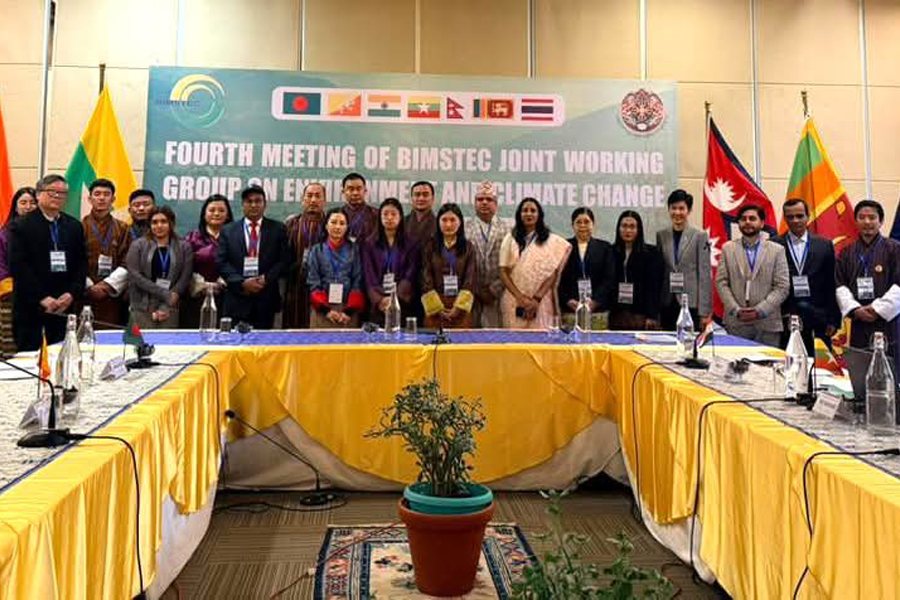
4th BIMSTEC meeting on environment and climate change held in Thimphu

FE ONLINE DESK
Published :
Jan 20, 2026 13:58
Updated :
Jan 20, 2026 13:58

1769043548531.webp


The fourth meeting of the BIMSTEC Joint Working Group on Environment and Climate Change (JWG-ECC) was held in Bhutanese capital Thimphu recently, emphasising regional cooperation and the mobilisation of climate finance.

The two-day meeting was hosted by Bhutan, the lead country for the Environment and Climate Change sector within the Bay of Bengal Initiative for Multi-Sectoral Technical and Economic Cooperation (BIMSTEC).

M. Mahbubul Alam, Director General of the Ministry of Foreign Affairs, led the Bangladesh delegation at the high-level meeting.

During the sessions, the working group finalised the Terms of Reference (ToR) for its future operations and reviewed the progress of various initiatives under the BIMSTEC Plan of Action.

A key focus of the discussions was "Climate Finance", specifically how member states can collectively mobilise and distribute resources to mitigate the growing impacts of global climate change.

Senior officials and representatives from the BIMSTEC Secretariat and all seven member states—Bangladesh, Bhutan, India, Myanmar, Nepal, Sri Lanka, and Thailand— participated in the deliberations.

The delegates underscored the urgency of adopting new regional initiatives to reduce climate risks and protect the unique ecosystems of the region.

Experts noted that Bangladesh’s active participation and the outcomes of this meeting would be instrumental in ensuring environmental security and sustainable development for countries situated along the Himalayas and the Bay of Bengal coastline.​
 
Analyze

Analyze Post

Add your ideas here:
Highlight Cite Fact Check Respond

Members Online

⤵︎

Latest Posts

Latest Posts