Bangladesh Defense
Saif
Senior Member
- Jan 24, 2024
- 21,419
- 9,743
- Nation

- Residence
- Axis Group


Money whitening provision may return
The government is likely to reintroduce a provision allowing the legalisation of undisclosed income through investment in selected sectors in the national budget for the next fiscal year.
Money whitening provision may return
Md Asaduz Zaman
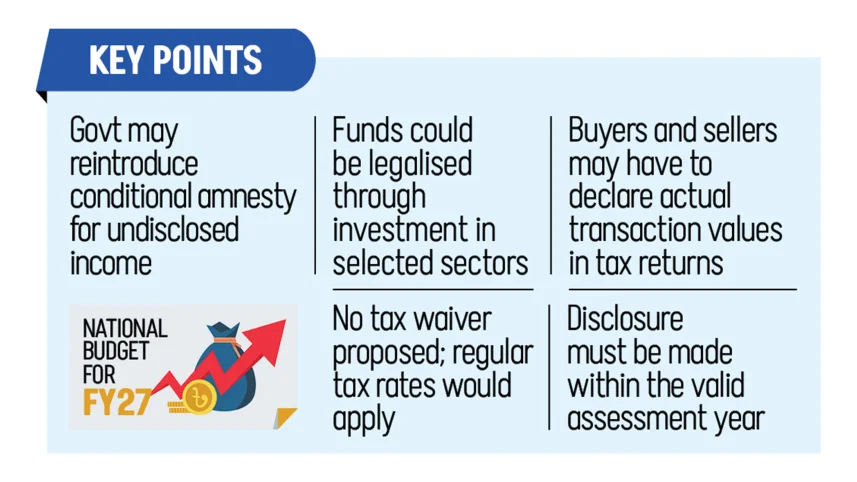
The government is likely to reintroduce a provision allowing the legalisation of undisclosed income through investment in selected sectors in the national budget for the next fiscal year.
The proposed amnesty scheme will include disclosure conditions, a finance ministry official said yesterday.
Speaking on condition of anonymity, the official said taxpayers may be allowed to regularise undisclosed funds by investing in designated sectors, provided they declare the actual transaction value in income tax returns filed by both buyers and sellers.
“Taxpayers can legalise their income by paying their regular rate in any assessment year in certain sectors, without any concessional treatment,” said the finance ministry official.
The Awami League government previously allowed taxpayers to legalise undisclosed assets by paying a flat 15 percent tax rate. Under that arrangement, individuals could declare previously undisclosed money in any assessment year by paying the specified rate, after which no government agency would question the source of the income.
But the proposed provision this time will introduce changes to that approach, said the official.
According to him, taxpayers will not be offered a single flat rate for regularising undisclosed income. Instead, in cases involving such undeclared gains, both buyers and sellers will be required to adjust their declared income and reflect the actual transaction values in their tax returns.
He added that structural inefficiencies in parts of the economy often lead to portions of income or capital gains remaining undeclared, and the government wants to provide an opportunity to adjust such income to encourage productive investment.
He also said the prime minister has, in principle, approved the proposal on May 14, with the expectation that it could help accelerate investment flows.
The official argued that the measure is intended to broaden the tax base and formalise informal capital, rather than offer a blanket waiver or reduced tax rate, as seen in previous amnesty schemes.
The move comes amid ongoing debate in policy circles over how to address large volumes of undisclosed income generated through property transactions, especially in land, flats and commercial real estate, where significant gaps often exist between market prices and declared deed values.
However, the proposal has already drawn criticism from economists and tax experts, who say repeated regularisation windows risk weakening compliance and discouraging honest taxpayers.
National Board of Revenue (NBR) Chairman Md Abdur Rahman Khan recently reiterated that the tax administration is moving away from concessional whitening schemes that allowed undeclared income to be legalised at reduced rates.
“We want to say that anyone can disclose undisclosed income in their tax records by paying taxes according to the existing rates. In fact, we would welcome that,” he said during a pre-budget discussion.
Criticising past practices, he added that successive amnesty schemes over the past five decades had “ultimately backfired”, as they discouraged compliant taxpayers and distorted tax culture.
“We want to move away from this culture,” he said, adding that individuals who evaded taxes in the past should not be incentivised with lower rates.
“At the very least, you must pay the regular tax,” he said.
Md Asaduz Zaman
The government is likely to reintroduce a provision allowing the legalisation of undisclosed income through investment in selected sectors in the national budget for the next fiscal year.
The proposed amnesty scheme will include disclosure conditions, a finance ministry official said yesterday.
Speaking on condition of anonymity, the official said taxpayers may be allowed to regularise undisclosed funds by investing in designated sectors, provided they declare the actual transaction value in income tax returns filed by both buyers and sellers.
“Taxpayers can legalise their income by paying their regular rate in any assessment year in certain sectors, without any concessional treatment,” said the finance ministry official.
The Awami League government previously allowed taxpayers to legalise undisclosed assets by paying a flat 15 percent tax rate. Under that arrangement, individuals could declare previously undisclosed money in any assessment year by paying the specified rate, after which no government agency would question the source of the income.
But the proposed provision this time will introduce changes to that approach, said the official.
According to him, taxpayers will not be offered a single flat rate for regularising undisclosed income. Instead, in cases involving such undeclared gains, both buyers and sellers will be required to adjust their declared income and reflect the actual transaction values in their tax returns.
He added that structural inefficiencies in parts of the economy often lead to portions of income or capital gains remaining undeclared, and the government wants to provide an opportunity to adjust such income to encourage productive investment.
He also said the prime minister has, in principle, approved the proposal on May 14, with the expectation that it could help accelerate investment flows.
The official argued that the measure is intended to broaden the tax base and formalise informal capital, rather than offer a blanket waiver or reduced tax rate, as seen in previous amnesty schemes.
The move comes amid ongoing debate in policy circles over how to address large volumes of undisclosed income generated through property transactions, especially in land, flats and commercial real estate, where significant gaps often exist between market prices and declared deed values.
However, the proposal has already drawn criticism from economists and tax experts, who say repeated regularisation windows risk weakening compliance and discouraging honest taxpayers.
National Board of Revenue (NBR) Chairman Md Abdur Rahman Khan recently reiterated that the tax administration is moving away from concessional whitening schemes that allowed undeclared income to be legalised at reduced rates.
“We want to say that anyone can disclose undisclosed income in their tax records by paying taxes according to the existing rates. In fact, we would welcome that,” he said during a pre-budget discussion.
Criticising past practices, he added that successive amnesty schemes over the past five decades had “ultimately backfired”, as they discouraged compliant taxpayers and distorted tax culture.
“We want to move away from this culture,” he said, adding that individuals who evaded taxes in the past should not be incentivised with lower rates.
“At the very least, you must pay the regular tax,” he said.