[🇧🇩] Can Bangla-Saudi Relation be elevated to Strategic Level?

Afghanistan Albania Algeria Andorra Angola Antigua Austria Azerbaijan Bahamas Bahrain Bangladesh Barbados Canada China Egypt Finland Germany India Iran Israel Japan Lebanon North Macedonia Pakistan Palestine Qatar Russia Syria Turkey Ukraine United Kingdom United States Yemen
[🇧🇩] Can Bangla-Saudi Relation be elevated to Strategic Level?
46
3K
More threads by Saif

G Bangladesh Defense

Saudi Arabia invites CA to Future Investment Initiative

BSS
Published :
Jul 28, 2025 20:28
Updated :
Jul 28, 2025 20:28

1753748178368.webp


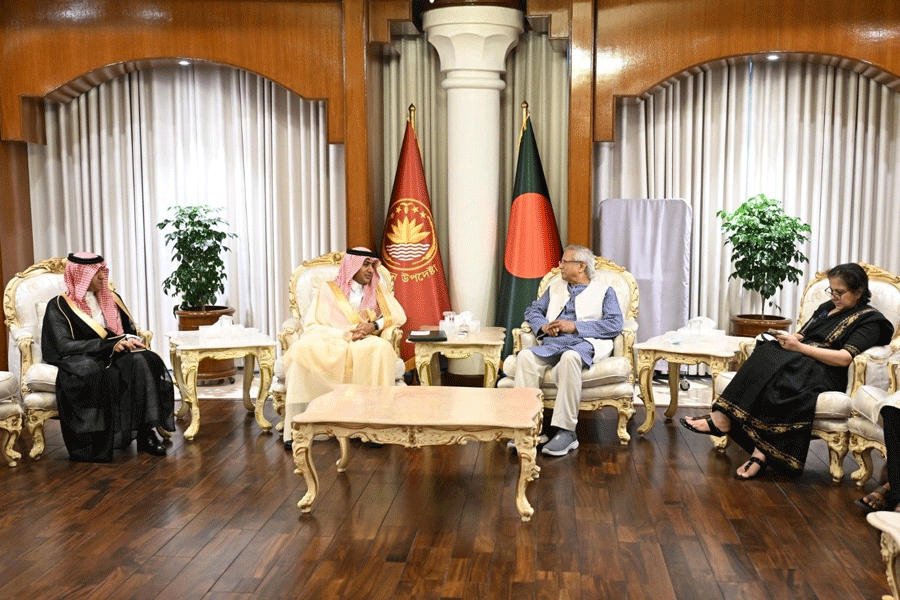
Saudi Arabia has invited Chief Adviser Professor Muhammad Yunus to attend the ninth edition of the Future Investment Initiative (FII9) to be held in Riyadh on October 27-30, 2025.

Saudi Ambassador in Dhaka Dr Abdullah Zafer bin Abiyah handed over the invitation of Saudi Crown Prince and Prime Minister Mohammed bin Salman to the Chief Adviser during a meeting at the State Guest House Jamuna on Sunday.

This is the first time a head of government from Bangladesh has been invited to the annual event being held since 2017, Chief Adviser's Deputy Press Secretary Abul Kalam Azad Majumder said.

Chief Adviser Yunus thanked the Saudi Crown Prince for the invitation to the event, where he said he would actively consider joining.

He also thanked the Saudi Crown Prince for accepting the invitation to visit Bangladesh on the occasion of the 50th anniversary of Bangladesh-Saudi Arabia diplomatic relations at a given date.​
 

Riyadh Air to launch Dhaka flights on August 1

FE ONLINE DESK

Published :
May 22, 2026 14:30
Updated :
May 22, 2026 18:02

1779492938965.webp


Saudi Arabia's new national carrier, Riyadh Air, is set to launch daily direct Dhaka-Riyadh flights on August 1, intensifying competition in Bangladesh's booming Saudi Arabia aviation market, driven by expatriate and Umrah travel demand.

The Saudi carrier's entry is expected to reshape one of Bangladesh's busiest international aviation markets, currently dominated by Biman Bangladesh Airlines, US-Bangla Airlines and Saudia.

"We are now in the final stage of operational preparations. We will begin daily flight operations from August 1," Md Sohag Hossain, managing director of Rhythm Group, the general sales agent (GSA) of Riyadh Air, said on Friday, reports BSS.

He said the airline has applied for slots to operate seven weekly flights on the Dhaka-Riyadh route.

The flight is scheduled to arrive at Hazrat Shahjalal International Airport at 2:00 pm before departing for Riyadh at 3:00 pm.

Hossain said the airline is also evaluating future expansion to Jeddah, Dammam and Madinah, while considering direct operations from Sylhet and Chattogram in later phases.

A senior official of the Civil Aviation Authority of Bangladesh, familiar with the development, said all regulatory formalities for Riyadh Air have been completed, with the airline now awaiting final approval of its operational schedule before commencing commercial flights.

Aviation expert ATM Nazrul Islam said the carrier's arrival could significantly intensify competition on Saudi-bound routes, particularly in pricing, transit connectivity and service quality.

"The addition of another full-service Gulf carrier operating daily services could create stronger airfare competition, improve passenger connectivity and expand travel options for nearly three million Bangladeshi expatriates living and working in Saudi Arabia," he said.

Islam observed that Riyadh Air's entry signals growing international confidence in Bangladesh's expanding outbound travel sector and increasing strategic importance within Gulf aviation networks.

The development follows discussions earlier this year between Saudi Ambassador to Bangladesh Abdullah Zafer H Bin Abiyah and Civil Aviation and Tourism Minister Afroza Khanam, during which the envoy confirmed Riyadh Air's strong interest in launching Dhaka operations.

Both sides at the time expressed optimism about strengthening bilateral cooperation in aviation and tourism, reflecting growing connectivity demand between Bangladesh and Saudi Arabia.

Launched in 2023, Riyadh Air is Saudi Arabia's new national carrier established as part of the Kingdom's Vision 2030 economic diversification strategy.

The airline is wholly owned by Saudi Arabia's Public Investment Fund and aims to position Riyadh as a major global aviation and logistics hub.

The airline is headed by former Etihad Airways chief executive Tony Douglas and plans to connect more than 100 destinations worldwide by 2030 through a rapidly expanding fleet of Boeing 787 Dreamliners, Airbus A321neos and Airbus A350 aircraft.

Saudi authorities said Riyadh Air is expected to contribute significantly to the Kingdom's non-oil economy and create thousands of direct and indirect jobs as part of Saudi Arabia's broader economic transformation agenda.

Bangladesh's aviation market has witnessed rapid growth in Gulf-bound traffic over the past decade, driven largely by outbound workers and religious travellers.​
 

Govt eyes boosting diversified exports to Saudi Arabia
Bangladesh Sangbad Sangstha . Dhaka 25 May, 2026, 00:27

1779685217984.webp


Commerce, industries and textiles and jute minister Khandakar Abdul Muktadir on Sunday called on businesses to submit sector-specific proposals aimed at expanding Bangladesh’s export presence in the Saudi Arabian market.

‘The government is ready to extend all necessary support to strengthen trade and skilled manpower development,’ he said.

The minister made the remarks during a meeting with a delegation from the Saudi Arabia-Bangladesh Chamber of Commerce and Industry (SABCCI) at his office in the city, said a press release.

Speaking at the meeting, Muktadir said Bangladesh’s export sector still remains heavily dependent on the readymade garment industry, although significant opportunities exist in Saudi Arabia and other Middle Eastern markets for pharmaceuticals, leather goods, jute products, processed food and other non-traditional export items.

He emphasized the need to move beyond conventional export strategies and adopt sector-based planning to tap into emerging opportunities in the Gulf region.

The minister said the government is willing to provide policy support and facilitate initiatives that can help diversify exports and improve Bangladesh’s competitiveness abroad.

Highlighting the importance of skilled human resources, the minister said Bangladesh is represented internationally not only through trade but also through its workforce employed overseas.

He underscored the need for proper training and skill development for expatriate workers, saying that transforming manpower into a skilled workforce would benefit workers, their families, and the national economy through increased foreign currency earnings.

During the meeting, SABCCI president Ashraful Huq Chowdhury said Bangladesh’s exports to Saudi Arabia could reach $1 billion by 2027 if coordinated initiatives are undertaken with adequate government support.

In response, the minister asked the business leaders to submit concrete proposals outlining areas where policy assistance, financial incentives or sectoral cooperation are needed.

He assured the delegation that the government would seriously examine any practical and realistic recommendations.

The SABCCI delegation also noted that Saudi Arabia’s Vision 2030 reform agenda, along with preparations for the World Expo and the upcoming FIFA World Cup, has created new opportunities for Bangladesh in sectors including education, skilled manpower development, green technology, environmental management, desert afforestation, agriculture, food processing, and microcredit-based financing initiatives.

The meeting concluded with discussions on strengthening bilateral trade, investment, and broader sectoral cooperation between Bangladesh and Saudi Arabia.​
 

Saudi operator brings first green crane to Patenga terminal

FE REPORT

Published :
Jun 24, 2026 09:48
Updated :
Jun 24, 2026 09:48

1782275068378.webp


The Saudi operator of Chittagong Port's Patenga Container Terminal (PCT) is set to launch state-of-the-art gantry crane operations from July, a move expected to significantly enhance container-handling efficiency at the largest seaport of the country.

Saudi Arabia-based Red Sea Gateway Terminal (RSGT), which has been operating the terminal since June 2024, has completed the installation of four custom-built gantry cranes -- the final major pieces of equipment required to scale up operations at the facility.

"These specialised and customised gantry cranes have been procured in accordance with the specifications provided by the Chittagong Port Authority," Sayed Aref Sarwar, Head of Commercial and Public Affairs at RSGT Bangladesh, told the FE.

He said commercial operations using the new equipment would substantially increase container throughput and vessel-handling capacity at the terminal.

Chittagong Port, Bangladesh's principal gateway for seaborne trade, handled approximately 3.41 million twenty-foot equivalent units (TEUs) in 2025, making it the busiest container port on the Bay of Bengal. RSGT has been operating the Patenga Container Terminal under a 22-year concession agreement signed with the Chittagong Port Authority.

The newly installed cranes, manufactured by Chinese equipment maker SANY, are capable of handling two 20-foot containers simultaneously, a feature not previously available at any Bangladeshi port.

The cranes will operate entirely on electricity, eliminating the use of fossil fuels in terminal crane operations.

"This will be the first fully green crane operation in Bangladesh's port sector. The equipment is capable of handling the projected container volumes efficiently while maintaining zero direct carbon emissions during operations," Mr Sarwar said.

RSGT expects container throughput at the Patenga terminal to rise sharply following the commissioning of the new equipment.

The terminal currently handles around 155,000 TEUs annually. With the new cranes becoming operational, throughput is projected to increase to approximately 400,000 TEUs this year, representing around 12 per cent of Chittagong Port's total container traffic.

According to Mr Sarwar, the terminal's annual handling capacity is expected to exceed 500,000 TEUs next year, accounting for roughly 17 per cent of the port's container operations.

RSGT, the first foreign company to operate a container terminal in Bangladesh, has been expanding both infrastructure and workforce capacity since taking over management of the facility.

The company has invested about $170 million so far to modernise the terminal and align its operations with international standards.

RSGT currently employs around 500 permanent staff, while a further 800 workers provide services on a contractual basis.

"All of our employees are Bangladeshi nationals. We have provided both local and international training programmes to develop their operational skills," Mr Sarwar said.

He added that some employees had been sent to Saudi Arabia for specialised training in modern port management and terminal operations.

The investment forms part of a broader effort to improve productivity, reduce vessel turnaround times and strengthen Bangladesh's maritime logistics infrastructure as trade volumes continue to grow.​
 

KSA keen to invest in Bangladesh’s transport, logistics
Staff Correspondent 16 July, 2026, 00:25

1784172251855.webp

Rumaih Mohammed Al-Rumaih, deputy minister of transport and logistics of the Kingdom of Saudi Arabia, and his delegation pose for a photo alongside Chowdhury Ashik Mahmud Bin Harun, chief executive officer of the PPP Authority and executive chairman of the Bangladesh Investment Development Authority, at a meeting in the capital on Wednesday. | Press release

Saudi Arabia has expressed strong interest in expanding its investment footprint in Bangladesh, particularly in the transport, logistics and maritime sectors, as both countries seek to deepen economic cooperation.

A Saudi delegation led by deputy minister of Transport and Logistics Rumaih Mohammad Al-Rumaih held meeting with a Bangladesh delegation led by Bangladesh Investment Development Authority executive chairman and Public-Private Partnership Authority CEO Chowdhury Ashik Mahmud Bin Harun on Wednesday.

Senior officials of Bangladesh Investment Development Authority, Public-Private Partnership Authority, the Bangladesh Economic Zones Authority also attended the meeting.

The Saudi deputy minister welcomed Bangladesh’s efforts to strengthen private sector participation and improve the ease of doing business, noting that these priorities align with Saudi Arabia’s strategy of becoming a global logistics hub.

He said Riyadh is encouraging leading Saudi companies to invest abroad in priority sectors and is keen to create more investment opportunities in Bangladesh while facilitating Bangladeshi businesses seeking to enter the Saudi market.

During the meeting, Al-Rumaih highlighted the operations of Red Sea Gateway Terminal at Chattogram Port’s Patenga Container Terminal, noting that more than 98 percent of its workforce in Bangladesh consists of local employees.

He said Riyadh is interested in expanding investment in Bangladesh’s maritime logistics sector through technology adoption, skills development and terminal modernisation.

Both sides underscored the importance of leveraging the current positive momentum to advance mutually beneficial investment projects.

‘Our discussions identified several sectors where Saudi interest strongly aligns with Bangladesh’s priorities, particularly logistics and supply chain infrastructure—from cold storage facilities to ports,’ said Ashik.

He added that Bangladesh is also prioritising investment cooperation in the financial services sector and is already engaging with several Saudi companies to help them better understand the country’s investment opportunities and advance potential projects.​
 

Bangladesh condemns Houthi naval blockade against Saudi Arabia


1784761863808.webp


Bangladesh has strongly condemned the Houthis’ declaration of a naval blockade against the Kingdom of Saudi Arabia.

It believes such actions risk escalating tensions, undermining regional peace and stability, and disrupting international maritime trade, the Ministry of Foreign Affairs said in a statement on Wednesday.

Bangladesh supports uninterrupted and lawful navigation of international maritime routes, including in the Red Sea, in accordance with international laws such as the United Nations Convention on the Law of the Sea (UNCLOS), the statement said.

Any disruption in the Red Sea, which is a vital conduit of global trade and energy supply, will result in serious economic consequences for people around the world, it said.

Bangladesh, therefore, calls for the safety and security of all seafarers and goods.

It also calls upon all parties to respect their obligations under international law, refrain from actions that could jeopardise maritime security, and engage in diplomacy.

Bangladesh remains deeply concerned about the continuing instability in the Middle East and reiterates its consistent position that dialogue, diplomacy and peaceful engagement are the only sustainable means to resolve conflicts.​
 

Bangladesh joins Saudi-led maritime defence coalition: Why the initiative, what are its goals?
Raheed Ejaz
Dhaka
Published: 01 Aug 2026, 17: 58

1785630190875.webp


Bangladesh joins Saudi-led maritime defence coalition: Why the initiative, what are its goals?

Saudi Arabia has formed a multinational maritime defence coalition comprising 14 countries, including Bangladesh, after disruptions to its energy exports through the Red Sea. The alliance aims to ensure the safe and unrestricted movement of all types of vessels through the Red Sea, the Bab el-Mandeb Strait, and the Gulf of Aden.

The Saudi Ministry of Defence announced the initiative in a statement on Thursday. A senior Bangladeshi government official, speaking on condition of anonymity, confirmed to Prothom Alo on Friday that Bangladesh has joined the Saudi-led coalition.

According to a report by Arab News, citing the Saudi Defence Ministry, 51 countries were invited to discussions on the alliance, and 43 participated. Ultimately, the coalition was established with 14 members: Saudi Arabia, Bangladesh, Turkey, Kuwait, Bahrain, Qatar, Jordan, Egypt, Pakistan, Djibouti, Somalia, Yemen, Sudan, and Nigeria.

A diplomatic source in Riyadh told Prothom Alo that Bangladesh was represented at Thursday's meeting by Lieutenant General Mir Mushfiqur Rahman, Principal Staff Officer (PSO) of the Armed Forces Division (AFD).

Several senior officials at Bangladesh's Ministry of Foreign Affairs, also speaking anonymously, said Saudi Arabia had been discussing the proposal with Bangladesh for more than a month. Riyadh had initially hoped to bring at least 50 countries into the initiative, but the alliance was launched with 14 members.

A Bangladeshi government source said Dhaka decided to join after reviewing and discussing the Saudi proposal.

Why Did Saudi Arabia launch this initiative?

According to Al Jazeera, the Red Sea, Bab el-Mandeb Strait, and Gulf of Aden connect the Mediterranean Sea with the Arabian Sea. Among these, the Bab el-Mandeb Strait is especially critical.

The strait is only 29 kilometers wide, yet 10 to 12 per cent of global maritime trade passes through it. Any disruption there has the potential to destabilise global trade and energy markets.

Saudi Arabia has faced precisely such a challenge. Since the outbreak of the Iran war, the Strait of Hormuz—through which about one-fifth of global energy supplies previously passed—has effectively been closed to Saudi energy exports.

As an alternative, Saudi Arabia shifted exports to the Red Sea, transporting oil from refineries in the country's eastern region via pipeline to the Red Sea port of Yanbu.

However, Yemen's Iran-backed Houthi movement recently declared a naval blockade against Saudi Arabia. Since then, Saudi vessels have come under Houthi attacks in the Bab el-Mandeb Strait, Red Sea, and Gulf of Aden, threatening the kingdom's alternative export route. Riyadh's decision to establish the new coalition is widely seen as a response to these growing challenges.

Objectives of the coalition

According to the Saudi statement, the coalition's primary goals include ensuring freedom of navigation in the Red Sea, Bab el-Mandeb Strait, and Gulf of Aden; safeguarding maritime routes stretching from the Indian Ocean to the Mediterranean; and strengthening cooperation and coordination among member states to address maritime security threats.

The statement does not specify what types of naval or air assets member states will contribute, nor does it disclose the location of the coalition's headquarters in Saudi Arabia.

It does state that members will share intelligence and other information, jointly plan maritime operations, conduct military exercises, and carry out coordinated naval operations.

Much of Yemen's coastline along the Bab el-Mandeb Strait is controlled by the Houthis, enabling the group to influence shipping through the chokepoint. Across the strait lie Eritrea and Djibouti.

Saudi Arabia may gain a strategic advantage from Djibouti's membership in the coalition. Nevertheless, the Saudi statement stresses that the alliance is intended as a defensive coalition and is not directed against any specific country.

Saudi Arabia has also left the door open for additional countries to join. Notably, a delegation from the European Union participated in the discussions.

However, the EU already operates its own maritime security mission in the Red Sea. It remains unclear how the Saudi-led coalition will complement—or differ from—existing European naval operations.

Security analyst Major General (retd) ANM Muniruzzaman, president of the Bangladesh Institute of Peace and Security Studies (BIPSS), believes Bangladesh's participation warrants careful examination.

He noted that Bangladesh has historically avoided joining military or defense alliances. With this being the country's first such participation, he said, Bangladesh must ensure it does not become entangled in any conflict.

He also observed that the Iran–United States war has deepened divisions across the Middle East. Given Bangladesh's extensive diplomatic, economic, and labor ties throughout the region, he argued that these broader strategic implications should be carefully considered.

Bangladesh previously joined the Saudi-led Islamic Military Counter Terrorism Coalition (IMCTC) in December 2015. Although it became a member of the 42-nation Muslim coalition, Dhaka did not send a full-fledged delegation to the alliance's headquarters in Riyadh. Saudi Arabia later urged Bangladesh to establish a more active presence and dispatch a permanent representative delegation.​
 

Latest Posts

Back