Bangladesh Defense
Saif
Senior Member
- Jan 24, 2024
- 21,435
- 9,743
- Nation

- Residence
- Axis Group

Chinese solar firms eye bigger role in Bangladesh’s renewable goals
Staff Correspondent 15 August, 2026, 00:07
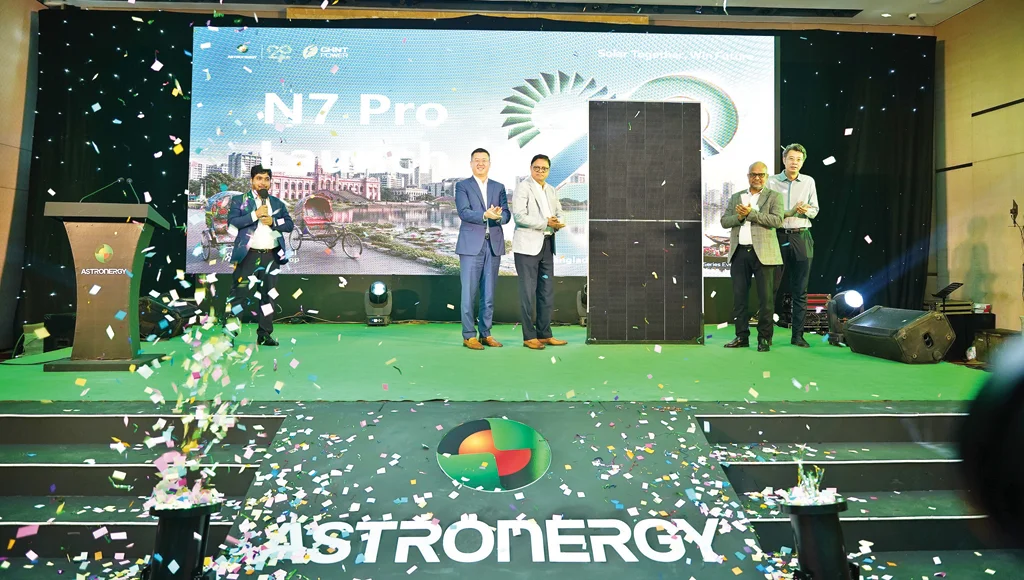
Max Group chairman Ghulam Mohammad Alomgir, Astronergy APAC sales head David Zhang and BSREA president Mostafa Al Mahmud, among others, attend launch of Astronergy’s latest N7 Pro solar module at an event in the capital on Thursday. | Press release photo
Chinese solar technology companies are seeking to expand their role in Bangladesh’s renewable energy transition, as the country prepares for a major increase in solar generation and local businesses also move to tap into the emerging market.
The development comes amid government plans to expand solar power through utility-scale projects, rooftop systems and solar irrigation, creating growing opportunities for international technology providers and domestic companies.
Against this backdrop, China-based global photovoltaic company Astronergy organised its ‘Astronergy World Tour 2026 – Bangladesh Roadshow’ in the capital on Thursday, bringing together representatives of the company, local industrial groups, renewable energy businesses, distributors, strategic partners and other stakeholders.
A major highlight of the event was launch of Astronergy’s latest N7 Pro solar module on the Bangladesh market.
According to the company, the ASTRO N7 Pro series uses upgraded TOPCon 5.0+ cell technology, along with a quarter-cut design and 20BB technology.
The module offers high bifaciality, power output, efficiency and reliability, while reducing degradation and hot-spot risks.
The module has a maximum power output of 670 watts and maximum efficiency of 24.8 per cent, the company said.
The roadshow also marked the company’s 20 years in the solar industry and underscored its intention to strengthen partnerships in Bangladesh.
The company’s Bangladesh initiative comes as the country faces growing pressure to diversify its energy mix, reduce dependence on imported fossil fuels and meet rising electricity demand.
Speakers at the event said that the government was targeting the development of 10,000 megawatts of solar power within the next five years.
Attending the event, Max Group chairman Ghulam Mohammad Alomgir said that the timing of Astronergy’s initiative was appropriate as Bangladesh was increasingly focusing on renewable energy.
‘Government is very serious about solar power and solar business,’ he said, urging businesses and investors to take advantage of the emerging opportunities.
Alomgir said that he had known Chint Power System, the parent group of Astronergy, for more than a decade and had visited its factory in China around 10 years ago.
‘Today, I know that they are a global leader in the solar sector,’ he said.
He said that Bangladesh was now at an appropriate stage to accelerate solar development, particularly through utility-scale projects, rooftop solar and solar irrigation.
Max Group has experience in the power sector, including gas-based power generation and engineering, procurement and construction contracting, and has already installed around 2.5MW of solar capacity at one of its factories, he said.
The group is now preparing to expand into the solar business.
Alomgir said that Max Group had already invested around Tk 20 crore for solar-related materials, which are expected to arrive soon.
He viewed Chinese companies such as Chint as potential partners rather than competitors.
‘The market is big. The government is thinking of 10,000 megawatts of solar power within the next five years, and down the line it will be more and more,’ he said.
Alomgir also said that the company planned to introduce its own solar-related products and services in Bangladesh and work with Blue Carbon Technology, a manufacturer and supplier of photovoltaic solar systems, LiFePO4 lithium batteries, micro-energy storage units and solar lighting solutions.
Meanwhile, Bangladesh Sustainable and Renewable Energy Association president Mostafa Al Mahmud said that renewable energy had become a strategic necessity for Bangladesh.
He said that rising electricity demand, dependence on imported fuels and increasing climate risks made an accelerated transition to renewable energy increasingly important.
Solar power, rooftop systems and battery energy storage would play a growing role in improving energy efficiency and strengthening the country’s energy security, he said.
Mahmud, however, stressed that cooperation with international renewable energy companies should extend beyond technology sales.
He called for greater technology transfer, competitive financing, transparent and competitive bidding processes and long-term investment partnerships.
‘There is incredible potential for stronger cooperation between leading Chinese renewable energy companies and Bangladesh’s private sector,’ he said, adding that international companies should work closely with capable local partners.
The roadshow also featured an award ceremony recognising local organisations and representatives in Best Distributor, Best Strategic Partner and Best Solar Project categories.
A contract-signing session further highlighted the company’s plans to expand commercial cooperation in Bangladesh.
Head of APAC sales of Astronergy David Zhang, GTS engineer Kathy Kong, sales manager of CPS Jackie Jiang also spoke at the event.
Staff Correspondent 15 August, 2026, 00:07
Max Group chairman Ghulam Mohammad Alomgir, Astronergy APAC sales head David Zhang and BSREA president Mostafa Al Mahmud, among others, attend launch of Astronergy’s latest N7 Pro solar module at an event in the capital on Thursday. | Press release photo
Chinese solar technology companies are seeking to expand their role in Bangladesh’s renewable energy transition, as the country prepares for a major increase in solar generation and local businesses also move to tap into the emerging market.
The development comes amid government plans to expand solar power through utility-scale projects, rooftop systems and solar irrigation, creating growing opportunities for international technology providers and domestic companies.
Against this backdrop, China-based global photovoltaic company Astronergy organised its ‘Astronergy World Tour 2026 – Bangladesh Roadshow’ in the capital on Thursday, bringing together representatives of the company, local industrial groups, renewable energy businesses, distributors, strategic partners and other stakeholders.
A major highlight of the event was launch of Astronergy’s latest N7 Pro solar module on the Bangladesh market.
According to the company, the ASTRO N7 Pro series uses upgraded TOPCon 5.0+ cell technology, along with a quarter-cut design and 20BB technology.
The module offers high bifaciality, power output, efficiency and reliability, while reducing degradation and hot-spot risks.
The module has a maximum power output of 670 watts and maximum efficiency of 24.8 per cent, the company said.
The roadshow also marked the company’s 20 years in the solar industry and underscored its intention to strengthen partnerships in Bangladesh.
The company’s Bangladesh initiative comes as the country faces growing pressure to diversify its energy mix, reduce dependence on imported fossil fuels and meet rising electricity demand.
Speakers at the event said that the government was targeting the development of 10,000 megawatts of solar power within the next five years.
Attending the event, Max Group chairman Ghulam Mohammad Alomgir said that the timing of Astronergy’s initiative was appropriate as Bangladesh was increasingly focusing on renewable energy.
‘Government is very serious about solar power and solar business,’ he said, urging businesses and investors to take advantage of the emerging opportunities.
Alomgir said that he had known Chint Power System, the parent group of Astronergy, for more than a decade and had visited its factory in China around 10 years ago.
‘Today, I know that they are a global leader in the solar sector,’ he said.
He said that Bangladesh was now at an appropriate stage to accelerate solar development, particularly through utility-scale projects, rooftop solar and solar irrigation.
Max Group has experience in the power sector, including gas-based power generation and engineering, procurement and construction contracting, and has already installed around 2.5MW of solar capacity at one of its factories, he said.
The group is now preparing to expand into the solar business.
Alomgir said that Max Group had already invested around Tk 20 crore for solar-related materials, which are expected to arrive soon.
He viewed Chinese companies such as Chint as potential partners rather than competitors.
‘The market is big. The government is thinking of 10,000 megawatts of solar power within the next five years, and down the line it will be more and more,’ he said.
Alomgir also said that the company planned to introduce its own solar-related products and services in Bangladesh and work with Blue Carbon Technology, a manufacturer and supplier of photovoltaic solar systems, LiFePO4 lithium batteries, micro-energy storage units and solar lighting solutions.
Meanwhile, Bangladesh Sustainable and Renewable Energy Association president Mostafa Al Mahmud said that renewable energy had become a strategic necessity for Bangladesh.
He said that rising electricity demand, dependence on imported fuels and increasing climate risks made an accelerated transition to renewable energy increasingly important.
Solar power, rooftop systems and battery energy storage would play a growing role in improving energy efficiency and strengthening the country’s energy security, he said.
Mahmud, however, stressed that cooperation with international renewable energy companies should extend beyond technology sales.
He called for greater technology transfer, competitive financing, transparent and competitive bidding processes and long-term investment partnerships.
‘There is incredible potential for stronger cooperation between leading Chinese renewable energy companies and Bangladesh’s private sector,’ he said, adding that international companies should work closely with capable local partners.
The roadshow also featured an award ceremony recognising local organisations and representatives in Best Distributor, Best Strategic Partner and Best Solar Project categories.
A contract-signing session further highlighted the company’s plans to expand commercial cooperation in Bangladesh.
Head of APAC sales of Astronergy David Zhang, GTS engineer Kathy Kong, sales manager of CPS Jackie Jiang also spoke at the event.